
Picture cars cycling through your site as liquid‑cooled cables push 150–350 kW straight into packs, cutting dwell to minutes. You’re buying DC fast chargers, so you’ll weigh 50 vs 150 vs 350 kW, CCS/CHAdeMO/NACS, ISO 15118 Plug&Charge, OCPP, load management, and utility capacity upgrades—alongside installation, permitting, uptime SLAs, and financing. The specs look similar at a glance, but the right choice hinges on a few critical constraints you can’t ignore.
Key Takeaways
- Power options 50–350 kW, delivering ~3–20 miles/min; select based on vehicle voltage (400/800 V), duty cycle, and dwell time.
- Connector compatibility: CCS (Combo), NACS (J3400), CHAdeMO; ISO 15118/DIN 70121 communications; Plug&Charge supported.
- Certified and compliant: UL 2202/2231, NEC 625, MID/ANSI metering, insulation monitoring, active thermal management, fault current ratings verified.
- Site readiness: 480 V three‑phase service, pad‑mount transformer, trenching/switchgear, voltage drop <3%, THD <5%; coordinate utility interconnection early.
- Software and service: OCPP 1.6/2.0.1, EMV/RFID payments, remote firmware signing, 97–99% uptime SLAs, 2–5 year warranty tiers; typical cost $90k–$250k per dispenser.
What Is a Level 3 (DC Fast) Charger?

What, exactly, qualifies as a “Level 3” charger? You’re using a DC fast charging system that bypasses the onboard AC charger and delivers controlled DC directly to the traction battery. Standards define it: IEC 61851-23/-24 govern DC equipment and control; SAE J1772 (Combo/CCS), CHAdeMO, and NACS specify connectors; ISO 15118/DIN 70121 handle communication, authentication, and Plug&Charge. Typical pack voltages up to 1000 V and high currents require active thermal management, interlocks, insulation monitoring, and UL 2202/2231 safety.
From a history overview, early public deployments used CHAdeMO (≈2010), then CCS (≈2013) broadened interoperability; NACS adoption is expanding. Data-driven operations use OCPP, MID/ANSI C12.20 metering, and >94% efficiency. Environmental impact hinges on demand management, renewable sourcing, and V2G (ISO 15118-20). You’ll see uptime SLAs and cybersecurity.
Power Levels Explained: 50 Kw to 350 Kw
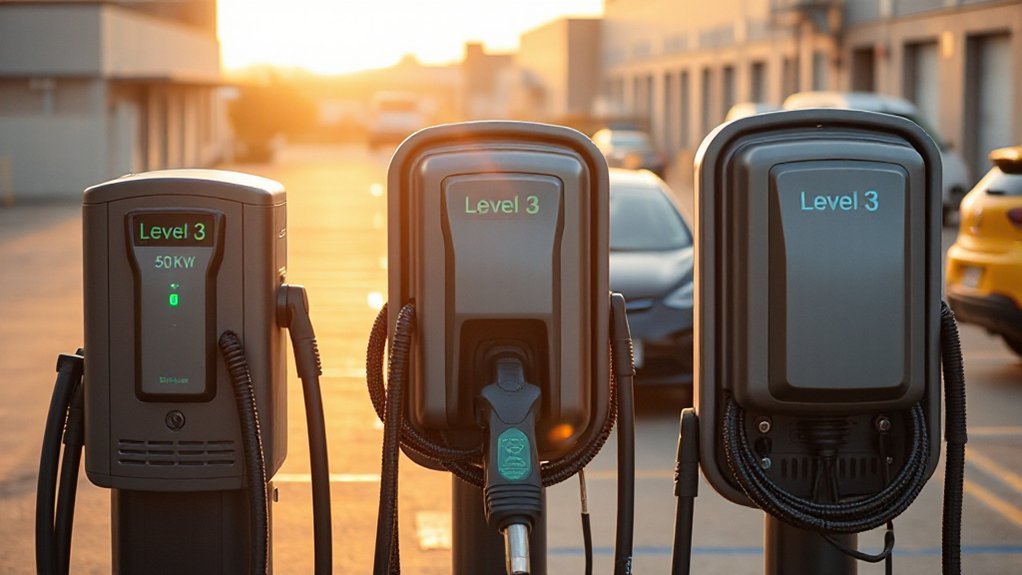
When you move from 50 kW to 350 kW, expected energy transfer scales from ~0.8 to ~5.8 kWh/min, translating to roughly 3–20 miles/min at 3–4 mi/kWh with 90–95% DCFC efficiency. You’ll see actual charging speed capped by your vehicle’s max DC charge rate, pack voltage (400 V vs 800 V), thermal/SOC limits, and station current/voltage capability (≈200–500 A, up to ~1000 V) under CCS/NACS control. Your compatibility range typically falls around 100–200 kW for many 400 V EVs, whereas 800 V models can support ~220–350 kW on 920–1000 V hardware negotiated via DIN 70121/ISO 15118.
Charging Speed Differences
Because DC fast chargers span 50 to 350 kW, charging speed varies by both charger capability and your vehicle’s maximum DC charge rate. You’ll see peak power only within the safe voltage-current envelope defined by the BMS and standards such as CCS and ISO 15118. At low state of charge, packs accept higher C-rates; as SOC rises, taper reduces power to protect cells. Battery chemistry, thermal management, and Ambient temperature govern how long you can hold the peak. Liquid-cooled cables enable sustained 300–500 A; air‑cooled leads typically limit current. Pack voltage determines power at a given amp limit. Expect 10–80% sessions to be power-limited first, then taper-limited. Accurate site specs list max kW, max A, cable cooling, and uptime. Check OCPP logs for verification.
Vehicle Compatibility Ranges
Charging speed depends on both charger output and your car’s DC acceptance, so vehicle compatibility spans defined power bands from 50 to 350 kW. You’ll map capability by voltage and current: 50 kW units (typically 125–200 A at 400 V), 150 kW (350–400 A at 400 V), and 250–350 kW high-voltage stacks (500–1000 V up to 500–600 A). Your vehicle may cap at 100–250 kW depending on pack design and thermal limits; taper begins near 30–60% SOC. Battery Variants dictate ideal voltage windows (e.g., 350–400 V vs 800–920 V architectures). Verify Firmware Compatibility for CCS/ISO 15118 Plug&Charge, power-share logic, and preconditioning commands. Check site nameplate, cable rating, and derating at >35°C. Legacy CHAdeMO supports ~50 kW; 800 V cars exploit 350 kW when available.
Connector Standards: CCS, CHAdeMO, and NACS Compatibility
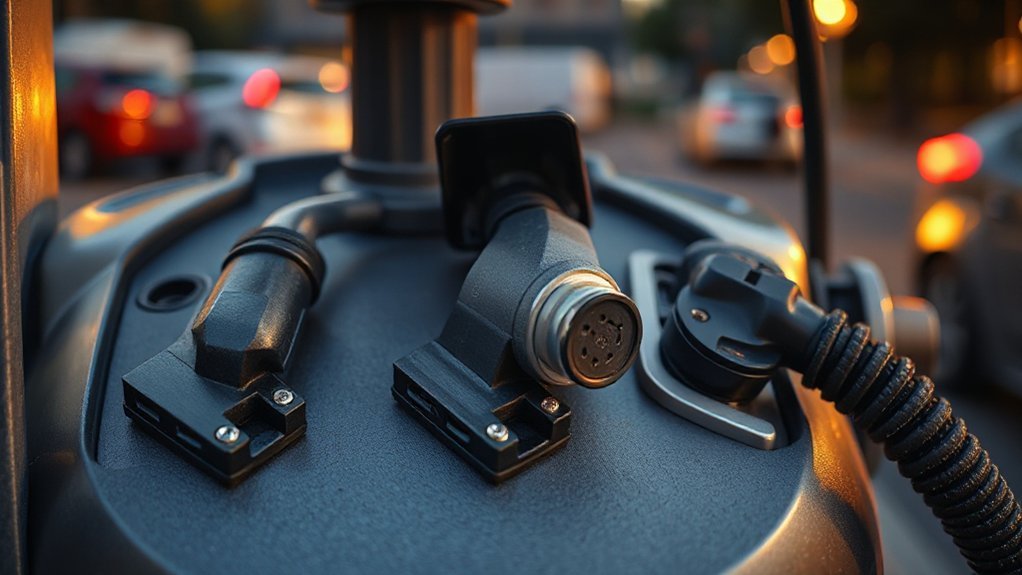
Although connector geometries and signaling stacks differ, DC fast-charging interoperability hinges on three standards: CCS (Combo 1/2), CHAdeMO, and NACS (SAE J3400). You’ll select hardware and cables based on pin assignments, communication protocols, and rated voltage/current. CCS uses a Type 1/2 AC inlet with two high-current DC pins, PLC signaling per DIN 70121 and ISO 15118-2/-20, and typically supports 200–1000 V, up to 500 A. CHAdeMO provides a dedicated DC coupler, CAN-based control, and commonly 200–500 V; v2.0 extends toward 400 kW. NACS (J3400) consolidates AC/DC on a compact two-pin power plus signal design, employs PLC with ISO 15118 features, and targets 500 V–1000 V, 500+ A. Offer multi-standard dispensers or J3400/CCS adapters to maximize vehicle coverage. Verify firmware supports plug-and-charge authorization and metering.
Site Readiness and Utility Upgrades
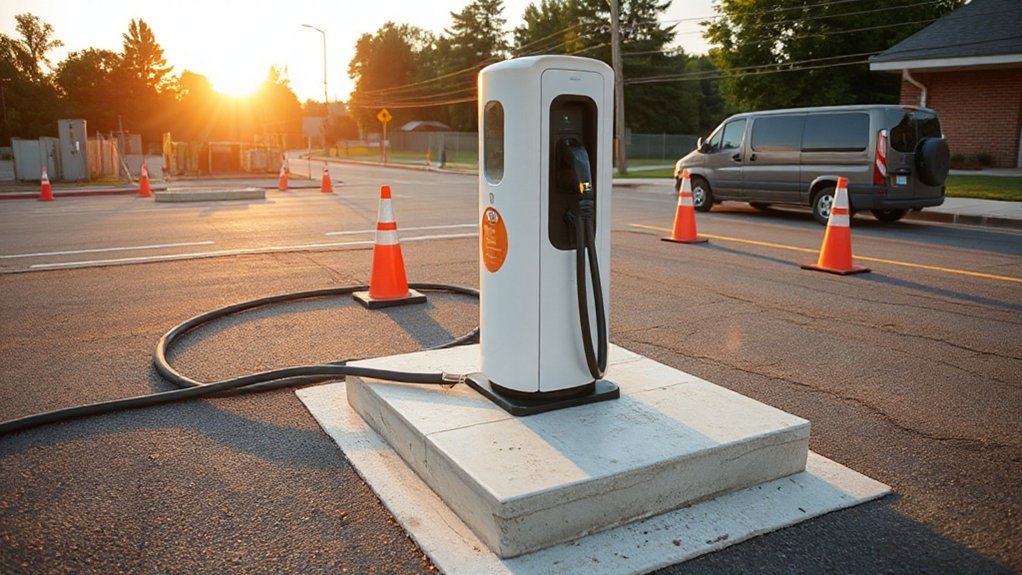
Before trenching or ordering dispensers, quantify site load and grid capacity with a utility-coordinated load study. Model your peak and coincident demand (kW/kVA), feeder voltage (480 V three‑phase), and short‑circuit duty. Validate transformer sizing, fault current, and protection coordination to IEEE/ANSI and NEC 625 requirements. Evaluate power quality: you’ll keep voltage drop <3% and current THD <5% with filtering if needed.
Plan utility upgrades early: a dedicated pad‑mount transformer, service lateral, and communications backhaul for OCPP and demand management. Right‑size conductors and switchgear for future expansion (N+20% capacity), and specify grounding, bonding, and surge protection.


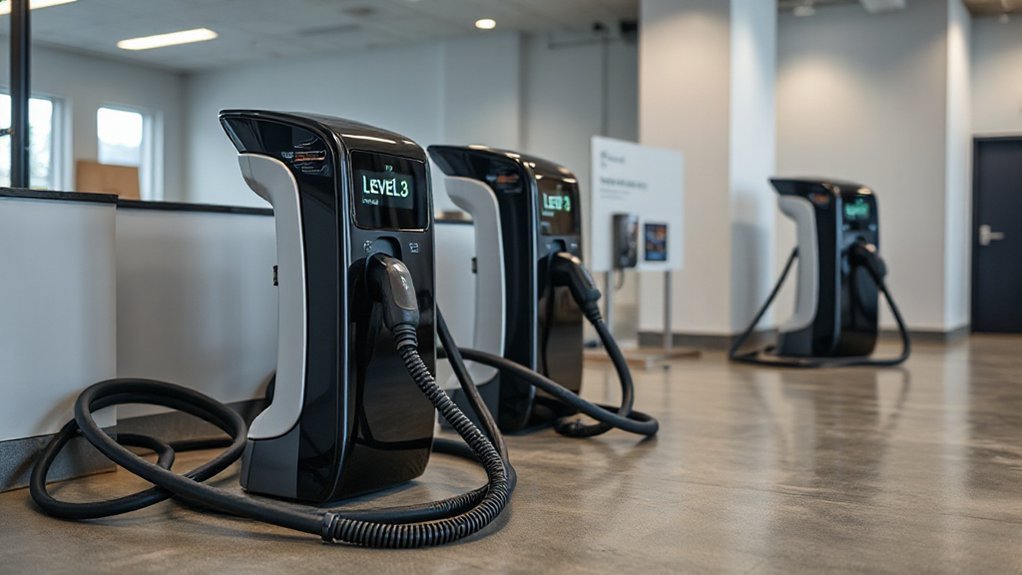

Integrate site readiness with landscape aesthetics and neighborhood engagement: mitigate noise from liquid‑cooled dispensers, screen equipment, preserve sightlines, and document lighting levels and EMF measurements to support community transparency.
Installation, Permitting, and Costs

How you stage installation, permitting, and cost control determines whether your DC fast charge site goes live on time and on budget. Specify UL-listed equipment, NEC 625 compliance, and ADA access. Engage the AHJ early on zoning restrictions and inspection timelines. Sequence civil, electrical, and commissioning to cut rework. Budget for trenching, conduit, switchgear, pads, bollards, signage, and make-ready.
| Phase | Tasks | Duration |
|---|---|---|
| Pre-permit | Plan, calcs, drawings | 2–6 wks |
| Civil | Trench, forms, concrete | 1–3 wks |
| Electrical | Conduit, terminations, test | 1–2 wks |
| Final | AHJ, meter, punchlist | 1–3 wks |
Expect $90k–$250k per dispenser, excluding service; carry 15% contingency for subsurface surprises and traffic control and change orders risk.
Software, Networking, and Payment Options

With civil and electrical work defined, you now specify the software stack, network backhaul, and payments to meet uptime, interoperability, and compliance targets. Select a Charge Point Operator platform supporting OCPP 1.6J or 2.0.1, OCPI for roaming, and Open APIs for fleet, EMS, and site integrations. Configure ISO 15118 Plug & Charge with certificate management (V2G PKI) and fallback RFID/QR flows. Provision redundant IP backhaul via dual-SIM LTE/5G and wired ethernet, with VPN, TLS 1.2+, and mutual auth. Implement remote firmware signing, role-based access control, and SIEM logging. For payments, enable EMV contact/contactless, PCI DSS scope minimization, tokenized wallets, and transparent tariffs. Enforce Billing Security: point-to-point encryption, offline transaction queuing, dispute evidence retention, and audit-ready settlement exports with reconciliations, chargebacks, and tax-compliant invoicing workflows.
Reliability, Service Plans, and Warranties

You’ll set an uptime target (≥99.0–99.5%) and tie it to a network SLA with MTBF, fault-rate, and mean-time-to-repair (MTTR) metrics. Validate durability via standards and ratings—IEC 61851/62196 and UL 2202 compliance, NEMA 3R/4X and IK10 enclosures, -30 to +50°C operation, 10,000+ mating cycles, and surge immunity per IEEE C62.41. You’ll select service-plan tiers that specify 24/7 remote monitoring, defined response/repair times (e.g., 4h/24h), scheduled preventive maintenance, firmware/security updates, and guaranteed parts availability.
Uptime and Durability
Because downtime erodes ROI, Level 3 (DC fast) chargers must demonstrate high uptime (target ≥97–99%) validated by field telemetry, MTBF/MTTR metrics, and standards-backed design. You should require OCPP-connected health monitoring, hot-swappable power modules, and fault-tolerant control to shrink MTTR. Specify enclosures with IP54–IP65/NEMA 3R–4X, IK10 impact protection, corrosion resistance, and verified thermal cycling per IEC 60068. Validate liquid- or forced-air cooling margins, cable flex life, and connector mating cycles. Demand certified safety (UL 2202/2231) and grid interoperability (ISO 15118). Review component derating, conformal coatings, and salt-fog tests for coastal sites, and log downtime root causes to optimize vendor accountability and reporting.
| Metric | Spec |
|---|---|
| Uptime | ≥97–99% (rolling) |
| MTBF/MTTR | >100k h / <4 h |
| Ingress/Impact | IP54–IP65, IK10 |
| Thermal cycling | IEC 60068 pass |
| Warranty | 5–10 years parts |
Service Plan Tiers
Routinely, define tiered SLAs—Basic, Advanced, and Premium—to match uptime targets, response commitments, and lifecycle risk.
Map Basic to 97% uptime, next‑business‑day response, quarterly preventive maintenance, and depot repair. Advanced targets 99% uptime, 8‑hour onsite response, monthly remote diagnostics, and expedited parts. Premium commits to 99.9% uptime, 4‑hour onsite response, 24/7 monitoring, and advanced swap spares. Specify MTTR thresholds (Basic ≤48h, Advanced ≤24h, Premium ≤8h) and credit schedules per missed KPI. Align warranties: Basic 2‑year limited, Advanced 3‑year thorough electronics, Premium 5‑year full system with connector wear coverage. Enforce standards: OCPP 1.6/2.0.1, ISO 15118 updates, and cybersecurity patches within 30 days. Use customer segmentation to size coverage for fleet, retail, and public DC sites. Guarantee billing transparency with itemized labor, parts, software, and network fees.
Incentives, Grants, and Financing Models

While Level 3 deployments hinge on power availability and site design, the economics usually turn on incentives, grants, and how you finance the asset. You can stack federal and state Tax Credits, utility make-ready funds, and grant programs to reduce capex by 30–80%, then finance the remainder with debt or Green Bonds. Model cash flows using demand charges, throughput, and O&M aligned to SAE, NEC, and IEEE interconnection standards. Underwrite conservatively. Quantify WACC impacts and sensitivities across tariff risk.
Stack incentives and smart financing; model cash flows; underwrite conservatively; price tariff risk into WACC.
- Incentives: 30% ITC-equivalent, bonus adders, utility rebates; verify prevailing wage and domestic content compliance.
- Grants: NEVI, CMAQ, and state trust funds; score criteria, uptime ≥97%, open standards, public access.
- Financing: tax equity, PPA/ESA, lease; DSCR ≥1.3x, tenor 7–12 years, residual value assumptions.
How to Choose the Right Charger for Your Location

Grants and tax credits only pay off if the hardware matches your load profile and grid constraints. Size DC power to feeder capacity and demand-charge exposure; validate duty cycle from traffic patterns and dwell times. Specify CCS/NACS connectors, ISO 15118 for Plug & Charge, and OCPP 1.6/2.0.1 for network roaming. Confirm utility interconnection, fault current ratings, and NEC Article 625 compliance. Choose -30–50°C ratings, NEMA 3R/4X, IK10, and MID/ANSI C12 metering. Plan ADA access, cable reach, and landscape integration. For resilience, design N+1 power modules, surge protection, and remote diagnostics and alerts.
| Metric | Target |
|---|---|
| Available service (kVA) | Supports 2–4 ports at 150–350 kW each |
| Typical dwell time | 10–35 min -> sets 150 vs 350 kW choice |
| Annual uptime SLA | ≥ 97–99% with 24/7 monitoring |
Document validations.
Conclusion
You choose minutes over hours, but you also choose specs over slogans. Evaluate 50–350 kW against dwell targets, CCS/CHAdeMO/NACS against fleet mix, and ISO 15118/OCPP against payment and control. Balance CapEx with uptime SLAs, liquid‑cooled cables with ambient derating, and incentives with interconnection timelines. Design to NEC, plan utility upgrades, and price total lifecycle. Pick the charger that fits your load profile today—and scales for tomorrow. Document performance KPIs, and verify warranties, service, and financing.