
Thinking about Level 3 at home in 2025? You’ll face equipment and install costs often in the tens of thousands, possible 400 A or three‑phase service, strict permitting, and potential demand charges. You must manage heat, noise, and accelerated battery wear from frequent high‑power sessions. Smart Level 2 with scheduling or V2H often wins on cost and reliability. But if you still need DC fast at home, key constraints may surprise you.
Key Takeaways
- In 2025, expect $10k–$40k hardware plus pads/switchgear, and often costly 400‑A or three‑phase upgrades; typical 200‑A homes lack capacity.
- Permitting and interconnection are nontrivial: stamped single‑line, NEC 625 compliance, utility transformer review, and final approvals before energization.
- Operating cost includes energy, demand charges, and fees; on‑peak DC fast sessions can cost 2–3× off‑peak without demand control.
- Frequent DC fast charging increases battery wear; mix Level 2 for routine charging and reserve DCFC for trips or urgent needs.
- For most households, a 7–11 kW Level 2 charger is cheaper, simpler, and adequate; home DCFC rarely boosts resale—public fast chargers suffice.
Upfront Costs and Power Requirements
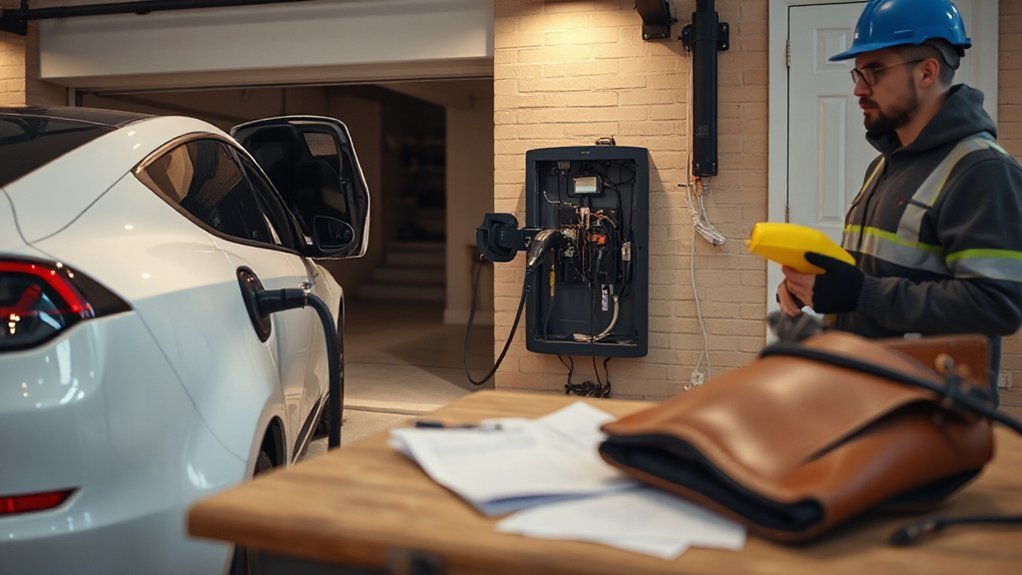
While Level 1 and 2 EV charging fit typical homes, true Level 3 (DC fast charging) rarely does because of power and cost. A 25–50 kW DC unit draws 100–200 A at 240–480 V; many houses have 200 A, 240 V service for the entire load. NEC 625 requires dedicated overcurrent protection, grounding, labeling, and working clearances; you must confirm fault-current ratings and load calculations per NEC 220. Hardware alone runs about $10,000–$40,000 for 25–50 kW, plus pads, conduit, and switchgear. Budget with depreciation schedules (5–7 years typical for equipment) and recognize that a personal DCFC rarely yields a resale premium. For safety, specify NEMA 3R or better enclosures, ground-fault protection, emergency stop, and listed equipment; verify conductor ampacity, voltage drop, and short-circuit duty.
Permitting, Utility Upgrades, and Approvals
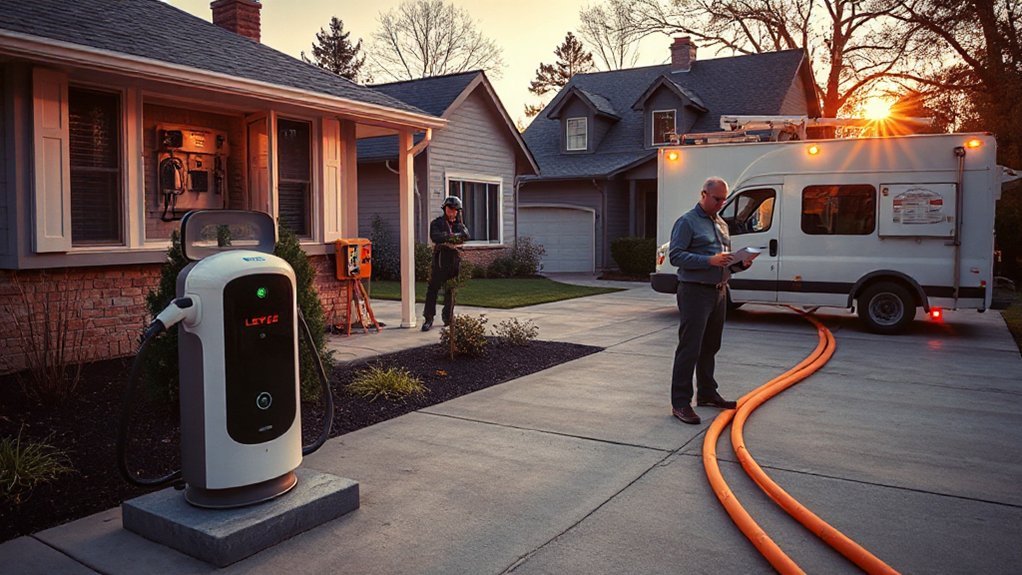
After sizing a 25–50 kW unit and verifying NEC 625 and 220 loads, you need permits and utility approvals before purchase. Your AHJ typically requires an electrical permit with a stamped single-line, load calculations, fault-duty verification per NEC 110.24, and proof of zoning compliance. Expect a utility interconnection review to assess meter/socket rating, service conductors, and transformer capacity; many homes need a 400 A or three-phase upgrade. Submit short-circuit and voltage-drop data, plus a proposed demand profile. Clarify fees, inspection timelines, and whether trenching or easements trigger separate approvals. Utilities may require protective devices or demand-response enrollment to manage feeder capacity. Schedule rough/final inspections and a utility cut-over. Don’t energize until you’ve received final sign-off in writing. Retain records for warranty and rebate audits.
Hardware Choices, Installation, and Site Design
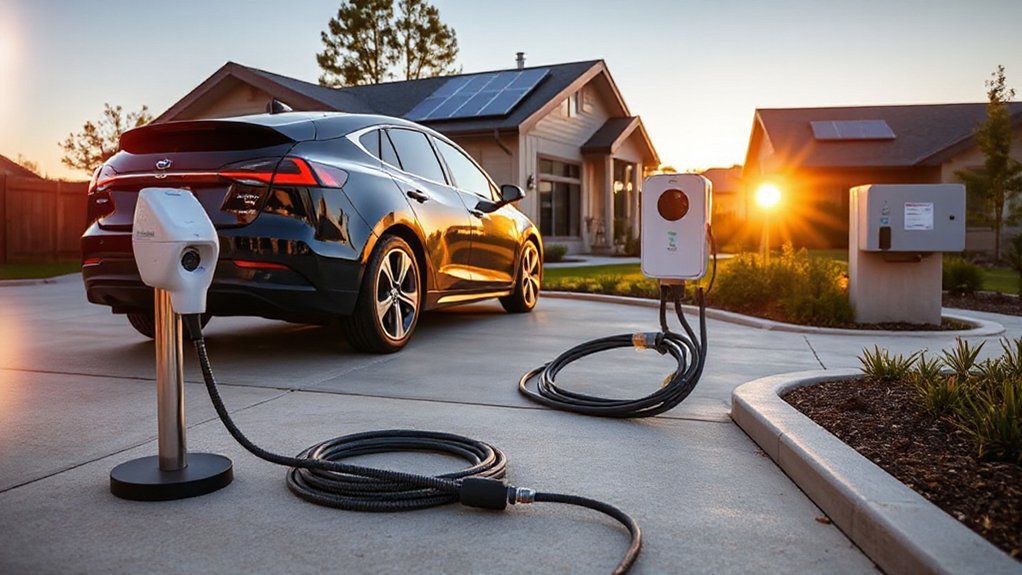
Because you’re installing a 25–50 kW DC fast charger at a home, select UL/NRTL-listed DCFC hardware with CCS/NACS connectors sized to your system voltage, integrated DC ground-fault protection, and a visible, lockable disconnect. Verify SCCR ≥ available fault current and label per NEC 110.24. Provide a Type 1 or 2 SPD on the feeder (NEC 215.18/230.67). Choose Mounting Options (pedestal or wall) rated NEMA 3R/4X, -30 to 50°C, with cable management. Pour a level concrete pad; anchor per manufacturer torque. Maintain 36 in working clearance and 6.5 ft headroom (NEC 110.26). Install bollards and wheel stops protecting conductors. Use 2–3 in PVC-coated rigid steel for exposed runs; bury conduits 18–24 in. Plan Landscape Integration: night lighting, drainage, snow shedding, and airflow around equipment clearances.
Operating Costs, TOU Rates, and Demand Charges
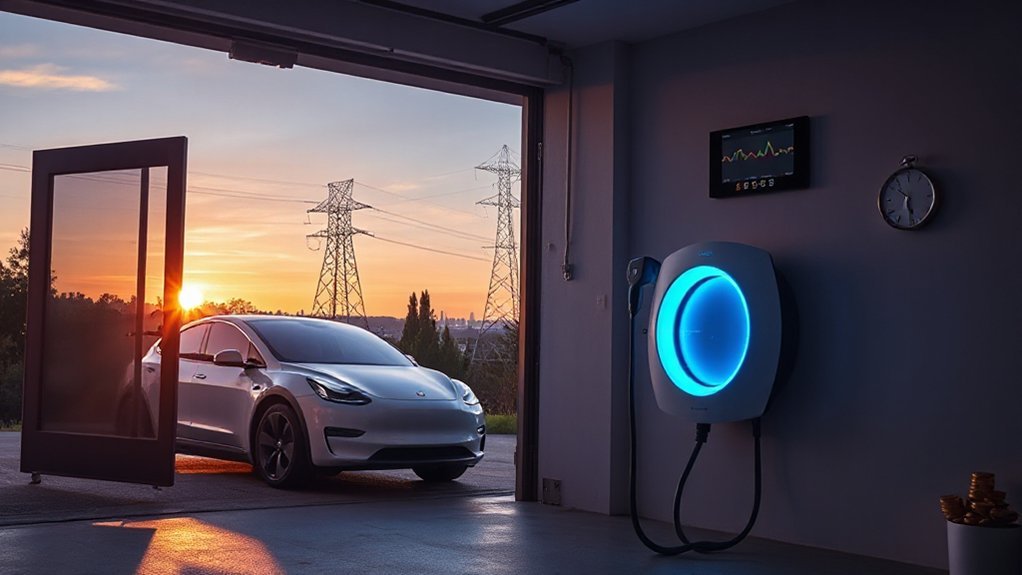
You calculate operating cost as (kWh x energy rate) + (kW peak x demand rate) + fixed fees, using interval meter data to verify load profiles. You capture TOU savings by scheduling off-peak sessions and throttling charge power to tariff thresholds while meeting continuous-load limits per NEC 625. You manage demand charges with load management, soft-start ramps, and optional storage to cap kW, staying within service capacity per NEC 220 and your utility interconnection to protect equipment and occupants.
Operating Cost Breakdown
A few core inputs drive your Level 3 home charging operating cost: energy consumed (kWh), time-of-use (TOU) pricing, and potential demand charges. You’ll pay base energy charges (typically $0.12–$0.35/kWh), plus fixed customer fees, then any demand component if your tariff applies ($5–$20 per kW of 15‑minute peak). Add networking/software subscriptions, routine preventive maintenance, and higher insurance premiums associated with high-power equipment. Include environmental externalities in your true cost model; using a social cost of carbon of $51/ton CO2e adds roughly $0.02–$0.05/kWh depending on grid mix. Confirm utility interconnection and applicable rider before energizing. Verify NEC 625 compliance, ventilation where required, GFCI protection, and accurate metering; those safety measures minimize outages that inflate operating costs through avoidable resets and service calls. Budget contingency for repairs.
Time-Of-Use Savings

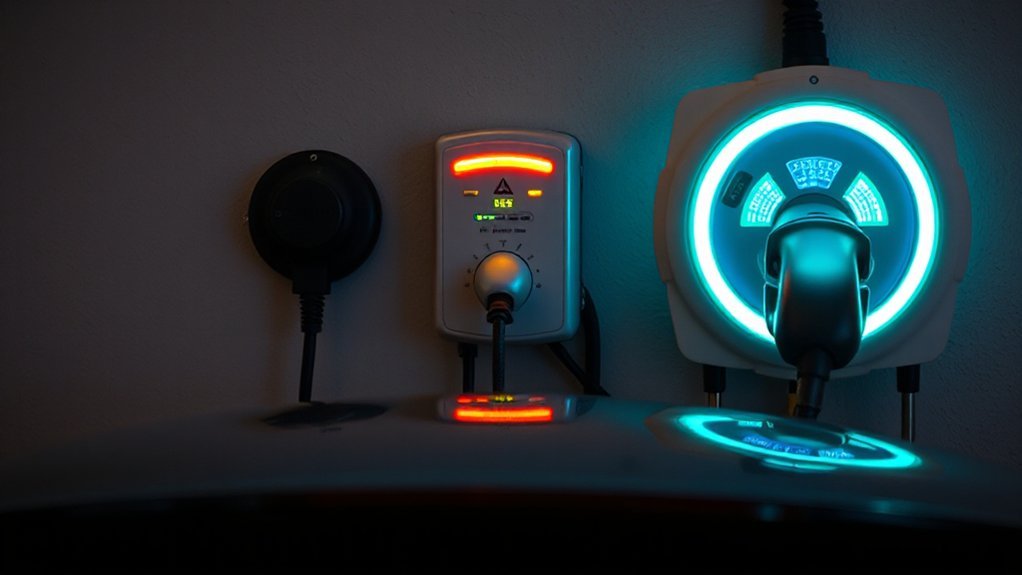
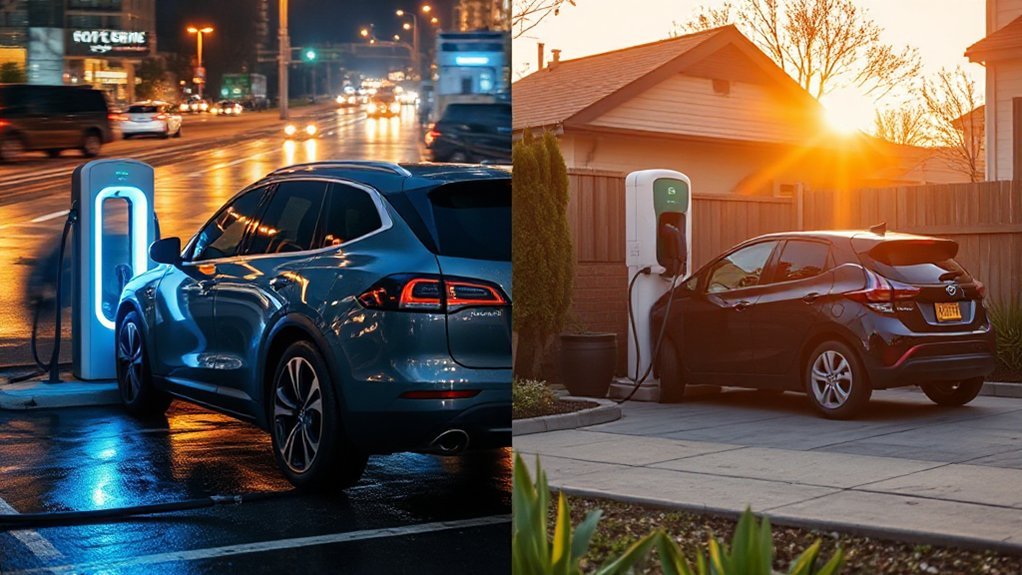

How can TOU pricing reshape your Level 3 home charging bill? By shifting energy to off‑peak windows. Many utilities price off‑peak at 9–14¢/kWh and on‑peak at 28–45¢. For a 50 kWh session, off‑peak costs $4.50–$7.00 versus $14–$22.50 on‑peak—saving $9–$15 per charge. Multiply that by 20 sessions/month and you’ll save roughly $180–$300.
Confirm local tariffs; some add demand charges for high instantaneous load, making schedule alignment critical. Seasonal variability matters: summer peaks often extend later into the evening, while winter mornings may be pricier.
Design to code. NEC 625, utility interconnection rules, and permit inspections require accurate load calculations, dedicated overcurrent protection, and labeled disconnects. Use the charger’s scheduler, verify clock sync, and document rate periods—Consumer education reduces errors and preserves safety and code compliance.
Managing Demand Charges
Why do Level 3 “home” installations obsess over demand? Because a 50–100 kW charger can set your monthly demand peak in minutes, triggering $10–$30/kW fees that dwarf energy costs. You control this by scheduling within TOU off-peak windows, capping output to your service limit, and using a demand controller that staggers loads with HVAC, water heating, and storage. Verify NEC Article 625 load calculations, service upgrade needs, and utility interconnection rules before commissioning. Ask for Billing Transparency: line-item demand, TOU, and riders. Prioritize Customer Education in your household: explain kW vs kWh, set charging setpoints, and post a simple “no overlap” load schedule. For resilience and safety, integrate UL-listed equipment, codified disconnects, and thermal monitoring, and test shutdowns monthly. Log data and review utility bills.
Battery Health, Noise, Heat, and Reliability
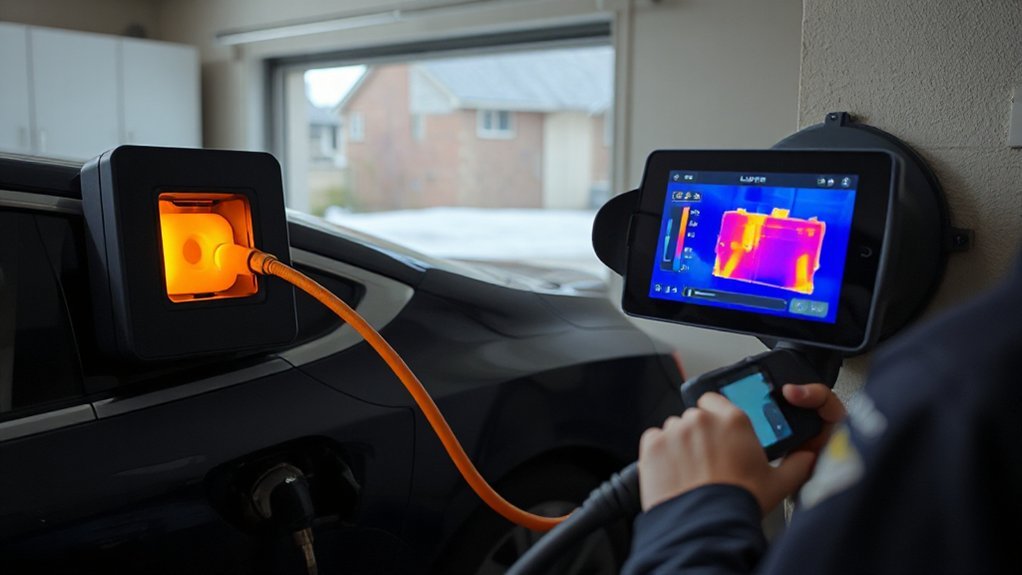
You quantify how repeated 150–350 kW sessions affect battery State of Health and cycle life, then set charge limits (e.g., 10–80% SOC and temperature caps) to reduce degradation. You specify liquid-cooling capacity, heat rejection, and <55 dBA at 1 m, and maintain NEC/NFPA clearances to control heat and noise safely. You monitor uptime via MTBF/MTTR, enforce UL 2202/2231 and ISO 26262 protections, and select NEMA 3R or Type 4X enclosures for durable, safe operation.
Fast Charging Battery Impact
While fast charging cuts downtime, it also increases thermal and electrochemical stress that can shorten battery life if unmanaged.
At >1C charge rates, lithium plating risk rises below ~10–15°C, accelerating capacity fade 20–40% over 500 cycles versus 0.5C baselines. High C-rates also increase impedance growth, triggering earlier power derating and reliability faults. Use OEM limits: avoid repeated 10–80% DC sessions more than necessary; mix Level 2 for routine needs. Keep SOC 20–80% to reduce SEI growth and protect critical materials, improving lifecycle emissions by extending pack service. Verify equipment complies with NEC 625, UL 2202/2231, and follows SAE charging profiles. Log DC session count, peak kW, and delta-SOC; if warranty thresholds exist, stay below them. Fans and contactors will make audible clicks; that’s normal.
Thermal Management and Noise
Fast-charge stress ties directly to heat generation and acoustic byproducts; managing both preserves battery life and uptime. You should size thermal paths for 150–350 kW duty, targeting cell temps at 20–35°C and ΔT across modules under 5°C. Specify liquid loops with Heat piping to sinks, PWM pump control, and fail-closed valves. Use thermistors on each string and validate with IEC 61851 duty cycles. For electronics, place power stages on vapor-chamber cold plates; maintain inlet coolant 15–25°C. Keep acoustic output under 45 dBA at 1 m at night; select low-RPM, large-diameter fans, and add Acoustic shielding around compressors. Route airflow away from neighbors. Verify compliance: NEC 625 clearances, UL 2202 thermal tests, UL 2231 touch-temp limits (<60°C enclosure). Log temps and noise for continuous verification.
Uptime, Safety, Durability
Every Level 3 home charger must prioritize uptime, safety, and durability by design: target >97% annual uptime with redundant sensing, watchdogs, remote diagnostics, and graceful derating rather than fault trips. You safeguard battery health by enforcing SOC windows, limiting ripple current, and logging cell temps. Remote monitoring plus predictive maintenance catch fan wear, contactor pitting, and insulation drift before failure. Keep noise under 55 dBA at 1 m and cap inlet heat rise to 30°C. Demand UL 2202/2231 compliance, surge protection, and IP54 or better enclosures. Log grid events, too.
| Metric | Target | Method |
|---|---|---|
| Uptime | >97% | Redundancy, watchdogs, remote diagnostics |
| Safety | UL 2202/2231 | GFCI, isolation monitoring |
| Heat | Inlet rise ≤30°C | Liquid loop, derate under load |
| Noise | ≤55 dBA @1 m | Low-RPM fans, PWM, acoustic lining |
Smarter Alternatives: Level 2, V2H, and Public DC Fast Options
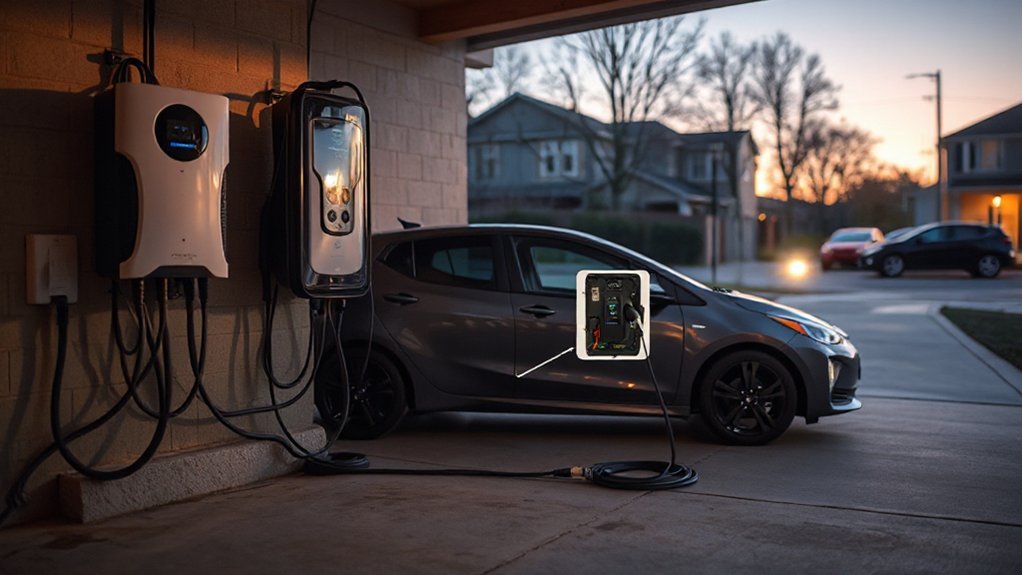
Because typical residential services and codes don’t accommodate 150–350 kW DC equipment, you can meet EV needs with three safer, compliant paths: Level 2 at home, V2H for resilience, and public DC fast charging as-needed. Install a UL 2594 EVSE on a 50A, 240V branch (NEC 625); delivering 40A continuous, you’ll add ~9.6 kW, recovering 30–35 miles/hour—adequate for most mobility patterns. Use managed charging via software ecosystems to shift load to off-peak TOU rates and avoid service upgrades. For V2H, choose UL 9741/1741-listed equipment with certified transfer/islanding per NEC 705; size to essential loads, not whole-home. When you need speed, lean on public CCS/NACS 150 kW sites; plan stops with reliability data, pricing, and battery preconditioning to protect cells, and manage thermal limits wisely.
Conclusion
You can pursue home Level 3, but the electrically ambitious route invites budgetary exertion, utility courtship, and code scrutiny. Equipment and installation often exceed tens of thousands, may trigger 400‑amp or three‑phase service, and risk demand-charge “surprises.” High-power cycles offer brisk top-ups yet gently hasten battery maturity, add heat and acoustic enthusiasm, and complicate reliability. Data favors safer, code-compliant pragmatism: a 9–11 kW Level 2 with smart scheduling, V2H, and occasional public DC fast sessions.