
Fast at-home charging meets strict electrical codes. You’ll match your Leaf’s onboard charger (3.3 or 6.6 kW) to an EVSE and circuit: 20–32 A on a 40 A breaker for 3.3 kW, or 40 A on a 50 A breaker for 6.6 kW. Plan for 8–12% losses, off‑peak schedules, UL-listed hardware, permits, and a licensed electrician with inspection. Here’s how to build it right—and what it really costs.
Key Takeaways
- Level 2 speed depends on the Leaf’s onboard charger: 3.3 kW (~14 A) or 6.6 kW (~28 A) on 240 V; higher-amp EVSE won’t charge faster.
- Expect slower charging near high state of charge and in heat; schedule overnight and provide ventilation to reduce derating.
- Typical installation: dedicated 240 V circuit sized per NEC 625’s 80% rule; e.g., 32 A EVSE on 40 A breaker, 40 A EVSE on 50 A.
- Choose a UL-listed J1772 EVSE with integrated GFCI, adjustable current, adequate cable, and weather-rated enclosure; avoid extension cords.
- Estimate cost by kWh rate times energy added plus 8–12% losses; shift charging to off-peak and enroll in utility rebates.
Level 2 Charging Speeds by Model Year and Onboard Charger
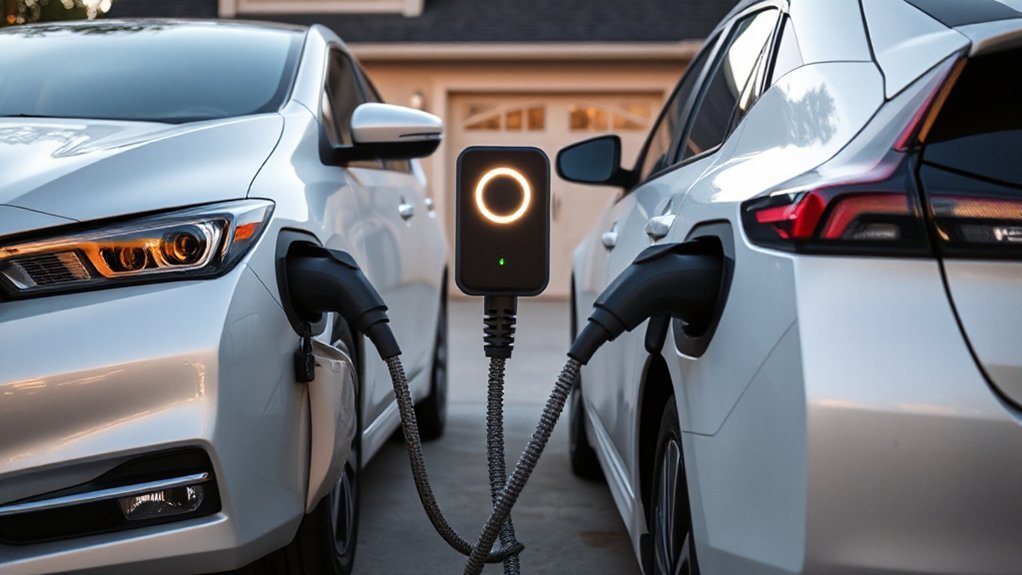
The Leaf’s Level 2 AC charging speed is capped by its onboard charger, which varies by model year and trim: 2011–2012 use a 3.3 kW unit, many 2013–2017 S trims retain 3.3 kW unless optioned, while most 2013–2017 SV/SL and all 2018+ models provide 6.6 kW. With 240 V supply, 3.3 kW draws about 14 A; 6.6 kW draws about 28 A. Size your EVSE and branch circuit per NEC 625 and the 80% continuous-load rule: at least 20 A for 3.3 kW, and 40 A for 6.6 kW is prudent. You won’t exceed the OBC limit, regardless of a higher-amp EVSE. Expect gentler charging curves near high SOC and in heat; OBC may derate. Manage thermal management with shade, ventilation, and scheduled charging.
Cost to Charge: Electricity Rates, Kwh, and Real-World Examples
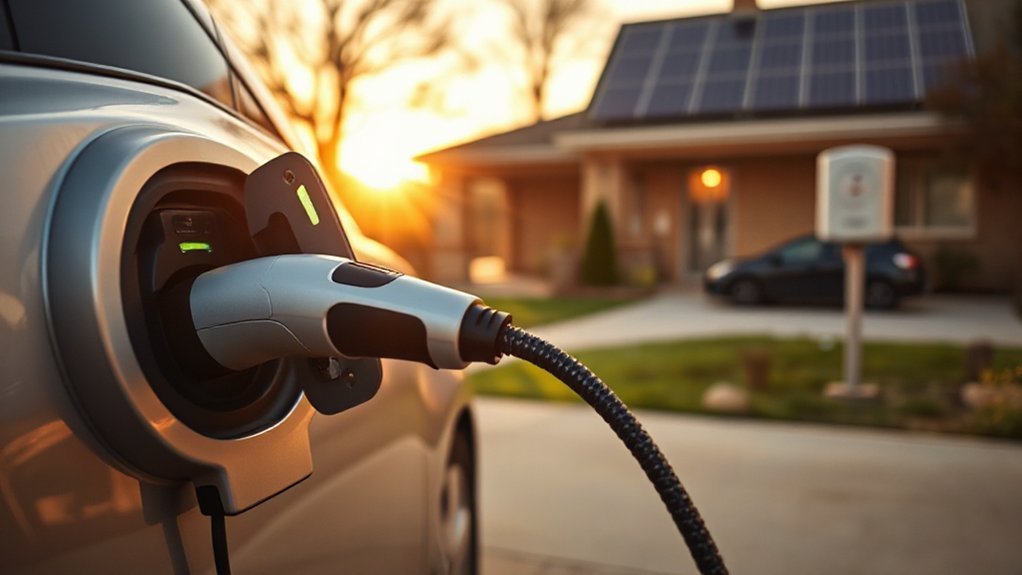
How much does it cost to charge a Leaf? You pay for energy in kWh, so multiply your utility rate by the usable battery energy added, then include 8–12% charging losses. Example: adding 30 kWh at $0.15/kWh costs about $5.10; with losses, ~$5.65. A 40‑kWh Leaf from 10% to 90% needs ~32 kWh, costing ~$4.80 off‑peak at $0.15, but $11.20 at $0.35 peak. Seasonal pricing and time‑of‑use rates can swing totals substantially. For fuel equivalence, at 30 kWh/100 miles, you’ll pay ~$3.00 per 100 miles at $0.10/kWh, or ~$10.50 at $0.35. Verify your tariff, taxes, and fixed fees. Use a UL‑listed EVSE, follow the manufacturer’s instructions, and don’t use extension cords to avoid overheating and nuisance trips. Check utility portals for interval usage data.
Circuit and Wiring Requirements for 240V Installations
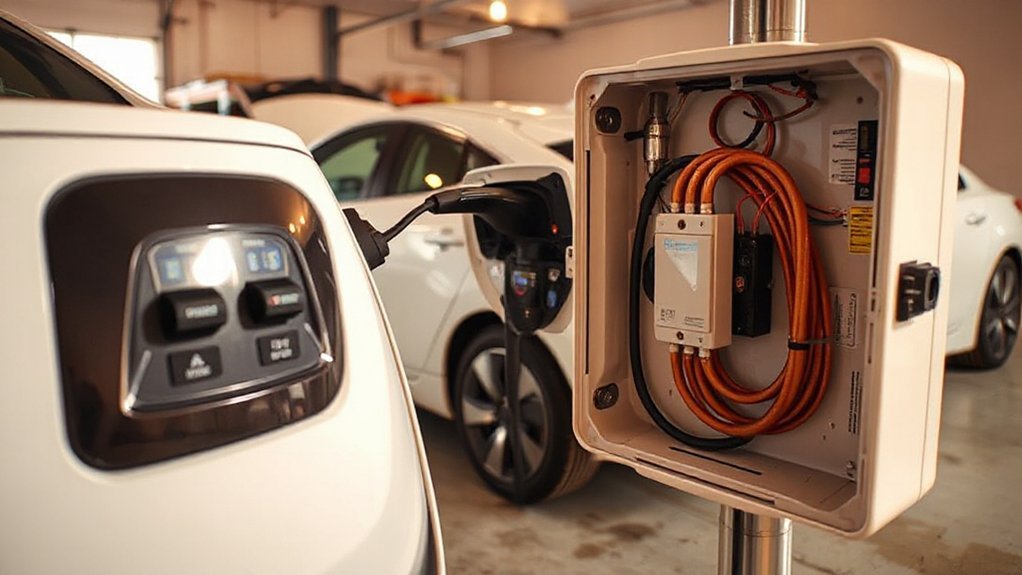
Before installing a 240‑V EVSE for your Leaf, confirm your service and panel can support a dedicated branch circuit sized per NEC 625 and 210: treat EV charging as a continuous load and rate the breaker at least 125% of the EVSE’s nameplate current (e.g., 32 A EVSE → 40 A breaker; 40 A EVSE → 50 A breaker).
Use copper conductors; size per terminal ratings. Torque lugs (NEC 110.14) to reduce Conductor oxidation and heat. Provide GFCI where required; bond/ground per NEC 250. Derate for temperature and bundling. Keep voltage drop under 3%.
| Item | Requirement |
|---|---|
| Circuit | Dedicated 240 V, continuous load |
| Breaker | 40 A or 50 A per EVSE |
| Conductors | Copper AWG per ampacity table |
Protect from UV and heat to limit Insulation aging.
Choosing a Home EVSE: Connectors, Amperage, and Smart Features
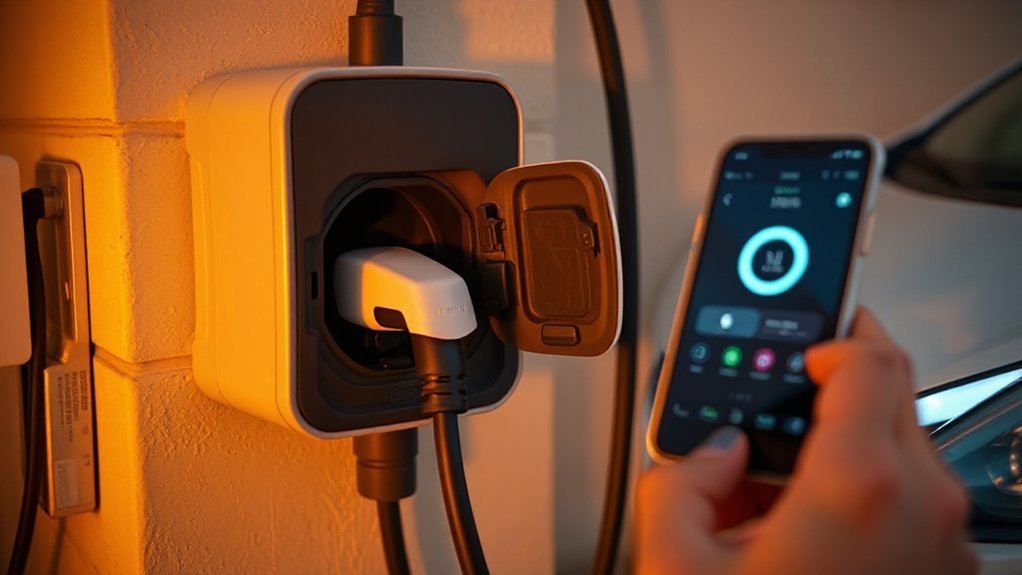
With your 240‑V branch circuit sized and protected per NEC 625 and 210, select an EVSE that matches both your Leaf’s AC charging capability and the circuit rating. The Leaf uses the J1772 plug under U.S. Connector Standards; confirm a robust, UL‑listed unit with integrated GFCI and ground monitoring. Size amperage correctly: treat charging as a continuous load and limit EVSE output to 80% of breaker rating (32A on 40A, 40A on 50A). Prefer adjustable current to align with future circuits or shared loads. Choose a durable NEMA 3R/4 enclosure, a flexible, cold‑rated cable, and an adequate cord length. For smart features, look for Wi‑Fi, scheduling, load sharing, utility integrations, secure Firmware Updates, and open protocols such as OCPP for vendor portability and longevity.
Installation Workflow: Permits, Code, and Safety Checks
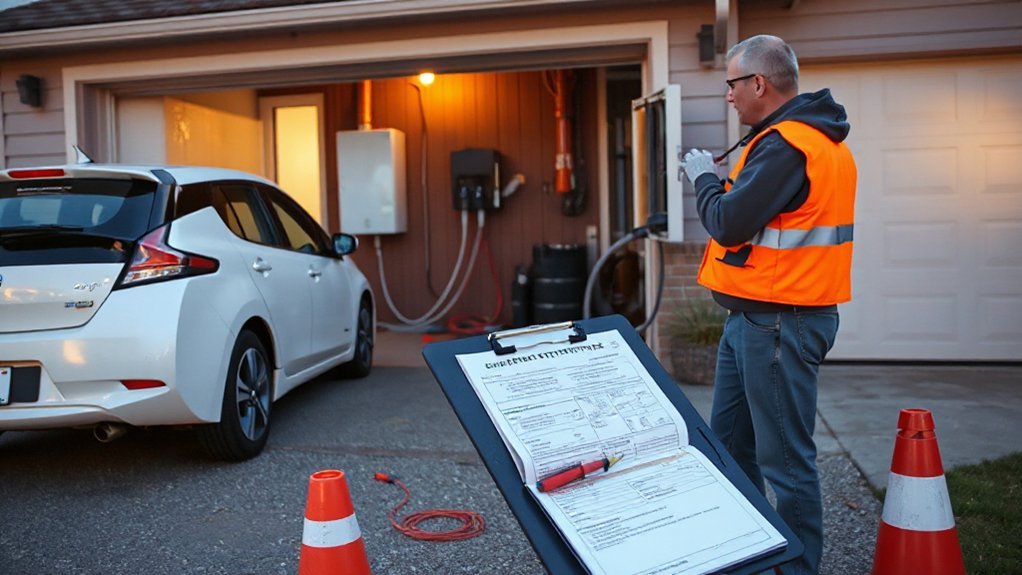

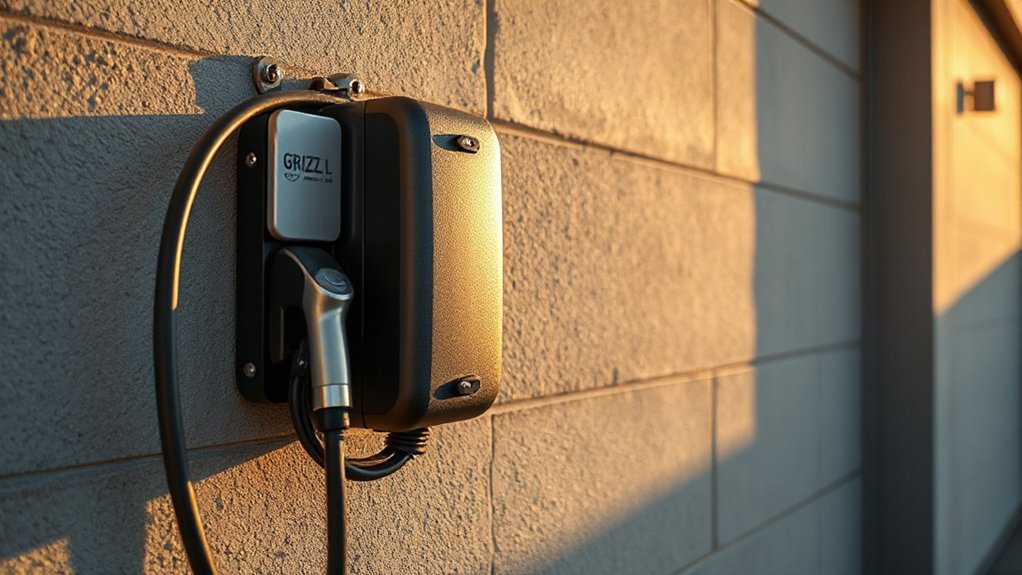
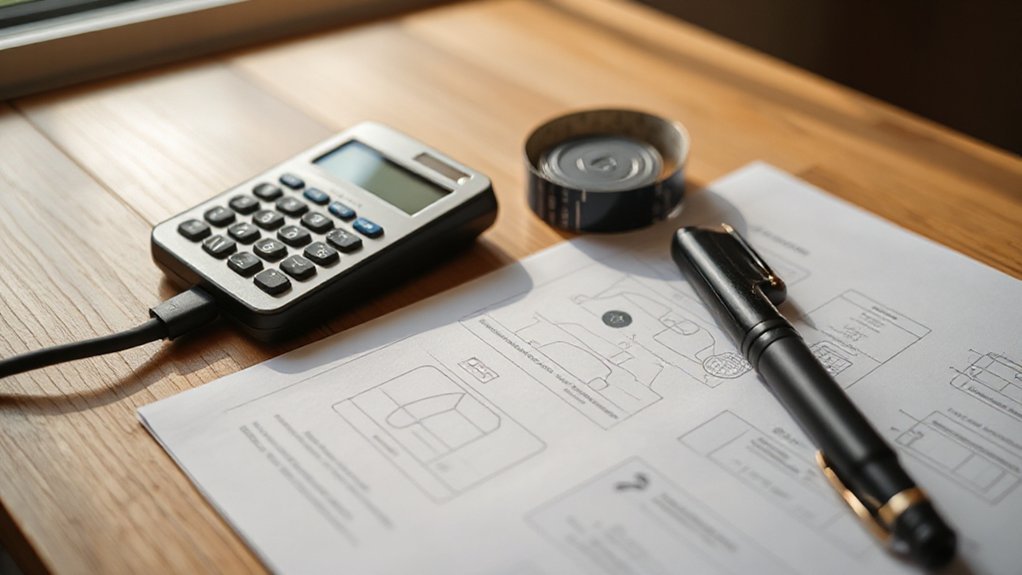
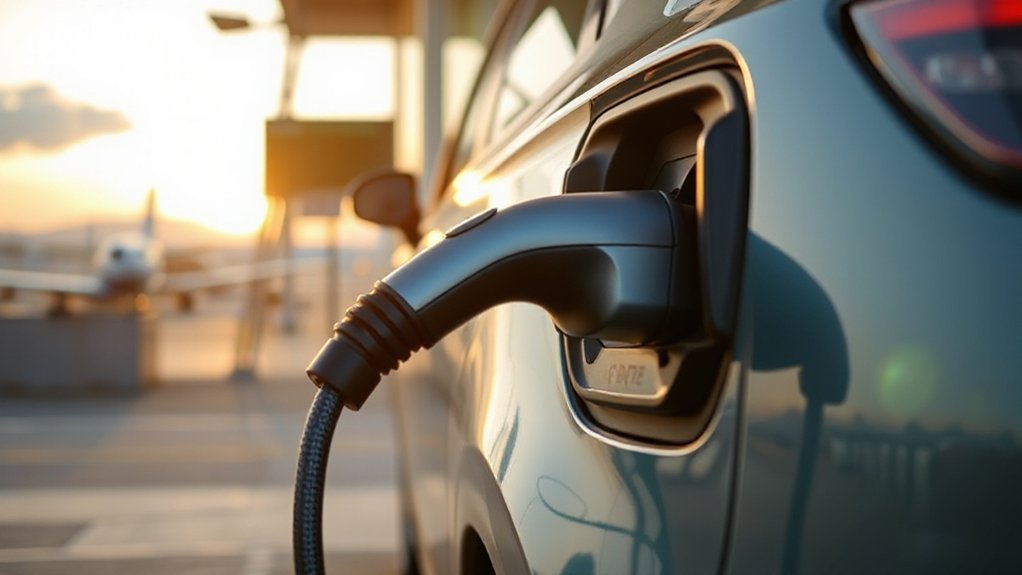
You’ll start by filing a permit with your local AHJ, submitting load calculations, panel rating, dedicated circuit size, and EVSE specs to document NEC 625 compliance. After approval, you have a licensed electrician install per the stamped plans and manufacturer instructions, and you won’t energize the circuit before inspection. You’ll finish with the final safety inspection, where the AHJ verifies breaker sizing, conductor gauge, GFCI/AFCI protection, grounding/bonding, working clearances, labeling, and proper commissioning before you’re cleared to charge.
Permit Application Process
Securing the right permits sets a safe, code-compliant foundation for your Nissan Leaf charging installation. Begin by confirming your Authority Having Jurisdiction (AHJ) requirements and fee schedule. Most cities use digital portals with document templates that specify submittals: application form, site plan, single-line diagram, load calculation (NEC 220), and EVSE spec sheet (UL 2594, NEC 625 listing). Show service rating, feeder and conductor sizes, overcurrent protection, grounding/bonding, GFCI notes, mounting height, working clearances (NEC 110.26), and conduit routing. If you need a panel or service upgrade, coordinate the utility release and obtain a separate permit. Use a licensed electrician, upload license and insurance, and secure HOA authorization if applicable. Don’t begin work until the permit is issued; keep it on-site and post clearly on-site.
Final Safety Inspection
After rough-in approvals, the AHJ conducts the final safety inspection to confirm your EVSE meets NEC 625, manufacturer listing/labeling, and the permitted plans. You’ll demonstrate correct breaker sizing, conductor ampacity, GFCI protection, working clearances, and proper bonding. Verify labeling, torque marks, and commissioning logs; have your Liability waiver ready if your utility requires meter work.
| Check | Code/Standard | Pass Criteria |
|---|---|---|
| OCPD/conductors | NEC 210/240/625 | Breaker ≤ EVSE rating; ampacity ≥ 125% load |
| GFCI/grounding | NEC 110.3(B)/250/625.54 | Listed GFCI functions; bonding continuous |
Label disconnects clearly; secure cords against mechanical damage.
Complete Operational drills: simulate plug-in, verify pilot signal, and confirm ventilation not required per 625.52. You’ll post directory signage, capture as‑built photos, and close the permit. Test AFCI interaction, verify kWh metering, and document panel directory updates today.
Incentives, Rebates, and Battery Care Best Practices
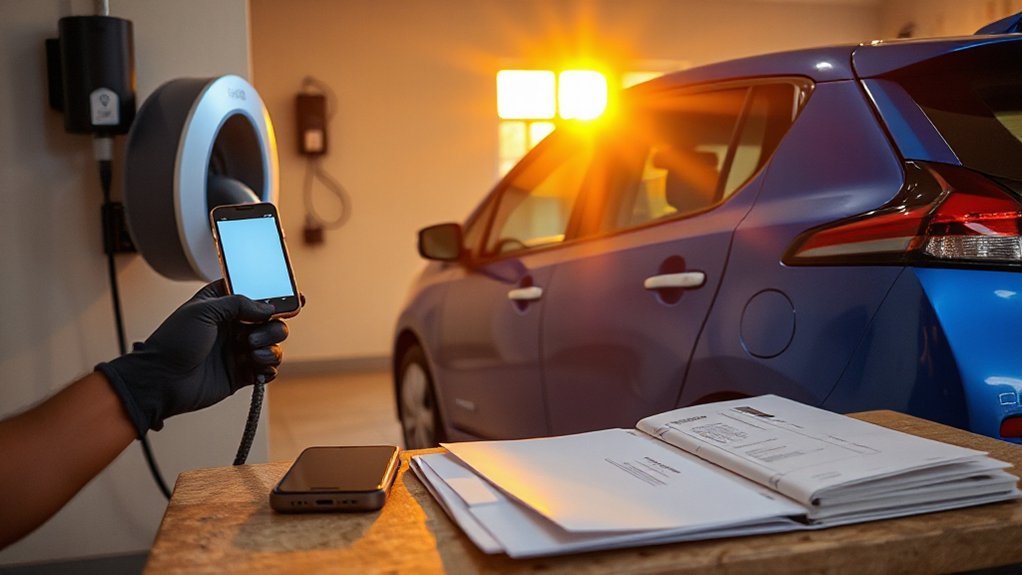
Before you energize your EVSE, verify federal tax credits, state/municipal rebates, and any HOV or toll benefits that reduce total installed cost. Contact your utility to confirm EV rates, managed-charging programs, and make-ready or charger rebates, and follow their interconnection, metering, and load-management requirements. To protect the Leaf’s battery, limit routine charging to about 20–80%, avoid frequent DC fast charging when the pack is hot, and store/charge in moderate temperatures.
Federal and State Incentives
While incentives vary by location and change often, you can cut Nissan Leaf ownership and charging costs by combining federal, state, and utility programs—so long as you install and operate equipment to code and keep required documentation. Start with federal credits: new-vehicle incentives hinge on final assembly, MSRP caps, battery sourcing, and your tax liability; confirm current IRS 8936 guidance. For home Level 2 EVSE, review Section 30C and Form 8911; the installation must meet NEC Article 625, have closed permits, and be in an eligible census tract.
| Program | What to check |
|---|---|
| Federal new EV | Assembly, MSRP, battery rules |
| Federal EVSE | NEC 625, permits, census tract |
| State vehicle | Tax credit/exemption rules |
| State EVSE | Rebate caps, inspection proof |
Verify eligibility criteria and retain claim documentation.
Utility Rebates and Programs
How can your utility cut your Leaf charging costs and support healthier charging habits? Enroll in a time-of-use rate and shift Level 2 charging to off-peak hours; you’ll often pay far less per kWh. Many utilities offer rebates for ENERGY STAR certified EVSE, service-panel upgrades, or load management devices. Use a licensed electrician who pulls permits and installs GFCI protection, correct conductor gauge, and a dedicated breaker per NEC Article 625. Ask about smart-charger pilot programs that give bill credits for automated off-peak or managed charging. Some utilities stack rebates with equity initiatives for income-qualified customers or multiunit dwellings, lowering upfront costs. You may also earn installation discounts for demand response enrollment. Review terms, required hardware, data-sharing consents, and deadlines, and save your approvals.
Battery Longevity Best Practices
Typically, you’ll extend your Leaf’s battery life by pairing smart charging habits with incentives that steer you to gentler, cooler cycles. Use off-peak rebates to schedule Level 2 at night. Target partial charging: stop around 70–80% for daily use, and charge to 100% only before trips. Prioritize temperature management: park in shade, precondition while plugged in, and avoid heat-soaked storage. Minimize DC fast sessions; favor home Level 2 to curb thermal load. Keep firmware current. Install a UL-listed, NEC-compliant EVSE on a dedicated circuit with GFCI protection; verify conductor sizing and clearances per the manufacturer. Inspect connectors routinely; don’t charge if damaged.
| Action | Benefit | Safety |
|---|---|---|
| Partial 80% | Life | Avoid 100% |
| Off-peak L2 | Cost | Listed EVSE |
| Temp manage | Comfort | Limit heat |
| Fewer DCFC | Stability | Monitor |
Conclusion
You choose a Level 2 plan that matches your Leaf’s onboard charger; you size the EVSE and circuit correctly; you pull permits and schedule inspections. You use a UL‑listed unit, a dedicated breaker, and code‑compliant wiring. You charge off‑peak, account for 8–12% losses, and monitor costs. You enable smart features, verify GFCI protection, and test load calculations. You hire a licensed electrician, document rebates, and protect the battery with sane SOC targets and temperate charging.