
When you’re stranded, portable EV charging isn’t one-size-fits-all: Level 1 (120 V, ~1–2 kW) adds miles slowly; portable Level 2 (240 V, ~3.8–9.6 kW) needs the right circuit; mobile DC units offer limited, thermally derated kW. You must match vehicle acceptance, J1772/CCS/NACS connectors, GFCI/insulation monitoring, and UL/CE listings to your use case and duty cycle. Choose wrong, and you carry weight without range—here’s how to avoid that.
Key Takeaways
- Level 1 portable EVSE on 120 V adds 3–5 miles/hour; limited to 12 A continuous on 15 A circuits per NEC.
- Portable Level 2 units on 240 V add ~15–35 miles/hour at 16–40 A; require appropriately sized breakers and UL-listed equipment.
- Mobile DC fast chargers deliver 30–120 kW via CCS; real power constrained by vehicle BMS, cable cooling, and state of charge.
- Roadside AC power banks output 1–3 kW at 120 V for emergencies, providing only a few miles per hour; monitor duty cycle and thermal limits.
- 12 V lithium jump packs only wake the low-voltage system to start charging; they do not recharge the traction battery.
How Portable EV Charging Works in a Pinch
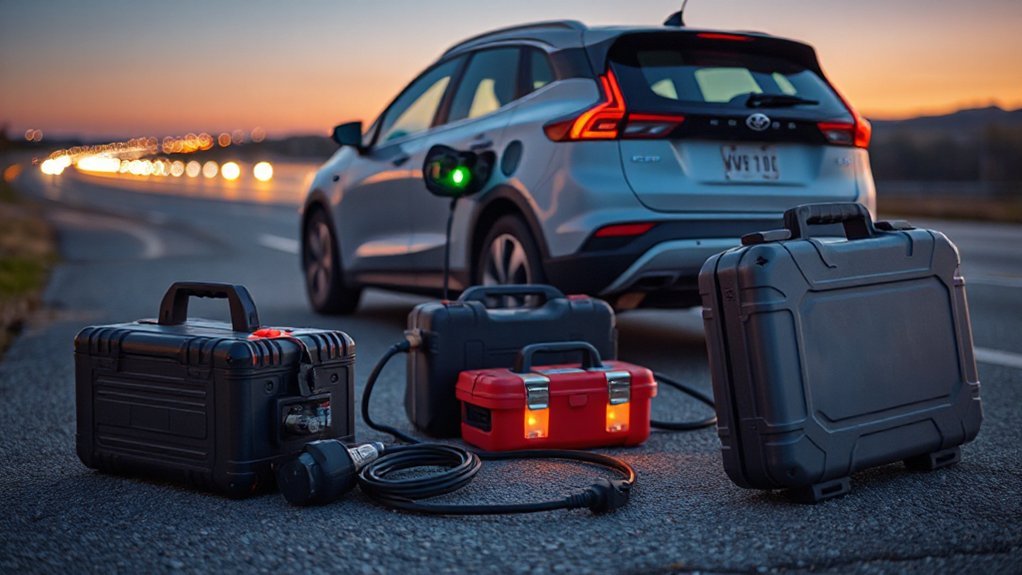
In a pinch, portable EV charging relies on onboard AC-to-DC conversion and standards-based signaling between a mobile EVSE and your car. You negotiate current via SAE J1772/IEC 61851 control pilot PWM, observe proximity detection, and begin only after ground continuity and insulation checks pass. The EVSE advertises allowable amperage; your onboard charger self-limits accordingly. For portable DC units, CCS with DIN 70121/ISO 15118 manages handshake, HV interlock, isolation monitoring, and negotiated voltage/current. Embedded GFCI/RCD, overtemperature sensors, and contactor checks enforce safety. Follow a concise Troubleshooting protocol: verify receptacle rating, cord temperature, pilot duty cycle, ground impedance, and fault codes. Address Legal considerations: use listed equipment (UL 2594/UL 2231), comply with NEC 625 and local permitting, and respect site power limits and signage and markings.
Level 1 Trickle Chargers: What You’ll Really Gain per Hour
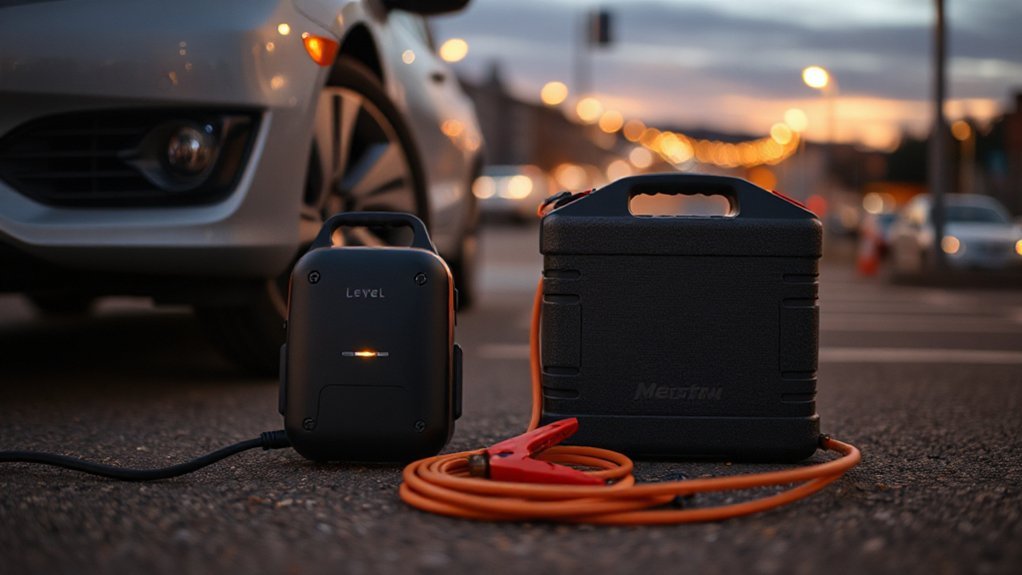
After covering handshake and safety for portable units, quantify Level 1 throughput using standard limits. On 120 V circuits, NEC 625/210 continuous load rules cap EVSE draw to 80%: 12 A on 15 A, yielding 1.44 kW nameplate. Real pack intake at 88–92% efficiency is about 0.9–1.3 kWh per hour. Using SAE J1772 assumptions, you’ll see Mileage Added of roughly 3–5 miles/hour at 3–4 mi/kWh. Expect SoC Increase of about 1.5–2.2%/hour for a 60 kWh pack, or 1.2–1.7%/hour for 75 kWh. Some units let you select 8–12 A to avoid tripping weak circuits, proportionally reducing gain. Cold packs and high SoC taper add further penalties. Plan on overnight sessions to recover meaningful range. Check receptacle ratings and cord temperature to maintain continuous duty compliance.
Portable Level 2 Units: Power, Plugs, and Circuit Requirements
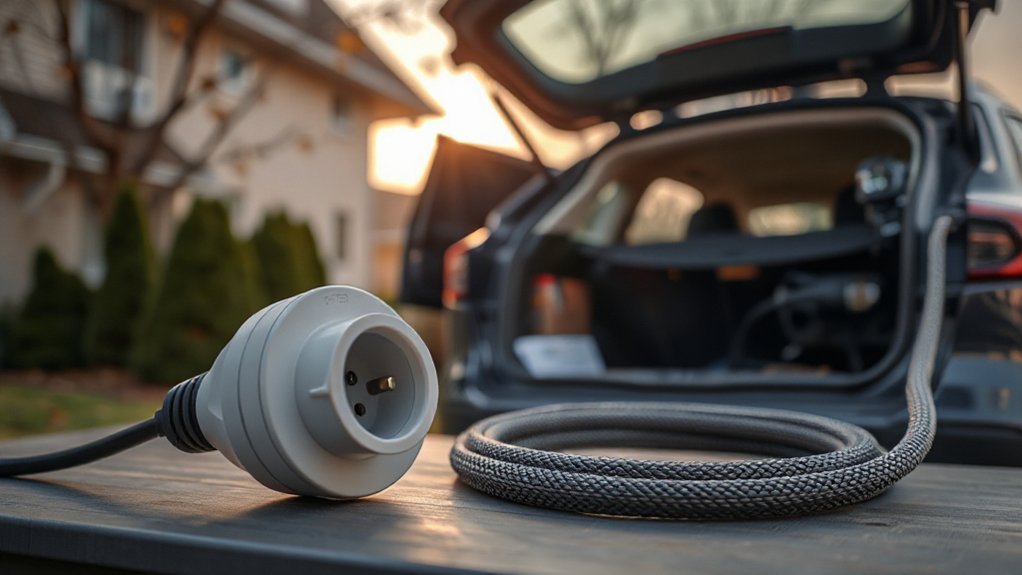
You’ll size a portable Level 2 unit by its amperage at 240 V—typical settings are 16 A (≈3.8 kW), 24 A (≈5.8 kW), 32 A (≈7.7 kW), and 40 A (≈9.6 kW)—and remember your car’s onboard charger may cap acceptance to ~6.6–11 kW. Expect NEMA 14-50 or 6-50 wall plugs, with some units offering 14-30/10-30/6-20 adapters; vehicle connectors are SAE J1772 or NACS, so use the correct coupler or adapter rated for the current. Per NEC 625 (125% continuous-load rule), a 32 A EVSE needs a 40 A breaker and a 40 A EVSE needs a 50 A breaker; don’t exceed conductor/rating limits and use properly listed GFCI protection where required.
Output Power Ratings
How much power can a portable Level 2 EVSE actually deliver? It’s constrained by the lesser of EVSE amp rating, branch-circuit capacity, and your car’s onboard charger. Apply NEC Article 625 continuous-load guidance (80% of breaker) and SAE J1772 pilot limits. Real output depends on supply voltage (208 vs 240 V), cable temperature, and firmware current caps. Consider Power Density and Thermal Derating: small, sealed housings often downrate at elevated ambient for connector and relay longevity. UL-listed units must state nameplate amps and duty cycle; verify conductor gauge and temperature class. The table shows approximate maxima at 240 V. If your vehicle accepts less current, charging power falls accordingly; if voltage sags, kW drops proportionally under real conditions.
| Breaker | Cont.A | kW@240V |
|---|---|---|
| 20 | 16 | 3.8 |
| 30 | 24 | 5.8 |
| 40 | 32 | 7.7 |
| 50 | 40 | 9.6 |
Plug Types and Adapters
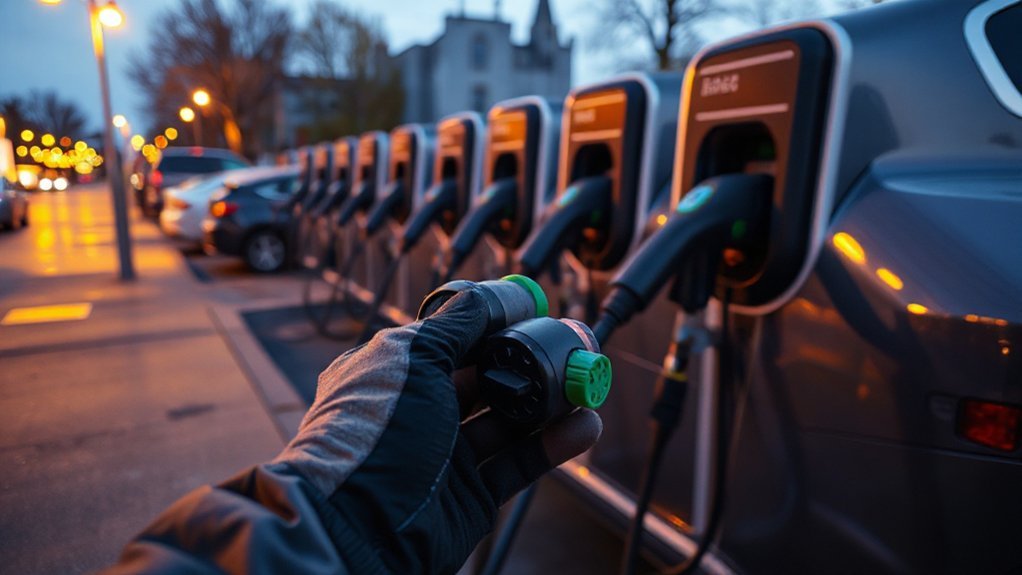
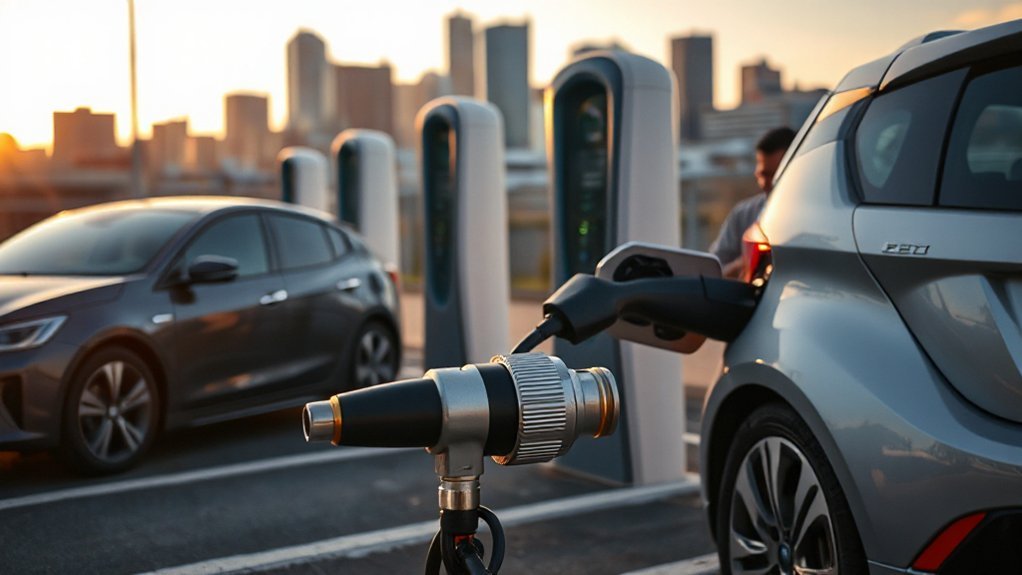


Power capability ties directly to the plug and circuit you connect to: the EVSE’s attachment plug dictates the maximum continuous current it should advertise via the J1772 pilot, and adapters can’t upgrade a circuit’s rating. Common portable Level 2 plugs include NEMA 14‑50 and 6‑50 (50 A), 14‑30 and 6‑30 (30 A), and twist‑lock L6‑30 (30 A). Select UL‑listed EVSEs with plug faces marked and color coding that matches adapters. Quality adapter sets pass through ground, neutral/line as appropriate, and embed over‑temperature sensors or resistor IDs so the EVSE can set the correct pilot. Prefer molded, strain‑relieved connectors with locking mechanisms (twist‑lock or latch) to resist disconnection. Follow SAE J1772, UL 2594, and NEC 625 labeling and grounding requirements when mixing plugs and adapters.
Circuit Amperage Needs
Why does circuit amperage matter? Portable Level 2 EVSE draw continuous load at 240 V, so NEC 625/210 apply the 125% rule. A 20 A receptacle (NEMA 6‑20) permits 16 A continuous; 30 A (6‑30) permits 24 A; 50 A (14‑50) permits 40 A. EVSE with adjustable current and SAE J1772 pilot should be set to the circuit’s rating to maintain service coordination and avoid nuisance trips. Check panel capacity using NEC 220 load calculations and account for demand diversity when other large loads run. Verify breaker type, conductor gauge, and receptacle condition; many codes require GFCI protection for 125/250 V, 50 A in garages/outdoors. Avoid extension cords; manage voltage drop to <3%. Derate for ambient temperature and bundled conductors. Check labeling and listings.
Mobile DC Fast Chargers: Specs, Connectors, and Real-World Rates
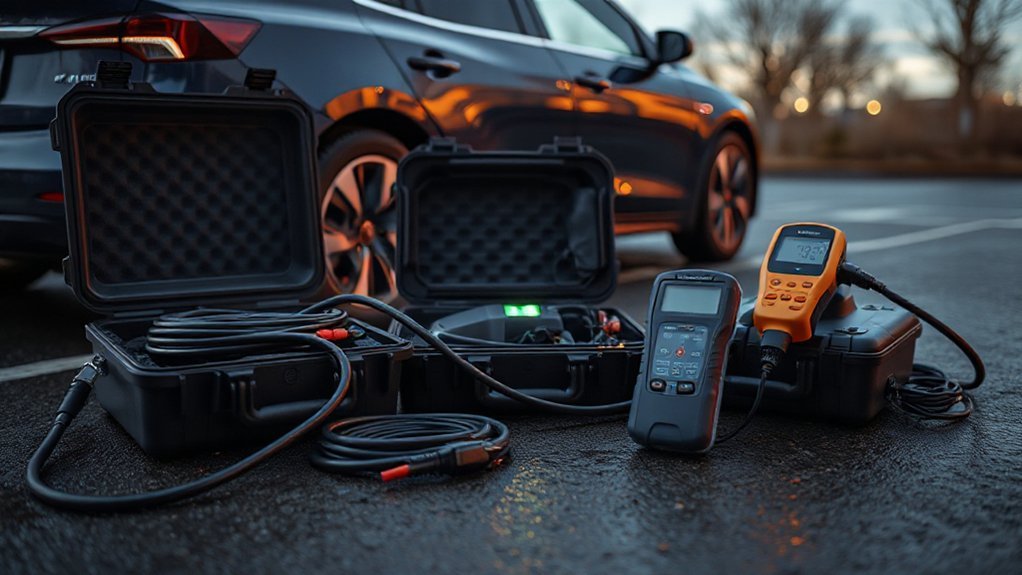
While mobile DC fast chargers advertise 60–180 kW nameplate outputs, your real charging rate hinges on voltage, current, connector, and vehicle limits defined by standards. CCS (SAE J1772 Combo/CCS1, CCS2, DIN 70121/ISO 15118) and SAE J3400/NACS typically support 200–1000 V and 300–500 A; CHAdeMO commonly caps near 500 V and 125–200 A. Liquid‑cooled leads sustain 500 A; air‑cooled cables derate earlier, triggering thermal throttling. Many mobile units are limited to 150–200 A despite 400–800 V compliance. Your EV’s BMS curve further constrains power above ~60–70% SoC. Verify connector current ratings, cable length loss, and duty cycle. Require data telemetry for voltage, current, temperature, and error codes via OCPP or ISO 15118. Expect field rates of 30–120 kW, depending on pack voltage and ambient.
Battery Booster Packs and Roadside Power Banks: Use Cases and Limits
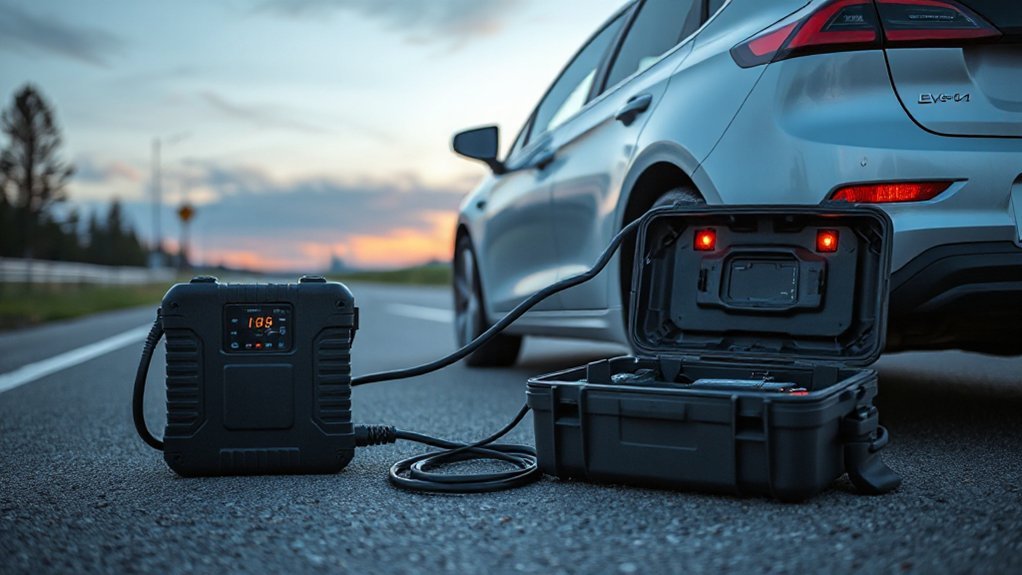
Although marketed as “portable EV chargers,” battery booster packs and roadside power banks serve two distinct roles with strict limits enforced by standards and vehicle controls. 12 V lithium jump packs only re-energize the low-voltage bus to let the BMS close contactors; they don’t supply traction energy (expect compliance with UL 2743/UL 2054/UL 2271 and proper reverse‑polarity protection). You’ll use a jump pack when the 12 V battery sags and the car won’t wake. Pick 1,000–2,000 A peak, IP65, UN 38.3 tested units. Roadside “power banks” deliver 1–3 kW at 120 V, adding roughly 3–9 miles per hour. Expect overcurrent, GFCI, and thermal limits. Cold derates occur. Follow OEM guidance—misuse can void warranty coverage. Use locking mounts for theft prevention. Never bypass vehicle interlocks.
Compatibility and Connectors: J1772, CCS, and NACS Explained
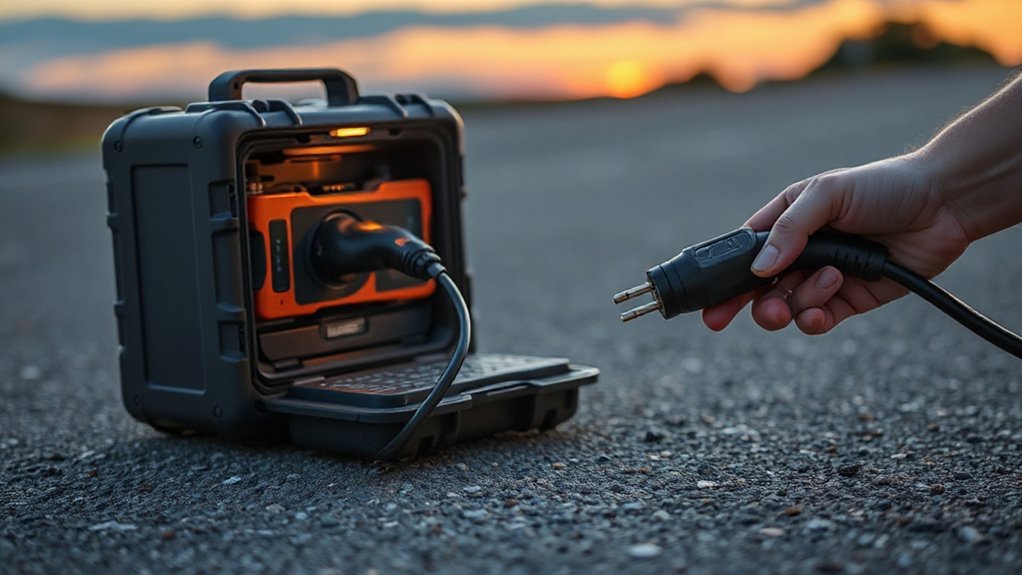
Portable power only helps if your plug and signaling match the car’s inlet and charge controls. You need the right interface and protocol. J1772 (SAE J1772 Type 1) handles AC Level 1/2 via PWM control, 120/240 V, up to 80 A. CCS (Combo 1/2) adds DC using PLC per ISO 15118/DIN 70121, typically 200–1000 V, up to 500 A. NACS integrates AC and DC on one connector; it negotiates over PLC and supports high current. Most portable chargers are AC-only J1772; DC “boosters” must speak CCS or NACS and pass certificate-based handshakes. Adapters translate pins but not protocols. Standards Governance spans SAE, ISO, IEC, and CharIN. Expect Regulatory Divergence: North America favors J1772/NACS; EU enforces Type 2/CCS2. Portable planning requires mapping vehicle inlet variants.
Safety, Weather Readiness, and Reliability in the Field
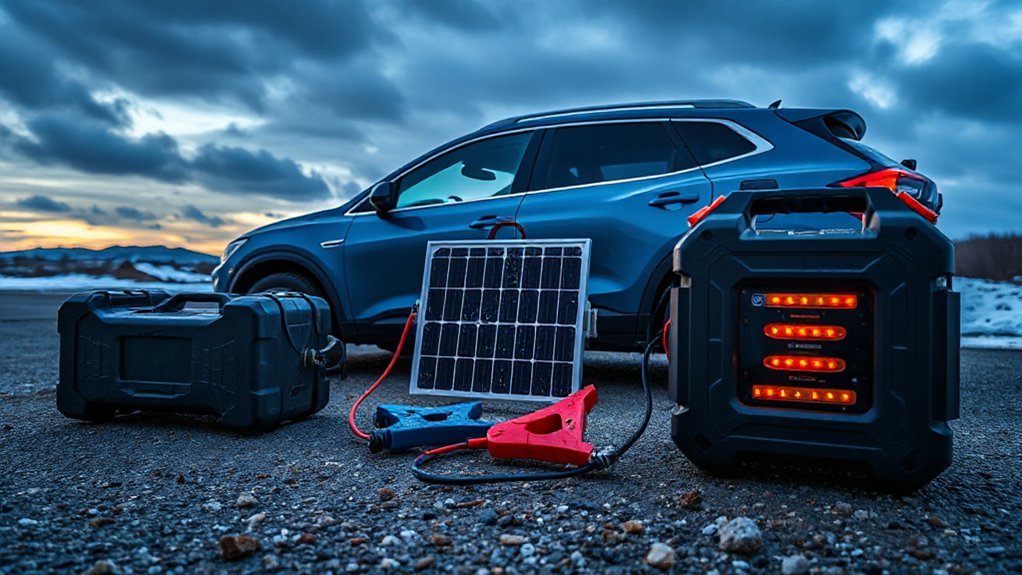
Because field charging exposes equipment to moisture, temperature extremes, and variable power quality, you should select portable EVSE and DC boosters that meet rigorous safety and environmental standards. Specify UL 2594/2231 (AC) or UL 2202/2231 (DC), IEC 61851, and ISO 17409, with 20 mA ground-fault, welded-contact detection, and isolation >500 VDC. Demand IP65–IP67 or NEMA 4/4X enclosures, salt‑fog validated (ASTM B117) for corrosion prevention, and -30°C to 50°C operating range with documented derating and thermal management. Require surge immunity per IEC 61000-4-5, ESD per -4-2, and EMC compliance (CISPR 11/FCC Part 15). Use UV-stable, oil-resistant TPE cables, strain relief tested to IEC 62196, and connectors rated >10,000 mating cycles. Verify conformal coating, gasketed vents, replaceable filters, and published MTBF, plus field-serviceable fuses and logs.
Costs, Weights, and What Fits: From Glovebox Backup to Fleet Tools
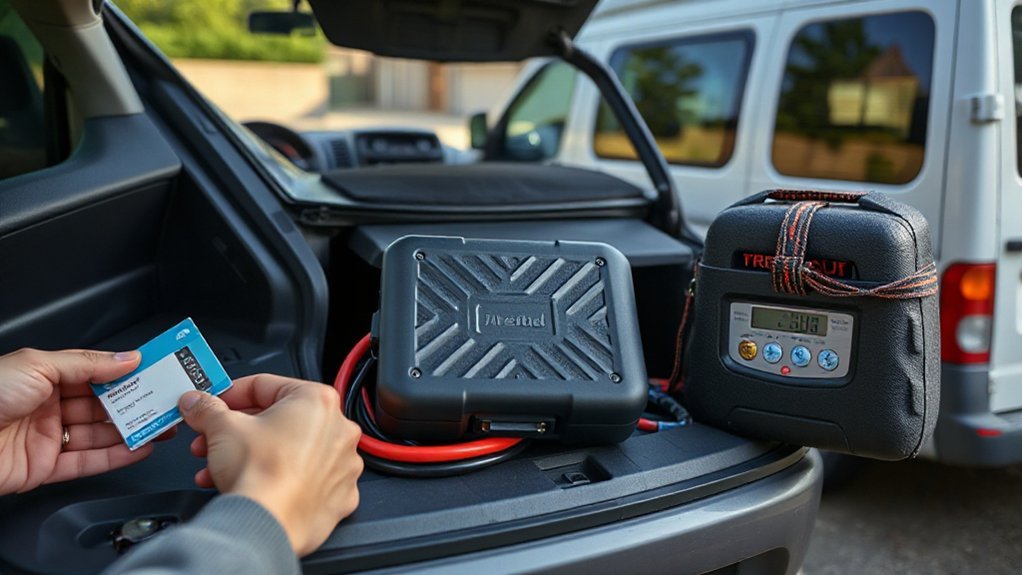
When you map use case to power, mass, and budget, categories fall into clear bands: glovebox AC “emergency” EVSE (120 V, 12–16 A, 1.4–1.9 kW) run 1–2 kg and $150–$300; travel L2 units (240 V, 16–32 A, 3.8–7.7 kW) are 2–5 kg and $250–$700; high-duty L2 (40–48 A, 9.6–11.5 kW) land at 4–8 kg and $500–$1,200 with NEMA 14-50 or hardwire pigtails.
Match connector standards and cord lengths to actual dwell times and circuits.
- Prioritize UL-listed EVSE, 105°C cable, IP54+ enclosures; plan Stowage strategies to prevent bend radius violations.
- For apartments, choose L2 at 16–32 A with interchangeable NEMA 6-20/14-50 plugs and J1772 adapters.
- For Fleet budgeting, model kWh/day, duty cycles, and spares; deploy 40–48 A units on managed circuits.
Audit labeling compliance.
Conclusion
You’ve seen how portable options bridge gaps: L1 trickle (120 V, 12 A), portable L2 (240 V up to 40 A), and compact DC units with CCS/NACS. Match your EV’s onboard limits, connector, and branch-circuit capacity, and insist on UL 2594/2231, GFCI, and IP54+. As a benchmark, a 120 V, 12 A EVSE (~1.44 kW) typically yields 4–5 mi/h—enough to cover the U.S. median commute of 12 miles in three hours. Choose standards; mitigate risk.