
Plugging a UL-listed 32A portable EVSE into a NEMA 14-50 on a 40A circuit gives you true Level 2 charging, but only if the circuit, plug, and vehicle’s onboard charger align. You’ll set current limits, confirm GFCI, pilot, and ground checks, and watch for thermal derating. Use correct adapters and 6‑gauge wiring, manage cables, and verify weather ratings. Skip any step and you risk nuisance trips—or worse; here’s how to get it right.
Key Takeaways
- Level 2 portable EVSE plugs into a 240 V receptacle; actual charge rate is limited by the circuit, EVSE setting, and vehicle onboard charger.
- On a 240 V, 20 A circuit derated to 16 A, expect about 3.5 kW and roughly 12–25 miles of range per hour.
- Look for UL/cETL listings (UL 2594, UL 2231), integral GFCI with self-test, temperature monitoring, surge protection, and fast fault shutdown via contactor.
- Match plug and vehicle standards: supply NEMA 14-50, 6-50, or 6-20; vehicle inlet J1772 (North America) or Type 2 (Europe).
- Set current to the lowest-rated component, use only listed adapters preserving grounding and pilot signaling, and keep cables uncoiled, dry, and temperature-monitored.
How Portable Level 2 Chargers Work

Plugging a portable Level 2 charger into a properly rated 240 V receptacle lets your EV’s onboard charger draw faster AC power while the EVSE (the control box on the cable) manages safety. You verify the circuit rating, receptacle type, and grounding per NEC, then seat the plug. Inside the EVSE, the internal architecture includes a contactor, GFCI, temperature sensors, and a microcontroller. Its control algorithms run self-tests, verify ground continuity, and generate the J1772 pilot to negotiate allowable current with your car. When checks pass, the contactor closes and power flows; if faults appear, it opens instantly. You monitor indicator LEDs. Keep cables uncoiled, plugs dry,. Use a dedicated breaker, NEMA plug, and avoid adapters. Inspect for heat or damage before every session.
Charging Speeds and Real‑World Miles Added


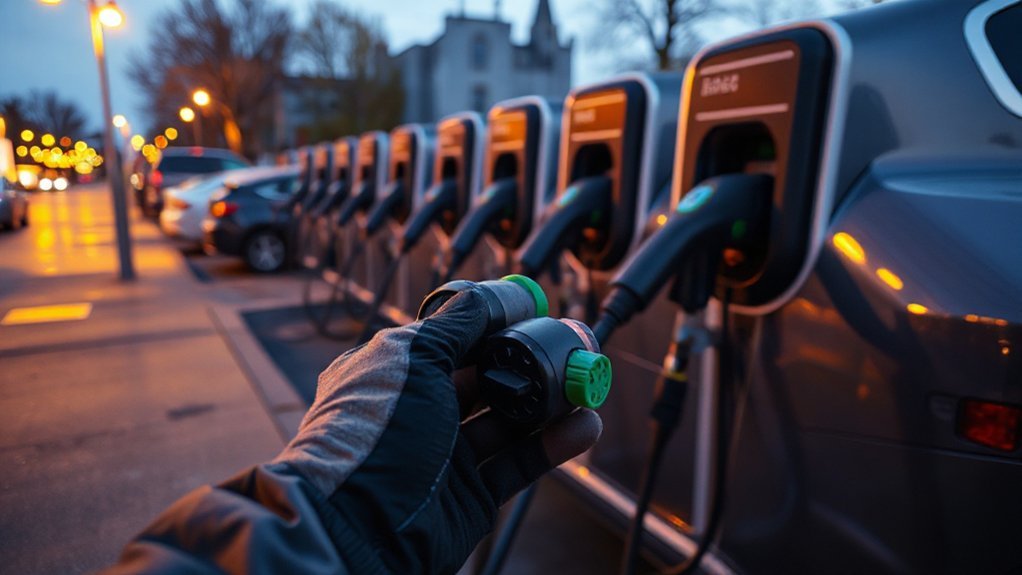
With the EVSE handling safety checks, your actual charging speed is set by the lowest limit among the branch circuit, the EVSE’s max current setting, and your car’s onboard charger. On a 240 V, 20 A circuit derated to 16 A continuous, you’ll add roughly 3.5 kW of power. Translate that to miles by dividing power by your car’s average Wh/mi; expect 12–25 mi/hr. Colder batteries slow charge curves; plan for seasonal range losses and taper near full. To minimize voltage drop, use short, heavy-gauge cords and dedicated circuits.
- Verify outlet rating and breaker size before setting amps.
- Monitor inlet temperature; hot plugs mean stop and investigate.
- Precondition the pack; warmer cells accept higher current.
- Leave charging headroom; 20–80% maximizes speed and battery health.
Key Features and Safety Protections to Consider
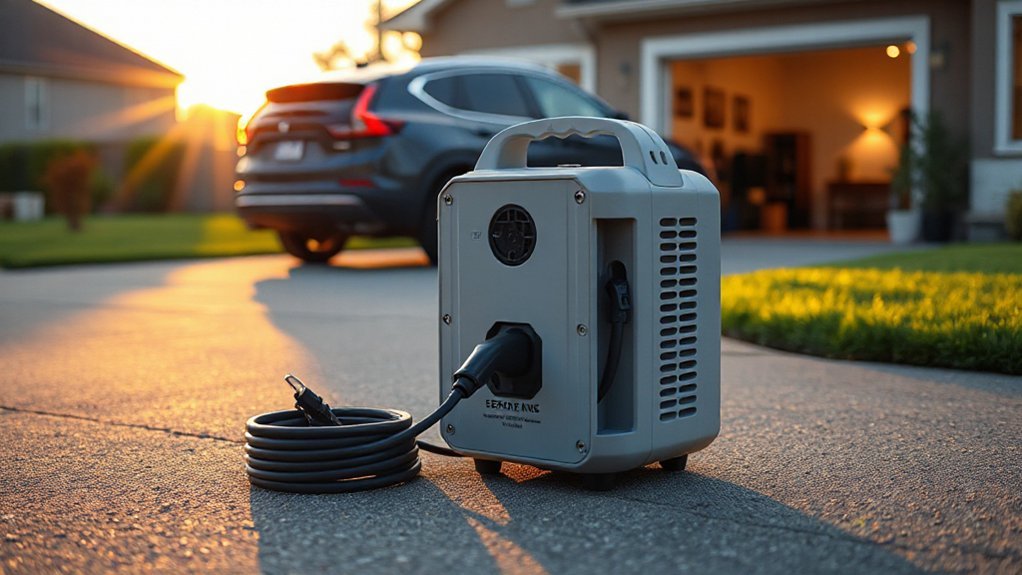
Although portability matters, prioritize a unit that’s certified and protected: look for UL/cETL listing (UL 2594, UL 2231‑1/‑2) or IEC 61851 compliance, an integral GFCI/RCD with auto self‑test, ground‑continuity and pilot/diode checks, welded‑relay detection, over/under‑voltage and overcurrent protection, and temperature sensors in both the wall plug and charge handle.
Favor robust enclosures (NEMA 4 or IP66), strain‑relieved cables, and clear fault codes. Require Surge protection and brownout recovery. Demand firmware that logs events, supports self‑diagnostics, and fails safe. Thermal monitoring should throttle or stop charging before connector damage or outlet overheating.
| Key feature | Why it matters most |
|---|---|
| Ground fault, welded‑relay, pilot/diode checks | Prevents energized pins, shock, and nuisance restarts |
| Over/under‑voltage, overcurrent, Surge protection | Safeguards EVSE, vehicle electronics, and household circuits |
Plug Types, Adapters, and Compatibility
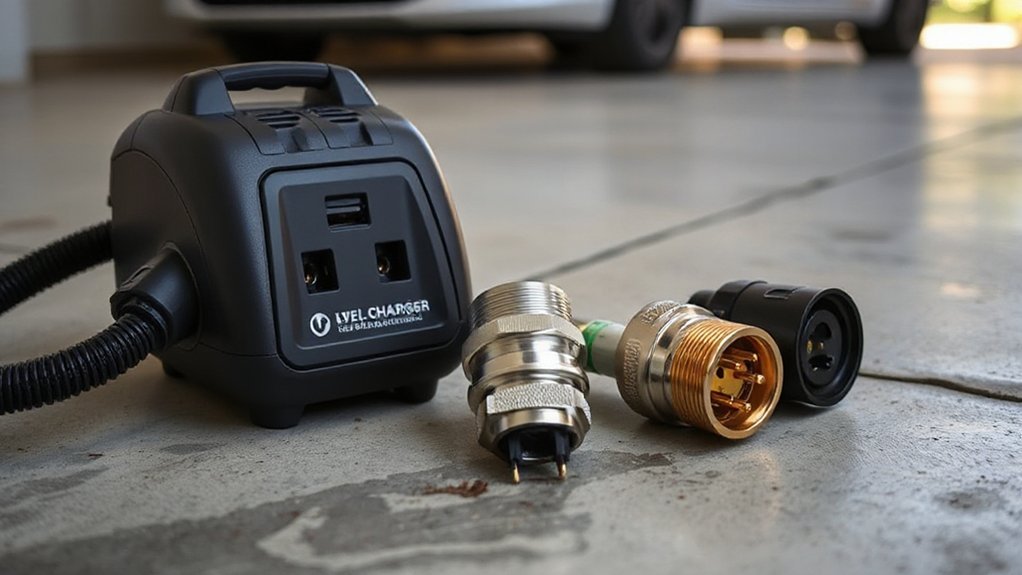
Choosing the right plug and adapter determines whether your Level 2 portable EVSE operates safely and at its rated power. Match your EV inlet (J1772 in North America, Type 2 in Europe) and verify plug standards on the supply side: NEMA 14‑50/6‑50/6‑20, or local sockets. Respect regional differences in voltage; confirm the EVSE’s input range and certifications. Use only adapters that preserve grounding, temperature sensing, and pilot signaling. Set current to the lowest rated component: circuit, receptacle, cord, or adapter. Avoid cheater cords; choose UL/CE‑listed gear with strain relief and correct gauge.
- Confidence in every click of a secure connector.
- Relief knowing the ground path is continuous.
- Pride in compliant, code‑worthy gear.
- Peace when the pilot line negotiates safe current.
Setup, Weatherproofing, and On‑the‑Go Use Tips
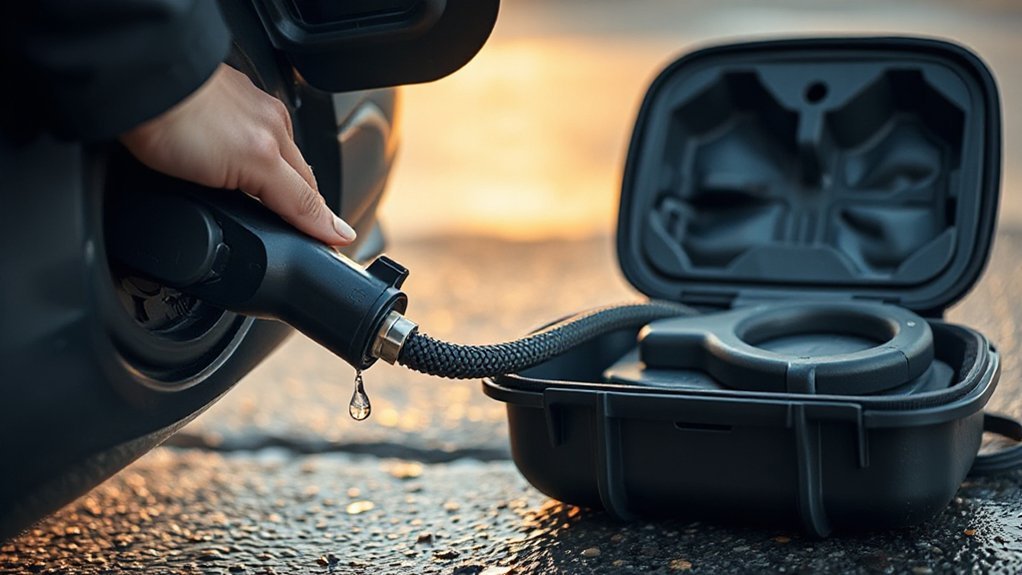
Before your first charge, inspect the EVSE, cord, and connectors for damage, then verify the supply is a properly grounded, code‑compliant circuit sized for the EVSE’s max current and protected by a GFCI as required (e.g., NEC 625).
Confirm the receptacle’s type and condition, torque terminations per manufacturer specs, and avoid extension cords. Mount or hang the EVSE to keep the control box off the ground; create a drip loop. Outdoors, use a listed in‑use cover and verify the unit’s NEMA/IP rating. Set the current to match the circuit; monitor plug and cord for heat. Practice cord management; route to prevent trips and pinch points. For on‑the‑go use, pre‑test at home and pack rated adapters. Choose storage solutions: ventilated bag, desiccant, gloves, and straps.
Conclusion
You’re ready to charge smarter: match the EVSE’s amps to a properly rated 240 V circuit, respect your car’s onboard-charger limit, and expect real‑world miles based on power, weather, and SOC. Choose UL‑listed units with GFCI, pilot/ground checks, thermal cutbacks, and heavy‑gauge cords. Use correct NEMA plugs/adapters only, test first, and route cables to avoid trip hazards. With setup and weatherproofing, your portable Level 2 charger works like a thousand pit crews—fast, safe, and code‑compliant.