
You can top up an EV with portable solar, but the numbers rule the outcome. Expect 200–800 W from foldable panels, 4–6 sun-hours, and 15–25% system losses, translating to roughly 1–8 miles per day (assuming 3–4 mi/kWh). MPPT controllers, battery buffers, and proper EVSE interfaces are mandatory. Panel area, orientation, and heat kill yield—so sizing, wiring, and safety choices become critical next.
Key Takeaways
- Portable solar can trickle-charge EVs via panels → MPPT → buffer battery/inverter → portable EVSE (J1772/NACS), or via integrated power stations.
- Expect modest range: 200–1000 W kits harvest ~0.7–3.5 kWh/day, adding ~2–14 miles/day at 3–4 mi/kWh.
- Size arrays by sun hours: Panel watts ≈ (Wh/day ÷ sun hours) ×1.2–1.3; use MPPT and 24–48 V storage 1.2–1.5× daily kWh.
- Verify EVSE and inverter ratings, voltage windows (120/240 V), grounding, GFCI/RCD, conductor size; target <3% voltage drop and IP65+ outdoor gear.
- Real-world losses and temperature reduce output 25–40%; choose durable monocrystalline panels, anchor securely, and follow UL 1741/2231 and NEC 625.
How Portable Solar Charging Works for EVs

How does a portable solar kit turn sunlight into miles of range? You deploy photovoltaic panels that convert irradiance into DC, then route it through an MPPT controller to harvest maximum power under temperature shifts and cloud variability. The controller feeds either a DC‑DC converter that sets the EV’s acceptable voltage window or an inverter plus portable EVSE that provides grid-simulated AC with pilot signaling. A buffer battery smooths transients, supports surge, and enables continuous EVSE duty cycles. You manage grounding, GFCI, overcurrent protection, and rapid shutdown per UL 1741, UL 2231, and NEC Article 625. Data logging tracks volts, amps, and efficiency losses across each stage. You also navigate regulatory hurdles for public sites, interconnection, and portable generator classifications and equipment labeling requirements.
Setting Realistic Expectations: Power, Range, and Time
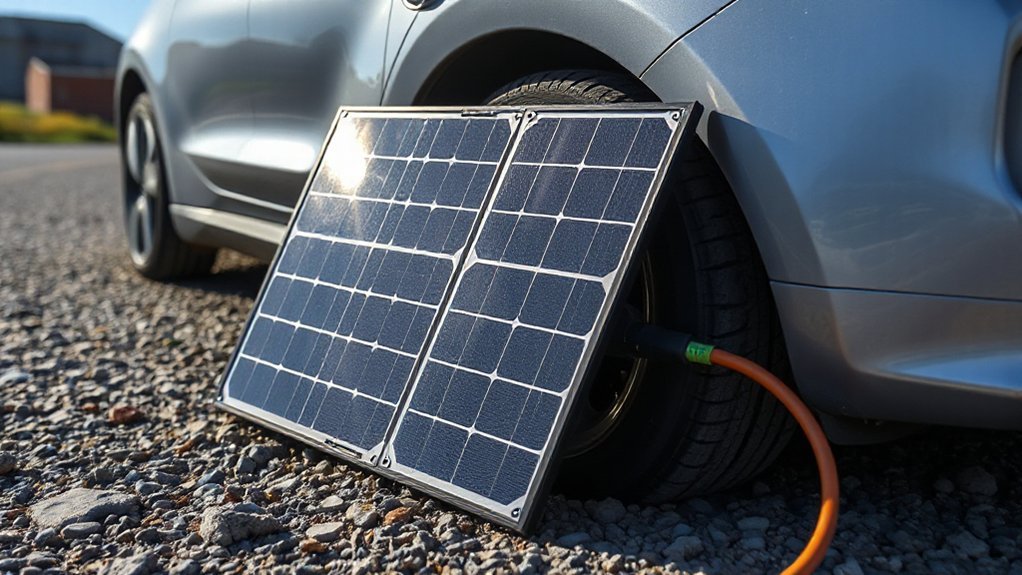
Set expectations by quantifying power output limits: most portable kits rate 200–1000 W (STC), but you’ll see ~60–80% of that in real conditions due to irradiance, temperature, and angle. With 4–6 peak-sun-hours, that translates to roughly 0.7 kWh/day (200 W) to 3.5 kWh/day (1 kW). Using typical EV efficiency of 3–4 mi/kWh (15–20 kWh/100 km), you’ll add about 2–3 miles/day with 200 W and 10–14 miles/day with 1 kW.
Power Output Limits
While rooftop PV can deliver multiple kilowatts, truly portable panels typically provide only 100–800 W in real sun, which governs how much range you can add and how long it takes. You should size expectations around insolation, panel rating, orientation, temperature derating, shade impact, and conversion losses. Under standard test conditions, a 200 W portable often yields 120–160 W at the MPPT input; cabling and inverter reduce a further 5–12%. Midday clear-sky irradiance might hit 800–1000 W/m², but tilt errors and clouds cut it rapidly. As cells heat, expect about −0.4%/°C power slope.
| Factor | Typical magnitude | Notes |
|---|---|---|
| Insolation variability | ±20–70% daily | Location, weather, tilt |
| Operating temperature | −0.4%/°C | Temperature derating |
| Partial shading | 10–90% loss | Shade impact; bypass diodes help |
| System losses | 8–20% | Wiring, MPPT, DC-DC/AC |
Range Added Per Day
Most portable solar setups add single-digit miles per day, not tens. With a 200–400 W array and 4–6 peak-sun hours, you’ll harvest roughly 0.6–2.0 kWh/day after controller, battery, and inverter losses (70–85% round-trip). At 2.5–4.0 mi/kWh, that yields about 2–8 miles/day. Seasonal variability, latitude, clouds, shading, and temperature swing output by 2× or more; winter at high latitudes can drop below 1 mile/day. Orientation matters: tilt toward the sun, avoid partial shading, and keep modules cool to reduce resistive losses. Vehicle factors change miles per kWh: larger SUVs may see 2–3 mi/kWh, efficient sedans 3.5–4.5. Terrain impact is real: hills, headwinds, and unpaved surfaces raise consumption, trimming daily range. Plan conservative energy budgets and buffer with grid or DC fast charging when available nearby.
Choosing Panels: Wattage, Efficiency, and Form Factor

You’ll size wattage by estimating your daily energy target and peak sun hours: Panel W ≈ (Wh/day ÷ sun hours) × 1.2–1.3 to cover controller, wiring, and angle losses. Prioritize high-efficiency monocrystalline modules (about 20–24% module efficiency) to maximize watts per square meter when space is limited. Weigh foldable panels (lighter, more portable, typically shorter lifespan and higher $/W) against rigid panels (heavier, more durable, better thermal stability, usually lower $/W) based on transport limits and duty cycle.
Wattage Sizing Basics
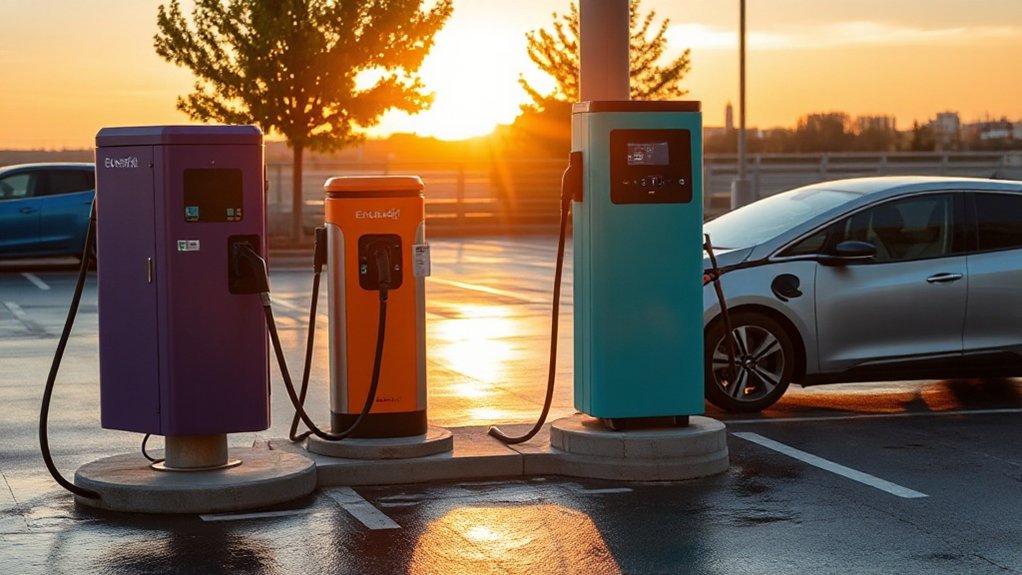
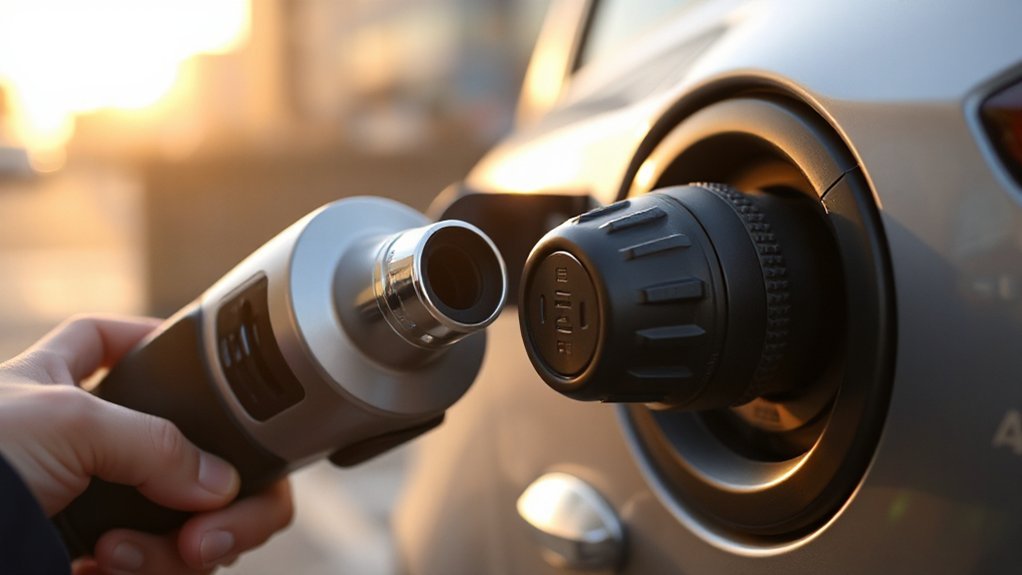

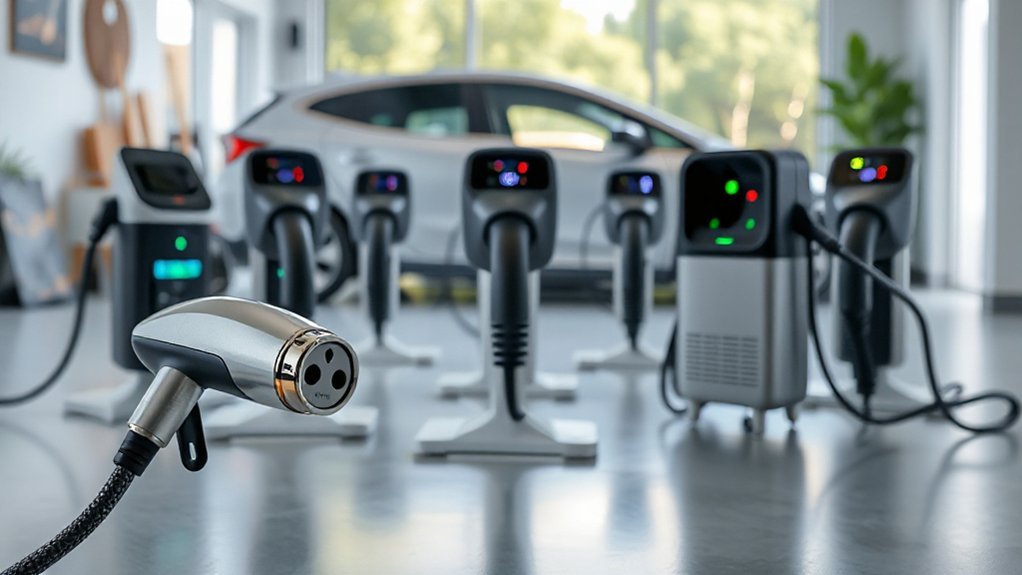
How much panel wattage do you actually need to add meaningful range from a portable setup? Start from energy math. Typical EVs use 250–320 Wh/mi. Net solar output ≈ panel_watts × sun_hours × 0.7 (losses, temperature, orientation). With 5 sun hours, 400 W yields ~1.4 kWh, or 4–6 miles. Scale wattage to your daily range target, roof/ground area, and inverter limits. Compare pricing trends ($/W) and warranty terms, since portable panels trade weight for durability.
| Watts | Daily kWh (5h, 0.7 net) | Miles/day @300 Wh/mi |
|---|---|---|
| 200 | 0.7 | 2 |
| 600 | 2.1 | 7 |
For gains, parallel foldables into a higher-watt array, but respect your charge controller’s max input watts and voltage. If you road-trip, model miles, sun hours, and pack space to pick a realistic wattage target.
Efficiency Ratings Matter
After sizing wattage from energy math, the next limiter is efficiency: watts per square meter and per kilogram. You evaluate area-limited output using module efficiency (%) and STC power density; 22% silicon yields ~220 W/m² at 1000 W/m² irradiance, while 18% yields ~180 W/m². For weight-limited kits, compute W/kg: divide STC watts by panel mass, including cabling and frame. Compare claims using rating methodologies tied to testing standards (STC vs NOCT). Expect NOCT power to be 70–80% of STC in real sun and heat. Review temperature coefficient of Pmax; −0.30%/°C beats −0.45%/°C for EV trip heat. Check low-light efficiency, bypass diode count, and IV curve shape. Validate specs with third-party flash test reports and serial-numbered datasheets. Confirm warranties link to measured performance, not estimates.
Foldable Vs Rigid
Why pick foldable over rigid for EV charging? Foldables typically deliver 100–400 W per panel at 18–22% efficiency, with integrated kickstands and MC4/XT60 leads. You’ll deploy 600–1,200 W using a 3–6 panel array, enough to add 3–8 miles/hour to an efficient EV via a 40–60 V MPPT power station. Their storage footprint is small; a 200 W tri-fold packs to a briefcase-size 20–25 lb unit, maximizing trunk space. However, laminated fabrics and PET faces scratch, so lifespan is 3–5 years outside.
Rigid panels push 200–450 W each at similar efficiency, but win the durability comparison: tempered glass, aluminum frames, 10–25 year ratings. They’re heavier (25–40 lb) and bulkier. You’ll get better heat dissipation, lower cell temps, and 2–4% higher real-world yield. Mounting options expand.
Charge Controllers, Inverters, and Power Stations Explained
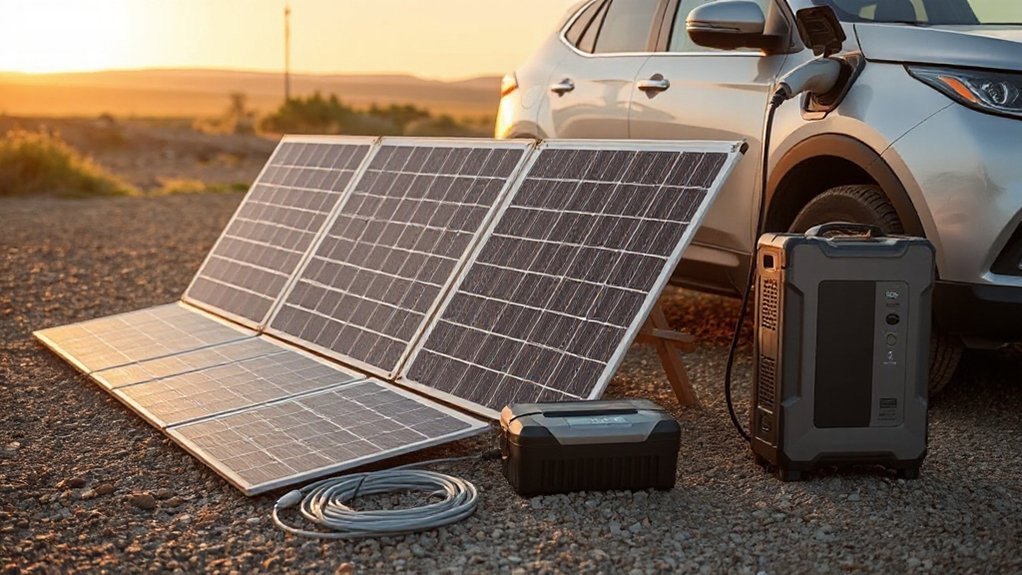
What turns scattered sunlight into usable EV miles is the power chain: the charge controller, inverter, and portable power station. You use an MPPT controller for MPPT advantages: it tracks the array’s maximum power point under changing irradiance and temperature, yielding 15–30% more harvest than PWM, especially with partial shading. Set charge profiles to match battery chemistry (LiFePO4 vs NMC vs AGM) to protect cycle life and maintain peak C-rate intake. The inverter matters only when you need AC; for DC-coupled EVSEs or DC fast charging, you minimize conversions. Evaluate continuous and surge ratings, efficiency at 20–50% load, and idle draw. Portable power stations integrate MPPT, inverter, BMS, and storage; compare round-trip efficiency, usable kWh, thermal management, and pass-through limits under real camping conditions.
Connectors, Cables, and Compatibility With Your EV

How do the pieces interface so the electrons you harvest actually reach your car? You’ll match connector standards end‑to‑end: MC4 from panels to charge controller, then DC output to an inverter or power station, and finally to the EVSE using J1772 or NACS. Verify conductor gauge: 10 AWG for array leads, 12 AWG minimum on AC EVSE cords; limit voltage drop under 3% at peak current. Check IP67/IP68 ratings and UV resistance for outdoor runs. Beware Proprietary Plugs on some power stations; adapters may add resistance and failure points. Confirm the EVSE’s input window (90–132 V, 180–264 V) and frequency. Validate ground continuity and GFCI operation. Use only listed adapters; unapproved modifications risk faults and Warranty Implications. Confirm connector temperature rise stays below 30°C at sustained load per standards.
Sizing Your Kit: Calculators and Example Setups

When sizing a portable solar kit for EV charging, start by quantifying energy and power: estimate your daily kWh target, divide by site peak-sun-hours to get required array watts, then derate for system losses (panel temperature, wiring, controller, inverter) of 25–40%. Use battery-to-wheel efficiency (AC charge: 85–92%) and charger limits to cap usable power.
Build trip templates: e.g., 6 kWh/day in 5 PSH with 35% losses needs 6,000/(5×0.65) ≈ 1,846 W array; pair with a 2 kW MPPT and 24–48 V storage buffer sized for 1.2–1.5× daily kWh. A minimal kit for 2 kWh/day at 4 PSH: 2,000/(4×0.7) ≈ 714 W. Run cost breakdowns: module $/W, MPPT, storage $/kWh, balance-of-system, plus weight per watt to compare portability. Validate with seasonal PSH and shading sensitivity.
Safety, Setup, and Maintenance Best Practices

Although portable solar kits seem simple, safe, reliable EV charging depends on disciplined electrical, thermal, and mechanical control with quantified margins. Verify UL/IEC certifications, IP65+ enclosures, and RCD/GFCI protection. Size conductors for ≤2% voltage drop at Isc, use MC4-rated disconnects, and fuse strings per NEC 690. Maintain cell temps <85°C; elevate panels for airflow and derate output 0.4–0.5%/°C above 25°C. Anchor mounts to resist 40–60 mph gusts; don’t skip guy lines. Ground frames; bond to surge protection. Implement Theft deterrence: lockable hinges, tamper bolts, GPS tag, and 10–15 dB motion alarm. Create an Inspection checklist: torque PV lugs (per spec), check insulation resistance >1 MΩ, test open-circuit voltage/short-circuit current monthly, clean glass, verify firmware, and log data. Train users and document procedures for audits.
Conclusion
You’ve seen how portable solar can top up an EV if you size it wisely. Target 200–600 W of panels, 4–6 sun-hours, MPPT control, and expect 1–8 miles/day after 30–50% losses. Match connectors, voltages, and EVSE limits; verify grounding and certifications. Use calculators, log kWh, and iterate. Start small, scale as needs grow. Remember, the devil is in the details: orientation, shading, and cabling turn lab watts into real miles while keeping you safe reliably.