
You want practical, standards‑based steps to pick chargers and size circuits: choose connector (J1772/CCS/NACS), decide single‑ or three‑phase, then compute load at target kW, apply 125% continuous per NEC, check conductor ampacity and voltage drop for run length and material, estimate session hours with AC≈0.90/DC≈0.95, and model TOU costs, demand, and incentives. Next, translate those numbers into breaker, cable, and permit requirements—
Key Takeaways
- Use charger sizing calculators to determine kW, breaker, conductor ampacity, and voltage drop based on voltage, current, run length, and efficiency.
- Follow connector compatibility guides to match J1772, NACS, CCS1, or CHAdeMO with your vehicle’s onboard charger, DC limits, and voltage window.
- Reference installation checklists for NEC 625 compliance, 125% continuous load sizing, permits, site assessment, GFCI, grounding, and working clearances.
- Apply load management tools to cap feeder demand, set per-port currents via J1772 pilot, and schedule charging by TOU rates or demand thresholds.
- Model cost and payback with calculators for energy, demand charges, incentives, TCO, and levelized cost per kWh using NPV and sensitivity analysis.
Choosing the Right Charger Type and Connector Standard
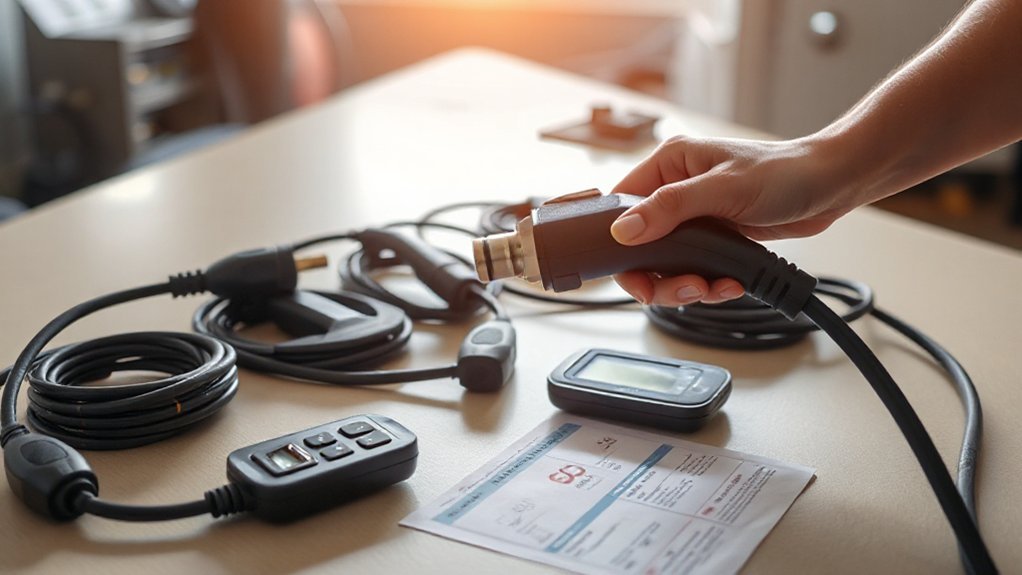
Which charger type and connector standard fit your vehicle, supply, and time-to-charge target? Start by computing required power: kW = V × A × PF ÷ 1000. For AC, limit by the lesser of circuit ampacity×0.8 and onboard charger kW. Estimate session time: hours ≈ usable_kWh ÷ (kW × η), with η≈0.90 AC, 0.95 DC. Choose L1 (120 V, 12 A≈1.4 kW), L2 (240 V, 32–80 A≈7.7–19.2 kW), or DC fast per your target hours.
Match Connector Compatibility to Vehicle Interoperability: J1772 for AC (most North American EVs), NACS for AC/DC (Tesla and adopters), CCS1 for DC combo, CHAdeMO legacy. Verify vehicle DC peak (e.g., 100–350 kW) and voltage window (e.g., 250–1000 V). Confirm cable rating ≥ peak current: Ipeak = kW ÷ Vpack.
Installation Planning, Permitting, and Safety Essentials





Before you mount hardware, quantify electrical capacity and code obligations to size, permit, and install the EVSE per NEC 625 and your AHJ. Perform a Site assessment: service rating, panel spaces, feeder length, and available fault current. Apply NEC 220; treat EVSE as a 125% continuous load to pick OCPD and conductor ampacity. Verify GFCI, grounding/bonding, working clearances (110.26), and wet-location/NEMA ratings. Limit voltage drop to ≤3% using VD=2KI L/CMA; upsize conductors as needed. Check trench depth, conduit fill and derating, and guarding. Plan Permit timelines with stamped one-line, load calc, spec sheets, and site plan. Schedule inspections and torque checks; commission with insulation and polarity tests.
- 48A EVSE requires 60A circuit.
- Verify AIC rating vs available fault.
- ADA minimum clear space; 625.17 signage.
Load Management and Smart Features for Homes and Fleets

With conductors, OCPD, and clearances set, you can now constrain EV load using code-recognized energy management. Apply NEC 220 demand calculations, then cap EVSE aggregate current so feeder ≤ calculated ampacity. Use Load Forecasting from interval data: kW_avg, kW_peak, diversity (ΣI_max × DF), and SOC windows. Implement V2G Integration under IEEE 1547/UL 1741 SA, holding export ≤ service headroom.
| Signal | Control Action | Emotion |
|---|---|---|
| Feeder ≥95% kVA | Shed lowest-priority port | Relief |
| Voltage sag >5% | Pause noncritical charging | Safety |
| TOU peak | Limit charge rate to 0.3C | Control |
| Departure imminent | Boost assigned vehicle | Confidence |
Algorithms: shed at 0.95 PF-corrected kVA; restore at 0.85. Prioritize critical departures; enforce per-port current via SAE J1772 pilot. Validate voltage drop ≤3% branch, ≤5% feeder+branch; log trips against OCPD curves. Test periodically.
Interactive Calculators: Circuit Sizing, Breakers, and Charging Time
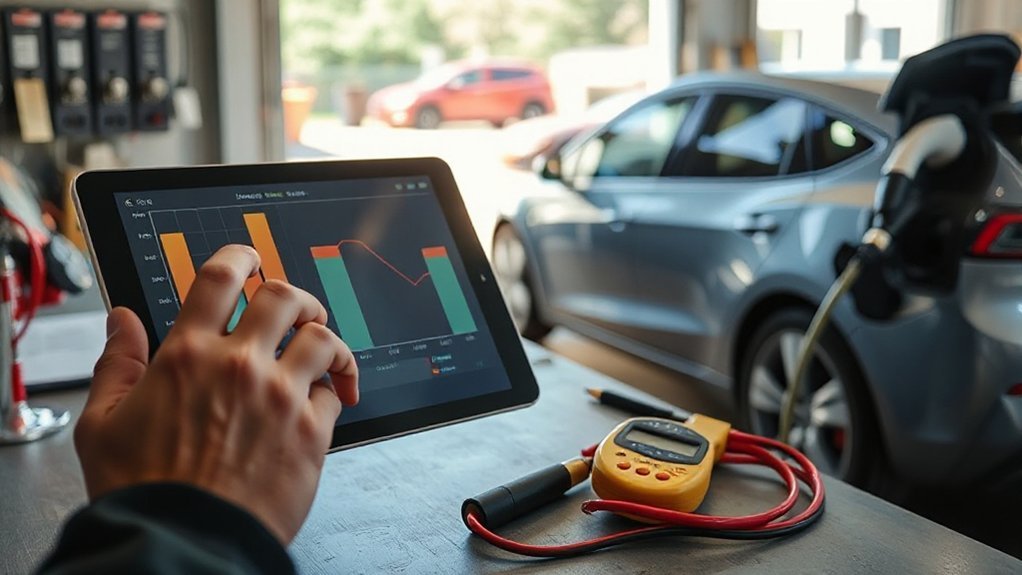
How do you quickly turn code rules into numbers you can build to? Use calculators that encode NEC 625 and Article 210. For continuous EV load, size conductors and breakers at 125% of EVSE nameplate current. Input voltage, phase, and desired charging power; the tool computes breaker rating, conductor ampacity, and voltage drop across run length. It also estimates charging time from usable battery kWh and target SOC using Unit Conversion between kW and kWh.
- Enter run length, conductor material, and temperature rating to check ampacity tables and 3%/5% voltage drop thresholds.
- Provide panel rating and diversity to flag feeder constraints and recommend derating.
- Compare single- vs three-phase and 120/240/208/480 V for Scenario Comparison of charge times and wire sizes.
Verified.
Cost Modeling: Energy Rates, Demand Charges, Incentives, and TCO

Why model EVSE costs like you size circuits—by turning every tariff and incentive into computable terms? You parameterize kWh energy charges, TOU tiers, and coincident demand charges ($/kW) by interval, then multiply by metered load profiles. Add fixed customer charges, network fees per port, and maintenance per NEC/NFPA service intervals. Model incentives as capex offsets, tax credits, or production rebates; discount them by eligibility risk. Compute TCO: NPV of capex, O&M, utility costs, and residuals using a real discount rate. Derive levelized cost per kWh = NPV(costs)/NPV(delivered kWh). Estimate payback period from cumulative cash flow. Apply depreciation schedules (MACRS/bonus) to after-tax cash flows. Stress-test elasticity: price, utilization, demand ratchets, and outage curtailments. Report sensitivities, confidence bounds, and present standardized assumptions for audits and verification.
Conclusion
You translate specs into action: pick the connector, size the circuit at 125% continuous load, verify ampacity and voltage drop, and compute charge hours with 0.90/0.95 efficiency. You model single- vs three-phase, apply TOU rates, demand charges, incentives, and total cost. You document permits, GFCI, and labeling to standards. The calculators unify it all—inputs become compliant outputs. Why guess when you can quantify, validate, and optimize every kilowatt, every breaker, every dollar, every conductor safely?