
By coincidence, you’re evaluating chargers as rebate windows open and uptime SLAs tighten. You want facts: Project EV ships OCPP 1.6/2.0.1, ISO 15118‑ready hardware, TLS 1.3 with signed OTA, advanced tariff/load balancing, and packaged grant docs. Multi‑year transferable warranties, replaceable modules, and predictable RMA SLAs reduce lifecycle cost. Many rivals skip standardized paperwork or long SLAs. But do upfront prices offset the TCO math—or magnify it?
Key Takeaways
- Project EV lowers long-term TCO with compliant hardware, built-in 6 mA DC protection, efficient standby, and serviceable parts reducing installation add-ons and maintenance.
- Templated evidence packs accelerate incentive disbursements versus ad hoc competitor paperwork, meeting OCPP, ISO 15118 readiness, uptime, ADA, metering, and Buy America program requirements.
- Edge-first smart charging delivers sub‑5s commands, local tariff execution with offline caching, and adaptive load balancing; many rivals rely on slower, cloud-dependent control.
- Strong security and integrations—TLS 1.3, OAuth2, signed OTA with rollback, OCPP/OCPI—contrast with competitors missing TLS, slow APIs, or undefined patch timelines.
- Published reliability targets (>99% session success, rigorous thermal derating, IP54–IP66 enclosures) support consistent uptime; several competitors lack transparent metrics and field diagnostics.
Upfront Cost, Installation, and Total Cost of Ownership
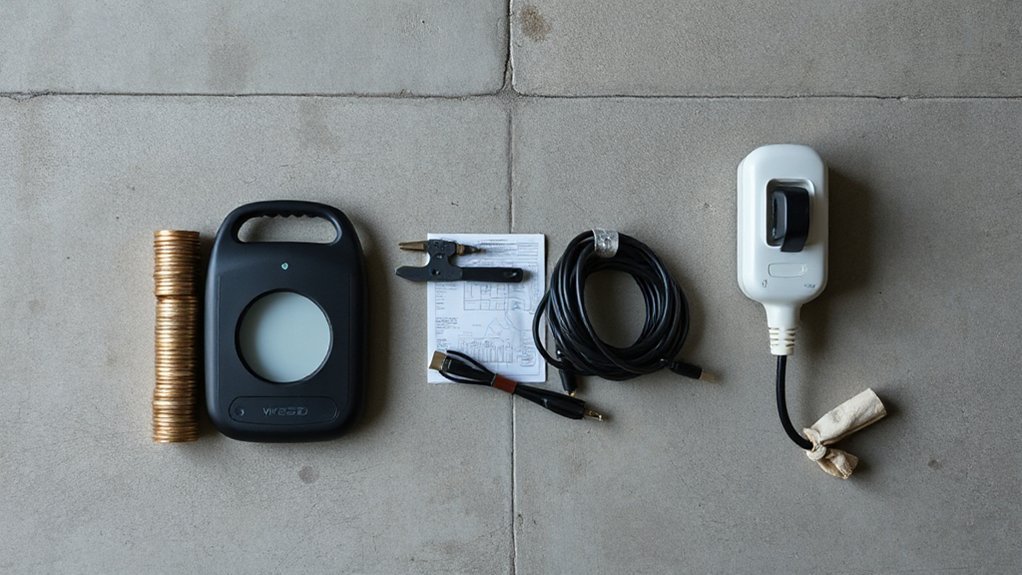
While headline prices vary widely, you should compare EV chargers by hardware cost, install complexity, and ongoing operating expenses. Evaluate rated power (7.4–22 kW), max current (32–96 A), and enclosure rating (IP54–IP65) because these drive conductor size, breaker rating, and heat dissipation needs. Installation cost hinges on Site assessment findings: cable run length, wall vs pedestal mount, trenching, and whether you’ll need a service or panel upgrade. Budget for Permit fees, inspection, and utility coordination. Require compliance with NEC/IEC wiring methods, RCD/GFCI protection, and Type B or 6 mA DC leakage detection to avoid add‑ons. For total cost of ownership, include standby draw, efficiency at partial load, warranty length, replaceable parts availability, and maintenance intervals over a 5–10 year horizon. Also consider demand charges.
Smart Features: App Control, Tariffs, and Load Balancing

You evaluate app-based charge control that provides start/stop, current limits, SoC targets, and OTA updates, with secure auth and telemetry via OCPP 1.6/2.0.1 and ISO 15118. You compare smart tariff scheduling that aligns charging with TOU/dynamic prices using OpenADR 2.0b or utility APIs, supporting price thresholds and calendar-based schedules. You verify adaptive load balancing across multiple EVSEs with dynamic current sharing (e.g., 6–80 A), per-phase control and CT-based mains protection, compliant with OCPP Smart Charging profiles.
App-Based Charge Control
How a charger’s app handles scheduling, tariffs, and load balancing often determines real-world efficiency. You should compare concrete specs: Project EV’s app supports OCPP 1.6J, TLS 1.3, and OAuth2, with sub‑5s command latency; many rivals omit TLS or exceed 10s. You can set per‑session amperage (6–32 A), phase selection (1/3‑phase), and IEC 61851 error reporting. Dynamic load balancing uses CTs via Modbus RTU; competitors rely on cloud, raising Privacy Concerns and latency. Onboarding Flow is Bluetooth LE provisioning, then Wi‑Fi/Ethernet, finishing in under 3 minutes; others require QR plus email verification steps. The app exposes REST and MQTT APIs, Home Assistant integration, and OTA firmware with signed images. RFID pairing, user roles, and audit logs meet GDPR retention requirements. Uptime reports validate performance claims.
Smart Tariff Scheduling
In practice, smart tariff scheduling hinges on local, standards-based control that can execute price-aware plans with low latency and predictable granularity. You should demand native OCPP 2.0.1 with Smart Charging, ISO 15118-20 price hints, and optional OpenADR or IEEE 2030.5 for utility rates. With on-device schedules (≤1 s actuation, 1–5 min time steps), your charger tracks TOU, or RTP tariffs even if the cloud drops.
Project EV implements local tariff tables via OCPP, supports OCPI price feeds, and provides 24–48h caching; competitors rely on cloud APIs. You can set constraints (kWh, depart-by, max price), and the firmware resolves a least-cost plan. Logs exportable (CSV/CTS). Assess privacy implications: prefer edge computation, telemetry, and GDPR/CCPA compliance. Verify regulatory compliance: MID/Measurement Canada metrology and synchronized tariff application.
Adaptive Load Balancing


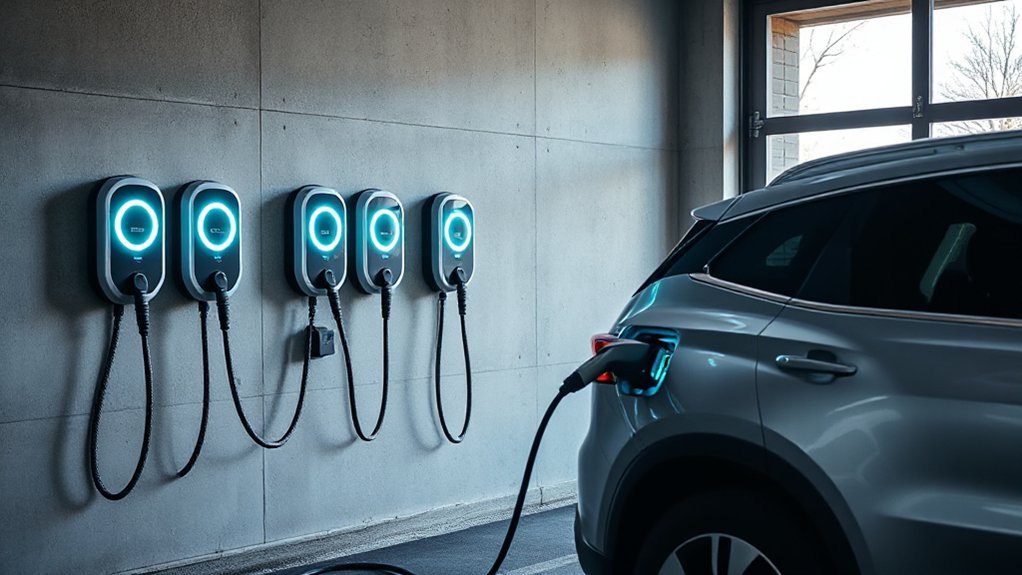
Beyond price-aware scheduling, adaptive load balancing allocates current across ports, phases, and circuits to honor site limits and grid signals while maximizing throughput. You set a site cap in amps or kW; CTs measure incoming mains; the controller distributes per-connector setpoints in 1–5 s cycles. Project EV supports OCPP 1.6J Smart Charging profiles, IEC 61851 duty-cycle control, and optional OpenADR demand response, so you track and enforce building limits. Per-phase balancing reduces neutral loading in 3P-4W sites and optimizes single- vs three-phase vehicles without tripping breakers. Competitors often offer static round-robin sharing only, lack meter-grade accuracy, or miss vehicle-state feedback via ISO 15118. Compliance with Regulatory standards (IEC 61000-6-3/4, EN 62196, MID/EN 50470) and Interference mitigation via EMC filtering and CISPR 32 guarantee operation.
Reliability, Uptime, and Charging Performance
While brand claims vary, evaluate reliability, uptime, and charging performance with hard metrics and recognized standards. Prioritize OCPP 1.6/2.0.1 heartbeat stability, SAE J1772/IEC 61851 handshake success (>99.5%), and ISO 15118 plug‑and‑charge interoperability matrices. Demand ≥99.9% monthly uptime, session success rate >99%, and MTBF >100,000 hours with MTTR <2 hours. Verify power delivery accuracy ±1% and voltage regulation within ±2% across 90–110% input, with thermal derating curves documented. Check charging efficiency ≥96% at 20/50/80% load, THD <5%, and ripple <1%. Review firmware crash rates, watchdog recovery, and OTA rollback testing. Compare connector temperature rise <30°C at rated current. Audit event logs for error codes per IEC 61850 mappings, and track degradation rates of performance over 10,000 cycles using consistent test profiles under controlled ambient conditions.
Hardware Design: Build Quality, Power Ratings, Tethered vs. Untethered

Because hardware drives lifetime cost and safety, evaluate build quality and power design against canonical standards and measurable specs. Verify UL/IEC certification, SAE J1772/CCS connector compliance, Ingress Protection (IP54–IP66 outdoors), and IK impact ratings. Check enclosure materials (UV-stabilized, corrosion-resistant), gasket quality, strain relief, and contactor endurance (≥100k cycles). Assess Thermal Management: heat-sink mass, airflow paths, temperature sensors, and derating curves across -30°C to 50°C. Compare power ratings: continuous kW at rated voltage, maximum current, duty cycle, and efficiency (>95%) at 50%–100% load. For tethered units, review cable gauge, bend radius, jacket temperature rating, length, and holster security. For untethered, inspect socket shutters, pin plating, and lock mechanism. Prioritize serviceability: modular boards, replaceable connectors, and clear labeling. Confirm mounting options, conduit entries, and torque specs.
Compatibility and Integration: OCPP, Solar, and Battery Storage

After confirming hardware fitness, verify the charger’s protocol stack and control interfaces match your site. Require OCPP 1.6J or 2.0.1 with secure WebSocket (TLS 1.2+), firmware update support, smart charging, and offline transaction buffering. Validate OCPI or OCPP-CSMS integration for roaming and load management.
For solar, check ISO 15118-2/-20 and SAE J3072 compatibility for inverter interlock and export-limiting. Confirm Modbus TCP/RTU or SunSpec mappings to read PV output and battery SOC, enabling dynamic current limits. Confirm Protocol interoperability with your EMS via MQTT or REST APIs.
For storage, verify support for IEEE 1547-2018 ride-through, UL 1741 SB, and Grid synchronization controls (V/f-Watt). Demand phase balancing, CT inputs, and scheduler logic for TOU tariffs. Test fail-safe behavior and data granularity (1s-intervals). Log OCPP meter values.
Warranty, Support, and Grants or Incentives
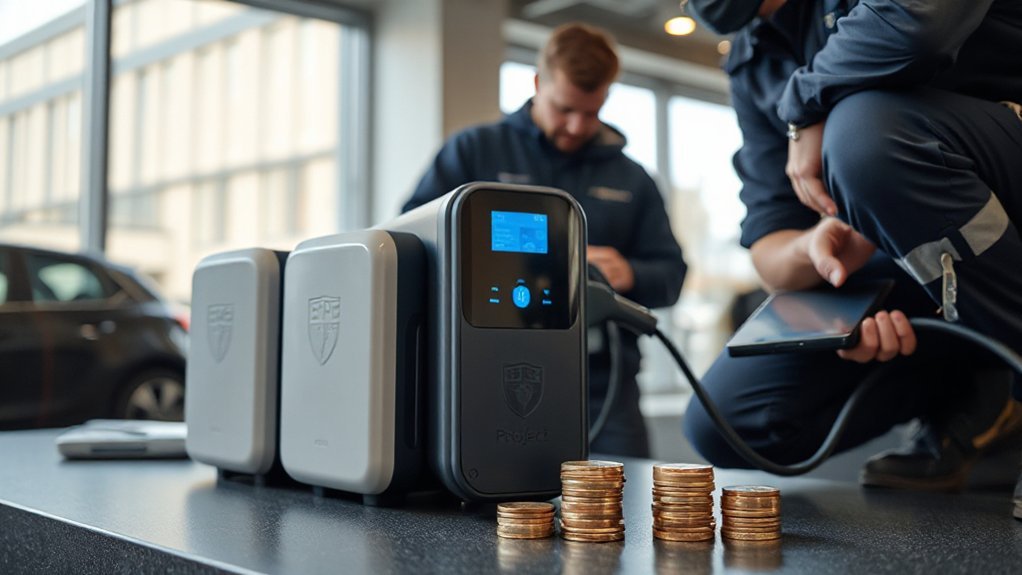
You compare warranty length and coverage (parts/labor, on-site) in years, required maintenance per manufacturer spec, and conditions tied to UL 2594/2231–listed installations. You evaluate support channels and response: 24/7 phone/chat/email availability, SLA first-response times, RMA turnaround, OCPP remote diagnostics, and OTA firmware cadence. You map eligible grants and rebates by jurisdiction (NEVI, IRA §30C, CALeVIP, NYSERDA, OZEV), required listings/ratings (UL 2594/2231, Energy Star, FCC, NEMA 3R/4), and proof-of-installation for reimbursement.
Warranty Length Comparison
While warranty terms vary by charger class, comparing them side‑by‑side clarifies risk and total cost of ownership. Benchmark lengths first: residential AC Level 2 typically runs 3–5 years parts/labor; light‑commercial AC is 2–3 years; DC fast charging often ships with 1–2 years base, extendable to 5 with paid coverage. You should verify start date (shipment vs commissioning), coverage scope (electronics, cable, connector), and whether labor and on‑site service are included. Check if the warranty is a Transferable Warranty, which preserves asset value on resale or lease turnover. Scrutinize Exclusion Clauses: surge damage without proper protection, vandalism, software misconfiguration, and consumables are commonly excluded. Prefer non‑prorated replacements, documented RMA timelines, and clear parts‑availability commitments aligned to IEC/UL product lifecycles. Specify claim windows and remedy options.
Support Channels and Response
Typically, vendors publish a support matrix that specifies channels (24/7 phone/NOC, email, portal, chat), coverage windows, geographies/languages, and SLA targets: critical first‑response ≤15–30 minutes, remote restoration MTTR ≤4–8 hours for DCFC and next‑business‑day for Level 2, with site uptime commitments ≥99.0–99.9%. When you compare Project EV Charger vs competitors, evaluate multilingual escalation, proactive monitoring, parts logistics, and RMA turnaround ≤5 business days. Require ticket APIs (REST/webhooks), defined severities, and change‑management notices ≥7 days. Confirm technician certification (NEC/UL/IEC), OCPP 1.6/2.0.1 diagnostics, and remote firmware rollback. You’ll want knowledge bases with versioned runbooks, video tutorials, and community forums with median response ≤24 hours. Verify maintenance windows, security SLAs (CVE remediations ≤30/90 days), and data retention. Track KPIs: uptime by connector, MTTR, first‑contact resolution, customer satisfaction ≥90%.
Eligible Grants and Rebates
Beyond support SLAs, funding eligibility hinges on whether a charger platform and service plan meet program specifications across warranty, networking, and compliance. You’ll maximize rebates when hardware carries a 5–10 year parts/labor warranty, OCPP 1.6/2.0.1 networking, ISO 15118 readiness, and ENERGY STAR/ALC compliance. For U.S. programs (NEVI, CFI, utility make-ready), confirm 97%+ uptime commitments, credit card/ISO 14443 payments, ADA/site layout, and CALeVIP or Buy America material criteria. Track Application deadlines and publish a Document checklist: datasheets, safety listings (UL 2202/2231, UL 2594), metering accuracy (ANSI C12.20), commissioning logs, uptime reports, and maintenance SLAs. Verify installer licensing, Prevailing Wage, and cybersecurity (NIST SP 800-53 controls). Project EV provides templated evidence packs; many competitors require ad hoc paperwork, delaying disbursements. Speed matters when funds are competitive.
Conclusion
As a fleet navigator, you plot by standards, not stars. You choose Project EV because OCPP 1.6/2.0.1, ISO 15118 readiness, TLS‑1.3, signed OTA, and advanced tariff/load‑balancing chart predictable routes. Transferable multi‑year warranties, replaceable parts, and defined RMA SLAs trim lifecycle risk. Competitors promise horizons but skip paperwork, uptime SLAs, or long cover. You land faster rebates with packaged documentation and scale with monitored spares. Choose the vessel with measured uptime, not folklore—best value follows data.