
You size a solar EV charger by your driving and local sun: convert miles to kWh (typical EV 250–350 Wh/mi plus ~10% charging losses), divide by peak sun hours and ~0.75 system factor, then by panel wattage. Cross-check NEC 690/705 limits, breaker sizing, and UL 1741/IEEE 1547 equipment. Account for winter PSH and TOU tariffs. Want a right-sized array that supports your charge schedule and stays code-compliant? Here’s how to compute it.
Key Takeaways
- Determine daily EV energy: miles × Wh/mi ÷ wall-to-battery efficiency, then add 10–25% margin for weather, aging, and variability.
- Size array: kWdc = daily kWh ÷ (winter PSH × 0.72–0.80); e.g., 12 kWh, 5 PSH, 0.75 → ~3.2 kWdc.
- Panels needed = kWdc ÷ module watts; e.g., 3.2 kWdc with 425 W modules ≈ 8–9 panels, adjusted for azimuth, tilt, and shading.
- Plan charging to align with midday solar and TOU tariffs; export limits and net-metering rules may constrain array size or benefits.
- For nightly charging without sun, add batteries sized to nightly EV kWh load × 1.1–1.2, considering round-trip efficiency and cost.
Start With Your Driving: Miles and Days per Week
How many miles do you actually drive, and on which days? For one month, log every trip: start/stop odometer, date (ISO 8601), day of week, purpose, and round‑trip routing. Don’t record while moving—NHTSA distraction guidance—capture data only when parked. Summarize weekly totals, median daily miles, and 95th‑percentile day to bound variability. Map commute patterns and use trip clustering to separate routine workdays from errands and outliers. Count driving days per week and identify consecutive non‑driving days, which can accommodate deferred charging. Verify readings against your vehicle’s trip computer; reconcile discrepancies. Note seasonal shifts (school year, weather) and rare long trips as separate categories. Maintain data integrity with timestamps and photos. This baseline informs realistic planning and safe scheduling under typical household and workplace constraints.
Convert Miles to Energy: Kwh Needed per Day
Convert your logged miles into daily energy demand by multiplying each day’s miles by your EV’s energy use (Wh/mi), then dividing by wall-to-battery efficiency to get kWh from the outlet. Use Unit conversions consistently: Wh ÷ 1000 = kWh; miles × Wh/mi = Wh. Example: 32 mi × 260 Wh/mi = 8.32 kWh; at 92% efficiency, 8.32/0.92 = 9.04 kWh from the wall. Apply a Reserve margin (10–25%) for weather, aging, and schedule variability: 9.04 × 1.2 ≈ 10.85 kWh/day. Reference data: odometer logs, telematics, or SAE J1711-like energy use metrics. Document assumptions. For safety and code coordination (NEC Article 625, IEC 61851), round up to the next kWh and verify your branch-circuit capacity and labeling compliance requirements before sizing PV generation and storage.
Factor In Vehicle Efficiency and Charging Losses
With your daily kWh-from-the-wall estimate in hand, account for vehicle efficiency variability and charging losses before sizing PV and storage. Apply well-documented ranges: onboard charger 90–96% (SAE J1772/IEC 61851), Inverter efficiency 96–99%, cable/connector 1–3% loss. Multiply these to get net wall-to-pack. Add 5–15% margin for Battery degradation and cold/thermal limits. For code compliance and safety, design per NEC 625 continuous-load rules—size EVSE circuits at 125%—and follow manufacturer temperature derating.
| Stage | Typical efficiency | Notes |
|---|---|---|
| PV inverter | 0.96–0.99 | UL 1741 listed |
| EVSE + onboard charger | 0.88–0.95 | varies with amperage |
| Wall-to-pack net | 0.84–0.93 | includes cabling loss |
Example: if inverter is 0.98 and charger is 0.92 with 2% cabling loss, your wall-to-pack is 0.98×0.92×0.98 ≈ 0.88; divide kWh-by-0.88. Verify conductor temperature ratings and terminations per UL manufacturer specs.
Local Sun Hours and Seasonal Variability
You’ll quantify peak sun hours (PSH) as the daily irradiance equivalent at 1 kW/m² (kWh/m²·day), using NREL PVWatts/TMY data and IEC 61724 performance metrics. Expect seasonal production swings of ~30–70% between summer and winter by latitude; model monthly PSH and don’t plan off the annual average—use the winter 10th percentile. For safety and compliance, size conductors, OCPD, and interconnection for worst-case current and temperature per NEC 690/705, and cap EV charge rates so low winter output doesn’t cause overloads or battery stress.
Peak Sun Hours Explained
Why does a site’s “peak sun hours” (PSH) matter for EV charging design? PSH converts variable irradiance into equivalent hours at 1 kW/m², so you can size arrays to meet kWh demand. Its definition origins trace to NREL and AM1.5 reference spectra (ASTM G173); common measurement standards include IEC 61724 for performance monitoring and ISO 9060 for sensor class. Use verified PSH to back-calculate PV capacity, then validate against NEC 625/690 for conductor ampacity, OCPD, and temperature corrections.
Calibrate pyranometers annually and log data at 1-minute resolution per IEC 61724, minimum.


Assume 85% DC-to-AC system efficiency:
| PSH (h) | Array kW for 20 kWh/day |
|---|---|
| 3 | 7.8 |
| 4 | 5.8 |
| 5 | 4.7 |
Document assumptions, include shading studies, apply arc-fault protection, and use lockout/tagout during commissioning.
Seasonal Production Swings
PSH anchors array sizing, but month-to-month “local sun hours” can swing ±30–60% at mid‑latitudes, shifting daily EV kWh yield and charger availability. Use TMY or NSRDB data to chart monthly PSH, then model inverter clipping, temperature effects, and albedo. In winter, lower irradiance and higher airmass cut PV output 25–50%; short days compress charging windows. Cold boosts module efficiency ~0.4–0.5%/°C below STC, but snow accumulation and shading can drop production to near zero until cleared. Plan array tilt and snow guards per ASCE 7 and local codes; verify clearances and OCPD per NEC 690/705. Size storage or grid import for worst‑month demand: cover your EV’s daily kWh plus 20–30% margin. Log performance to IEC 61724‑1 and adjust EVSE current limits accordingly during low irradiance.
From Kwh to Panels: Sizing by Panel Wattage
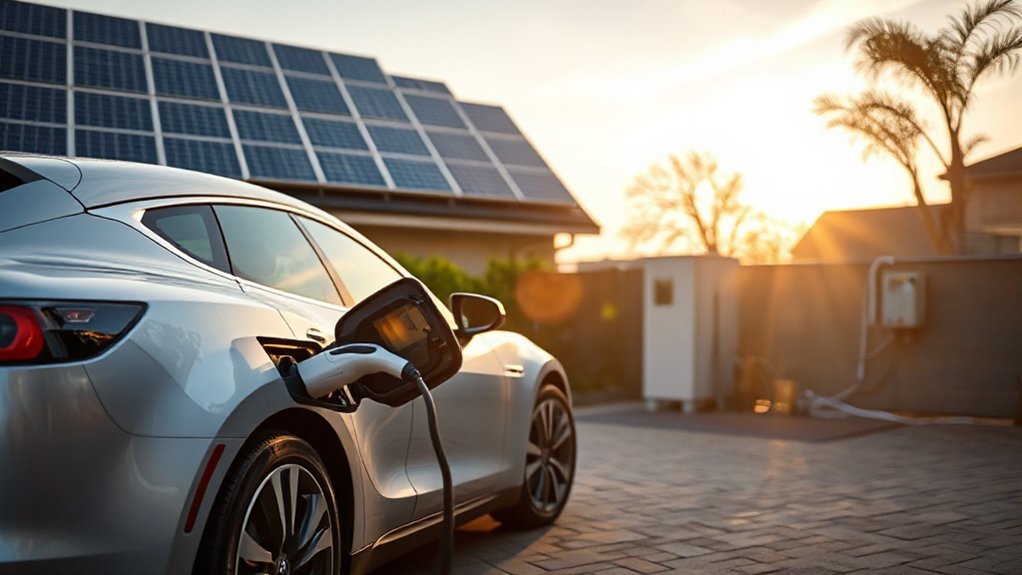
While your EV’s daily kWh target anchors the design, convert that energy into an array size by dividing by site peak sun hours (PSH) and a conservative system efficiency, then translate to module count using nameplate watts corrected for real-world output. Use: array kWdc = kWh ÷ (PSH × ηsystem). Assume ηsystem of 0.72–0.80 per NREL derates and NEC 690 allowances. Correct each module’s STC watts for temperature coefficient and nameplate accuracy; account for manufacturing variability verified under IEC 61215/61730. Example: 12 kWh, 5 PSH, 0.75 → 3.2 kWdc. With 425 W modules and a 0.90 correction, count = 3.2 ÷ (0.425 × 0.90) ≈ 8.4 → specify 9. Check inverter DC/AC ratio, UL 1741 listing, conductor ampacity, and OCPD for safe operation limits.
Roof Orientation, Shading, and Real-World Production
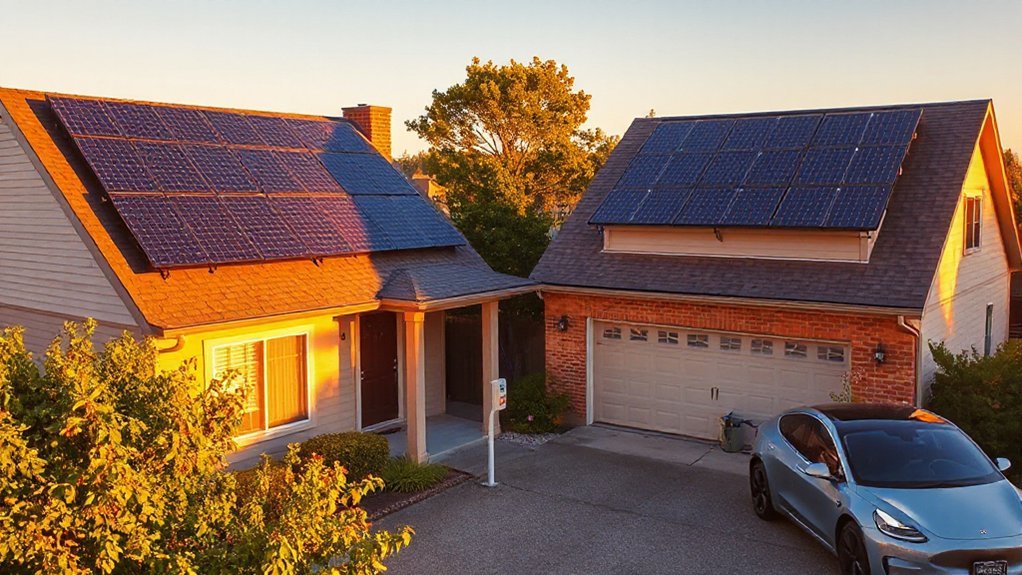
Because roof azimuth, tilt, and shade govern kWh yield more than nameplate watts, site and model the array to maximize plane-of-array (POA) irradiance and minimize losses. Use Shade mapping (fisheye photos, LiDAR) to quantify hourly obstruction; even 10% shade can cut annual output 12–15% without module-level power electronics. Target azimuth within ±15° of south and tilt near latitude for winter-biased EV charging. Validate with TMY data and IEC 61724 performance ratios. Respect NEC 690 clearances, 690.12 rapid shutdown, and fire-access pathways; string voltage must stay within inverter MPPT windows across -10 to 50°C. Balance Installation aesthetics with row spacing to curb self-shade and soiling.
- Safety first—protect life and property. Always.
- Accuracy matters—trust measurements. Calibrate annually.
- Beauty counts—own your roof. Neighbors notice.
Level 1 vs. Level 2: Charging Speed and Home Electrical Limits
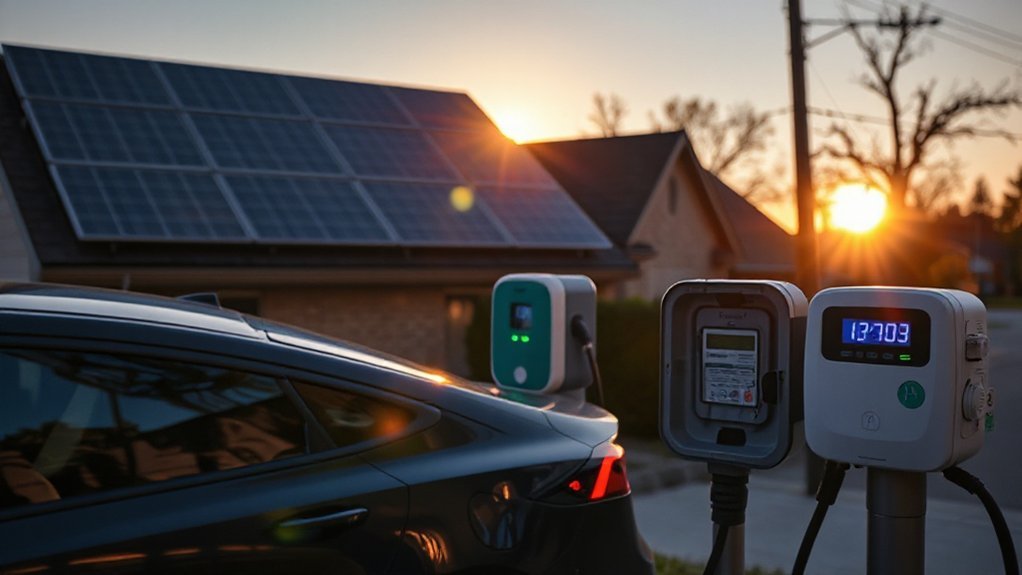
Even before you compare charging speeds, match the EVSE to your home’s capacity and code requirements. Level 1 uses 120 V at 12–16 A (1.4–1.9 kW), adding roughly 3–5 miles/hour. Level 2 uses 240 V at 16–48 A (3.8–11.5 kW), delivering ~12–40 miles/hour. Per NEC 625, EV charging is a continuous load; size the branch circuit at 125% of the EVSE rating (the 80% rule). Typical pairs: 12 A on 15 A, 16 A on 20 A, 32 A on 40 A, 48 A on 60 A, with GFCI and a dedicated circuit. Verify service capacity (100 A vs 200 A) via an NEC 220 load calculation. Budget for permits, Charger Costs, and Circuit Upgrades or panel upgrades. Prioritize labeling, ventilation clearances, and inspection.
Utility Rules: Time-of-Use, Net Metering, and Export Limits
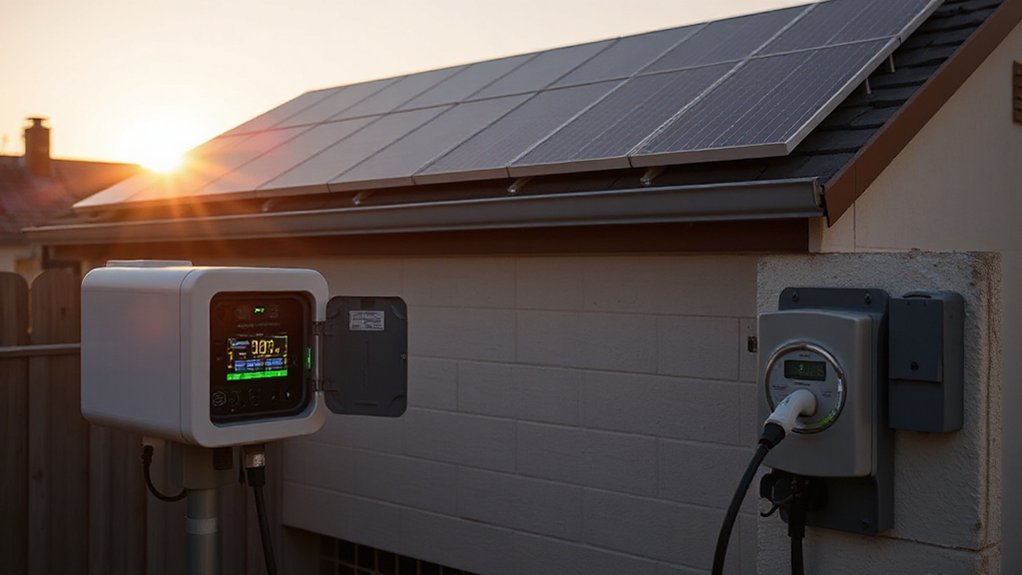
How do your tariff and interconnection rules shape when you charge and what your solar can push to the grid? Time-of-Use (TOU) rates often swing from 12–20¢/kWh off-peak to 35–60¢/kWh on-peak; program your EVSE to prioritize midday solar and avoid peak. Net metering may credit exports at retail, wholesale, or an avoided-cost adder—verify crediting granularity (15‑min vs hourly) to prevent billing disputes. Export limits under IEEE 1547 and UL 1741 SA, enforced via your utility interconnection, can cap backfeed (e.g., 10 kW or 100% of service rating per NEC 705.12). Confirm demand charges on whole-house meters; a brief 10–15 kW spike can dominate your bill.
Let tariffs steer charging: chase midday solar, mind TOU swings, crediting granularity, export caps, and demand spikes.
- Feel relief: schedule TOU, save monthly.
- Protect crews: anti-islanding engaged, sleep easy.
- Avoid penalties: set export limit smartly.
When to Add Batteries for Night Charging and Backup
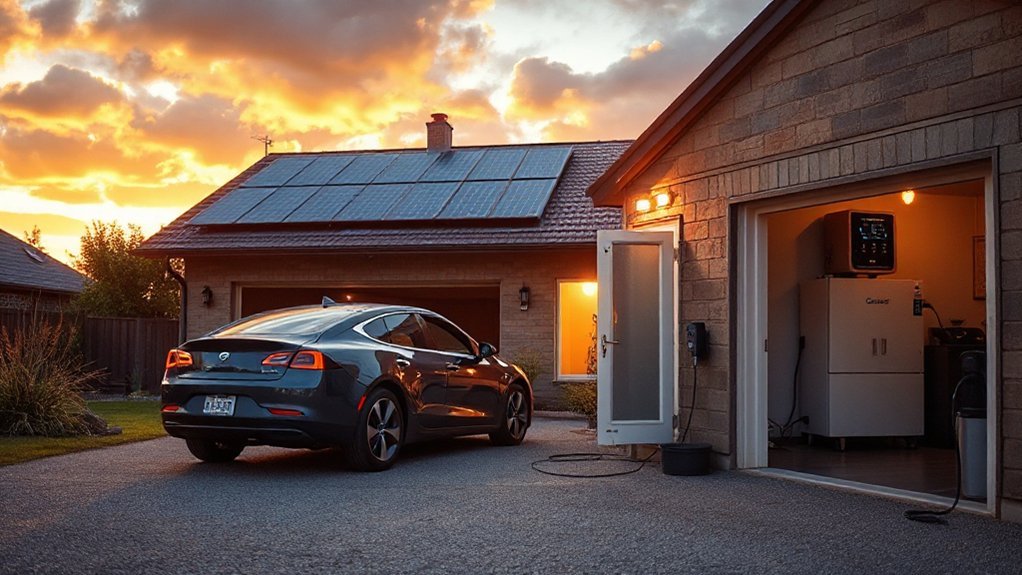
When do batteries pencil out for night charging and backup? Start by quantifying your nightly EV load: e.g., 8 kWh for 25 miles at 0.32 kWh/mi. Size storage so usable capacity (kWh × depth-of-discharge × round‑trip efficiency ~0.9) covers that plus 10–20% margin. If TOU spread ≥$0.20/kWh, cycling nightly can offset costs; compute levelized cost per delivered kWh = installed $/kWh ÷ warranted cycles × round‑trip efficiency.
For blackout needs, define backup duration: 8–24 hours for critical loads and EV trickle at 1.4 kW. A 10 kWh LFP battery yields ~7–8 kWh usable.
Specify systems certified to UL 9540/9540A, IEEE 1547, and compliant with NEC 705/706, with transfer switch and rapid shutdown. Chemistry comparison: prefer LFP for safety, cycle life, and temperature tolerance.
Future-Proofing for a Second EV and Home Load Growth
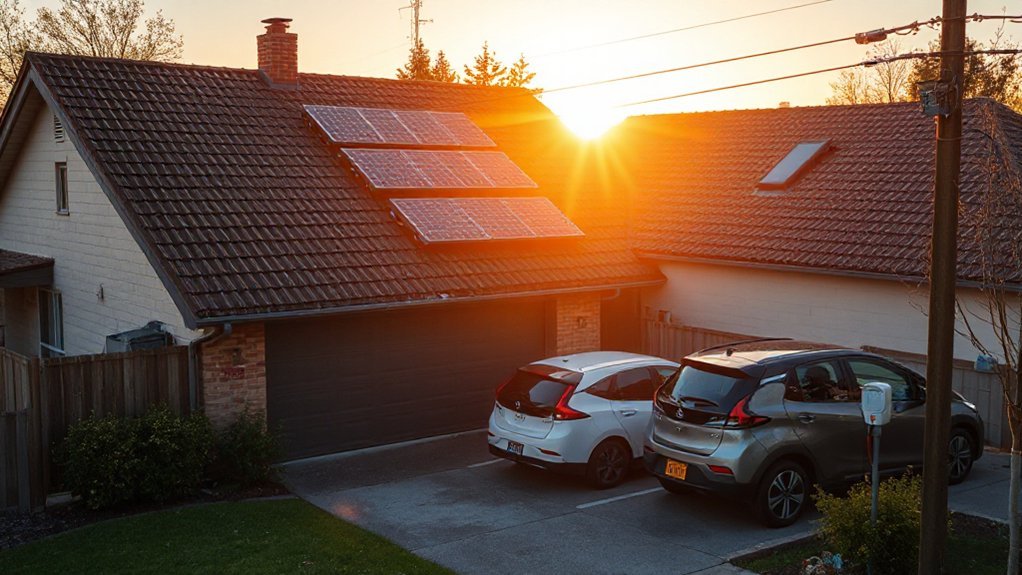
Plan for a second EV and rising household loads while you size solar and storage so you don’t rebuild later. Estimate future demand: a second EV at 30–40 kWh/day, heat pump +5–10 kWh/day, and appliance upgrades. Upsize array and inverter now (NEC 705), and spec EVSE to NEC 625. Model annual energy with PVWatts; target 110–130% of today’s use if roof allows. Choose storage and PCS certified to UL 1741/IEEE 1547 for export safety. Coordinate the Permitting Process early and verify service capacity with NEC load calculations; plan a 200–320 A upgrade if needed. Use Incentive Programs before they sunset.
- Avoid regret—cover school runs, storms, and rate hikes.
- Protect loved ones—safer, code-compliant power.
- Feel proud—net-zero ready for your growing electric life.
Conclusion
Now you can chart your solar EV course with a calibrated compass: translate miles to kWh (250–350 Wh/mi), divide by peak sun hours and 0.72–0.80 efficiency, then size panels by wattage. Validate loads, breaker ratings, and conductors per NEC 625/690, UL 1741/9540, and IEEE 1547. Plan winter PSH, export limits, and TOU rates. Use licensed pros, permits, rapid-shutdown, AFCI/GFCI, and derating. Size for today, leave roof for tomorrow—your driveway becomes a quiet, sun-fed fuel dock.