
Measure twice, cut once: you plan a solar EV charging station with NEC-compliant wiring, proper load calculations, and utility interconnection from day one. You assess site shading, soil, and wind loads, size PV and inverters to EVSE demand, and decide Level 2 vs DCFC based on capacity and demand charges. You evaluate canopies, trenching paths, and optional batteries for resilience—then you quantify costs, incentives, and risks that change the design—
Key Takeaways
- Decide Level 2 (3–19 kW) or DC fast (50–350 kW); design PV→inverter/EVSE, protection, grounding, metering, and controls per NEC/UL standards.
- Assess site loads and solar: log charging demand, build 15‑minute profiles, size PV/ESS, conduct shading, voltage‑drop, and interconnection checks.
- Electrical scope: verify service capacity; DCFC often needs new transformer and 480 V three‑phase; include GFCI, rapid shutdown, lockable disconnects.
- Permits and interconnection: submit sealed plans, product cut sheets, IEEE 1547 settings; expect studies, inspections, and PTO over weeks to months.
- Budget: Level 2 $3k–$12k/port; DCFC $80k–$250k+ each; PV $2–$6/W (canopies higher); storage $400–$800/kWh; incentives can reduce costs ~30%+.
How Solar EV Charging Works

Begin with a PV array converting solar irradiance to DC, routed through MPPT charge hardware and appropriate overcurrent protection. At the module level, photon absorption across semiconductor bandgaps generates current; string wiring feeds a combiner, then a DC disconnect. You land conductors on a listed charge controller or DC-DC stage, verify polarity, and size OCPD per NEC 690. For AC Level 2, a grid-tied inverter provides isolated, grounded AC to the EVSE; for DC fast charging, a galvanically isolated DC supply regulates pack voltage and current. Implement equipment grounding, bonding, and surge protection. Provide rapid shutdown, GFCI, and lockable disconnects. The EVSE manages pilot signaling, metering, and temperature limits, while the controller enforces SOC targets and safe charge profiles and logs events for compliance.
Site Assessment and Load Analysis

Evaluating the site starts with quantifying EV charging demand and available electrical capacity. You’ll log arrival patterns, dwell times, and peak concurrency to build a 15‑minute load profile. Verify service rating, main OCPD, feeder ampacity, and spare breaker spaces. Perform short‑circuit and voltage‑drop calculations, confirm equipment SCCR, and review grounding and bonding per NEC Articles 250, 625, and 110. Coordinate utility transformer capacity. Conduct shadow mapping for canopy/roof, and perform access auditing for ADA and egress.
Quantify EV demand, build 15‑minute load profiles, verify capacity, protection, NEC compliance, utility coordination, shading, and ADA access.
- Document parking circulation, queuing, and safety setbacks; locate pedestals to avoid impact zones, snow push, and plow paths.
- Evaluate soil, wind, and seismic loads for foundations; verify clearances, working space, and arc‑flash labeling.
- Plan trench routes, one‑call locates, drainage, and lighting; assess communications for networked EVSE and OCPP.
Sizing the Solar Array for EV Demand
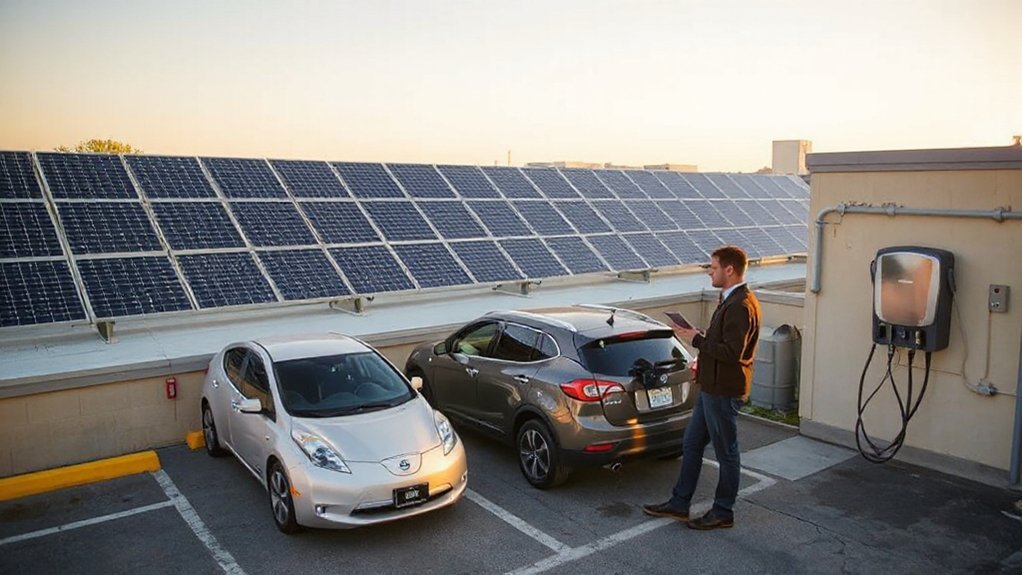
How do you translate the 15-minute EV load profile into a PV array size that’s safe, code‑compliant, and matched to charging behavior? Start by converting interval kW to daily kWh by season, then map it to plane‑of‑array irradiance and expected PV yield. Apply NEC continuous-load sizing: treat charging as continuous; size conductors, OCPD, and inverter outputs at 125% of maximum coincident PV backfeed. Use behavioral modeling to align peak arrival windows with solar production, minimizing curtailment. Run sensitivity analysis on weather variability, soiling, degradation, and expansion scenarios. Select a DC/AC ratio that clips no more than your risk target while keeping voltage windows within inverter limits. Verify interconnection limits under NEC 705 and utility rules. Document assumptions and reserve margins for safety and reliability.
Choosing Between Level 2 and DC Fast Charging

You must weigh charging speed: Level 2 delivers about 3–19 kW for hours-long charging, while DC fast charging supplies 50–350 kW for rapid sessions. For installation, you’ll size conductors and protection per NEC 625 and 220—Level 2 uses a dedicated 240 V circuit, whereas DCFC often needs 480 V three-phase, new switchgear, and utility interconnection. Account for equipment, trenching, transformers, and demand charges, and specify UL-listed hardware, required GFCI/AFCI and OCPD, with commissioning approved by the AHJ.
Charging Speed Comparison
When should you spec Level 2 versus DC fast charging for a solar EV site? Use dwell time, vehicle mix, and battery acceptance as primary selectors. Level 2 delivers 7–19 kW for 2–8 hour stops; DC fast offers 50–350 kW for 15–45 minute sessions, but many cars cap rates or trigger Thermal Throttling. Align inverter output and storage with peak kW and apply NEC load calcs and OCPD coordination.
- Level 2 fits workplaces and depots; it maximizes solar use and limits peak stress.
- DC fast fits corridors and turnarounds; verify connector standards and cable cooling.
- Mixed sites need dynamic load management and SOC-aware queuing to enforce Charging Etiquette.
Prioritize safety: labeled disconnects, ground-fault protection, cord management, and traffic clearances. Always.
Installation and Costs
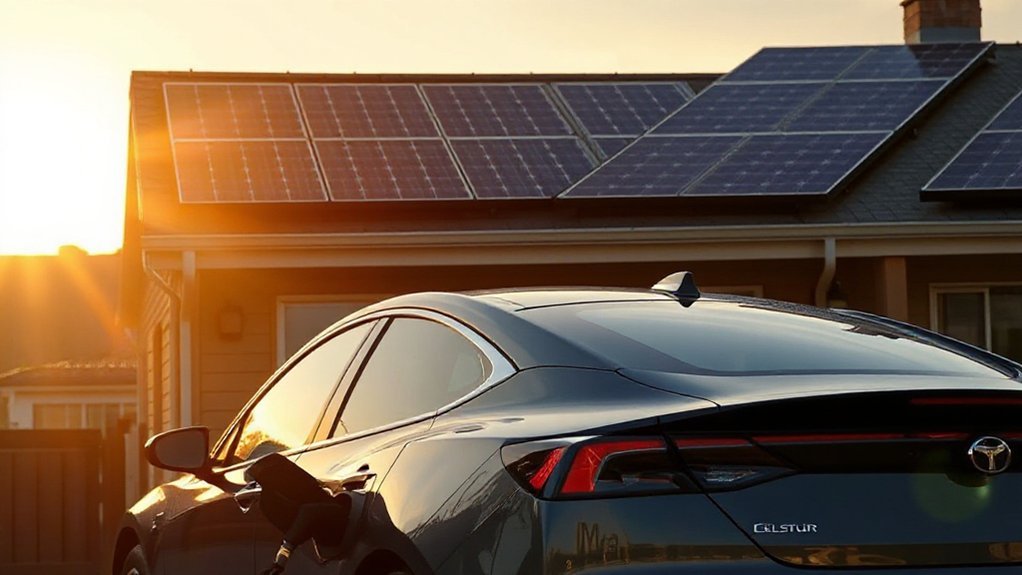


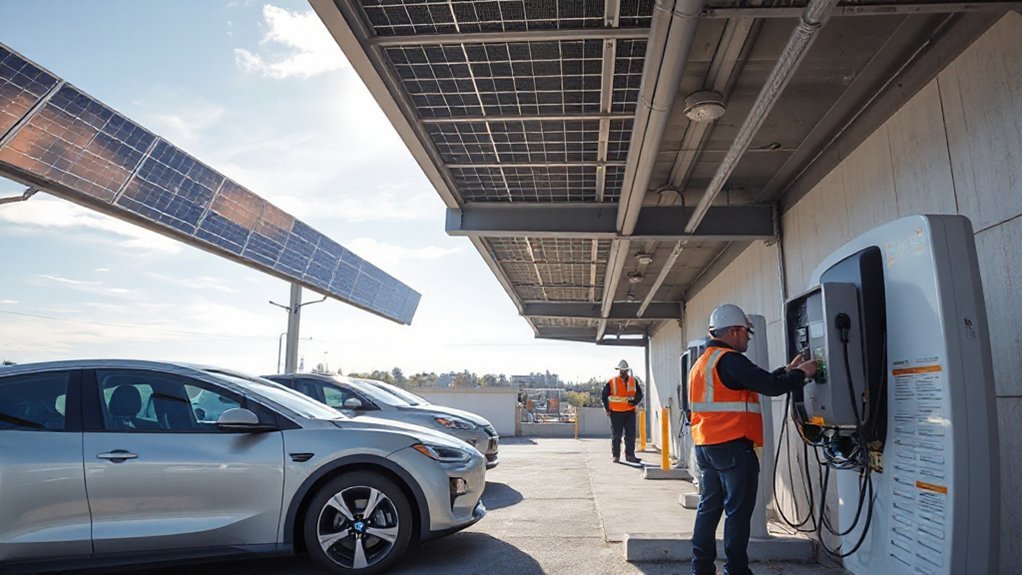
Having matched charging speed to dwell time and vehicle mix, the install and cost profile comes into focus: Level 2 favors lighter infrastructure, while DC fast demands utility-grade capacity and thermal management. For Level 2, plan 208/240 V circuits, load calculations per NEC 220, raceway sizing, GFCI where required, and bollard protection. Expect modest trenching, panel upgrades, and OCPD coordination.
For DC fast, budget new service, dedicated transformer, switchgear, ventilation clearance, and continuous-duty cooling. Coordinate utility interconnection, short-circuit ratings, arc-flash labeling, grounding, and commissioning. Mitigate demand charges with solar, storage, and smart load management. Include signage, lighting, ADA access, and networked monitoring. Obtain permits and inspections early. Perform contractor vetting, verify bonding, and require as-built drawings. Prioritize warranty negotiation, parts availability, and uptime SLAs.
Grid-Tied Vs Battery-Backed System Designs
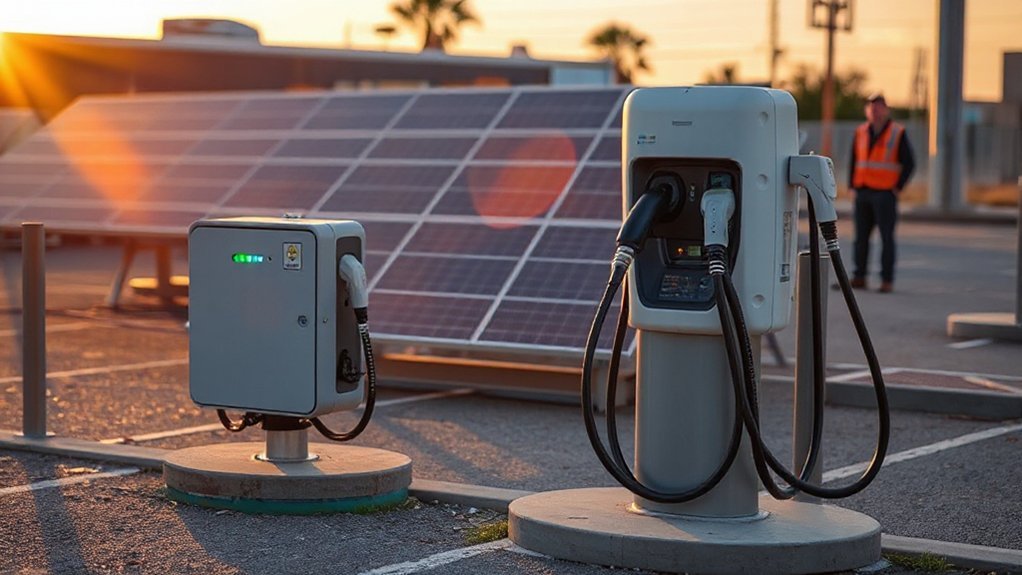
While both architectures can charge vehicles from PV, grid-tied and battery‑backed designs differ fundamentally in topology, interconnection, and safety requirements. In grid-tied systems, you route PV through UL 1741 SA inverters to the service panel; anti‑islanding, rapid shutdown, and IEEE 1547 settings protect workers and the utility. Battery‑backed systems add an ESS, transfer equipment, and islanding logic, demanding UL 9540/9540A compliance, ventilation, and robust thermal management to limit cycle degradation and fire risk.
- Choose grid‑tied when the site has reliable utility service and you need simple NEC Article 690/705 interconnection.
- Choose battery‑backed when resilience, demand shaving, or TOU optimization matter; design for fault‑current limits and clearances.
- In both cases, provide labeled disconnects, grounding, surge protection, and EVSE load management, operator signage.
Equipment, Labor, and Soft Cost Breakdown
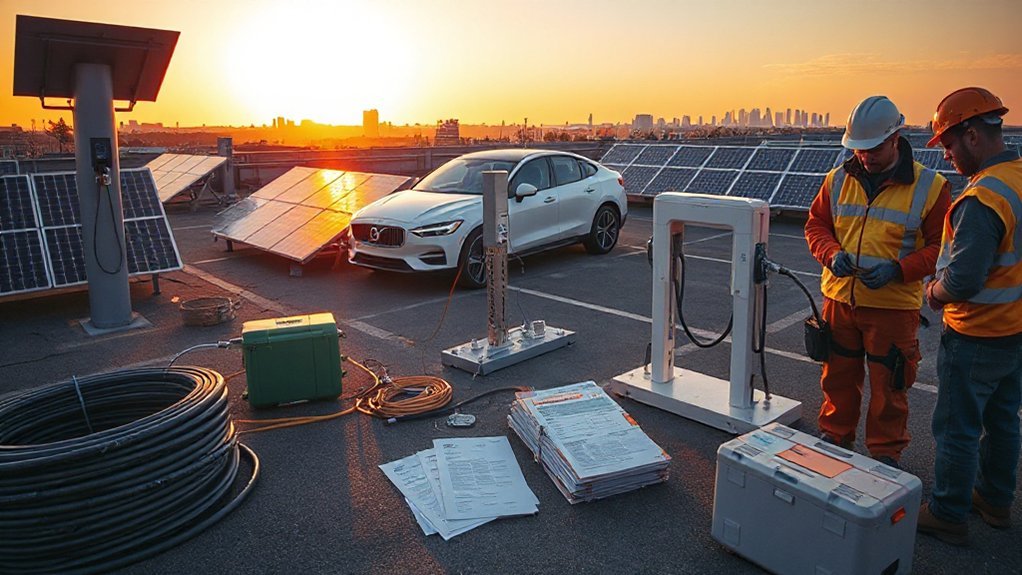
With your system topology selected, the budget breaks into three buckets: equipment, labor, and soft costs. Equipment includes PV modules, UL 2703 racking, inverters, Level 2 or DC fast chargers, switchgear, transformers, conductors, NRTL‑listed protection, metering, network gateways, bollards, and canopy steel. Specify NEC-compliant grounding, surge protection, and labeling. Labor covers layout, trenching, concrete, steel erection, conduit/pull, terminations, torqueing, insulation resistance tests, functional checks, commissioning, and arc‑flash labeling, performed by licensed electricians following NFPA 70E. Soft costs span stamped engineering, load studies, short‑circuit/coordination analysis, as‑builts, O&M manuals, training, monitoring subscriptions, warranty administration, project management, bonding, financing, and Insurance premiums. Model asset life and Depreciation schedules to forecast Levelized Cost of Charging and plan spares for fuses, contactors, and communication modules, cables, labels, and signage.
Permits, Interconnection, and Incentive Stacking

You’ll start with a local permitting checklist aligned to NEC, IBC/IFC, ADA, and zoning, confirming stamped plans, one-line diagrams, load calculations, structural anchorage, fire setbacks, and compliant signage. You’ll manage the utility interconnection process by selecting the correct tariff/tier, submitting fault-current and anti-islanding data, protection settings, and commissioning tests to guarantee safe parallel operation. Finally, you’ll build an incentive stacking strategy that sequences ITC, MACRS, state rebates, utility make-ready funds, and LCFS/NEVI grants without double-dipping, while meeting prevailing wage, domestic content, and Buy America requirements.
Local Permitting Checklist
How do you turn a solar EV charging concept into a code-compliant, utility-ready site? Use a local permitting checklist aligned with NEC, IBC, IFC, and local amendments.
- Site and zoning: verify use, setbacks, parking counts, ADA paths, historic districts, neighbor notifications.
- Structural/electrical plans: sealed drawings, array anchorage, canopy wind/seismic, conductor sizing, OCPD, grounding, labeling per NEC 690/625.
- Civil/fire: trenching plan, one-line and site plan, clearances, bollards, fire lane access, PV rapid shutdown signage, lighting photometrics.
Submit permit applications, contractor licenses, product cut sheets, and equipment certifications; schedule inspections for footing, electrical rough-in, and final. Confirm bonding of EVSE pedestals, arc-fault protection where required, tamper-resistant receptacles for ancillary loads, and compliant accessibility signage; document deviations with AHJ-approved alternatives to guarantee life-safety and plan-review approval fast.
Utility Interconnection Process
After securing local permits and stamped plans, initiate the utility interconnection track required to energize the PV and EVSE safely and legally. Submit the interconnection application with single-line diagrams, equipment data sheets, fault-current and load calculations, and a site plan. Specify inverter certification (UL 1741 SA/IEEE 1547), relay settings, metering, and proposed EVSE nameplate. Request a service review for transformer capacity and any required upgrade. Align Timeline expectations early; utility studies and PTO can span weeks to months. Coordinate a protection study, export limits, and IEEE 1547 settings per utility standards. Plan a commissioning checklist, utility witness test, and labeling per NEC and NFPA 70E. Drive Stakeholder coordination among the utility, AHJ, engineer, installer, and EVSE vendor to maintain safety and compliance throughout construction.
Incentive Stacking Strategy
While permits and interconnection move forward, build an incentive stack that sequences federal, state, and utility programs without triggering basis conflicts or double‑dipping. Map eligibility windows, prevailing-wage rules, domestic content adders, and step-down dates. Use Stakeholder mapping to align AHJs, utilities, EPCs, and funders. Document cost basis by component to keep ITC, 179D/45L, and utility make-readies distinct. Execute Program sequencing so grants reduce basis after tax credits are calculated, when required. Keep metering, load-control, and NEC/UL compliance proof in your incentive files.
- Verify site control, W-9/UEI, and SAM registration before any application opens.
- Submit interconnection approval and commissioning test reports to satisfy utility rebate milestones.
- Track change orders, as-builts, and commissioning logs to substantiate placed-in-service dates.
Retain warranties and O&M agreements.
Residential, Workplace, and Commercial Use Cases

Designing solar-powered EV charging for homes, workplaces, and public sites demands segment-specific power, safety, and code compliance. In residences, size PV and storage to cover daily kWh, select UL-listed Level 2 EVSE, protect circuits per NEC 625, 690, and 705, apply load calculation or EV-ready provisions, and use GFCI and surge protection. For workplaces, implement networked EVSE with access control, load management to cap demand, and OSHA/NEC labeling; allocate circuits per parking density and provide ADA-compliant spaces. For commercial sites, design for higher duty cycles, canopy PV, clear egress, bollards, and separate metering for Revenue streams. Plan Fleet integration with CCS/NACS hardware, scalable switchgear, and smart tariffs. Verify utility interconnection, fault-current coordination, and fire-lane setbacks. Document commissioning tests and as-built drawings to satisfy authorities.
Maintenance, Monitoring, and Future Expansion
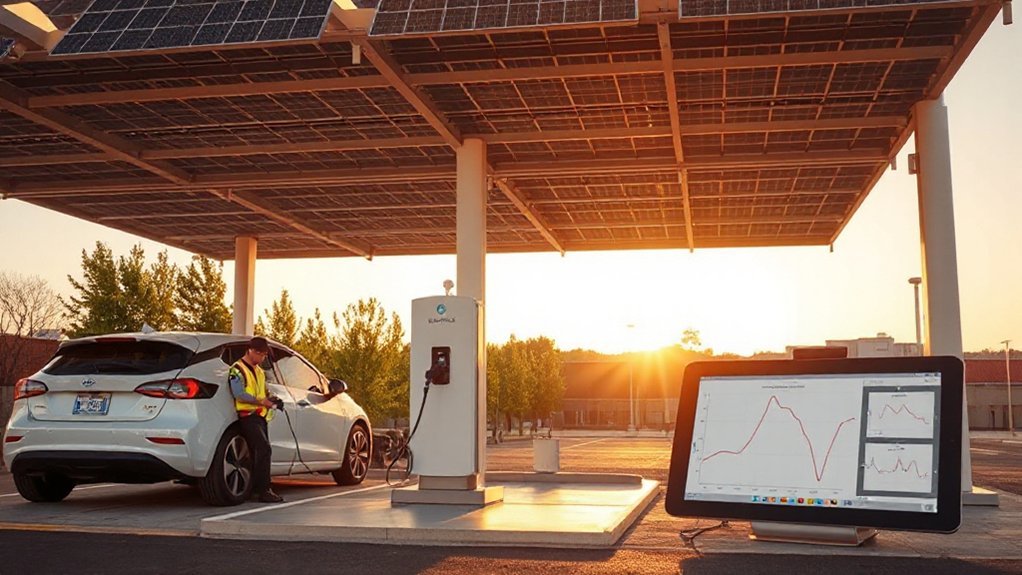
Because EVSE and PV-interactive systems operate under continuous load, you need a preventive maintenance and monitoring program that’s code-compliant and safety-led. You’ll verify torque on terminations, IR-scan panels, test GFCI, update firmware, and log results per NEC and IEC records. Implement predictive maintenance with sensor analytics and remote diagnostics to minimize downtime and hazards. Trend PV output, charger utilization, insulation resistance, ground continuity, and surge protection status. Clean modules and cooling intakes to sustain nameplate performance. For future expansion, provision spare conduits, network drops, panelboard spaces, transformer kVA, and structural load paths. Standardize on OCPP and ISO 15118 for interoperability and smart charging.
- Set alarm thresholds and response playbooks safely.
- Test backup power and islanding failover functions quarterly.
- Review cybersecurity and user access controls.
Conclusion
You’ve seen how sunlight becomes miles: PV to inverter to EVSE, simple in concept, exacting in execution. You balance Level 2 convenience against DCFC demand, grid-tied efficiency against battery-backed resilience. You size arrays by load profiles, not hopes; you permit, trench, interconnect, and commission to code. Model costs, stack incentives, and schedule O&M. Design for NEC, plan conduits for tomorrow’s expansion. Build safely, operate reliably, and you’ll cut carbon and demand charges without cutting corners.