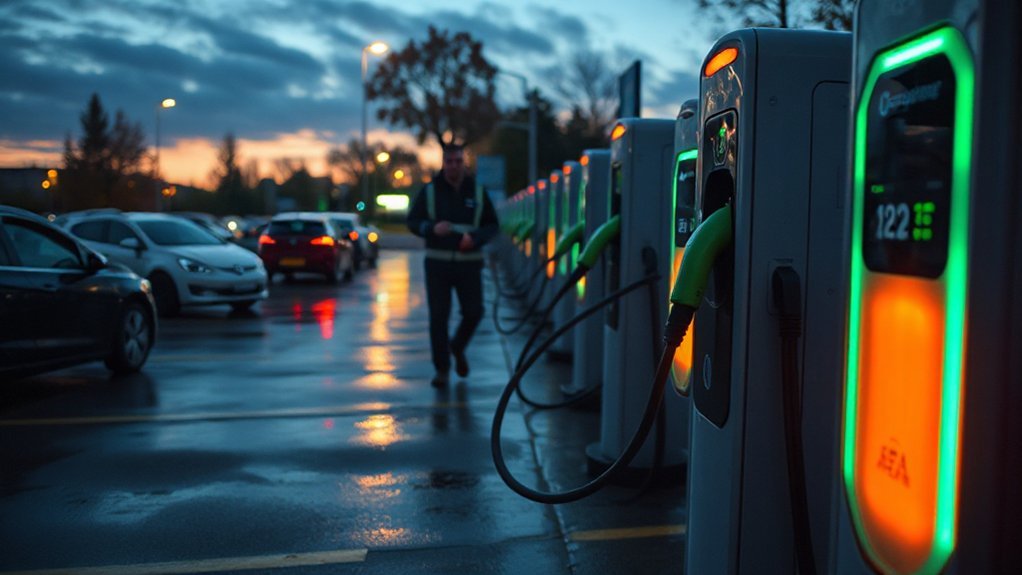
You might wonder whether the 2025–2026 Model Y really charges as fast as Tesla claims. You’ll get clear answers on ports, home setup, and Supercharger behavior, plus what to set for daily charging and road trips. Keep going if you want practical steps that save time and money on the road.
Key Takeaways
- Use the CCS2 inlet for AC Type 2 and public DC charging; many CCS stations deliver up to about 170 kW.
- Install a 240V Wall Connector (up to 11.5 kW/48A) for fastest home AC charging and Wi‑Fi scheduling.
- Model Y’s onboard charger limits AC to about 11 kW; set vehicle current to ~80% of circuit capacity for safety.
- At Superchargers, enable battery preconditioning and expect Model Y peak rates up to ~250 kW on V4 stations where available.
- Before every session check seals, cables, and vehicle prompts, and carry adapters for non‑CCS public chargers.
Charging Port, Connectors, and Standards for the 2025–2026 Model Y
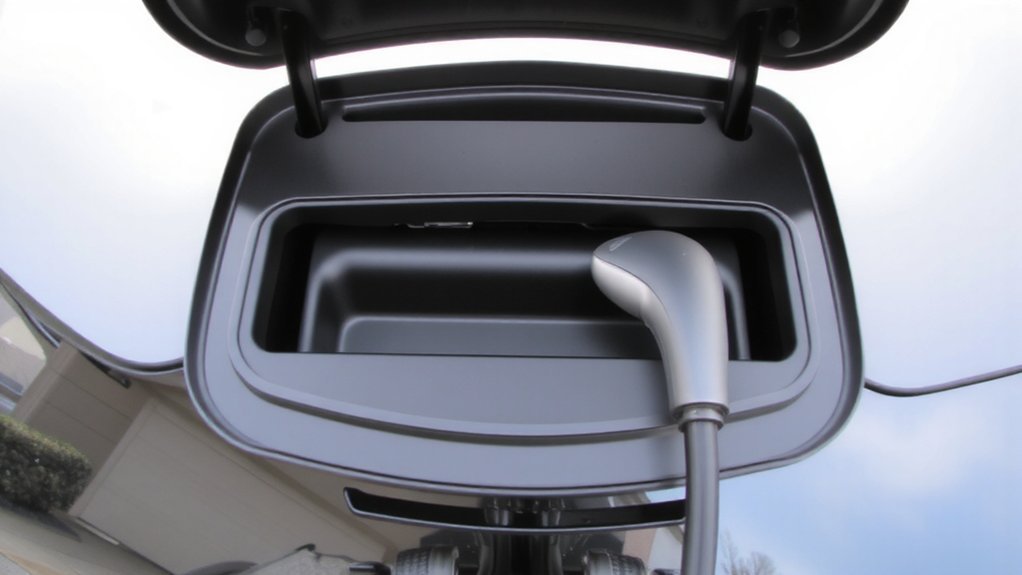
Where’s the charge port? It’s on the left rear side, hidden behind a door in the tail‑light assembly so you can access it safely. You can open the door with the cable button, touchscreen, pressing the door edge when unlocked, key fob, or voice command. Most homes run on single-phase power, which typically limits AC charging power to about 7 kW.
The hybrid CCS2 port accepts Type 2 (Mennekes) for AC and the full CCS2 plug for DC fast charging, letting you use public CCS chargers and compatible Superchargers. The 2025 Model Y supports up to 170 kW DC, enabling roughly 20–80% in about 21 minutes.
Tesla parts (1490374-10-E) and reusable fasteners simplify service. Follow connectors’ secure seating and vehicle prompts to protect the battery and guarantee safe charging. Check seals and cables for damage before every charge session, always.
Home Charging Options: Level 1, Level 2, and Wall Connector Setup
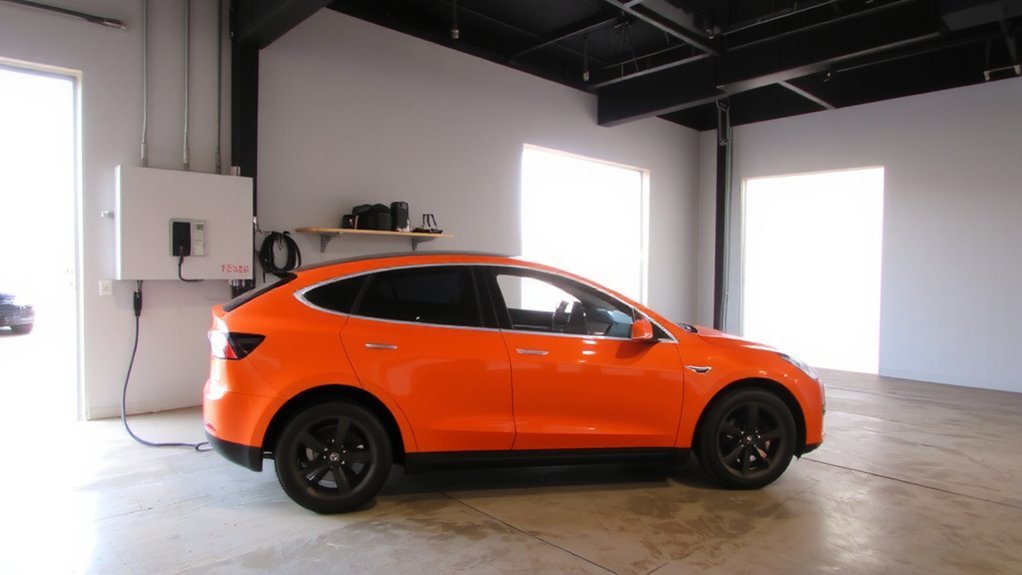
At home you can use the portable Level 1 Mobile Connector for slow, occasional top-ups or choose a Level 2 setup or hardwired Wall Connector for regular, faster charging.
A NEMA 5-15 outlet yields about 2–4 miles/hour with the Mobile Connector, while a 240V Level 2 circuit or Wall Connector delivers roughly 20–44 miles/hour depending on amperage.
Pick the option that matches your daily range needs, installation budget, and preference for a permanent, monitored Wall Connector.
For fast on-the-road top-ups, the Model Y supports 250kW DC ultra-fast charging where available.
Level 1 — Mobile Connector
Although slower than Level 2 chargers, the Tesla Mobile Connector lets you charge a 2025–2026 Model Y from a standard 120V household outlet. You’ll need to buy the Mobile Connector separately; it’s not included with new cars. The Mobile Connector is available separately for $299.95 USD and includes the adapters and a storage bag.
The bundle includes the main unit with attached cable, a 120V (NEMA 5‑15) adapter, a 240V NEMA 14‑50 adapter, and a storage bag. Expect roughly 3 miles of range per hour on 120V (about 1.3 kW); 240V with the connector can reach up to the unit’s 32A limit (≈7.7 kW).
The car automatically adjusts charging current; no manual tweaks are required. Use the Mobile Connector as a convenient backup or for travel, and follow outlet ratings, avoid extension cords, and inspect connectors before each use for safety.
Level 2 — Wall Connector
You’ll get the fastest and most convenient home charging with Tesla’s Wall Connector, which delivers up to 11.5 kW (48 A at 240 V) in North America — roughly 44 miles of Model Y range per hour. Install a licensed electrician using appropriate circuit breakers and wiring; a 60A breaker yields 11.5 kW, 40A gives 7.7 kW.
Set output between 12A–48A to match your panel and use group power management for up to four units. The connector is Wi‑Fi enabled for scheduling, remote monitoring, and firmware updates; register it to your account for full features.
Its 24‑ft cable, weatherproof design, and integrated safety protections support safe indoor or outdoor use. Check local incentives and expect professional commissioning via Tesla and installer apps plus maintenance. The Gen 3 Wall Connector also supports power-sharing among up to six units.
Installing and Configuring Home Charging: Circuit, Current, and Settings
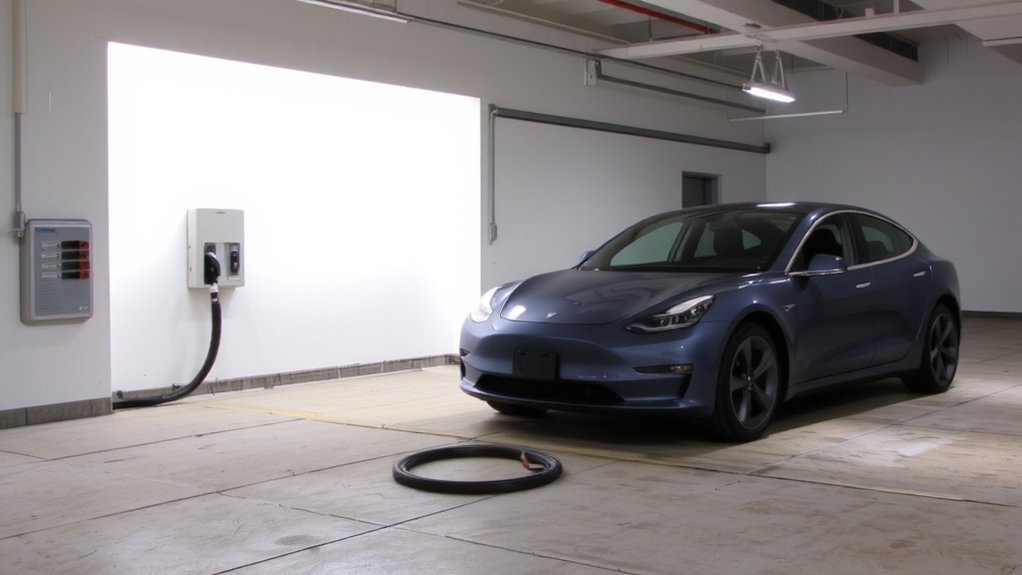
You’ll need a dedicated single‑phase 240V circuit sized and protected to match the charger—typically a 40A breaker for a 32A Level‑2 setup—and proper grounding per local code.
Installers should fit residual current (RCD)/GFCI protection and follow permitting and safety standards so the circuit trips safely on faults.

You can set and limit charging current from the vehicle touchscreen or Tesla app, lowering amperage below the circuit maximum or scheduling off‑peak charging to avoid overloads and save on costs.
Remember the Model Y has an 11 kW on‑board charger that limits AC charging power.
Circuit Requirements and Protection
When planning a home Level 2 circuit for your Model Y, design it as a dedicated 240V run sized for the charger and the car’s onboard charger capacity, with breakers chosen for continuous loads (for example, a 32 A continuous charge needs a 50 A breaker per NEC rules, and many installers recommend a 60 A breaker for the fastest 11.5 kW charging).
Use copper conductors sized to the breaker and run length—6 AWG is standard for 50 A, while 4 AWG or larger may be needed for longer runs or higher ampacity. Route wiring in conduit, use grounding (minimum #10 AWG copper), and guarantee overcurrent protection coordinates with the Wall Connector. Consult a licensed electrician, obtain permits, follow local code and RCD requirements. Also remember that home Level 2 charging operates at 240 volts.
Setting Charge Current Limits
Several controls let you set the charge current for your Model Y — tap Controls > Charging or the battery icon to reduce amperage below the cable or circuit maximum; you can only change settings while parked. The car defaults to the cable’s max but remembers per-location preferences, so your home rate sticks.
Match the car’s current to your circuit (use 80% rule: a 30A circuit → ~24A charge) to avoid tripping breakers or overloading wiring. Tesla connectors and onboard chargers negotiate limits and block settings above cable or circuit ratings.
Lower currents are safer on household outlets; use dedicated 240V circuits or a Wall Connector for higher, configured amperages. Temporarily slide past daily limits for trips, then return to recommended settings for safe operation.
Using Tesla Superchargers: V4, Speeds, and Preconditioning
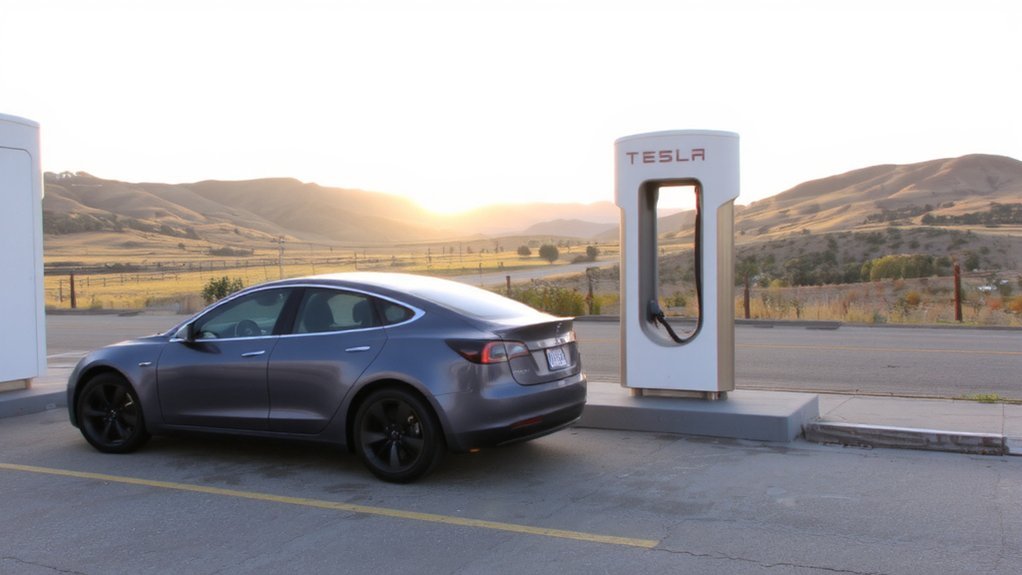
If you plan to use a V4 Supercharger, know that the new cabinets can deliver up to 500 kW to cars (1.2 MW for the Semi) but current Model Y and other S3XY models remain capped at about 250 kW, so peak speed depends on your vehicle’s architecture and battery state. V4 Cabinet deployments start 2025, so you may see more sites coming online soon.
When you navigate to a Supercharger your Tesla preconditions the battery, warming or cooling cells to hit ideal temperature and maximize safe charge rates. Expect fastest charging at low state of charge and moderate temperatures; cold batteries charge slower until preconditioned.
The V4 connector is longer and more flexible, and stations monitor voltage, temperature, and resistance, pausing charging if needed. Plan stops, watch preconditioning prompts, and prioritize safety over speed for every trip.
Public Charging: CCS, Type 2, Adapters, and Network Access
A good place to start is understanding that your Model Y uses a combined CCS inlet (Type 2 for AC and the full CCS pin set for rapid DC), so you can plug into a wide range of public chargers beyond Tesla’s network; the port sits on the near-side rear flank next to the taillight. For planning trips, remember that the battery has a usable 82 kWh capacity which affects how long you’ll need to charge between stops. You’ll use the Type 2 portion for AC charging at workplaces or slower public points and the full CCS connection for tethered rapid DC chargers. In North America, you may need NACS/CCS adapters depending on the site; in Europe Type 2/CCS is common.
Always use certified adapters, verify activation methods (app, RFID, contactless), watch pricing, and confirm the car and charger complete their safety handshake before current flows safely.
Road Trip Charging Strategy and Planning
How do you keep a road trip flowing with minimal downtime? Use Tesla’s Trip Planner to route through V4 Superchargers, pre-condition the battery before arrival, and set a practical charge limit (80–90%) for most stops. Monitor percentage state rather than just range and keep at least a 10–20% buffer.
Rely on Trip Planner recommendations and real-time availability. Prefer frequent 15–30 minute stops for rapid initial charging. Choose Supercharger sites near amenities and confirm status via the app.
Plug in immediately when you arrive; the car latches and starts charging automatically. Keep software/maps updated, carry adapters and the Mobile Connector, and plan backup chargers in case of outages to stay safe and on schedule. Monitor charging progress and unplug at your target to avoid delays. Also carry the included J1772 adapter for compatibility with many public chargers.
Cost, Efficiency, and Charging Etiquette
You’ll save most by charging at home — expect about $11–$18 per full charge (roughly $0.04 per mile) versus $17–$43 at Superchargers, with public rates often $0.25–$0.50/kWh and higher at peak times. For reference, the Model Y typically uses a 75 kWh battery pack in many versions. Charging at home uses typical $0.14–$0.15/kWh rates; a Model Y Long Range usable pack near 70–73 kWh yields about 3.5–4 miles/kWh, so you’ll pay about $4–$5 per 100 miles.
Level 2 home or public charging is efficient and practical; Level 1 is slow and Superchargers are best for road trips. Expect roughly 85% efficiency due to conversion losses and slower speeds near full. Be courteous: move when done, avoid hogging stalls, obey station rules, and keep areas clear for safety and other drivers. Plan stops and regularly monitor charging to reduce wait times.
Battery Care, Charging Limits, and Best Practices
Because batteries age faster when they’re kept at extremes, set your daily charging window and habits to protect the pack. Keep routine charges between 20% and 80%, use 90% as your daily limit if you need range, and reserve 100% for trips. Never let the battery fully discharge; for storage aim for 50–60% and leave the car plugged in when parked long-term.
Protect battery life: keep routine charges between 20–80%, use 90% only when needed, store at 50–60%
Limit DC fast charging to twice weekly, and precondition the battery before SuperCharging to speed and reduce stress. When using public stations, note that Tesla Superchargers can deliver up to 250 kW for rapid charging. Manage temperature: park shaded or garage, use cabin overheat protection, and allow a 30-minute cool-down before charging in heat. Apply over-the-air updates and schedule charging for off-peak rates for battery longevity.
- Set daily cap: 80–90%
- Store at 50–60%
- Precondition before SuperCharging
Conclusion
You’re now armed to tame the Model Y’s charging wilderness—home, Supercharger, and roadside. Like a seasoned navigator, you’ll pick the right plug, set smart limits, and precondition for fast fills, turning anxiety into predictable rhythm. With a well-chosen wall connector, occasional CCS stops, and mindful battery habits, trips feel smoother and costs shrink. Stay curious, plug in thoughtfully, and your Tesla will reward you with quiet, confident miles and joyful driving every single day ahead.