
You navigate a maze of plugs, voltages, and protocols to charge reliably. AC (Type 1/J1772, Type 2, NACS) feeds onboard chargers; DC fast uses CCS, NACS, CHAdeMO, or GB/T with external rectifiers. Adapters range from passive AC signal pass‑through to active DC translators. Compliance—ISO 15118, IEC/UL—drives safety, billing, and warranties. Understand levels, connectors, and network roaming now—before compatibility and costs surprise you.
Key Takeaways
- EVs store DC; AC charging uses an onboard converter, while DC fast charging uses an external rectifier; power is limited by charger or station capability.
- Connector standards vary by region: NACS/CCS1 (North America), Type 2/CCS2 (Europe), Type 1/CHAdeMO (Japan), GB/T (China).
- AC adapters are usually passive pin-mappers; DC adapters require active protocol translation (PLC via ISO 15118/DIN 70121) and strict voltage/current limits.
- CCS↔NACS DC adapters exist at high power; CHAdeMO↔CCS/NACS adapters are rare and typically limited to around 50 kW.
- Use certified adapters/EVSE (UL/IEC), honor CP/PP logic, current ratings, GFCI, and thermal derating; avoid daisy-chaining to maintain safety and warranties.
AC Vs DC: How EVS Take a Charge
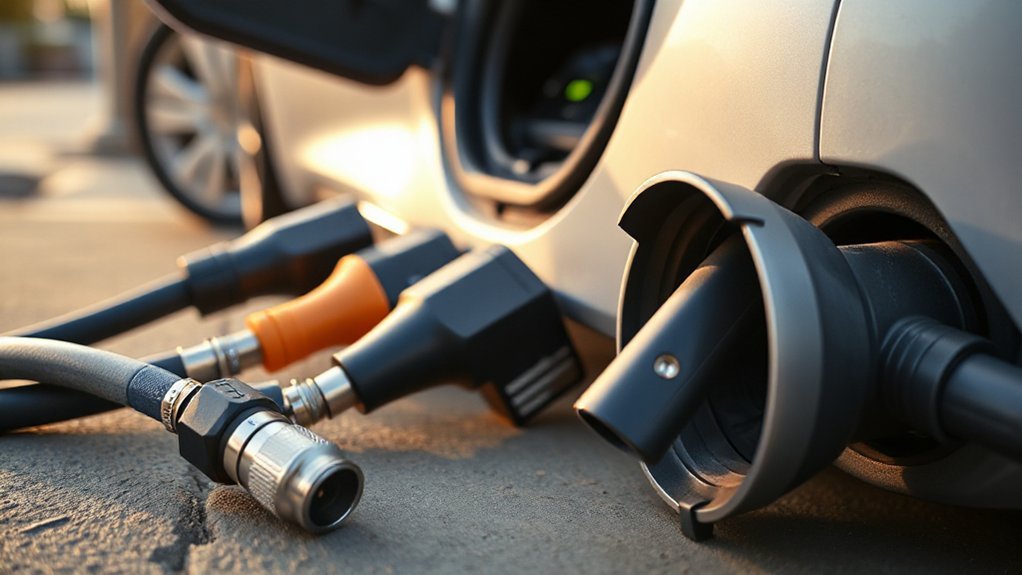
Because traction batteries store energy as DC, EVs always charge their packs with DC; the distinction is where conversion happens. With AC supply, your Onboard Converter rectifies AC to DC and regulates current to the pack’s target voltage, typically 350–800 V. Power is capped by the converter’s rating and wiring limits. With DC supply, the external EVSE performs rectification and regulation; the pack connects through contactors, and the BMS commands voltage and current setpoints. Control and safety follow IEC 61851 signaling and ISO 15118 or DIN 70121 for communication. You monitor cell temperatures, enforce limits, and coordinate Thermal Management to keep internal resistance and degradation low. Proper grounding, insulation monitoring, and residual current detection mitigate shock and fault energy during normal and abnormal conditions.
Levels 1–3: Power, Speed, and When to Use Each
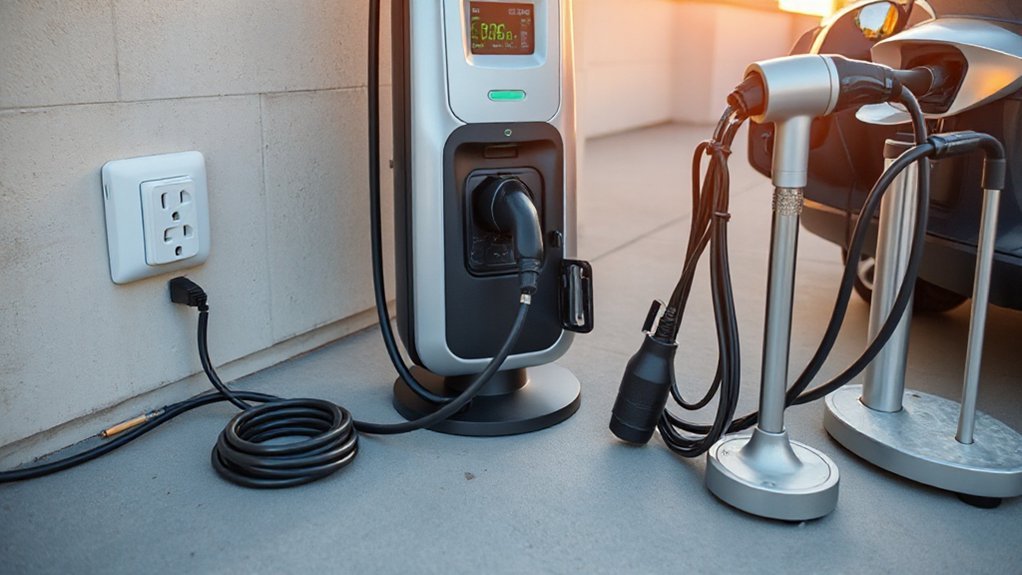
You use Level 1 (120 V, ~1–1.9 kW) and Level 2 (208–240 V, ~3.3–19.2 kW via SAE J1772/NACS AC) for daily parking, adding roughly 3–5 and 12–40 miles of range per hour, respectively. For long trips, you rely on DC fast charging (CCS/NACS DC at 50–350 kW), typically restoring 10–80% in ~20–40 minutes depending on pack size and charge curve. Choose based on dwell time and cost: Level 1–2 is lowest stress and cheapest per kWh at home/work, while DC fast trades higher demand/fees for speed during travel.
Level 1–2: Daily Use
While DC fast charging is best for road trips, Level 1 and Level 2 handle daily energy needs with predictable, low-cost replenishment and minimal battery stress. Level 1 (120 V, ~12 A, ≈1.4 kW) adds about 3–5 miles/hour; it suits overnight top‑offs and workplace plugs. Level 2 (240 V, 16–48 A, ≈3.8–11.5 kW) delivers roughly 15–40 miles/hour via SAE J1772 in North America (or NACS on newer vehicles) and Type 2 in Europe per IEC 62196-2. Use a dedicated circuit, GFCI protection, and the 80% continuous-load rule (e.g., 40 A breaker for 32 A EVSE). Program charging to off‑peak TOU rates and preferred SOC windows (e.g., 20–80%) to shape charging habits. Maintain cable storage with strain relief, clean contacts, and UL/CE‑listed equipment for safety.
DC Fast: Long Trips
How do you minimize trip time on the highway? Use DC fast charging (Level 3) and plan around 10–80% state of charge. Modern sites deliver 150–350 kW via CCS1/CCS2 or NACS; legacy CHAdeMO often caps at 50 kW. Your actual rate depends on pack temperature, battery cooling capacity, and charger voltage/current limits. Precondition the battery en route to hit peak power at arrival.
Stop at chargers co-located with rest stops every 100–150 miles. Short, high-power sessions are faster than deep charges. Target stations with 800 V hardware if your car supports 400/800 V switching. Avoid stalls that share power. Monitor taper: unplug when power falls below 2–3× your Level 2 rate. Use Plug and Charge or app-based RFID to reduce dwell and payment overhead.
Connectors Guide: CCS, NACS (Tesla), CHAdeMO, Type 1 (J1772), Type 2
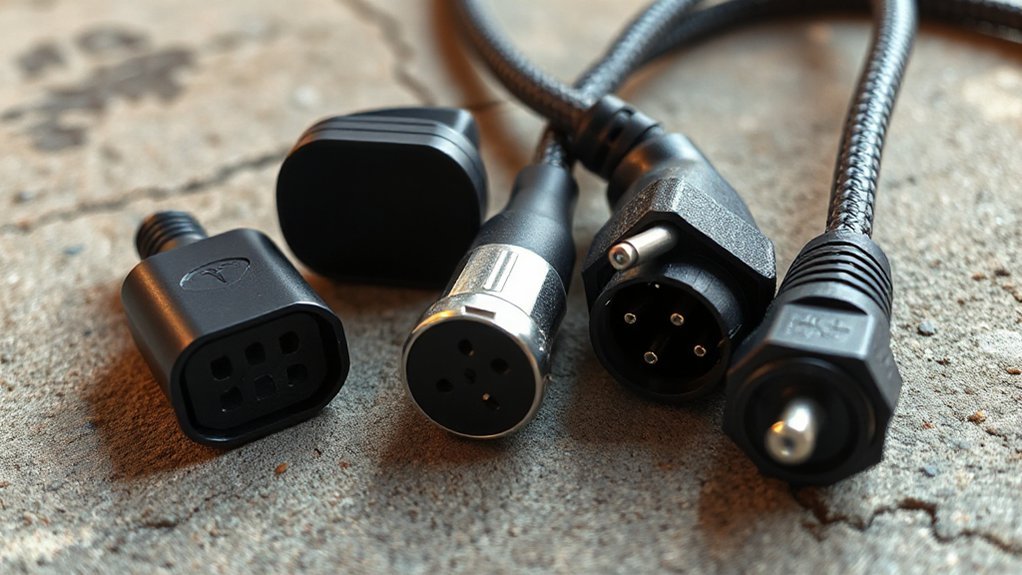
You’ll need to match adapter options to power and protocol: AC is often passive (Type 1↔NACS, Type 2→NACS/J1772), while DC requires protocol alignment (CCS uses PLC; CHAdeMO uses CAN), making CCS↔CHAdeMO conversion uncommon and power‑limited. In North America, NACS (SAE J3400) is supplanting CCS1/J1772 with OEM commitments covering roughly 90% of 2025–2026 EV sales; Europe mandates Type 2 for AC and CCS2 for DC; Japan retains CHAdeMO for DC with Type 1 for AC. You should plan your kit accordingly—carry AC adapters and, where available, certified NACS↔CCS1 DC adapters—while not expecting practical CHAdeMO↔CCS/NACS DC solutions.
Adapter Options by Standard


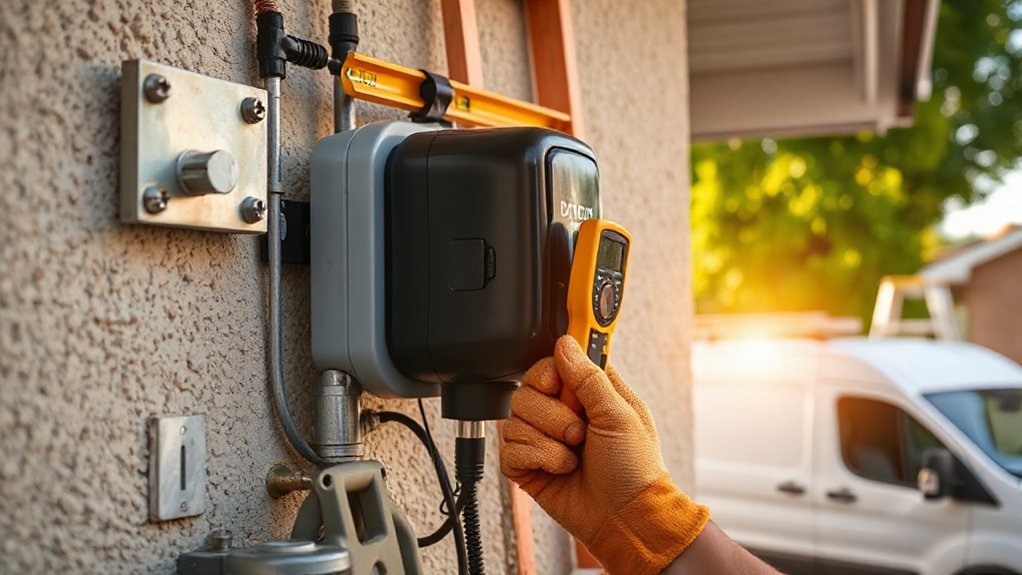
Because EV connector families differ in pinouts, signaling, and regional standards, viable adapters depend on both electrical format (AC vs DC) and protocol compatibility. You should verify handshake support (PLC vs CAN), current limits, and safety interlocks. Patent licensing and manufacturer partnerships often dictate which adapters exist and receive firmware updates.
- CCS to NACS DC: uses ISO 15118/PLC translation; typically 500A, 1000V ratings; requires UL listing and OEM authentication.
- NACS to CCS AC: operates in J1772 mode; up to 80A single-phase; no DC pass-through.
- CHAdeMO to CCS/NACS DC: scarce; CAN-to-PLC gateway; usually capped at 50 kW; may need external 12V.
- Type 1 to Type 2 AC: passive with control‑pilot mapping; single-phase only; Type 2 three-phase not supported via simple adapters.
Validate certifications before purchase.
Regional Use and Adoption
Adapter options only help if they match what regions actually deploy and mandate. In North America, you’ll encounter NACS rapidly standardizing DC fast charging as automakers adopt Tesla’s interface; CCS1 remains widespread at public sites, while Type 1 (J1772) persists for AC. In Europe, Type 2 is mandatory for AC and CCS2 dominates DC under EU AFIR; CHAdeMO is rare. Japan still favors CHAdeMO for DC and Type 1 for AC, though CCS adoption is growing. China uses GB/T variants, so you need dedicated adapters. Regional policy incentives, interoperability rules, and grid readiness shape rollout density, maximum power (e.g., 150–350 kW corridors), and uptime. Plan routes by connector mix, power classes, and roaming support to minimize idle adapters. Also, repair response times matter locally.
Adapters: Compatibility, Limitations, and Safety
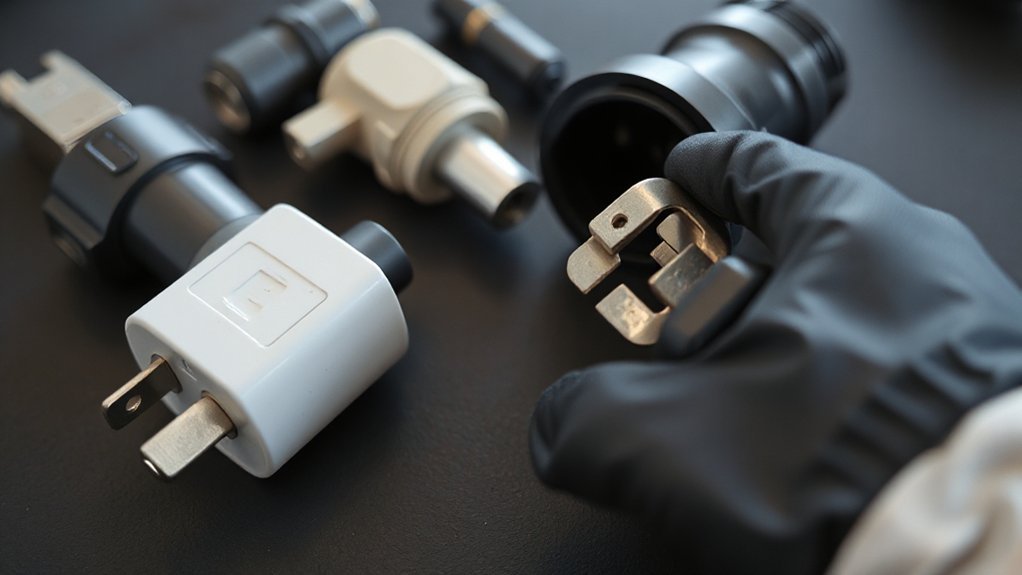
While adapters expand where you can charge, they introduce strict constraints set by connector standards and safety certifications. You should verify IEC, UL, or TÜV marks, current/voltage ratings, and pinout mapping before use; misuse can void warranties, and OEMs publish clear warranty implications. Always brief passengers on emergency procedures—stop button, manual latch release, and fire protocols—because adapters can alter fault paths and clear times.
- AC: J1772↔Type 2: pilot/PP logic must preserve 6–80 A limits; no phase conversion.
- DC: CCS1↔NACS/CCS2 requires certified high-power adapters; no CHAdeMO→CCS without active handshake.
- Temperature: derate above 35°C; look for 105°C cable, 80°C connector ratings; avoid daisy-chaining.
- Protection: require CP/PP integrity, ground continuity, DC leakage detection (IEC 62752/61851), and firmware updates.
Log serials and test monthly with an EVSE checker.
Charging Networks and Roaming: Access, Apps, and Payment
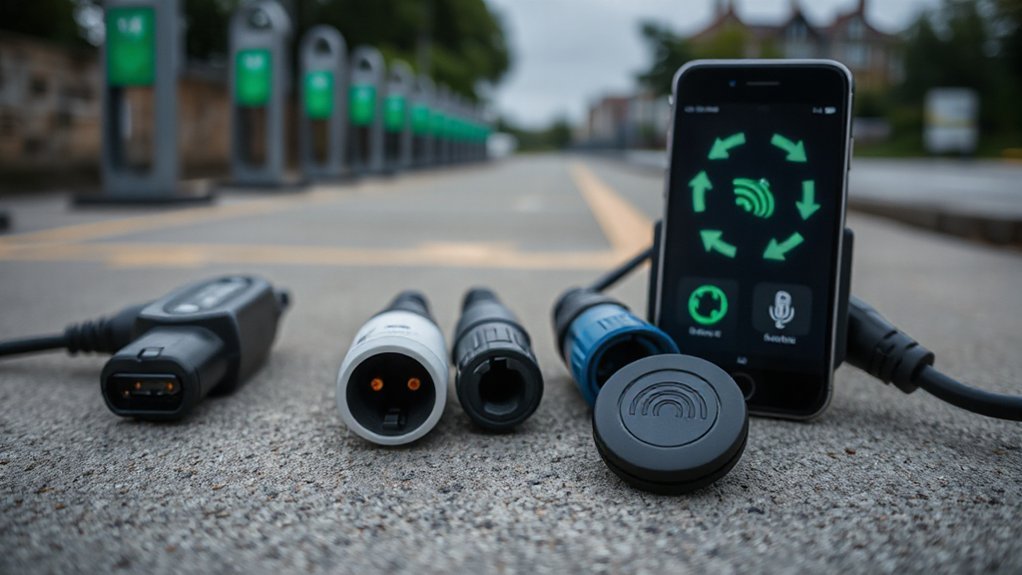
Even as plugs converge, your real access depends on networks, roaming protocols, and payment rails. You’ll interact with a Charging Point Operator (CPO) via a Mobility Service Provider (MSP) using OCPI roaming or hub platforms like Hubject and Gireve. OCPP links the charger to the back end; ISO 15118 enables Plug&Charge with certificate-based authentication. For non-15118 sessions, you can start with RFID, app, or EMV contactless.
Expect Dynamic Pricing: tariffs combine per‑kWh, per‑minute, session, and idle fees, sometimes congestion‑responsive. Networks publish availability and pricing via OCPI; regulators increasingly require price transparency and 97% uptime targets. Pay through MSP wallets or direct pay; PSD2 SCA and PCI DSS govern card flows. Protect Data Privacy with GDPR/CCPA compliance, tokenized identifiers, and minimal telemetry retention policies, controls.
Home and Workplace Charging: Hardware, Installation, and Costs
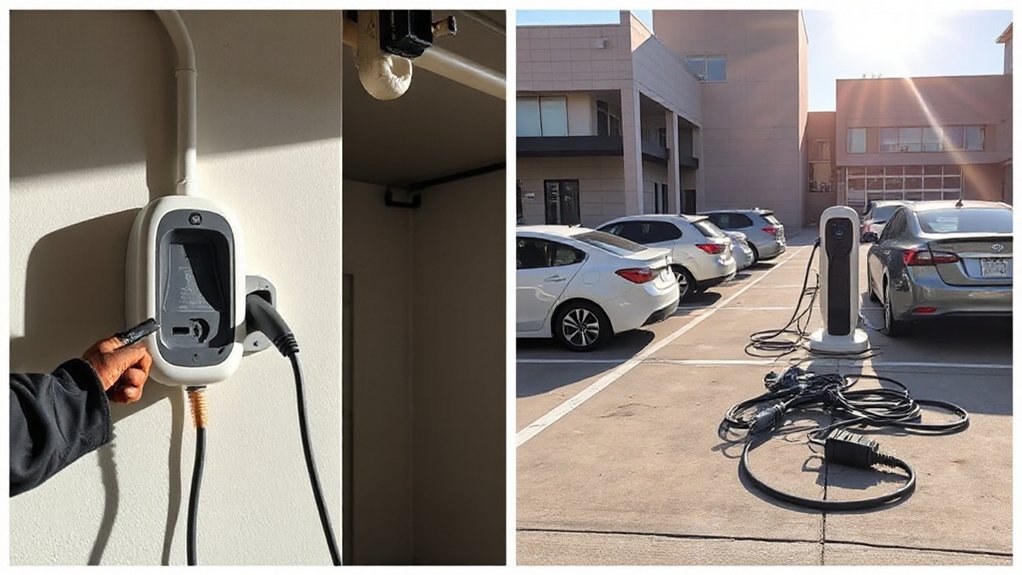
Map your charging needs to hardware, electrical capacity, and code requirements to control total cost of ownership. At home, choose Level 1 for overnight trickle or Level 2 (32–48 A) for faster replenishment. At workplaces, distribute more ports at lower power to match dwell time. Size circuits per NEC 625: continuous load at 125%, GFCI, proper labeling, and load calculations. Verify Permit requirements with your AHJ and utility incentives.
- Select UL-listed EVSE with J1772, Wi‑Fi/OCPP, and adjustable current limits.
- Assess panel capacity; consider a dedicated 40–60 A breaker or a load-share controller.
- Plan cable management, bollards, and Aesthetic integration with signage and lighting.
- Estimate costs: EVSE $400–$900, installation $800–$3,000; add trenching, network fees, and demand charges.
Document commissioning data and set access controls properly.
The NACS Shift: Automaker Adoption and the Road to Universal Charging
As SAE formalized Tesla’s North American Charging Standard as J3400 in late 2023, automakers accelerated commitments, positioning a single, compact connector as the de facto North American plug for both AC and DC. You now see most major brands announcing NACS/J3400 migration: adapters in 2024–2025, native ports on new models from 2025. Brand partnerships with Tesla and third‑party networks enable Supercharger access while expanding dual‑standard sites. J3400 carries single‑phase AC and high‑power DC on two DC pins, supports 1,000 V class packs, and enables >500 A with liquid‑cooled cables. Policy incentives matter: NEVI funding initially required CCS1, but updated guidance allows J3400 if CCS compatibility remains. For you, the roadmap is clear: near‑term adapters, cross‑network roaming, and converging hardware toward universal, reliable fast charging.
Conclusion
You navigate universal charging like a Swiss‑army toolkit: AC (Type 1/J1772, Type 2/NACS) feeds onboard rectifiers; DC fast (CCS, NACS, CHAdeMO, GB/T) bypasses them for >100 kW. You pick Level 1–3 by dwell time, verify IEC/UL listings, and trust ISO 15118 for secure handshakes and Plug&Charge. You match passive AC adapters to pilot signals; you require active, thermally rated DC translators. With network roaming, authenticated apps, and pro installation, you charge safely, interoperably, and warranty‑clean.