
You want the cheapest, fastest charge in [City]? Use 150–350 kW DC fast hubs (Electrify America, EVgo, Tesla) near interstates for quick top-ups at roughly $0.35–$0.75/kWh; rely on public Level 2 at workplaces, malls, and hotels for $0.12–$0.30/kWh. Check live apps for real-time stalls, CCS/NACS compatibility, idle fees, and sites with 97%+ uptime. Carry adapters. Next, we’ll pinpoint exact stations, peak times, and costs.
Key Takeaways
- Use major DC fast networks (Tesla, Electrify America, EVgo, ChargePoint) near interstates/retail; prefer 350 kW, 4–12 stalls, real-time availability, ≥97% uptime.
- For daily stops, Level 2 (7–11 kW) at workplaces, retail, hotels; expect ~25–35 miles/hour; aim for sites with 97%+ uptime.
- Typical costs: DC fast $0.28–$0.79/kWh; Level 2 $0.12–$0.35/kWh; memberships and off-peak windows cut 10–40%.
- Avoid extra fees: move at 80–90% SOC, watch idle charges $0.25–$1.00/min, respect dwell limits, validate parking to prevent max rates.
- Filter maps by connector (NACS/CCS; CHAdeMO waning), power, and live status; enable Offline Maps and energy-aware routing for reliable trips in [City].
Top DC Fast Chargers in [City] by Network and Location
Tesla Supercharger (mostly 250 kW+ NACS), Electrify America (150–350 kW CCS; limited CHAdeMO), EVgo (100–350 kW), ChargePoint DC (62.5–250+ kW), and Shell Recharge or other regional operators anchor [City]’s DC fast network. You’ll find highest-power hubs near interstate ramps, logistics corridors, and high-traffic retail. Verify charger compatibility: NACS vs CCS adapters, CHAdeMO phase-out. Expect $0.28–$0.59/kWh typical, with per-minute tiers where required; idle fees run $0.35–$1.00/min after grace periods. Memberships shave $0.03–$0.12/kWh. Site ownership matters: utility- or CPO-owned sites price more consistently; host-owned sites vary with demand charges and parking policies. For throughput, target 4–12 stall sites with 350 kW hardware and 1000 V capability; shared power cabinets reduce peak rates under load. Check uptime metrics (≥97%) and amenity hours. Prefer sites publishing real-time availability.
Best Level 2 Options for Work, Shopping, and Overnight Stays
While DC fast covers road trips, Level 2 (208–240 V) is the value play for routine dwell times at work, retail, and hotels in [City]. Target sites with 7–11 kW output; they add roughly 25–35 miles per hour, fitting an 8-hour workday or overnight stay. Prioritize Connector types: J1772 for most non-Teslas; NACS at newer sites; many stations include dual cables. Assess Location density near your routine stops to cut detours and queue risk. Check reliability scores, uptime above 97%, and pricing before you plug in.
- Workplace garages: 20–40 ports, 6–8 kW, idle-fee enforcement, posted uptime and access.
- Retail clusters: high Location density, 9–11 kW, 2-hour limits, shop while charging nearby.
- Hotels: overnight L2, 7 kW minimum, guest priority, apps showing Connector types availability.
Pricing Breakdown: Rates, Peak Times, and Time-of-Use Tips
Because pricing varies by network, site host, and time-of-use windows, break costs down by unit: per-kWh energy, per-minute access, session fees, and idle penalties.
Check posted tariffs: DC fast rates run $0.28–$0.59/kWh off-peak and $0.45–$0.79/kWh during peaks; L2 sits $0.12–$0.35/kWh. Per-minute pricing ranges $0.15–$0.60/min, rising with higher power tiers. Session fees commonly add $0.25–$3.00. Compare billing models by your vehicle’s max kW; slow-charging on per-minute plans inflates effective $/kWh. Use off-peak windows (typically 9 p.m.–6 a.m. or mid-day) to cut costs 15–40%. Enable app notifications for peak windows and TOU blocks offered. If you drive weekly, evaluate subscription discounts: $4–$15/month plans can drop kWh or minute rates 10–25%. Precondition the battery en route so chargers hit target kW sooner, reducing dwell under per-minute schemes.
Avoiding Extra Fees: Idle Charges, Parking Rules, and Validation

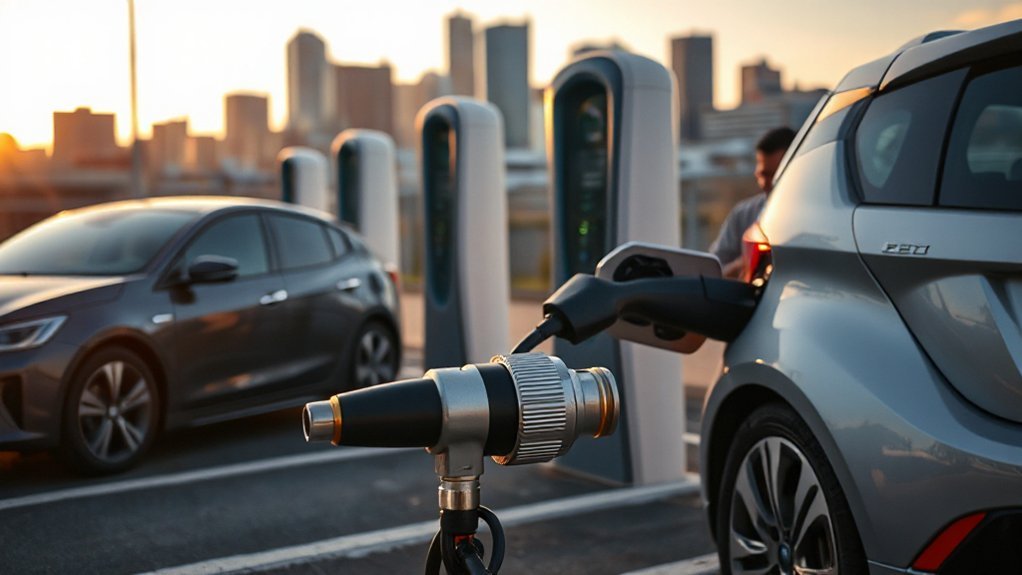

Check each station’s idle fee time limit—typical thresholds start 5–10 minutes after reaching 100%, with penalties around $0.35–$1.00 per minute—so you set alerts and unplug before charges accrue. You verify posted parking rules (EV-only hours, max dwell times, meter requirements), because citations and tow fees can exceed the session cost. You confirm whether the site offers validation, the qualifying spend, and the process (QR code, app, or cashier) to offset or eliminate parking charges.
Idle Fee Time Limits
Once your battery reaches the set state of charge, many networks start billing idle time, turning minutes into dollars fast. You’ll see fees kick in when your session hits 80–90% SOC or the charger flags “complete.” Typical idle rates run $0.25–$1.00 per minute; a 15‑minute delay can add $3.75–$15.00. Track each provider’s Grace periods and Enforcement variability—apps show timers, but billing clocks differ.
- DC fast: 5–10 minute grace, then escalating tiers (e.g., $0.40/min rising to $0.80/min after 30 minutes).
- Level 2: lower rates ($0.05–$0.20/min) but longer dwell; overnight idling becomes expensive.
- Demand peaks: some networks tighten limits during congestion, applying higher idle multipliers to maximize turnover.
Set departure alerts, and unplug promptly to contain total session cost. Avoid buffer overruns in your charging schedule.
Parking Rules and Validation
Idle fees aren’t the only meter running; parking rules around chargers can add $1–$6/hour in garage or curb fees, plus fines if you misread the sign. Verify dwell limits (30–180 minutes) and “EV charging only” windows; once you exceed them, systems switch you to the posted tariff or issue a citation. Typical offense penalties run $35–$85, with repeat violations doubling. Many sites require validation: scan a QR, enter your plate, or tap RFID within 10–15 minutes, then get merchant validation to reduce rates to $0–$2/hour. Miss validation and you’ll pay the default maximum (often $16–$28). For curbs, meters may bill in 6–15 minute blocks at $0.50–$1.25/block. If cited, use the appeal process within 10–14 days with charger session logs and photos to support reversal.
Reliability and Amenities: What to Expect at Popular Sites
Evaluate station uptime trends by checking network-reported uptime percentage, session success rate, mean time to repair, and power derating so you can forecast availability and avoid time-costly detours. Quantify how outages push you to higher-cost alternatives, increase queue time, or trigger idle/parking fees, and model total session time to estimate effective $/kWh. Assess on-site amenities—24/7 access, restrooms, shelter, Wi‑Fi, and food—by hours and proximity, so you can price the value of time saved and expected incidental spend.
Station Uptime Trends
Although charger counts grab attention, uptime drives your actual cost and trip time in [City]. You pay for outages via idle fees, detours, and pricier fallback energy. Track network availability and prioritize sites with 97–99% uptime, maintenance scheduling, and fast incident response.
- Verify concurrent charger uptime; 4 of 8 live still queues.
- Check mean time to repair and remote-reset success to gauge exposure.
- Model seasonal reliability: heat, ice, and salt increase derates and connector faults.
Seasonal reliability swings throughput: heat throttles modules; winter raises cable errors and derates, extending sessions. Compare monthly uptime by operator and site, not just region averages. Favor modular power units and remote diagnostics; they recover faster. If faults run 1/1,000 sessions, risk is low; at 1/100, add buffer time.
On-Site Amenities
Frequently, on-site amenities determine your real charging cost and risk more than the posted kWh rate. You pay with time: reliable bathrooms, 24/7 lighting, and indoor seating cut unplanned detours that add miles and idle fees. Sites with convenience stores, ATMs, and Wi‑Fi let you stack errands, reducing opportunity cost per kWh. Look for posted hours, security cameras, and canopy coverage; these correlate with longer uptime and fewer abandoned sessions. Pet relief areas and kid zones lower stopover friction, keeping you on-site until you reach target SOC. Prefer hubs with multiple vendors, restrooms within 200 feet, and food options open past 10 p.m. Monitor amenity density in apps; under-amenitized lots drive higher risk of session interruption and paid re-plugs. Factor weather shelter and staffing.
Must-Have Apps and Maps for Live Availability in [City]
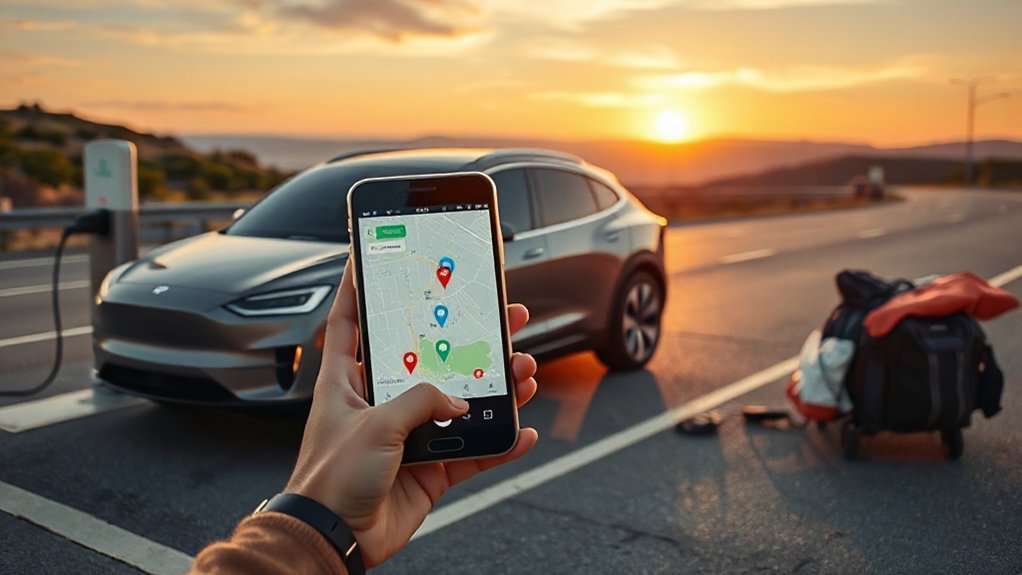
Dashboards that surface real-time plug status, pricing, and charger power help you cut costs and idle time in [City]. You’ll compare kW, fees, and waits across networks, then route to the cheapest open stall. Prioritize platforms with Crowdsourced Updates for queues, broken connectors, and ICEing reports; they cut false positives. Enable Offline Maps so tunnels, garages, or rural gaps don’t break navigation or tariffs. Filter by connector type, power, and peak/off-peak windows. Set price alerts for dynamic rates and demand charges. Export history to audit $/kWh and model degradation costs.
- API-backed live status (OCPI/OCPP) for uptime, connector IDs, and transparent pricing.
- Energy-aware routing using SoC, elevation, traffic, and weather to minimize $/mile.
- Wallets, RFID, and loyalty integration to auto-apply free kWh, coupons, and credits.
Conclusion
You’ll cut costs and time by pairing 150–350 kW DC fast hubs on interstates ($0.35–$0.75/kWh) with Level‑2 at work, malls, and hotels ($0.12–$0.30/kWh). Check live maps for CCS/NACS, uptime ≥97%, pricing, and idle fees; plan 10–80% top‑ups to stay in the peak charge curve. Carry adapters, favor sites with restrooms, and monitor peak pricing. Validate parking when required. With a telegraph-era budget mindset, you’ll optimize every kWh, avoid surprises, and keep your schedule predictable daily.
