You probably don’t know your Zappi can enforce export limits and provide PEN/PME fault protection without extra hardware. You use clamp CTs for real‑time import/export monitoring, then let Mode 3 control dynamically balance loads to protect your supply. You select Eco, Eco+, or Fast to prioritize PV while staying within BS 7671 and RCD/RCBO coordination. With app scheduling and phase options, you cut costs—if you commission it correctly, which is where it gets critical.
Key Takeaways
- Zappi is a solar-aware EV charger that modulates charge current in real time using CT clamps to prioritise surplus PV or wind generation.
- Supports Eco, Eco+, and Fast modes, enabling surplus-only charging, blended grid/PV, or full-rate charging up to configured supply limits.
- Delivers dynamic load balancing to protect the home’s main breaker, with per‑phase monitoring and import caps to prevent overloads.
- Provides secure app control for scheduling, tariff alignment, current limits, export limiting, session logs, and OTA firmware updates with API access.
- Integrates safety features including Type A RCD with 6 mA DC detection and built‑in open‑PEN protection compliant with BS 7671 Section 722.
What Makes the Zappi a Smart, Solar‑Aware Charger

Although it looks like a standard Mode 3 EVSE, Zappi continuously measures your home’s import/export with clamp CTs and modulates the charge current in real time to prioritize surplus solar (or wind) generation. You get dynamic load management that respects your service limit, reducing current to prevent trips and overheating. The controller follows IEC 61851 signaling, integrates Type A RCD with 6 mA DC leakage detection, and adds PEN-fault protection for TN-C-S supplies. Configurable schedules, charging locks, and import/export clamps keep it code compliant. Secure connectivity uses authentication, encryption, and cybersecurity features to protect settings and users. Over-the-air firmware updates deliver fixes and safety enhancements without opening the enclosure. You can set min/max current, phase, and import caps to match your installation and site.
How Solar and Wind Integration Prioritizes Clean Energy

Leveraging surplus generation, Zappi monitors real‑time import/export via CT clamps and adjusts charge current per IEC 61851 to draw first from excess solar or wind before importing from the grid. You configure export margin, phase limits, and earthing provisions to maintain electrical safety and compliance.
- Dynamic setpoints throttle current to prevent reverse power flow and nuisance trips at the service head.
- Priority logic favors on-site renewables, reducing CO2 and aligning with Policy Incentives for self-consumption.
- Frequency and voltage thresholds safeguard Grid Stability and protect sensitive loads during disturbances.
- Integrated RCD protection and PEN-fault detection mitigate shock risk without compromising availability.
- Data logging and API hooks let you verify yield, audit demand response, and document compliance.
You maximize renewables while keeping circuits within design limits.
Charging Modes: Eco, Eco+, and Fast

You’ll compare Eco and Eco+ to see how each modulates charge current to prioritize surplus renewables while holding within grid import limits and branch-circuit ratings. You’ll also assess Fast mode performance, which delivers the circuit’s full allowable output subject to CT sensing, breaker size, RCD protection, and thermal derating. Throughout, you’ll apply manufacturer parameters and local electrical codes to prevent backfeed, overload, and nuisance trips.
Eco Vs Eco
Why choose Eco, Eco+, or Fast on your Zappi? You’ll weigh energy sources, charge stability, and wiring limits. Eco blends grid and surplus PV, maintaining a current above your vehicle’s minimum. Eco+ prioritizes surplus only, pausing below export thresholds to prevent reverse power. That “Eco vs Eco+” split often triggers naming confusion and shapes consumer perceptions, so verify settings before connecting.
- Set a minimum charge rate aligned with EVSE and EV limits.
- Enable export margin to avoid nuisance pauses with PV swings.
- Use CT clamps per code to guarantee accurate surplus measurement.
- Verify RCD/RCBO protection; fluctuating load can stress upstream devices.
- Schedule off-peak windows while allowing Eco+ to resume on solar.
Fast remains available but reserve it for needs.
Fast Mode Performance
Fast mode prioritizes stable, full‑rate charging and ignores PV surplus logic from Eco/Eco+. Select it when you need predictable current delivery up to the configured supply limit and the vehicle’s onboard charger rating. The Zappi holds amperage without ramping, minimizing session time but increasing grid import. Verify circuit capacity, OCPD, and RCD type A/EV per local code before enabling maximum current. Confirm cable rating and connector temperature; rely on onboard Thermal management and Zappi temperature derate to prevent overheating. Continuous high C‑rates can accelerate Battery degradation in warm climates, so schedule charging in cooler periods when feasible. In three‑phase installs, balance phases and set export/CT priorities accordingly. If the site has demand charges, integrate load management to cap current. Always maintain firmware updates regularly.
Dynamic Load Balancing and Home Supply Protection

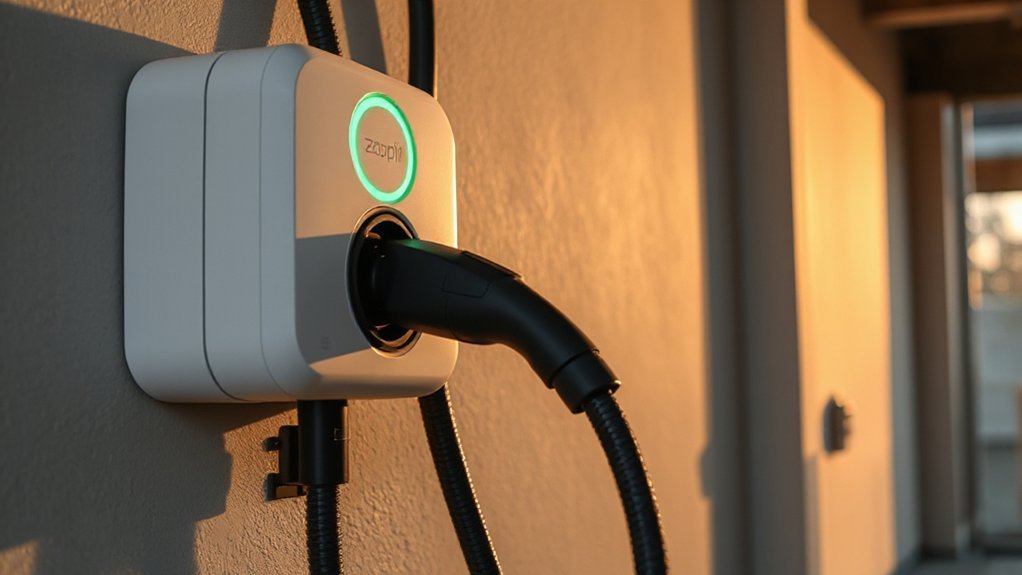
Because home electrical demand varies, Zappi’s dynamic load balancing continuously measures your property’s total load and modulates EV charge current in real time to stay within the supply rating and protect the service fuse. You set a maximum import threshold; Zappi tracks it via CT sensors and adjusts amperage per phase, preventing nuisance trips and thermal stress. It supports Appliance prioritization and Peak shaving, so essential circuits stay powered while charging remains within code.
- Learns baseline usage and reacts in sub‑second intervals.
- Respects main breaker rating and utility service constraints.
- Coordinates with time‑of‑use tariffs to minimize import peaks.
- Scales current from 6–32 A, single or three phase.
- Logs events, aiding verification and electrical compliance records for audits, maintenance planning, warranty support, and documentation later.
Built‑In PEN Fault Protection and Installation Considerations

You can rely on the charger’s built‑in PEN fault protection to avoid a separate earth rod on PME/TN‑C‑S supplies, provided local regulations allow it and its disconnection thresholds are verified. You’ll size conductors for design current and volt‑drop, maintain CPC continuity, and use a 30 mA Type A RCD upstream as required; the unit’s integrated 6 mA DC monitoring covers RDC‑DD. You must record ZE/PSC, earthing type, ADS times, and EVSE test results before energising, and confirm compliance with BS 7671, the IET Code of Practice, and any DNO/OZEV conditions.
No Earth Rod Requirement
Although zappi’s integrated PEN-fault protection permits connection to a TN-C-S (PME) supply without a local earth electrode, you must configure and verify it in accordance with BS 7671:2018+A2:2022, Reg 722.411.4.1(iv). Confirm supply type, bonding integrity, and fault-loop parameters; document commissioning results to evidence compliance.
- Perform a PEN-fault simulation test to verify automatic disconnection and touch-voltage limits.
- Validate main protective bonding sizes and continuity to extraneous-conductive-parts serving the charge point location.
- Assess external influences (AD, AE) and mounting height to maintain mechanical protection and accessibility.
- Notify the DNO where required and retain manufacturer settings logs, test certificates, and photographs.
- Schedule periodic inspection and firmware updates to sustain safety functions over the installation’s life.
This mitigates liability, supports insurance implications, and may enhance resale value overall.
Wiring and RCD Choices
When selecting wiring and RCD arrangements for a zappi, match the final circuit to BS 7671:2018+A2:2022 Section 722 and the unit’s built‑in 6 mA DC and PEN‑fault protection. Use a Type A RCBO upstream; the zappi manages DC leakage, so Type B isn’t usually required. For RCD Selectivity, fit a time‑delayed S‑type upstream where discrimination is needed. Size cables for full‑load current, installation method, and grouping. Verify MCB Coordination with fault level, Zs, and required disconnection times. Confirm IP rating, routing, and bonding integrity.
| Component | Recommended choice | Reason |
|---|---|---|
| Circuit cable | Copper, sized with CPC | Thermal, loop Zs |
| RCD/RCBO | Type A, 30 mA; S‑type if required | Coordination, discrimination |
| OCPD | B/C curve per fault level | MCB Coordination, trip stability |
| PEN protection | Use internal monitoring | Open‑PEN disconnection |
Regulatory Compliance Checks
Before energising the zappi, confirm compliance with BS 7671:2018+A2:2022 Section 722, with particular focus on 722.411.4.1 for PME supplies and open‑PEN protection. Verify the zappi’s built‑in PEN fault detection, earth monitoring, and loss‑of‑neutral response align with manufacturer data and test results. Record measurements, protective device ratings, and EVSE earthing method.
- Prove disconnection times with loop impedance tests at origin and charger terminals.
- Validate ADS coordination: upstream OCPD, RCD/RCBO type, and rated residual current.
- Confirm PME conditions, electrode requirements, and touch‑voltage limits per 722.411.4.1.
- Test PEN simulation using the charger’s routine to ensure automatic isolation works.
- Inspect segregation, cable routes, IP ratings, and bonding continuity to extraneous parts.
Complete the Certification Process and retain Documentation Requirements for traceability and audit.
App Control, Scheduling, and Cost Optimization

How do you turn Zappi’s smart features into lower bills without compromising safety? Use the myenergi app’s user interface to configure charge modes, lockout, and current limits consistent with wiring regulations and your breaker rating. Enable tariff management to align schedules with off‑peak windows and demand charges. Set minimum SoC and maximum daily kWh to prevent overcharging.
Create schedules with start/stop times, export-limiting, and load balancing to keep total demand below service capacity. Pair CT clamps for real‑time grid import/solar export monitoring, then apply ECO or ECO+ to prioritize surplus generation while honoring RCD and PEN fault protection. Review session logs, costs, and exceptions. If your DNO publishes curtailment events, add a manual override to suspend charging and protect compliance. Test alerts before use.
Single‑Phase Vs Three‑Phase Performance and Future‑Proofing
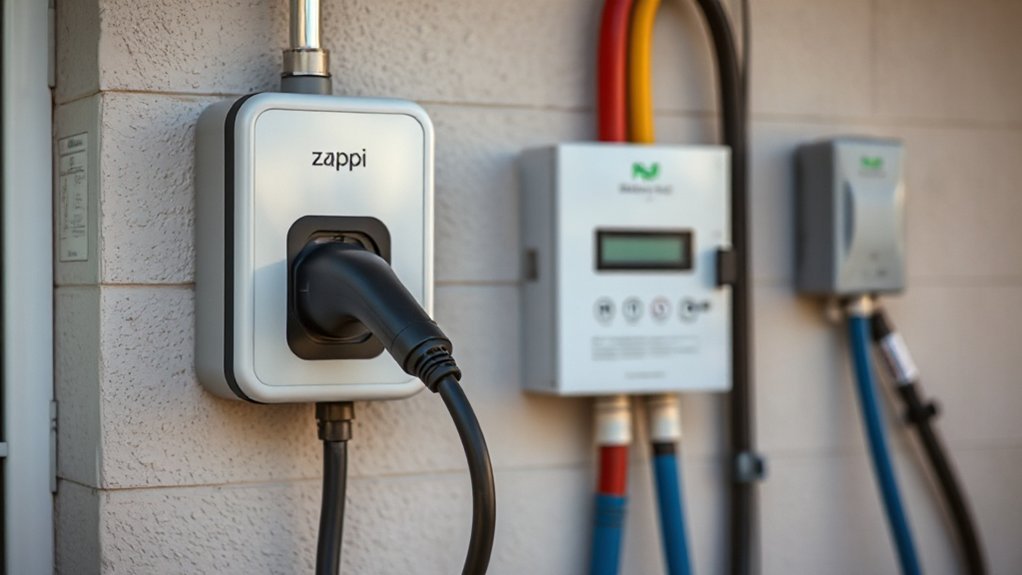
Selecting single‑phase or three‑phase supply for your Zappi determines achievable charge rate, cable size, protection, and utility permissions. Single‑phase at 230 V typically delivers up to 7.4 kW; three‑phase at 400 V can provide 11–22 kW, if your EV supports it. You must size conductors, RCD/RCBO, and breakers per IEC 60364 or local code, consider voltage drop, and notify the utility/DNO.
- Assess capacity scaling: present demand, diversity, and main service limits.
- Verify infrastructure compatibility: meter, panel space, earthing, and fault level.
- Coordinate load management, including CT clamps and export/import limits.
- Plan generation synergy: PV, battery, and phase balancing with ECO modes.
- Model lifecycle cost: upgrade works, tariffs, and resale value.
Three‑phase future‑proofs fleets and heat pumps; single‑phase suits modest dwellings in many retrofit scenarios.
Conclusion
You install Zappi, pretend you’re saving the grid single‑handedly, and then actually do it. You prioritize PV with Eco/Eco+ or blast Fast mode, while CTs juggle import limits to keep main fuses from performing pyrotechnics. Built‑in PEN protection and RCD/RCBO coordination keep you inside BS 7671, not a coroner’s report. You schedule tariffs in the app, cap currents, and pick single‑ or three‑phase like a grown‑up. It’s smug, yes—because it’s safely, auditable‑ly smart and compliant.