
You arrive in an Ioniq 5 at a Tesla Supercharger: can you plug in, negotiate ISO 15118, and pull 230 kW on an 800 V pack? Universality hinges on connector (CCS, NACS, CHAdeMO, Type 2), voltage window (400 vs 800 V), signaling (ISO 15118, DIN 70121, GB/T), back-end roaming (OCPP/OCPI), and adapters or whitelists that cap speed or block access. Here’s what actually makes a station “universal”—and why it still might not be for you.
Key Takeaways
- EV chargers aren’t fully universal; compatibility depends on plug type and communication protocol supported by the car and station.
- Regional standards differ: CCS1 and NACS in North America, CCS2 in Europe, GB/T in China, CHAdeMO mainly Japan.
- Adapters bridge some plugs, mostly AC; DC fast adapters exist but add limits, require proper signaling, and aren’t guaranteed for every vehicle.
- “Universal” networks aim for open access, roaming, card payments, high uptime, and accurate metering, but availability varies by provider.
- Charging speed isn’t universal; it depends on station power level and your vehicle’s voltage system and maximum charge acceptance.
What “Universal” Really Means for EV Charging

How should “universal” be defined for EV charging? You should apply measurable criteria that align policy definitions with consumer expectations and system interoperability. A universal network guarantees: open access (24/7), transparent kWh pricing, open-loop payments (tap, EMV), and published uptime ≥97% verified by independent telemetry. It supports roaming via standardized protocols (e.g., OCPI) and station-network control via OCPP, enabling cross-network authentication without proprietary apps. It delivers multi-power capability (AC and DC levels) with clear minimums (e.g., 7–11 kW AC, 150 kW DC) and accurate metering certified to weights-and-measures rules. It provides ADA-compliant site design, redundant power, and cyber-safety aligned with ISO 15118/27001. Finally, it provides real-time data, repair SLAs <48 hours, and consumer remediation for failed sessions, plus clear signage and multilingual customer support.
Plug Types and Connectors: CCS, NACS, CHAdeMO, and Type 2
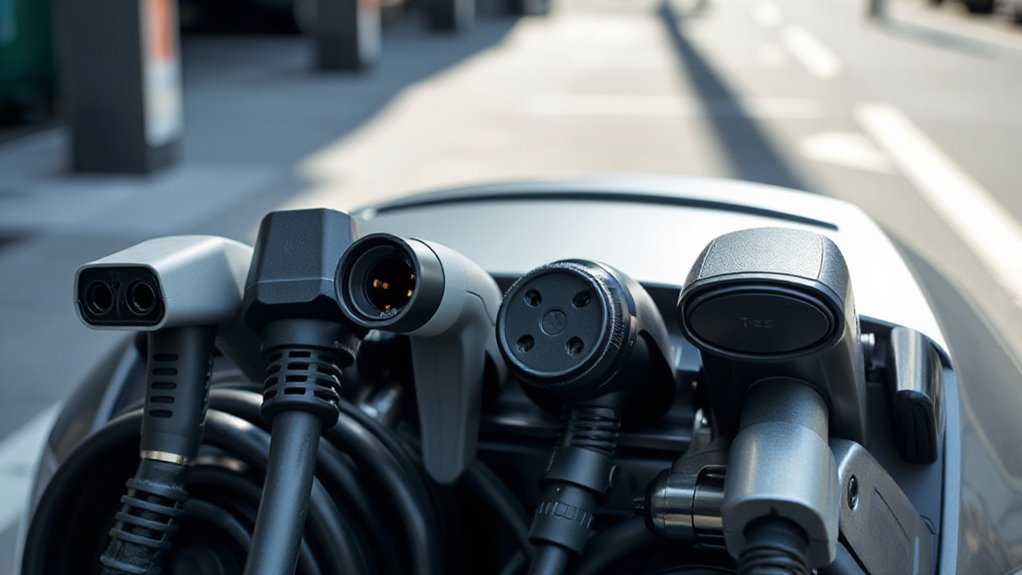
With “universal” defined by open access, interoperability, and measurable uptime, the physical interface—plug types and signaling—must meet the same bar. You’ll encounter four dominant connectors. CCS (Combo 1/2, IEC 62196-3) layers DC pins beneath the Type 1/2 AC shell, uses DIN 70121 and ISO 15118, and supports plug locking, HVIL, and proximity/control pilot safety features. NACS (SAE J3400) delivers compact pin configuration, high current density, PLC-based comms, and native support for ISO 15118 features like Plug&Charge. CHAdeMO specifies a separate DC-only plug, CAN-bus messaging, robust interlocks, but shrinking deployment. Type 2 (IEC 62196-2) defines the AC interface and pilot functions used by CCS2. Adapters and vehicle inlets govern interchangeability; you guarantee interoperability by matching connector, signaling protocol, and certified cable ratings, and fault detection.
Charging Levels Explained: Level 1, Level 2, and DC Fast

A clear taxonomy defines EV charging: Level 1, Level 2, and DC fast. You’ll see Level 1 at 120 V delivering ~1.3–1.9 kW, roughly 3–5 miles of range per hour. Level 2 uses 208–240 V at 3.3–19.2 kW, yielding about 12–75 miles per hour. DC fast supplies 50–350 kW, adding roughly 3–20 miles per minute; many cars charge 10–80% in 20–40 minutes. Standards: SAE J1772 for AC, UL 2594/2202 for equipment, and NEC 625 for installation. Apply Safety precautions: dedicated circuits, correct breaker sizing, intact cables, GFCI where required, thermal monitoring, and clear egress. Consider Environmental impact: higher power increases losses and peak demand; schedule charging off‑peak and prefer efficient stations (>94% conversion) to minimize grid and emissions. Verify labels and follow manufacturer instructions.
Regional Differences and Vehicle Compatibility
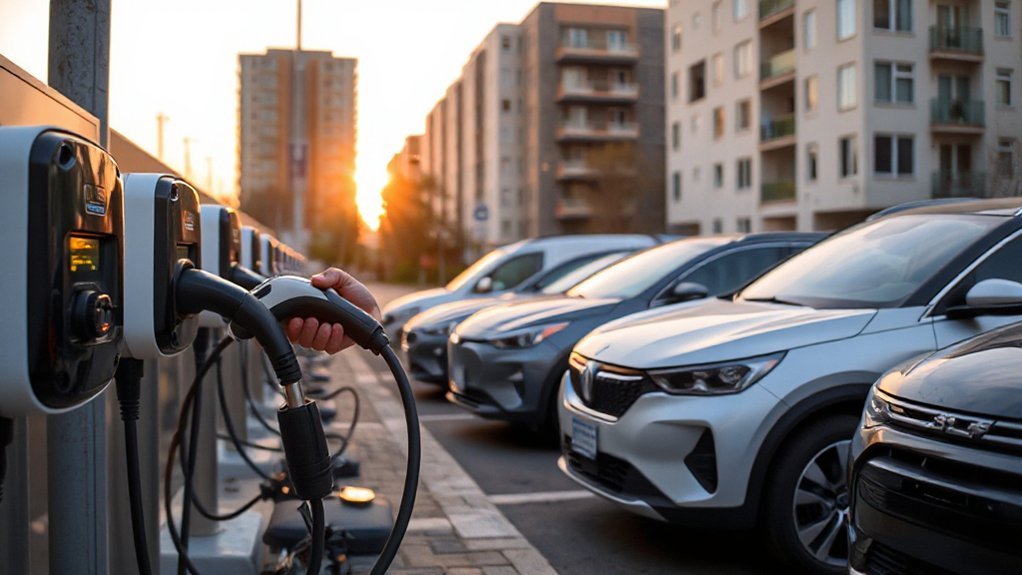

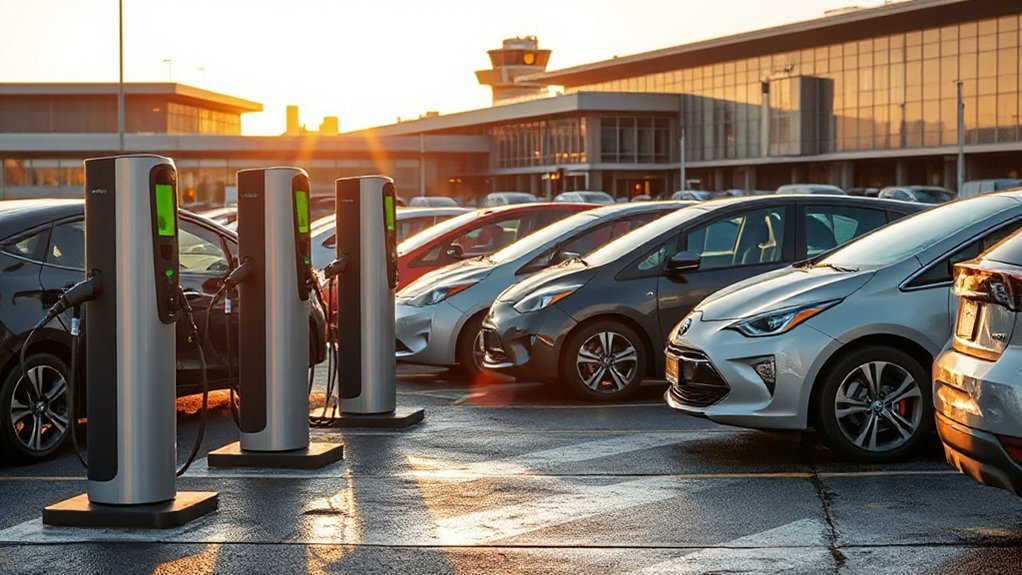
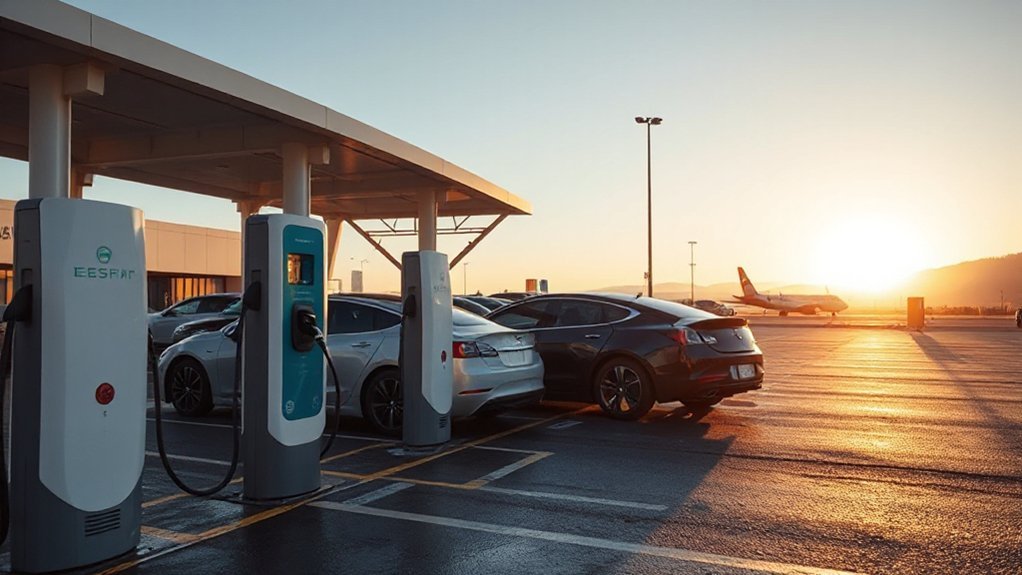
Beyond power levels, connector standards and communication protocols vary by region and dictate vehicle compatibility. In North America, CCS1 and NACS dominate DC; in Europe, CCS2 with Type 2 AC is mandated; China uses GB/T for AC and DC; Japan retains CHAdeMO; India migrates from Bharat DC001/AC001 to CCS2. Vehicles typically accept 400 V or 800 V architectures; both charge on compliant stations, but cable current, connector rating, and site load-sharing cap real power. Communication stacks differ: DIN 70121 and ISO 15118 (Plug&Charge) are common in EU/NA, while GB/T uses CAN-based messaging. Backend interoperability hinges on OCPP versions. Regional codes, metering accuracy, and payment rules affect uptime, warranty variations, and service infrastructure, influencing your practical charging options and reliability, and total cost of ownership.
Adapters: When They Help and When They Don’t

You should first confirm that an adapter actually bridges the standards you need (e.g., NACS↔CCS1, Type 2↔Type 1) and preserves signaling like PLC and CP/PP, because mismatch stops the session. Verify whether it supports DC fast charging or only AC; many market adapters are AC-only, and some CHAdeMO↔CCS solutions are limited or uncertified. Expect power caps from adapter ratings and thermal limits—typical ceilings are 32–80 A on AC and 250–500 kW on DC—so your delivered kW may fall well below the station’s nameplate.
Compatibility Across Standards
How do disparate EV charging standards interoperate—and where do adapters bridge the gap versus hit hard limits? You get basic AC interoperability via Type 1 to Type 2 adapters when the pilot/PP signaling per IEC 61851 remains intact. For DC, CCS1, CCS2, and NACS can interwork through passive adapters only if the vehicle supports PLC handshakes (DIN 70121/ISO 15118) and vendor whitelists permit. CHAdeMO’s CAN-based protocol generally blocks simple bridging; it requires active translators and often OEM approval. Check safety certifications (UL, CE) on any adapter. Verify cybersecurity standards: ISO 15118-20 security, ISO 21434, and IEC 62443 for networks. Backend compatibility matters too: OCPP 1.6/2.0.1 affects authorization and telemetry. Ultimately, your car’s firmware dictates adapter acceptance and feature parity. Across regions and model years.
Impact on Charging Speed
While adapters can expand site compatibility, they don’t always preserve peak charge rates. You’ll often see throughput capped by protocol translation, cable gauge, or handshake limits. CCS-to-Tesla or CHAdeMO bridges may constrain current, voltage, or both. Standards like ISO 15118, DIN 70121, and SAE J3400 define messaging, but adapters can’t upgrade your pack’s acceptance curve. Charging speed still depends on battery chemistry, state of charge, and thermal management. Evaluate adapter specs: maximum kW, current (A), and supported voltages; compare them to the station’s and vehicle’s limits. Use adapters when they align; skip them when they bottleneck.
- Thick cable warming under sustained amperage
- Power meter holding below advertised kW
- Fan noise rising as pack cools
- Taper starting early at mid-SOC
- Connector latch stressing under load
Network Access, Payments, and Apps
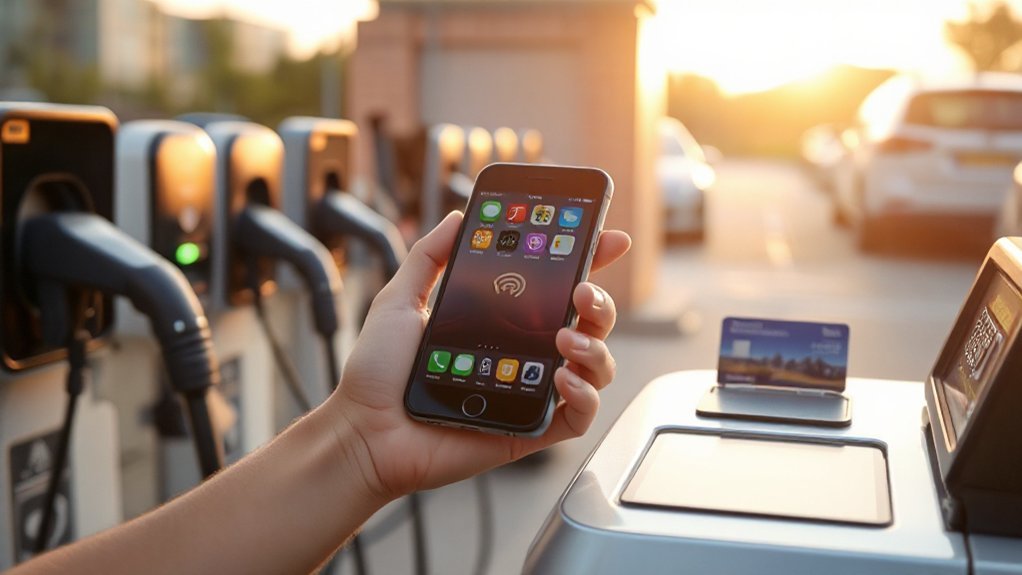
You assess roaming and interoperability by confirming your eMSP or vehicle supports OCPI/OICP for cross-network authentication and ISO 15118 Plug&Charge where available. You verify the CPO implements OCPP for session control, live status, and tariff transparency to guarantee reliable handoffs across networks. For payments, you use EMV contactless, RFID (ISO 14443) cards, or apps with tokenized wallets; confirm PCI DSS compliance, itemized pricing, and receipt support.
Roaming and Interoperability
Why does roaming matter in EV charging? You want consistent access across networks without new accounts or hardware. Roaming depends on interoperable protocols and precise data exchange. Open standards—OCPI for roaming, OCPP for charger control, and ISO 15118 for Plug&Charge—enable cross-network discovery, authorization, and charging records. API Harmonization reduces proprietary gaps, while Session Authentication safeguards start/stop commands and meter data integrity. With eMSPs and CPOs connected via hubs, you benefit from reliable availability, accurate kWh reporting, and uniform error codes. Roaming KPIs should track authorization latency, session success rate, uptime, and data freshness across roaming partners.
- A single map showing roaming-eligible stations
- Handshake logs confirming contract certificates
- Real-time status: available, charging, faulted
- Metered energy traceable to signed readings
- Seamless handoff between networks at borders
Payment Methods and Apps
Because payments anchor trust and revenue, EV charging networks must support multiple access modes—app login, RFID, Plug&Charge, QR wallets, and contactless EMV—under harmonized standards. You benefit when operators implement ISO 15118 for Plug&Charge certificates, EMVCo and PCI DSS for card security, and tokenized app flows using OAuth2 and OpenID Connect. For network access, OCPP handles charger-to-cloud sessions, while OCPI transmits tariffs, roaming authorizations, and receipts. You expect transparent pricing, real-time availability, and VAT-compliant invoices. Robust user onboarding should verify identity, store preferred methods, and enable parental controls for fleets. Prioritize stations with offline authorization, rate capping, and dispute workflows. Evaluate accessibility features: screen contrast and height, tactile buttons, voice prompts, and app-based fallback. Track uptime, failed sessions, and refunds to benchmark reliability and trust.
Where the Standards Are Headed Next

How will EV charging standards consolidate over the next few years? You’ll see rapid policy convergence around NACS and CCS, harmonized safety layers via ISO 15118-20, and stricter uptime SLAs. Utilities will require metering accuracy (ANSI C12), open roaming via OCPI/OCPP 2.0.1, and cryptographic provisioning for Plug&Charge. Bidirectional specs will mature, enabling vehicle to grid and home backup. Expect mandated connector interoperability, calibrated pricing per kWh, and standardized cybersecurity baselines aligned to IEC 62443. Grid codes will integrate EVSE telemetry, while incentives tie funding to verifiable performance metrics.
- Unified, ruggedized connectors across national corridors
- Roaming sessions authenticated in milliseconds via OCPI frameworks
- Sub-1% metering error at sustained 350 kW throughput
- Bidirectional dispatch during peak alerts, ISO 15118-20
- 99.9% uptime dashboards statewide with API transparency
Conclusion
You came in testing the theory that EV charging is universal. It isn’t—yet—but you can navigate it. Match connector (CCS, NACS, CHAdeMO, Type 2), comms (ISO 15118, DIN 70121, GB/T), and power limits (AC L1/L2 vs 400/800‑V DC). Use adapters cautiously; they may cap current or block handshakes. Verify network access (OCPP/OCPI roaming, payment). The trend points to NACS/CCS plus ISO 15118, higher voltages, and better interoperability. You’ll charge confidently by checking specs first everywhere.