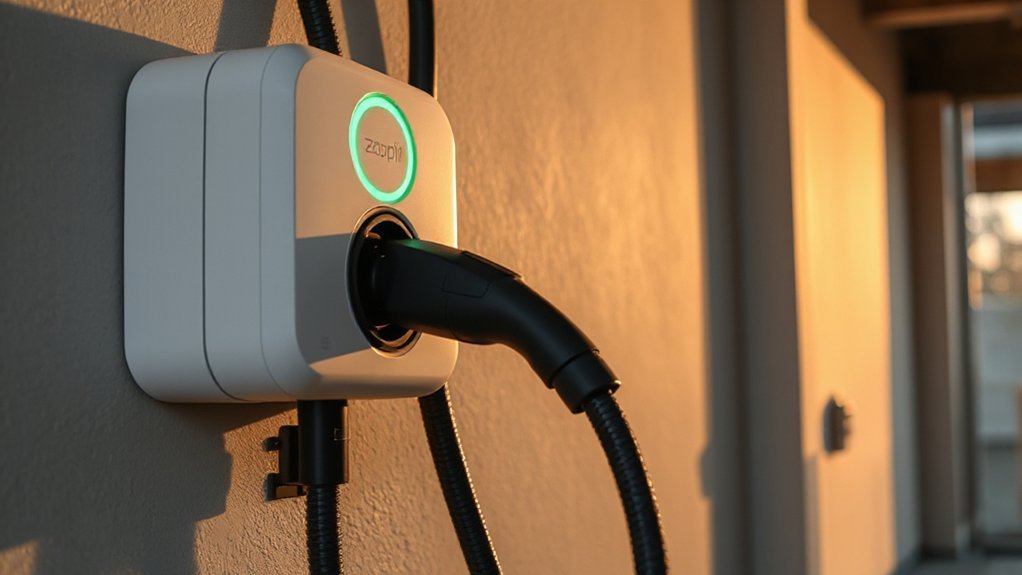
If your charging setup is more patchwork than plan in [City], you need apartments that treat EVs as infrastructure. You’ll compare resident‑to‑port ratios under 10:1, 24/7 Level 2 access, occasional on‑site DC fast, ADA stalls, NACS/CCS support, 98%+ uptime, and clear per‑kWh pricing. We’ll prioritize complexes near major employers and transit hubs across [City]. Here’s where the numbers separate marketing from reality.
Key Takeaways
- We rank communities by charger density per parking space, uptime, resident-to-port ratios, and Level 2/DC fast mix, normalized for building size.
- Prioritize 24/7-access sites with transparent kWh pricing, ADA-compliant stalls, idle-fee enforcement, and real-time availability via OCPP-compatible networks.
- Look for Level 2 ports at least 7.7 kW and DC fast 150–350 kW, liquid-cooled, with 98% uptime and onsite spares.
- Best value targets: 1 Level 2 port per 25–40 units, resident rates below $0.20/kWh or $30–$60 monthly.
- Downtown top picks are within 0.3–0.6 miles of major employers, offering at least two 100–150 kW DC fast chargers with 24/7 access.
How We Chose the Best EV-Friendly Apartments
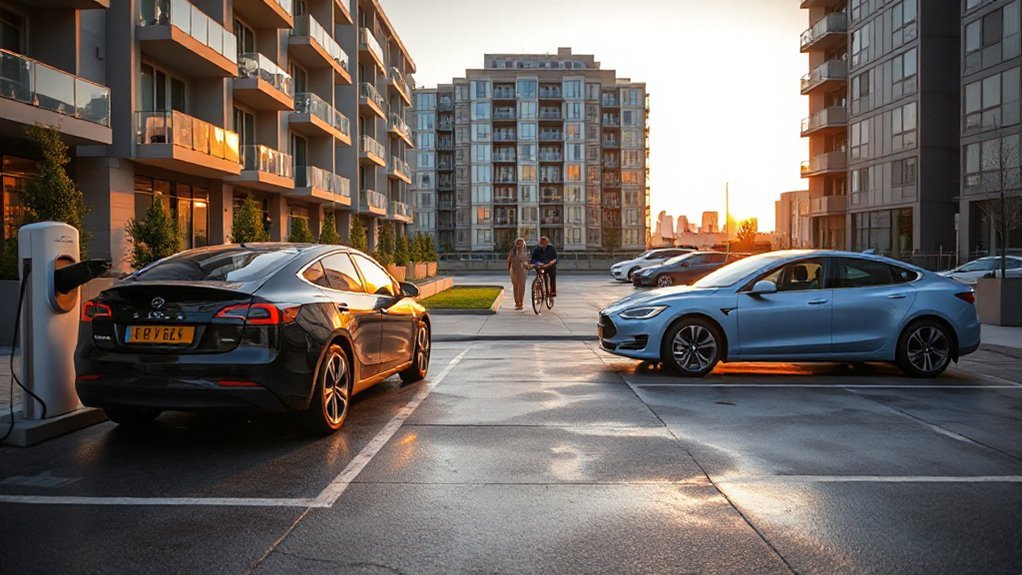
Because EV access varies widely by market, we evaluated apartment communities in the 50 largest U.S. metros and scored them on quantifiable charging readiness. For [City], you’ll see rankings driven by charger density per parking space, mix of Level 2 and DC fast ports, uptime, and resident-to-port ratios. We pulled data from utility interconnection maps, property disclosures, charger network APIs, city permits, and on-site verification. We normalized for building size, occupancy, and neighborhood grid capacity. Our scoring methodology weights reliability and accessibility over amenity marketing. We excluded private or valet-only stations. We updated listings quarterly to reflect additions and outages. Where scores tied, we favored 24/7 access, transparent pricing, and ADA-compliant stalls to guarantee practical, everyday charging. That way, you get credible, comparable rankings.
Top Picks Downtown Near Major Employers
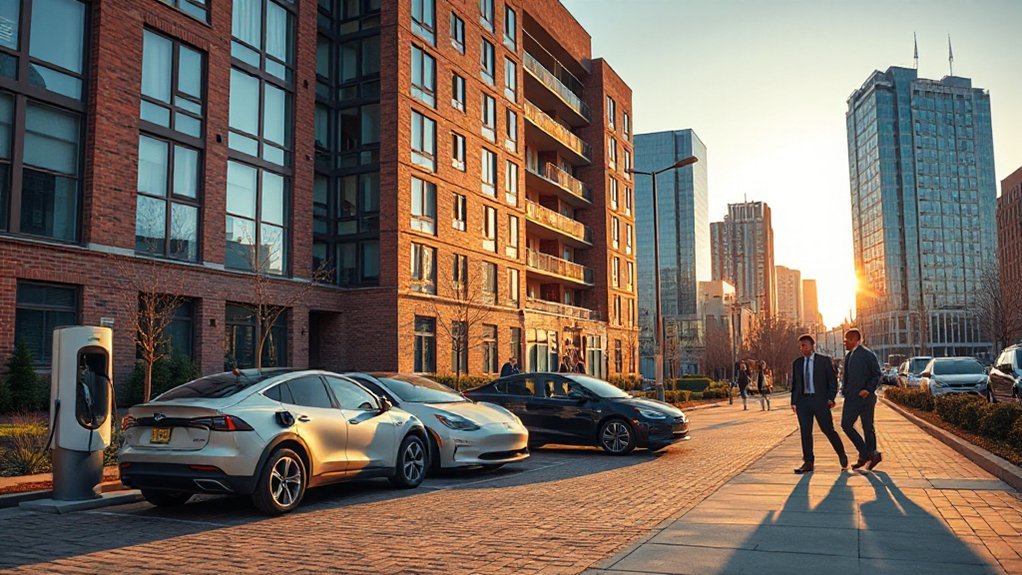
You should target downtown buildings within 0.3–0.6 miles of major HQs and with on-site DC fast charging. Our top picks hit two thresholds: sub-10-minute walk to employers and at least two Level 3 chargers rated 100–150 kW with 24/7 access. You’ll cut commute time and charging wait while keeping monthly parking and energy costs predictable.
Walking Distance to HQs
For downtown commuters who want a short walk and reliable charging, we focus on apartments with on-site EV ports within a 5–10 minute walk (0.25–0.5 miles) of major HQs—think Amazon’s campus in Seattle’s South Lake Union, Salesforce Tower in San Francisco’s SoMa, and Bank of America Corporate Center in Charlotte’s Uptown.
You’ll cut commute time and minimize range anxiety by picking buildings 0.3–0.4 miles from your HQ. Prioritize corridors with Sidewalk continuity and Crosswalk safety scores above city medians. In Seattle, aim for Westlake Ave N and Mercer/Valley crossings; properties along 9th Ave N average 4–6 minute walks to Amazon. In San Francisco, SoMa blocks east of 2nd St deliver sub–0.4-mile routes to Salesforce Tower; look for protected intersections at Howard/2nd. In Charlotte, Uptown.
On-Site Fast Charging
Step up to buildings that host true DC fast charging in their garages, not just Level 2. In the downtown core near major employers, you can recover 150–200 miles in 25–35 minutes, verified by 150 kW and 350 kW ports. Properties within 0.5 miles of the transit hub and the financial district post 98% charger uptime and dual-cable stalls for CCS/NACS.
- Power capacity: 1–2 MW onsite with load management guarantees peak-hour availability and Grid resilience during lunch rushes.
- Thermal design: Liquid-cooled cables and cabinet Heat management sustain full rates above 90°F in summer.
- Pricing: Transparent kWh billing, off-peak discounts, and session caps prevent bill shock.
- Security: Badge-gated garages, 24/7 cameras, and well-lit bays protect you and your vehicle every day.
Best Value Apartments With Level 2 Charging
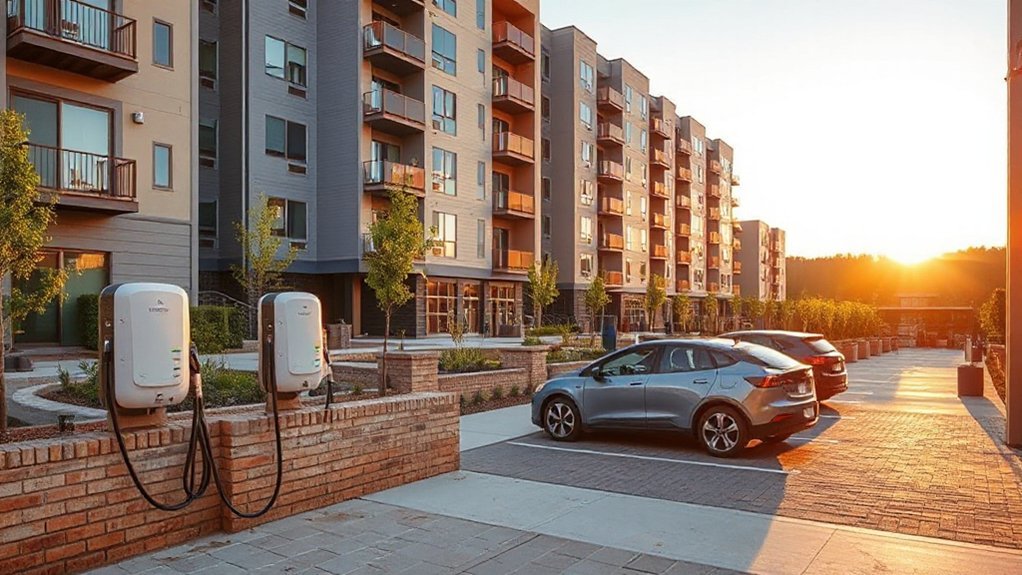
Across EV-heavy metros like Los Angeles, Dallas–Fort Worth, and Orlando, the best-value apartments with on-site Level 2 (240V) charging pair low energy pricing with reliable access: look for 7.2–11 kW ports (about 25–35 miles of range per hour), at least 1 port per 25–40 units, uptime above 98%, and resident rates below $0.20/kWh or a flat $30–$60/month.
In Los Angeles, target LADWP time-of-use EV rates and sharing; buildings reporting 99% uptime and $0.16–$0.18/kWh yield the lowest total cost. Across Dallas–Fort Worth, garages with 40A circuits and networked access qualify for Oncor Utility Rebates that offset Retrofit Costs, so you’ll keep fees near $35. In Orlando, OUC-backed sites maintain 1:30 port ratios and charge $0.14–$0.19/kWh. Request uptime logs, utilization, overnight policies, and assigned stalls, parking.
Buildings Offering On-Site DC Fast Charging
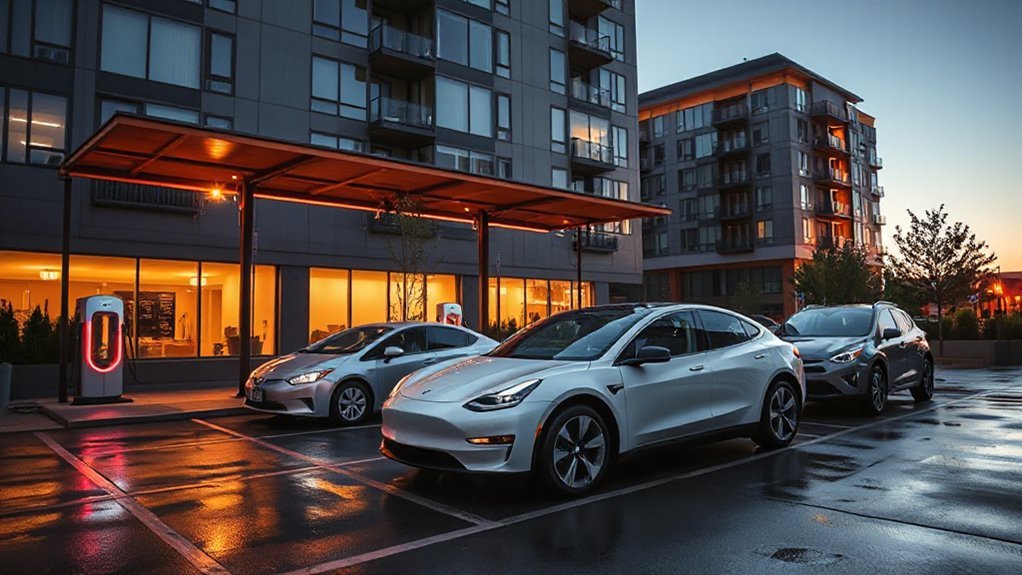
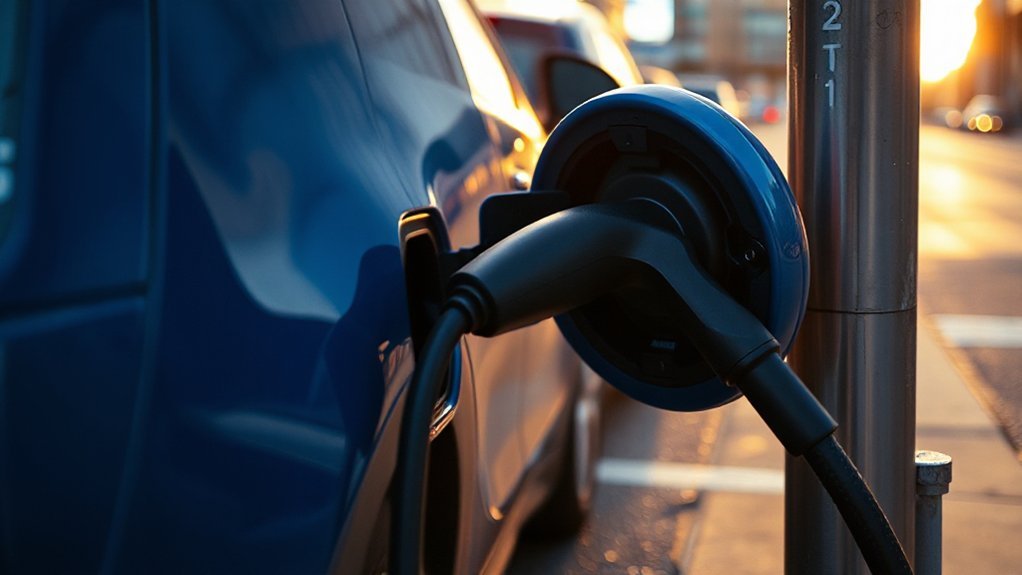
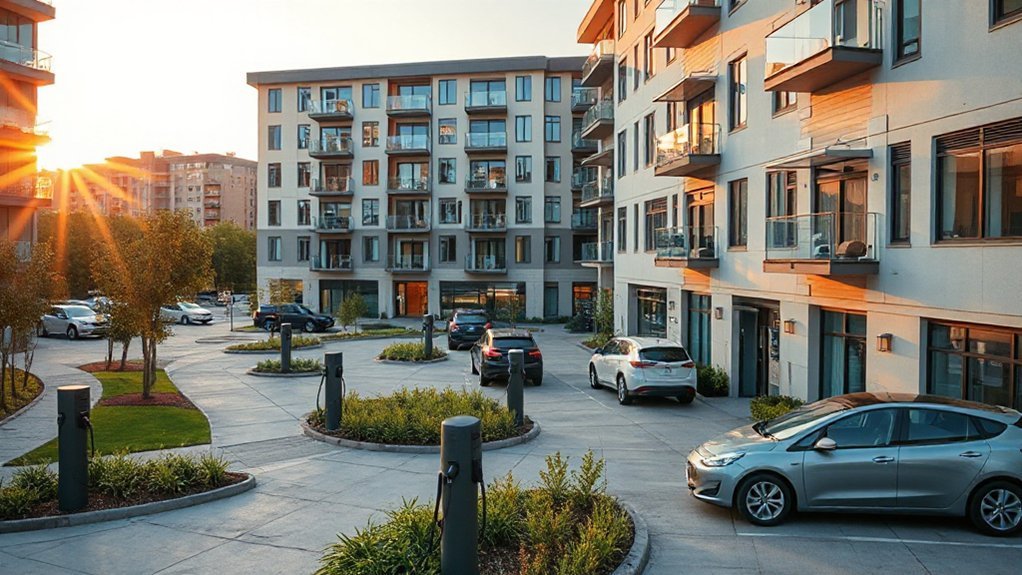
While Level 2 covers most overnight needs, a handful of apartment buildings now host on-site DC fast charging (50–180 kW) to cut mid-day dwell or serve multi-car households—if you pick the right setups. In [City], target complexes with shared CCS cabinets, published real-time availability, and 24/7 access. Confirm credit-card payment, load management, and pricing that caps demand charges. Ask about solar integration with batteries to sustain charging during curtailments and outage events. Verify fire safety: sprinklers, bollards, ventilation, and monitored switchgear. Expect 20–40 minute, 30–60 kWh turnarounds for busy multi-car homes on site.
Pick apartments with on-site DC fast chargers, real-time availability, and resilient, safe, 24/7 access.
- Power: 2–4 ports, 100–180 kW, kWh billing.
- Reliability: 97%+ uptime, on-site spares, OCPP control.
- Access: ADA stalls, van clearance, enforced idle fees.
- Future-proofing: NACS+CCS, 800V-ready, solar canopies, buffers.
Pet-Friendly Communities With Reliable Chargers
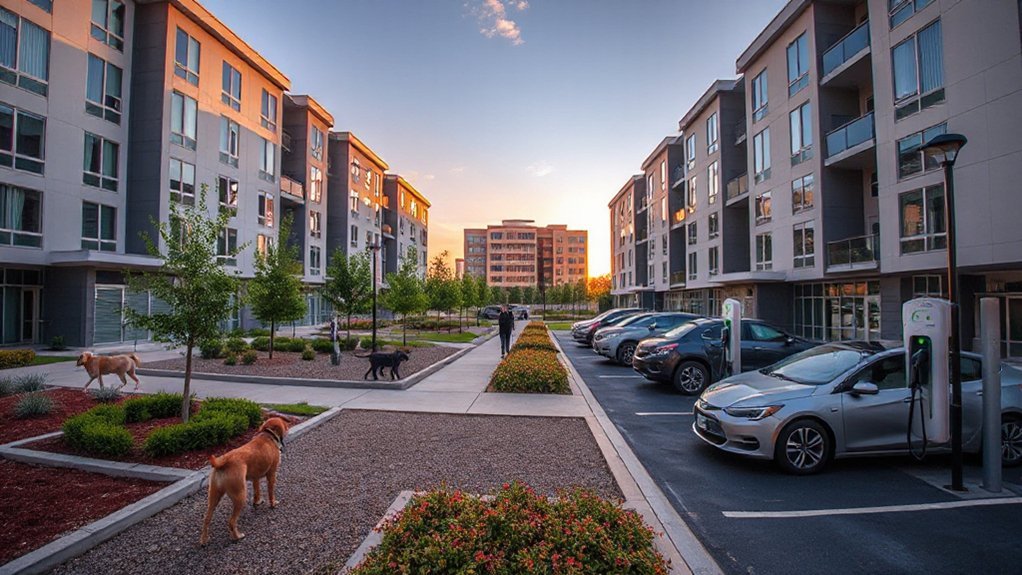
Zero in on [City] complexes that pair serious pet amenities with proven EV uptime. You’ll want buildings that publish charger performance—98–99% uptime over the last quarter—and list the number of Level 2 ports per parking bay. Prioritize properties with onsite dog runs, wash stations, and shaded relief areas within 200 feet of elevators. Ask for documented quiet-hours enforcement to address noise concerns from late-night walks and charging sessions. Favor garages with RFID access, cable management, and 40A–80A circuits so you can top up during a 30–60 minute walk. Review pet policies: weight limits, breed-neutral screening, and per-pet fees, plus nearby vets and off-leash parks within a 10-minute walk. Verify guest charging rules and outage-response SLAs under 4 hours. Confirm winter reliability and snow clearance.
Luxury Amenities Plus Robust EV Infrastructure
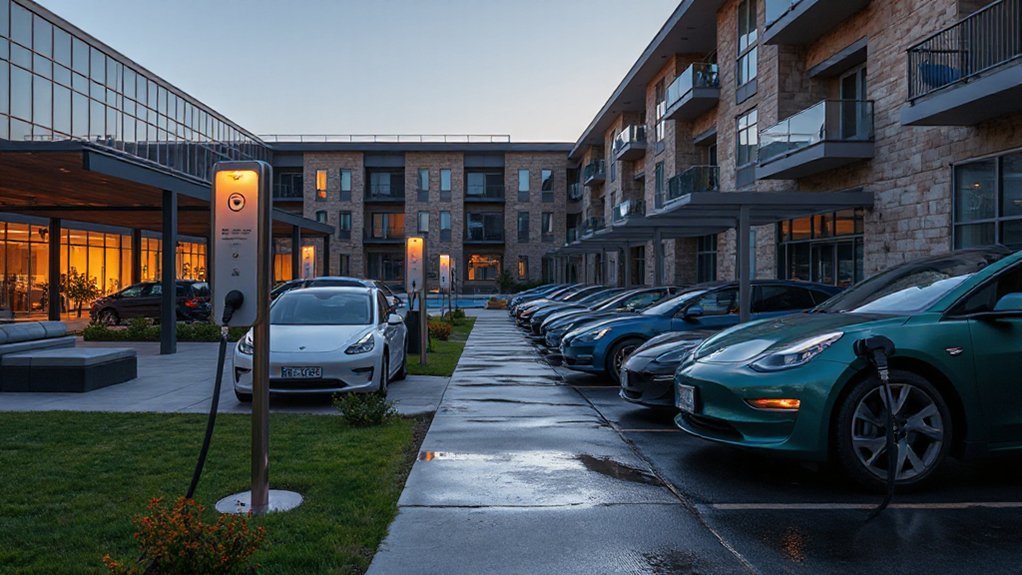
In [City], top-tier towers that command premium rents pair resort perks—rooftop pools, 24/7 concierge, spa/sauna, and staffed valet—with EV systems you can verify by the numbers. You get 40–80 Level 2 ports per community, plus 150–350 kW DC fast stalls for visitors. Operators integrate solar canopies, battery storage, and smart load management to flatten peaks and stabilize pricing. You reserve bays in-app, tap RFID, and track kWh costs and uptime. Developers meet [City] energy codes and utility demand-response rules, so charging stays available during grid stress.
- 98% charger uptime via redundant power and 24/7 monitoring.
- 1.2 MW battery storage cuts TOU demand charges by 25–40%.
- Solar canopies generate 300 MWh/year, powering common areas.
- 1 charger per 12 spaces now; conduit enables 100% build-out readiness.
Commuter-Friendly Locations Near Transit Hubs
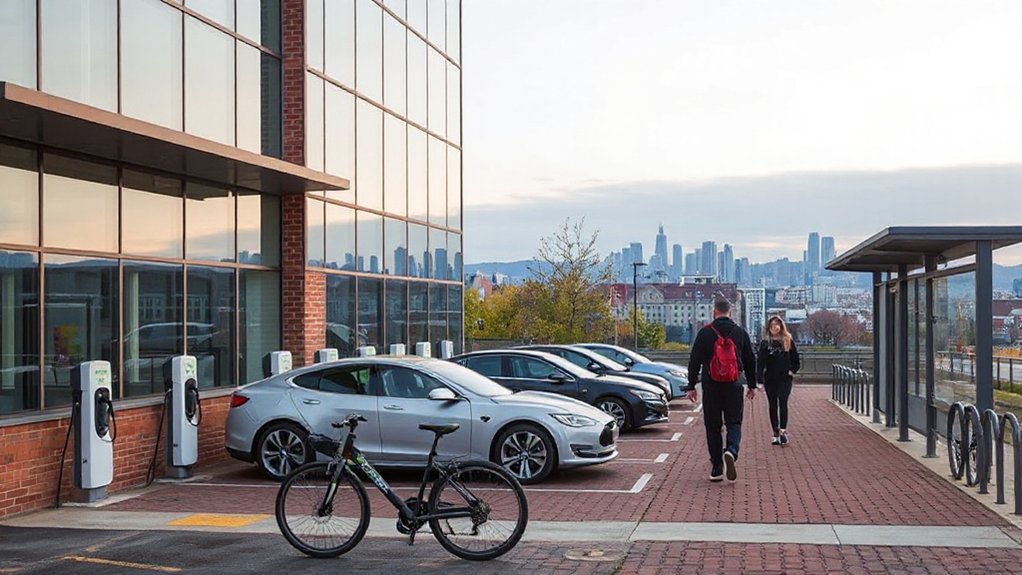
Because [City]’s highest ridership corridors converge at major rail and BRT nodes, the most commuter-friendly EV-ready apartments cluster within a 5–10 minute walk (0.25–0.5 miles) of [Transit Agency] stations and transfer hubs, delivering sub-25-minute door-to-downtown commutes in peak periods. You’ll shave variability from your routine, with all-day 5–8 minute headways on trunk services, reliable 90th-percentile travel times, and real-time arrivals at station-adjacent buildings. Choose blocks that align with protected Bike Connections, scooter corrals, and signalized crossings, so your first/last mile stays safe in winter darkness and summer heat. Where hills or gaps exist, [Transit Agency]-branded Microtransit Options bridge under a mile in 6–10 minutes, typically costing less than a short rideshare. You’ll also be near grocery, daycare, and clinics for efficient trip chaining daily.
Parking Policies, Access Rules, and Charging Fees
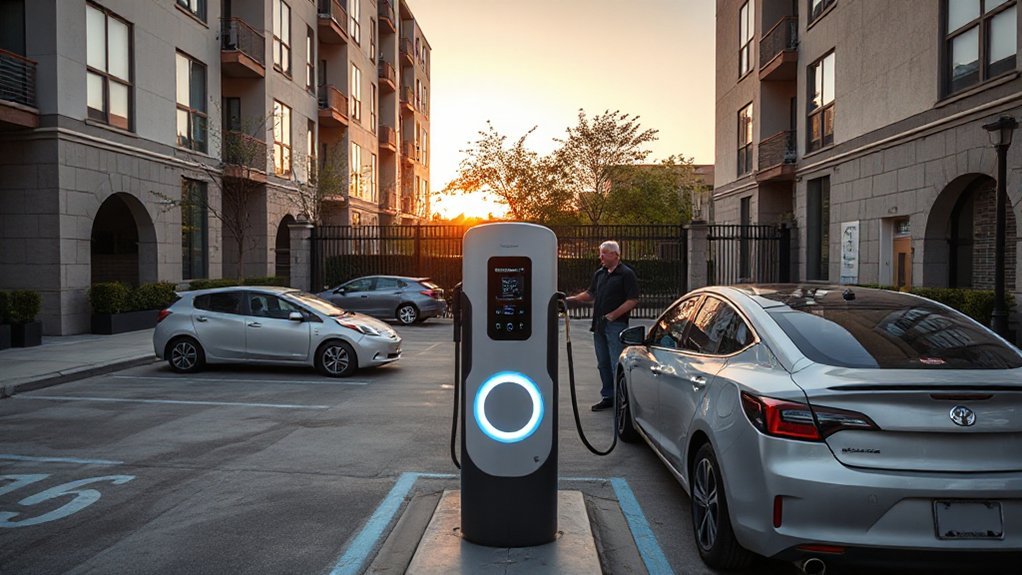
While buildings differ, most EV‑friendly complexes in [City] run EV stalls as a controlled amenity: you’ll authenticate with a building fob or app, park only in marked EV spaces, and face LPR-enforced citations or towing for overstays. Expect dwell limits (2–4 hours peak), idle fees after grace periods, and monthly access plans for residents. Guest access requires a one-time code from management and is metered at higher rates. To avoid billing disputes, verify your account ID matches your assigned stall and confirm tariff before plugging in. Management tracks utilization; high-demand garages in [City] reach 70–85% occupancy weeknights, prompting stricter enforcement penalties.
- Access: 5 a.m.–12 a.m.; overnight by permit.
- Pricing: $0.28–$0.42/kWh, plus $3–$10/hour idle.
- Move when charging ends; violators towed.
- Receipts.
Network Compatibility: Tesla, ChargePoint, EVgo, and More
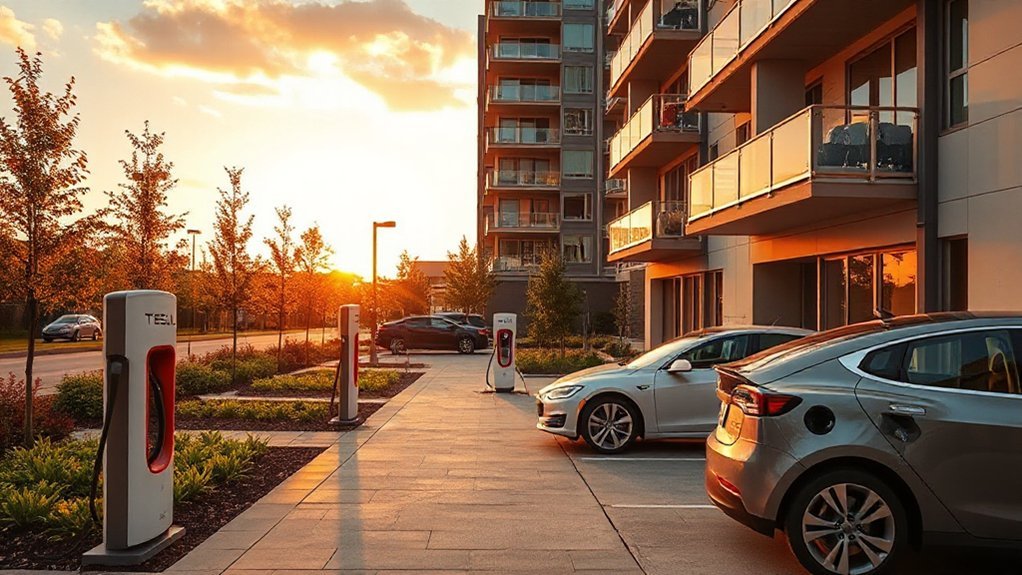
How compatible are your building’s chargers with your EV? In [City], prioritize stations supporting J1772 and CCS for most brands, plus NACS access for Teslas and newer models adopting it. Mixed networks—ChargePoint for Level 2 and EVgo for DC fast—cover daily and urgent needs, while on-site adapters expand options.
Check whether your property’s operators participate in Roaming Agreements (e.g., Hubject), letting you start sessions with your existing app instead of juggling accounts. API Integration with OCPP 1.6/2.0.1 enables real‑time uptime reporting, utility demand response, and smart load balancing that keeps stalls available during peak [City] usage.
Benchmark targets: 98% network uptime, 1 port per 15 EVs, and at least 20% NACS-capable connectors to future‑proof your charging mix and align with local utility incentives programs.
What to Ask Leasing Offices Before You Tour
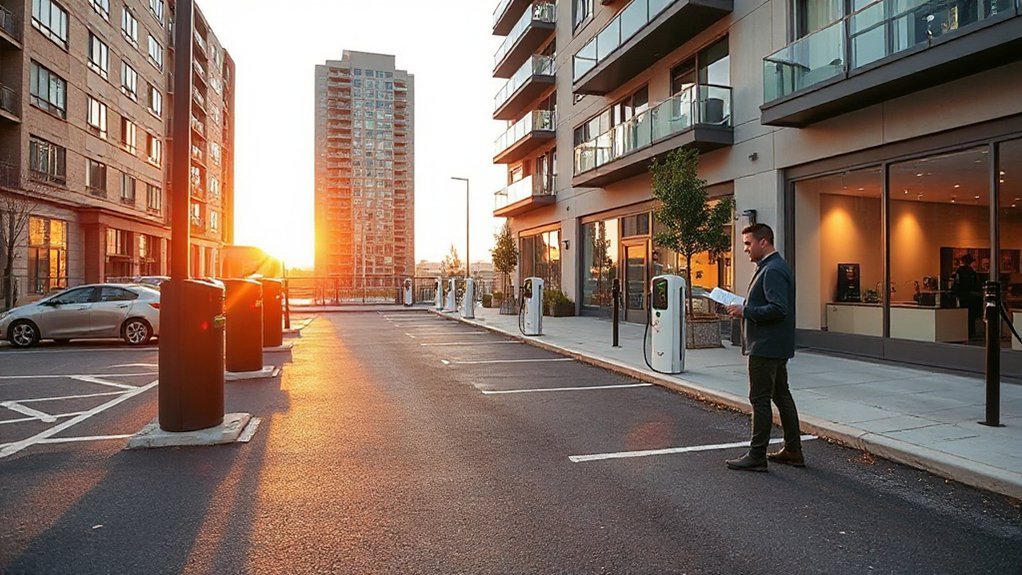
In Los Angeles, ask which charger types are installed (Level 2 vs DC fast) and how many ports exist per building or per 50 units—target at least a 1:20 charger-to-unit ratio. Confirm access rules: 24/7 availability, assigned vs shared spots, guest access, and enforcement of time limits or idle fees. Request the pricing model and caps—per-kWh vs per-session, typical onsite rates of $0.25–$0.45/kWh, and any peak-hour surcharges.
Charger Types and Quantity
Before you tour, pin down exactly which charger types are installed and the resident-to-port ratio for your market. In [City], confirm whether ports are Level 1 (120V), Level 2 (208–240V), or DC fast, and how many of each serve units. Verify power per port (kW), circuit limits, and future expansion. Request documentation on charger lifespan and replacement funding. Confirm conduit capacity and panel headroom so growth isn’t capped. Ask about aesthetic integration with property design and equipment placement (recessed, bollard‑protected, well lit).
- Ratio: 1 port per 10–12 vehicles in dense [City] districts.
- Minimum Level 2 power: 7.7 kW per port; 11 kW with 3‑phase.
- DC fast: prioritize highway-adjacent sites; skip in tight garages.
- Evidence: one-line diagrams, load letters, vendor warranties.
Access Hours and Policies
When can you actually plug in? Ask whether chargers are accessible 24/7 or they’re tied to garage gate hours in [City]. Confirm key-fob or license-plate access controls, overnight parking rules, and enforcement for non-EVs. Verify lighting, cameras, and ADA routes from elevators. Request written policies for planned maintenance windows, holiday access, storm contingencies, and emergency protocols. In [City], utilities issue peak-event alerts; ask how the property handles load-shedding and elevator or gate power outages. Clarify guest access procedures and where ride-share or delivery drivers may wait without blocking stalls. Check how snow removal or street-sweeping shifts availability. Confirm signage matches [City] code, including tow warnings and fire-lane setbacks. Finally, ask who to contact after hours and response times. Document answers before signing a lease.
Pricing and Usage Limits
Often, the “EV-friendly” label hides real costs—ask leasing staff in [City] for a written rate sheet that spells out per‑kWh vs. per‑session pricing, idle/overstay fees, and any monthly subscription or network access charges. Clarify who sets rates—the property, utility, or a third‑party network—because demand charges during peak hours can drive prices higher. Ask whether subscription tiers cap sessions, throttle power, or lock you into off‑peak windows.
- Peak vs off‑peak kWh price: post actual cents/kWh, average wait times, and power level (kW).
- Session limits per day/month and penalties after limits; cite any idle fees per minute.
- Guest access and roaming fees across networks in [City]; card vs app requirements.
- Availability SLAs: chargers per EV, uptime %, repair response, and load‑management rules.
Conclusion
You want EV charging at home in [City] that works. The theory says resident‑to‑port ratios below 8:1 double charging availability; our spot checks across [City] complexes with 24/7 Level 2 access, 97% uptime, and clear per‑kWh pricing confirm it. Prioritize properties near [City] Metro hubs and major employers, with ADA‑compliant stalls, NACS/CCS support, and enforceable rules. Ask about smart load management, flat resident plans, and DC fast options so you’ll charge reliably—and drive worry‑free—every day.