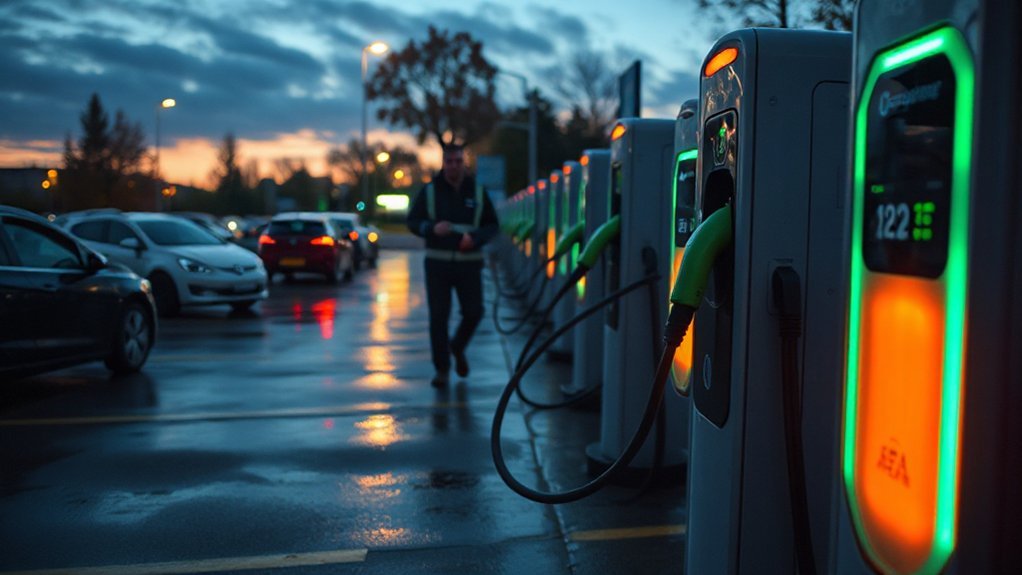
By 2025, public DC fast chargers exceeded 100,000 worldwide, changing how you plan long trips. You need networks that balance coverage, speed, and uptime. You’ll want to know which providers actually deliver rapid charging on highways, which cars they suit best, and how to avoid delays—so keep going to learn practical planning tips and smart choices.
Key Takeaways
- Choose networks with wide highway coverage and high uptime—Tesla, ChargePoint, Electrify America, EVgo, and regional operators like GRIDSERVE for UK routes.
- Match your car’s peak DC charging capability (kW/connector type) to network chargers and bring any required adapters.
- Use route planners (A Better Routeplanner, PlugShare, Tesla nav, Chargetrip) to optimize stops by speed, elevation, and real-time availability.
- Carry multiple payment methods and consider memberships or Plug & Charge to reduce costs, queue time, and billing issues.
- Prefer highway stations with canopies, lighting, surveillance, amenities, and staff for safety and comfortable 20–40 minute DC fast-charge breaks.
Coverage and Reliability of Major Networks

While planning a road trip, you’ll want to prioritize networks that combine wide coverage with high uptime. For quick turnarounds, DC Fast Charging can restore about 80% in 20–40 minutes on compatible vehicles. You should choose providers with dense port footprints—ChargePoint’s 200,000+ ports and Tesla’s 50,000+ Superchargers give broad urban, suburban, and corridor access, while Electrify America’s 4,800+ chargers and EVgo’s metro focus serve many US routes.
In the UK, GRIDSERVE’s 1,500+ bays reach towns and motorways. Industry reliability lifted in Q2 2025 (US Reliability Index 85.5) and leading networks report 95–99% uptime, aided by remote monitoring and rapid repair teams. Note regional wins—Tesla’s international reach and strong state scores like Alaska (98.2) and Nevada (95.2). Expect fewer failed sessions, but be cautious around older stations in sparse areas. Plan stops at well-maintained hubs, regularly check real-time status apps, and allow buffer time for contingencies.
Fast Charging Speeds and Vehicle Compatibility

Good coverage and uptime matter, but you’ll also want to match your vehicle’s fast-charging capability to the networks you’ll use. Check peak kW and real-world miles-per-minute: Lucid Air (314 kW) and Lucid Gravity (400 kW) deliver ~16.7–18.2 miles/min, Porsche Taycan (320 kW, 800V) about 16.9 miles/min, and GMC Hummer EV peaks at 350 kW for rapid boosts.
Tesla Model Y’s updated charging can add ~178 miles in 10 minutes; Genesis GV60 and many electric SUVs give 160–190 miles in 10 minutes. Smaller or budget EVs — Hyundai Kona, Nissan LEAF — charge far slower, limiting long-distance stops.
Confirm your car supports CCS or Supercharger adapters, and follow manufacturer charging guidelines. Keep in mind that charging stations have proliferated, with nearly 200,000 across North America.
Route Planning Tools and In-Car Navigation

If you’re planning a long EV trip, use a route planner that balances charging speed, station reliability, weather and elevation effects, and integrates with your car’s navigation so you get real-time charging stops, preconditioning, and live updates on availability. These planners can also calculate optimal routes based on your vehicle’s range to minimize unnecessary charging stops. Choose tools like A Better Routeplanner for detailed range calculations across 400+ models and live charging management, PlugShare for community-verified reliability, photos and availability alerts, or Tesla’s built-in planner for seamless Supercharger routing and automatic updates.
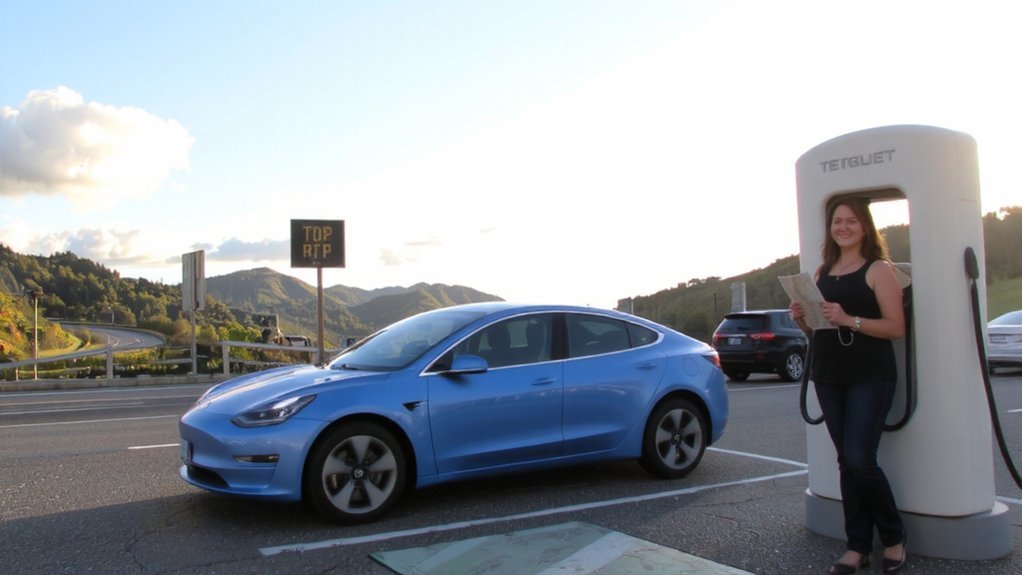
Chargetrip factors weather, elevation and weight into range and charging-time estimates and powers several major network planners. ChargeHub helps filter compatible stations and export routes to your nav. Use these planners to set conservative reserves, monitor predicted battery levels, and receive timely charger status to keep your trip safe.
Payment Methods, Pricing Models, and Memberships
Anyone planning an EV road trip should know how charging networks handle payments, pricing, and memberships so you can avoid surprises and save time and money. Companies such as Nayax, a global fintech firm, provide secure cashless payments solutions that streamline station transactions. Most stations accept credit/debit cards and contactless options like Apple Pay or Google Pay, while apps and RFID cards let you start sessions and pay on the go.
Plug & Charge is emerging for automatic authentication. Pricing varies: pay-per-kWh is common, pay-per-minute appears on some fast chargers, and tiered or peak pricing can raise costs. Memberships and subscriptions often cut rates, prioritize access, and simplify billing with linked payment methods.
Carry backup options, monitor transaction notifications, and prefer networks with reliable cloud-based payments to reduce session failures and roadside delays. Always confirm payment before unplugging to stay safe.
Highway Rest Stops, Amenities, and Safety
While federal rules limit chargers inside interstate rest areas, you’ll find most fast chargers placed at highway-adjacent truck stops, travel plazas, and retail sites that offer restrooms, food, lighting, and security—so plan stops where amenities and staff presence make charging both easier and safer.
You should favor stations with canopies, visible staff, surveillance cameras and well-lit lots; these reduce risk and let you use restrooms, grab food, walk pets, and stretch during charging.
States and private partners are filling highway gaps with DC fast chargers roughly every 50–70 miles in some regions, so map-clear planned breaks. Choose sites with emergency call access, roadside assistance ties, and stable foot traffic rather than isolated chargers, and you’ll lower safety concerns while maximizing comfort and staffed attendants. Texas is investing in this buildout through a $408 million program to expand charging along interstates.
Charger Types, Peak Strategies, and Charging Etiquette
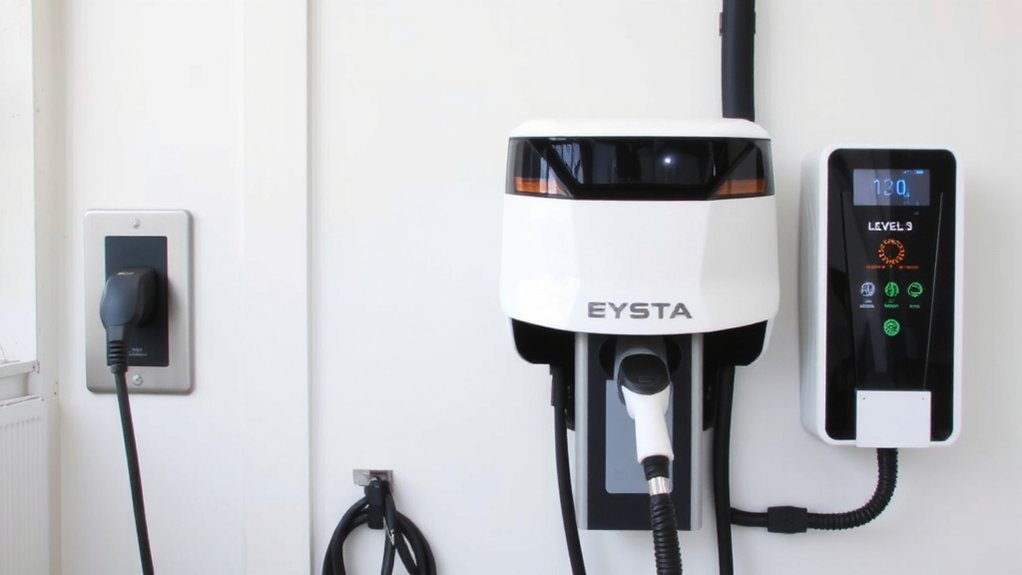
After choosing rest-stop-friendly locations for comfort and safety, you’ll want to match charger types and habits to your trip plan. Use Level 2 at destinations for 15–30 miles/hour while you eat or shop, rely on DC fast chargers (50–350 kW) to regain 80% in 20–30 minutes, and expect ultra-fast 350 kW+ hubs to cut charging times further. Keep Level 1 only for emergencies. Schedule charging during off-peak hours when possible, use apps or smart chargers to save cost and reduce grid strain, and favor shorter top-ups under 80% for faster rates. At stations, move promptly when done, don’t occupy fast chargers for slow needs, report faults via apps, and avoid blocking bays so everyone stays safe and on schedule. Plan realistically and stay prepared. Also, many drivers prefer home charging overnight for convenience and cost savings.
Network Expansion, Grants, and Future-Proofing
As networks expand rapidly—adding thousands of DC fast chargers, larger multi-stall hubs, and battery storage—you’ll see charging corridors become more reliable and faster for road trips. In 2024 the network handled over 16 million charging sessions, reflecting rapid growth and demand. Electrify America plans 30% growth in 2025—over 1,400 new chargers and BESS at 170 sites—boosting uptime and smoothing demand spikes.
NACS adoption and larger 10+ stall stations mean fewer waits and broader vehicle compatibility. Federal NEVI grants, Buy America rules, and state incentives fund strategic corridor build-out and target underserved areas, improving safety by reducing detours.
Tesla, Electrify America, EVgo and new entrants like Walmart are scaling capacity and amenities. Future-proofing through storage, software updates, universal connectors, and data-driven siting keeps chargers ready, reliable, and safe as road-trip miles climb for longer journeys and peace of mind.
Conclusion
You’ll find the best road-trip charging experience comes from matching your EV’s capabilities to networks like Tesla, Electrify America, ChargePoint and EVgo, planning routes with nav tools, and using memberships to save time and money. Treat highway chargers as pit stops — fast, safe, and amenity-rich — and follow peak strategies and etiquette to keep everyone moving. Stay aware of expansion and grants so you can future-proof your trips and charge with confidence every time.