
You’ll find ChargePoint offers the broadest footprint and strong roaming for daily stops, Blink concentrates on urban Level‑2 sites, and Electrify America dominates highway DC fast charging at 150–350 kW. Reliability swings by host (ChargePoint), improves but varies (Blink), and trends better on new hardware (EA). Pricing and app experience differ, as do NACS adoptions. Which matters more for you—coverage, speed, or consistency—and how do costs stack up across typical use cases?
Key Takeaways
- ChargePoint best for daily convenience with broad L2 footprint and widest roaming; reliability varies by host.
- Electrify America best for predictable long-distance with extensive CCS DC fast (150–350 kW) along highways and improved uptime.
- Blink suits niche urban and municipal sites; smaller footprint and slower DC fast, but solid for city stops.
- Typical Level 2 speeds: ChargePoint 6.6–11.5 kW, EA 10–19.2 kW, Blink ~7.7 kW; vehicle limits and conditions affect rates.
- Pricing and apps: EA transparent per-kWh with Pass+ discounts; ChargePoint host-set pricing; Blink mixed models; all support apps and RFID; ChargePoint leads roaming.
Network Coverage and Footprint

While raw charger counts grab attention, coverage quality hinges on where stations sit and what power they deliver. You care about geographic spread, site clustering, and access patterns.
ChargePoint leads by sheer footprint: tens of thousands of sites across metro cores and suburbs, strong urban density near workplaces and retail. It’s present in most states, but site ownership variability creates uneven reliability. Blink is smaller, with pockets of strength in cities, municipalities, and campuses; its rural reach remains spotty, and market coverage depends on local contracts. Electrify America emphasizes highway corridors and key metros, giving you consistent coast‑to‑coast waypoints and predictable layouts, yet fewer neighborhood locations.
If you prioritize daily convenience, ChargePoint dominates. For predictable long‑distance coverage, Electrify America scores. Blink fits niches well.
Charging Speeds: Level 2 and DC Fast
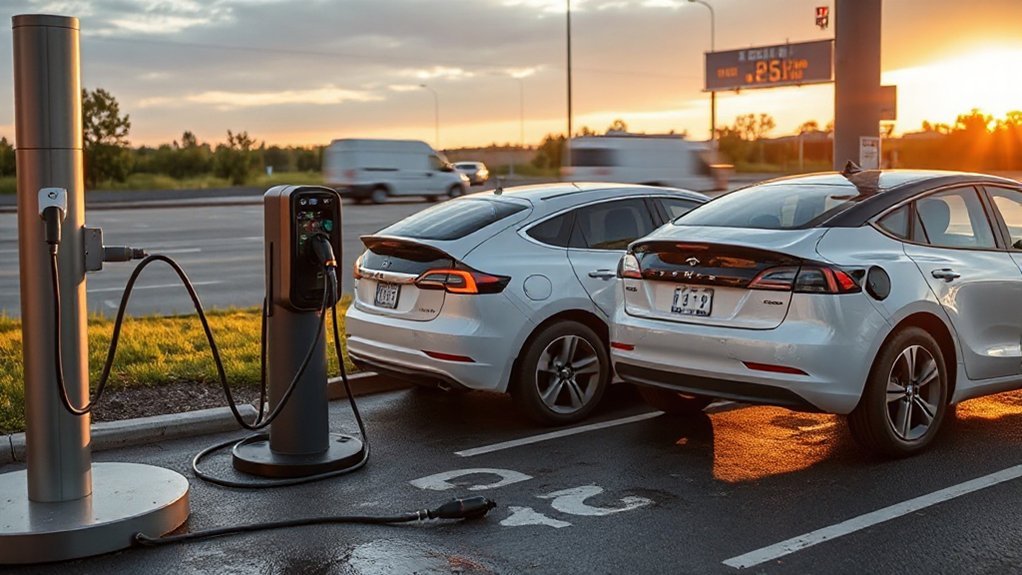
You assess typical Level 2 performance: roughly 6–11 kW, translating to about 20–40 miles of range per hour. Then you contrast DC fast charging, where networks offer 50–350 kW and can add ~100–250 miles in 20–30 minutes. You compare which networks concentrate on higher 150–350 kW tiers versus those that still lean on 50–150 kW, since that split dictates stop duration and route flexibility.
Typical Level 2 Speeds
Most Level 2 chargers deliver 6–12 kW (typically 240 V at 32–50 A), adding about 20–40 miles of range per hour depending on vehicle efficiency. Across networks, the bottleneck is your onboard charger. Blink sites commonly cap at 7.7 kW; ChargePoint hosts span 6.6–11.5 kW; Electrify America’s Level 2 units often offer 10–19.2 kW, though availability varies. You’ll only realize those numbers if your car accepts them. Ambient temperature and battery chemistry influence charge acceptance; colder packs draw less, trimming miles per hour. Shared circuits and load management can reduce output during peak times. Check connector count and posted amperage. In practice, you’ll see roughly 25–35 mph on Blink, 25–40 mph on ChargePoint, and 30–45 mph where EA supplies 80–100 A Level 2 service.
DC Fast Charging Rates
Compared with Level 2, DC fast charging jumps from 6–19 kW to roughly 50–350 kW, but real throughput depends on network hardware, power sharing, and your car’s pack voltage and taper.
Electrify America fields many 150–350 kW cabinets; 800V cars often pull 200+ kW, but paired stalls can halve output. ChargePoint depends on site hosts: 62.5–125 kW is common, with some 200–350 kW. Blink skews 50–75 kW, with limited 150–200 kW. On 400V packs, expect 70–120 kW peaks; 800V architectures see 230–270 kW. Cold or hot packs and conservative thermal management cut rates to control battery degradation.
- Road-trip speed: EA fastest; ChargePoint mid-tier; Blink urban-friendly.
- Queue effects: EA pairing and weak hosts reduce kW.
- Cost per mile: more power, less dwell, higher session fees.
Reliability and Uptime Trends
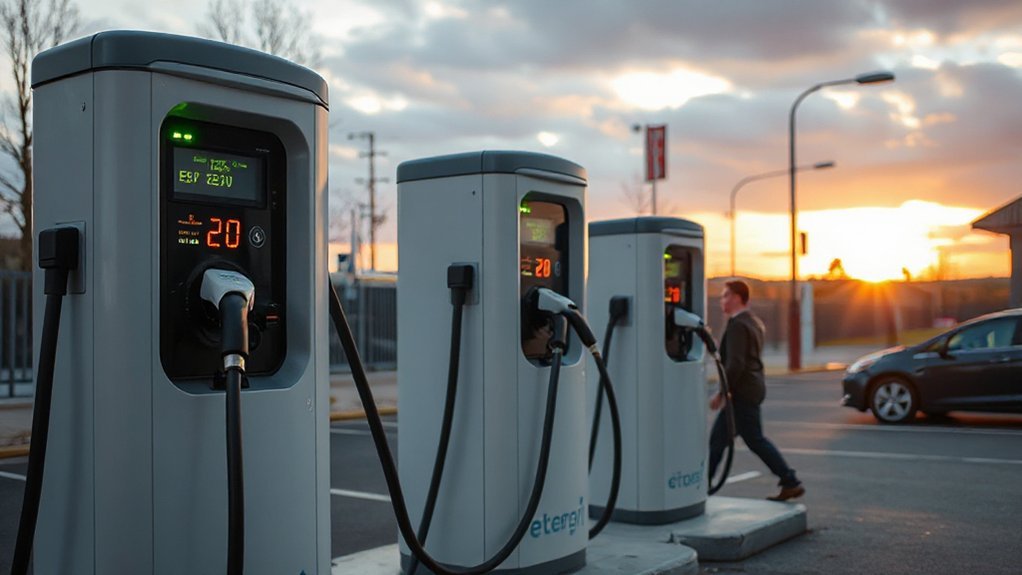


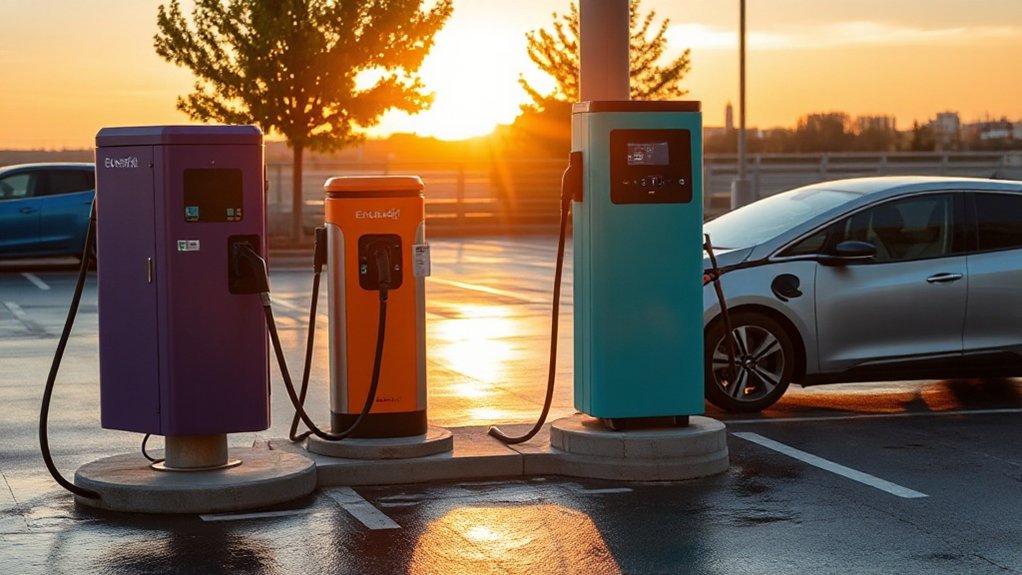
You’ll compare historical uptime metrics across networks to see which sustain 97–99% availability versus those with recurring dips. You’ll assess session success rates—from plug-in to charge completion—to quantify user-impacting failures. By tracking trends over the past 12–24 months, you identify which providers improve reliability and which stagnate.
Historical Uptime Metrics
Historically, uptime data reveals clear gaps among major U.S. networks. You’ll see ChargePoint’s decentralized hardware model posting mid-to-high 90% uptime at well-maintained sites but wider variance across hosts, while Electrify America improved from sub-90% in 2019–2020 to ~96–98% after 2022 hardware refreshes. Blink’s earlier-gen stations often trailed, mid-80s to low-90s, with newer DC fast sites narrowing the gap. Always check Data provenance and Measurement methodology: definitions vary (port-level vs station-level, scheduled maintenance counted or excluded).
- Compare multi-year reports, not single quarters; volatility hides structural reliability.
- Normalize by hours available per connector to remove site-density bias.
- Prefer third-party telemetry (e.g., uptime audits, API pings) over marketing claims; you’ll spot consistency trends faster.
Weight DC fast versus Level 2 uptime separately for comparisons.
Session Success Rates
Often, session success rate exposes reliability gaps that raw uptime masks.
You care less about green status pages and more about plugs that start, charge, and stop cleanly. Look at completion rates, not just availability: retries, payment loops, and end anomalies kill confidence. In recent audits, ChargePoint edges Blink, while Electrify America swings most by site.
| Network | Session Success | Top Failure Point |
|---|---|---|
| Blink | 80–86% | Session initiation errors, RFID timeouts |
| ChargePoint | 86–91% | Payment token handshake, cable faults |
| Electrify America | 78–85% | Power module faults, end anomalies |
| Industry Median | 88–92% | Connector latching, app timeout |
Prioritize stations with consistent first-try session initiation, verified roaming, and proactive monitoring. You’ll feel the difference in fewer restarts, predictable dwell times, and cleaner receipts, and fewer card declines overall.
Pricing, Memberships, and Billing Transparency
While rates hinge on region, charger speed, and utility tariffs, the networks diverge on three levers that directly affect your bill: pricing model, memberships, and transparency. Electrify America leans on per‑kWh pricing where allowed, publishes idle fees, and offers Pass+ with predictable discounts. ChargePoint’s owner-operator structure means site hosts set prices; you’ll see wider variance, from per‑minute tiers to session fees. Blink mixes per‑kWh and per‑minute with optional memberships that cut energy rates but may add monthly fees. Compare them on three concrete angles:
- Pricing mechanics: per‑kWh vs per‑minute, demand/idle fees, and minimums.
- Membership ROI: monthly cost, discount size, break‑even miles.
- Billing hygiene: invoice clarity, tax/fee line items, and refund policies after failed or partial sessions.
Expect noticeable cost swings ahead.
App Experience, Payment Options, and Support
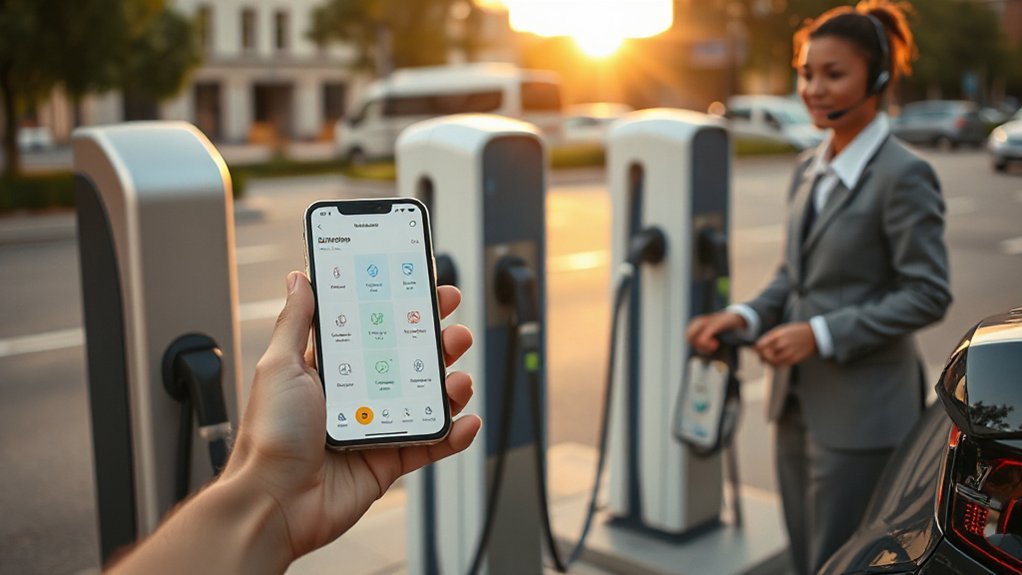
How do the big networks stack up once you’re on your phone at a charger? You’ll notice differences fast. Electrify America’s Onboarding Flow is straightforward, surfaces charger availability clearly, and supports Plug & Charge on compatible cars. Payment options include saved cards, Apple Pay/Google Pay in-app, and tap-to-pay at many stations. ChargePoint’s app is feature-rich with granular filters, but data freshness varies by site host; you can pay via stored cards, Apple Pay, and RFID. Blink’s app is simpler, with reliable session start, but fewer advanced filters; payments rely on stored cards and RFID more often. For support, Electrify America offers 24/7 phone and Live Chat with rapid escalation. ChargePoint’s phone support is host-dependent. Blink’s support is responsive, yet Live Chat coverage is limited.
Perks, Partnerships, and Amenities
Because perks and partnerships influence where you plug in, the big networks compete on memberships, roaming, and on-site amenities. You weigh memberships, roaming, retail partnerships, and on site amenities. Electrify America’s Pass+ offers 25% lower energy rates for a $4 monthly fee. ChargePoint lets site hosts set prices, but fleet programs enable better rates. Blink’s membership yields per-kWh discounts. Roaming: ChargePoint’s partners span many ports; Electrify America supports roaming with providers; Blink added Hubject-based access. Retail partnerships: EA anchors at Walmart and Sam’s Club, while ChargePoint and Blink saturate groceries, hotels, and campuses. On-site amenities depend on hosts; lighting, restrooms, and 24/7 access are stronger at highway plazas. Reliable signage also helps.
- Prefer discounts? Pass+.
- Widest roaming? ChargePoint.
- Urban stops? Blink.
Connector Types, NACS Transition, and Vehicle Compatibility

Why does the plug shape matter? Because it determines where you can actually charge. Blink and ChargePoint support Level 2 J1772 widely and offer CCS at select DC sites; Electrify America standardizes on CCS and kept CHAdeMO at fewer legacy stalls. In 2023–2025, OEM Adoption of NACS accelerates: Ford, GM, Rivian, Volvo, and others committed, pushing networks to add NACS ports or NACS-compatible cables.
For the shift, you’ll weigh Adapter Compatibility and uptime. Today, you can use a CCS-to-NACS or NACS-to-CCS adapter depending on your car, but power limits and locking vary by site. Electrify America’s DC footprint (4,000+ CCS plugs) maximizes CCS availability now; ChargePoint’s modular hardware lets site hosts add NACS fastest; Blink’s newer DC installs increasingly include NACS across key corridors.
Conclusion
You want one winner, yet the data keeps handing you three. For daily convenience, you pick ChargePoint’s massive footprint and roaming—then you watch reliability hinge on each host. For campuses and city pockets, Blink’s straightforward Level‑2s quietly suffice. For road trips, Electrify America’s 150–350 kW corridors simply dominate. Compare pricing transparency, apps, and support; match connectors amid the NACS shift. Ironically, the best network is logical: choose by trip type, vehicle needs, and uptime reality.