You can install an EV charger in your garage, but you’ll need to plan carefully. You’ll check your panel capacity, pick the right Level 1 or Level 2 unit, handle permits, and plan cable routing for safety. There are cost and rebate variables too — here’s what to check next.
Key Takeaways
- Yes—you can usually install an EV charger in a home garage; Level 1 needs no special wiring, Level 2 requires a 240V circuit.
- Level 2 chargers need a dedicated 240V circuit sized to continuous current, proper breaker, and matching conductors (commonly 50A with 6 AWG copper).
- Mount the charger near the parked car on the nearest wall, minimize tripping hazards, and provide cable management and ventilation space.
- Most jurisdictions require permits and inspections for new 240V circuits or service upgrades; submit plans and keep records.
- Hire a licensed electrician to perform load calculations, confirm panel capacity, install breakers, GFCI/protection, and ensure code-compliant, safe installation.
Assessing Your Garage Layout and Charger Placement
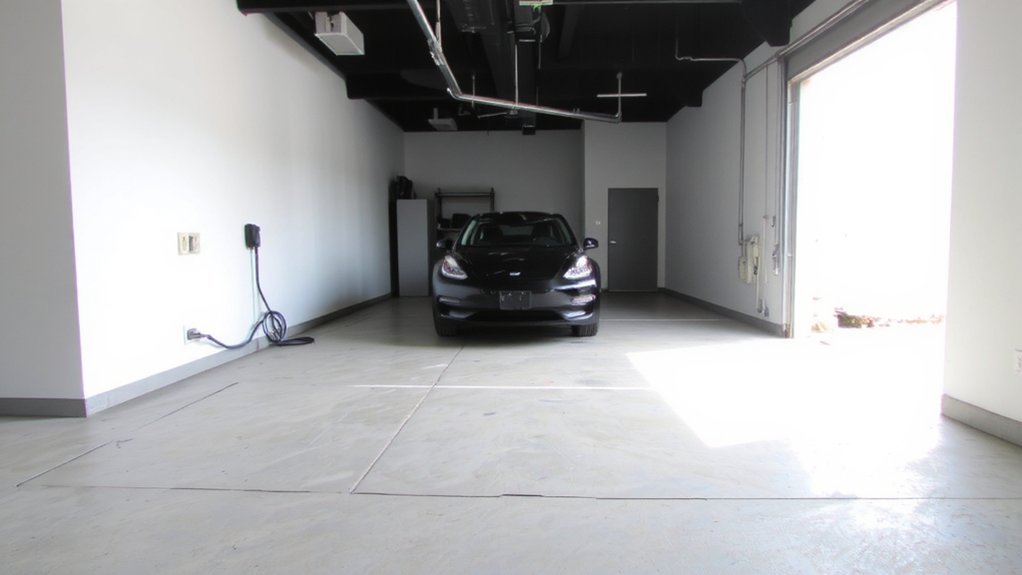
When evaluating your garage layout, start by picturing where the car parks and mount the charger on the wall nearest the vehicle’s charging port so the typical 5 m cord reaches without tension or crossing walkways. New one- and two-unit homes must have electrical conduit installed capable of supporting a Level 2 EV charger. You should place chargers to minimize tripping and accidental impact, keeping them away from vehicle paths and high foot-traffic zones. In single-car garages, favor a front corner near the parking spot; in two-car garages, position units centrally if both cars need access.
Keep the area clutter-free, provide cable management to lift cords off the floor, and leave clear ventilation space to prevent overheating. Mount at a safe ergonomic height and follow manufacturer and local mounting recommendations to maintain accessible, hazard-free charging, and secure all connections before each use.
Home Electrical Service Requirements and Load Calculations
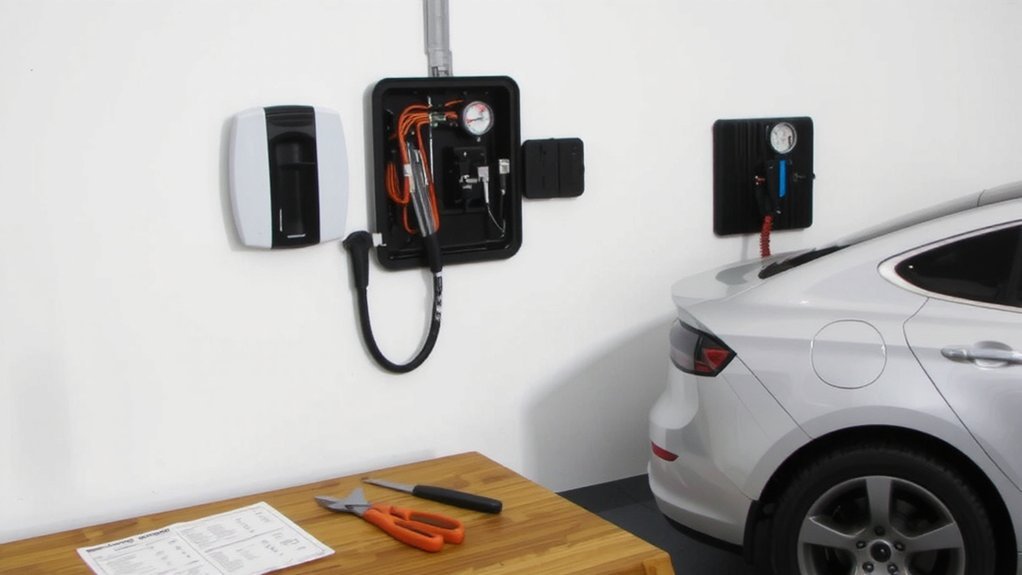
Check your service panel capacity (e.g., 100‑amp vs 200‑amp) since that determines whether you can add a charger or need an upgrade. For most homeowners, a dedicated Level 2 charger is recommended because Level 2 chargers use a 240‑volt circuit and charge 3–10 times faster than Level 1. You’ll also need a dedicated 240V circuit—often a NEMA 14‑50 or a hardwired line—with the correct wire gauge and breaker sized to the charger.
Do a basic load calculation (subtracting existing appliance demand from panel capacity) or install load management to guarantee you won’t overload the system.
Service Panel Capacity
Service panel capacity determines whether your home can safely support a Level 2 EV charger. Check your panel rating—most homes have 100‑
Developers and homeowners should account for Electrical Panel Sizing.
Dedicated 240V Circuit
A dedicated 240‑volt circuit is required for any Level 2 EV charger and must be sized to the charger’s continuous current—NEC requires circuit capacity at 125% of the charger’s maximum load, so an 80‑amp charger needs a 100‑amp breaker and appropriately gauged conductors.
You should install a dedicated double‑pole breaker, match conductor gauge to amperage, and don’t repurpose dryer or range circuits. Grounding, weatherproofing, and continuous‑service rated wiring protect against overheating and faults. Always follow NEC Article 625 and hire a licensed electrician to verify panel capacity and proper breaker sizing. Installing a 240V outlet will reduce charging time compared to a standard 120V outlet.
- Visualize a new breaker slot feeding 240V to your garage.
- Imagine thick, insulated conductors running in conduit to the charger.
- Picture a labeled, locked breaker dedicated solely to EV charging safely.
Load Calculation Basics
When you add a Level 2 EV charger, perform a load calculation to guarantee your home’s electrical service can handle the extra demand. A proper calculation, required by the NEC, verifies your panel rating (100A, 150A, 200A) can support existing loads—HVAC, kitchen, laundry—and the charger (typically 7.2–11.5 kW).
Treat EV charging as a continuous load and limit it to 80% of breaker rating. Identify charger amperage, list appliance wattages, convert to amps, sum loads, and apply NEC factoring rules. Watch for hidden or simultaneous peak loads that can trip breakers.
If capacity’s insufficient, consider a panel upgrade, energy management, circuit sharing, lower-amperage charger, or off‑peak charging. Always consult a licensed electrician to ascertain safe compliance. Document the calculation and keep a copy for inspectors. Also keep in mind household electricity is measured in volts and amps.
Choosing the Right EV Charger Type and Power Level
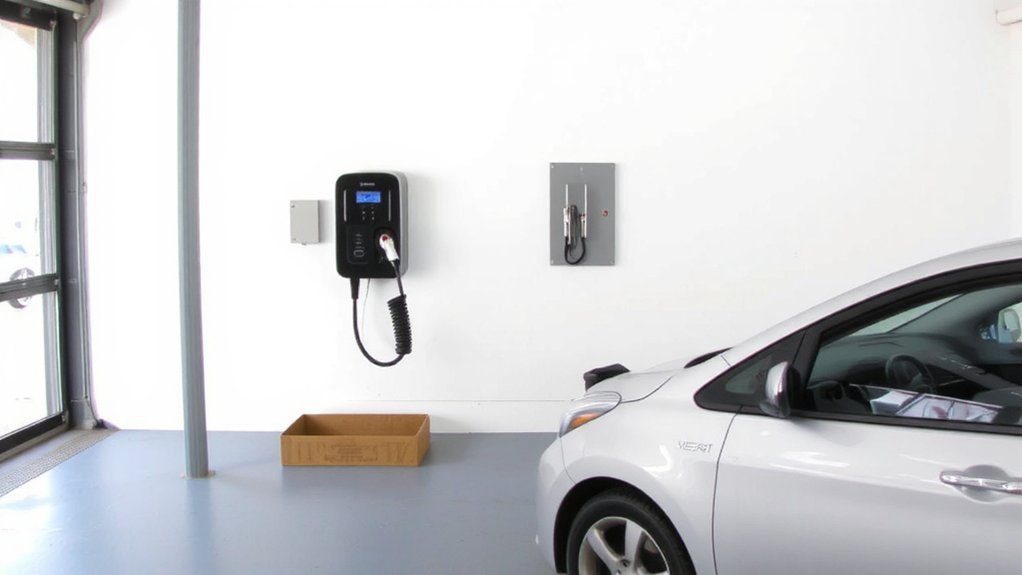
If you’re deciding which charger to install in your garage, focus first on how far you drive and what your EV accepts: Level 1 (120V) gives about 3–5 miles/hour and needs no special wiring, while Level 2 (240V) — either hardwired or plug-in — delivers far faster charging (typically 16–50 amps, ~3.8–12 kW) and is the common home choice.
1. A compact Level 1 cord tucked on a wall hook for light drivers.
2
A strong option is the Emporia Pro, which offers load balancing and a powerful tracking app for monitoring energy use.
Permits, Codes, and Municipal Inspections
Before you buy or install a Level 2 unit, check local permitting and inspection rules—most U.S. jurisdictions require permits for 240V circuits, panel upgrades, or trenching, and failing to follow them can lead to fines, insurance problems, or rework. Most Level 2 chargers require a dedicated 240V circuit. You’ll typically submit a permit application with location, electrical overview, charger type, diagrams, and load calculations.
Hire a licensed electrician who knows local code and can coordinate with your utility if service upgrades are needed. Expect municipal inspections after installation; inspectors confirm that work matches approved plans and code. If an inspection fails, you’ll correct issues and schedule re-inspection.
Keep permits, inspection reports, and approvals for warranty, insurance, and resale. Contact your building department early to avoid delays. Noncompliance can increase costs and hazards substantially.
Wiring, Breakers, Grounding, and Safety Components
Because an EV charger ties directly into your home’s electrical system, you need a dedicated 240‑volt circuit sized and protected for continuous load—typically a 50‑amp breaker with 6 AWG copper conductors for common Level 2 installs—run in appropriate conduit and supported per code. For most home installations you’ll be installing a 240-Volt circuit to the charger.
Install a dedicated 240‑volt circuit for Level 2 EV charging—typically 50‑amp with 6 AWG copper, in proper conduit
You’ll also run a four‑conductor cable (hot, hot, neutral, ground), terminate it correctly at the panel and charger, and guarantee GFCI protection for residential Level 2 units.
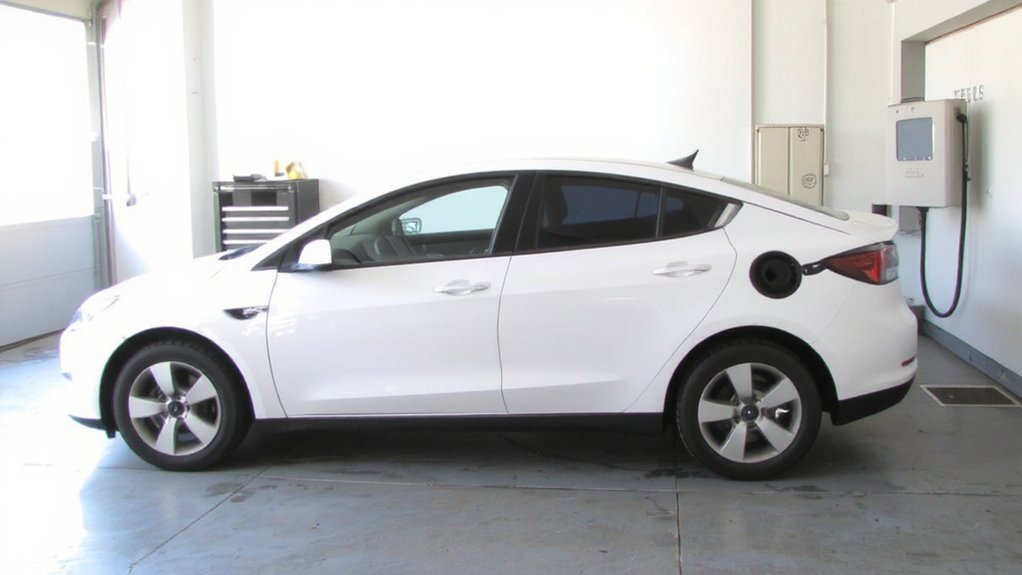
Match breaker type to wire and panel, plan for a 50‑amp breaker even if initial draw is lower, and consult local NEC/CEC rules. Use certified equipment, consider surge protection, and hire a licensed electrician.
Picture the setup:
- Conduit entering panel neatly.
- Four‑strand cable labeled.
- GFCI breaker and clear disconnect for safety.
Mounting, Conduit, and Cable Management Solutions
Now that you’ve got the circuit, breaker, and grounding sorted, mounting, conduit routing, and cable management determine how usable and durable the installation will be. Many homeowners find wall-mounting midway on the garage wall works well because the typical Grizzl-e Classic setup provides about a 25 ft reach.
Choose panel, wall, or ceiling mounts based on reach, door swing, and vehicle position: panel mounts between bays give dual-side access; wall mounts midway offer about 25 ft of reach; ceiling mounts with tool balancers store retractable chargers.
Install sturdy backer boards for heavy units. Run metal or PVC conduit sized for easy pulls and future upgrades, keep continuity, and avoid garage door tracks or shelving.
Use wall holders, retractable reels, swivel arms, or simple clamps to keep cables off the floor, avoid sharp bends, protect floor crossings, inspect regularly for wear, and replace damaged parts when necessary.
Hiring a Licensed Electrician Versus DIY Risks
Often people try DIY to save money, but installing a 240V EV charger exposes you to serious safety, code, and financial risks that usually outweigh the upfront savings. You should hire a licensed electrician who understands NEC requirements, load calculations, grounding, and permit processes.
DIY 240V EV charger installs invite safety, code, and insurance risks—hire a licensed electrician instead.
Professionals use calibrated tools, correct wire sizing, and secure connections that reduce fire and electrocution risks and protect warranties and insurance coverage.
- Visualize a properly grounded circuit, neat conduit, and a labeled breaker.
- Imagine a failed inspection avoided because permits and code were followed.
- Picture warranty protection and reduced liability when a pro signs off.
Choosing a pro limits hidden long-term hazards and gives you documented, code-compliant work. Ask for proof of license, insurance, and a written scope of work. Keep in mind a Level 2 charger can draw up to 80 amps, so a professional will evaluate your panel and perform proper load calculations.
Costs, Rebates, and Financing for Home Charger Installation
You should expect upfront installation costs typically in the $800–$2,500 range, with simple 240V hookups around $300–$800 and complex jobs (panel upgrades, trenching) reaching $4,000 or more.
Check federal and state incentives—federal tax credits can cover up to 30% of installation (capped at $1,000) and many states, utilities, or municipalities offer additional rebates or program-specific requirements.
If cash is tight, consider installer financing, utility loans, or residential leasing plans that let you spread payments over monthly terms.
Keep in mind the Average cost of EV charger installation is typically $1,200–$4,000.
Upfront Installation Costs
Because upfront costs vary a lot, plan for anywhere from about $800–$2,700 for a typical Level 2 home install, with simple jobs using an existing 240V outlet as low as $300–$800 and complex jobs (panel upgrades, trenching) climbing past $2,500–$4,000; the charger itself usually runs $300–$1,200, labor commonly adds $500–$1,500, and permits/extra work can tack on hundreds more.
A typical Level 2 charger requires a dedicated 240V circuit.
You should budget for panel upgrades ($1,500–$2,500), a subpanel or long conduit ($600–$1,200+$200–$1,000), and weatherproofing or trenching fees. Hire a licensed electrician who includes permits and inspections to protect safety. Compare quotes and ask for itemized estimates. Don’t skip proper grounding checks.
- Garage with existing 240V outlet — quick, low-cost.
- New circuit and short run — moderate cost, 2–4 hours.
- Panel upgrade/trenching — highest cost, extra permits.
Available Rebates & Incentives
After budgeting for installation costs, look into rebates and incentives that can reduce your out‑of‑pocket price considerably. The federal tax credit covers 30% of qualified hardware and installation up to $1,000 for home chargers installed at your principal residence before June 30, 2026; it’s non‑refundable and can be carried forward. Confirm eligibility.
In California many utilities offer $150–$1,500 rebates: PG&E covers up to 100% of equipment for income‑eligible households (up to 50% for others), Alameda $500, Anaheim $1,000 for networked units, SMUD and Roseville $600. Income‑based programs like PG&E’s Rebate Plus and Clean Cars for All provide larger grants (up to $2,000) but require proof of income and vehicle registration. Some rebates need preapproval, licensed installation, or cover equipment only; funds may run out. PG&E requires that the name and address on your receipt, vehicle registration, and income documents match and that submitted documents are legible copies.
Financing and Payment Options
Expect total installation to run roughly $800–$2,500 for most homes, with complex jobs—panel upgrades, trenching or extensive wiring—pushing costs to $4,000 or more; charger hardware is usually $400–$1,200 and labor $400–$1,500. You can pay cash or use savings, spread costs with manufacturer or installer financing, or tap utility low‑interest loans and home equity options.
Include permit, trenching and panel upgrade estimates to avoid surprises. Prioritize licensed electricians and safety inspections; improper work risks fire or code violations. Compare 3 clear payment paths to visualize choices: Get written estimates and keep records of permits and inspections always.
- Cash or savings — no interest, immediate ownership.
- Manufacturer/installer financing — 12–60 months, promotional rates.
- Utility loans or HELOC — lower rates for larger upgrades.
Most home installs use a 240V connection.
Future-Proofing: Smart Charging and Expansion Planning
Many homeowners will want a charger setup that adapts as EV technology and household needs change, so plan for smart features, modular expansion, and grid interaction from the start. You should choose a smart charger that supports scheduling, remote monitoring, firmware updates, and load balancing to prevent circuit overloads. Also, give careful thought to charger placement in the garage to address safety, accessibility, and cable management.
Include conduit and extra capacity in your electrical work to add ports or higher-power units safely. Integrate the charger with solar, home batteries, and your HEMS to prioritize clean, low-cost energy and enable V2G or demand-response participation.
Check local codes and utility programs—rebates may require grid-interactive equipment. Finally, pick models with reliable firmware and vendor support so safety, compatibility, and expandability stay current as standards evolve. Plan periodic inspections and updates to maintain safe operation.
Conclusion
You can install an EV charger in your garage if you plan properly, confirm service capacity, and follow code. Don’t assume everything fits—test the theory by sketching layouts and taping a cable path on the floor to visualize clearances and tripping risks. That visual check proves ideas fast, guides placement, and shapes conversations with your electrician. With permits, proper wiring, and smart planning, you’ll charge safely and confidently at home for years to come ahead.