
You probably don’t know that several states give you a statutory “right to charge” that landlords or HOAs can’t unreasonably deny (e.g., CA Civ. Code §§1947.6, 4745; CO, NJ, VA analogs). To use it, you must submit drawings, permits, insurance, and UL‑listed equipment specs, and demand a written response by deadline. You’ll also need a capacity check and clear cost/removal terms. Here’s how to cite, propose, and avoid common denials.
Key Takeaways
- Many states have right-to-charge laws preventing landlords/HOAs from unreasonably blocking compliant EV charging installations.
- Expect to submit a written request with plans, permits, proof of insurance; use a licensed electrician and listed equipment.
- Tenants usually pay installation, operation, and maintenance costs; separate metering or submetering may be required.
- Installation options include Level 1 (120V outlet) or Level 2 (240V circuit), in dedicated or shared parking spaces.
- Landlords can set reasonable safety and code conditions but must give timely written decisions; remedies exist for unlawful delays or denials.
Your Right to Charge: Laws, HOA Rules, and Protections

While rules vary by jurisdiction, many states now have “right to charge” statutes that bar landlords and HOAs from unreasonably prohibiting residential EV charging and instead require reasonable restrictions, cost allocation, and safety compliance. You can invoke these laws to challenge blanket bans, delays, or aesthetic pretexts. Cite specific enactments (e.g., Cal. Civ. Code §4745; Colo. Rev. Stat. §38-33.3-106.8) and any local fire/electrical codes adopted by reference. Expect permissible conditions: permitted equipment, electrician licensing, load calculations, and indemnity limited to your negligence. Demand decisions in writing and preserve timelines for HOA appeals and, if available, administrative remedies. Scrutinize Privacy implications: charging data, footage, RFID identifiers, and utility account access should be minimized, purpose-limited, and disclosed. Document all communications and retain plans, approvals, and denials.
Landlord Requirements and How to Secure Approval
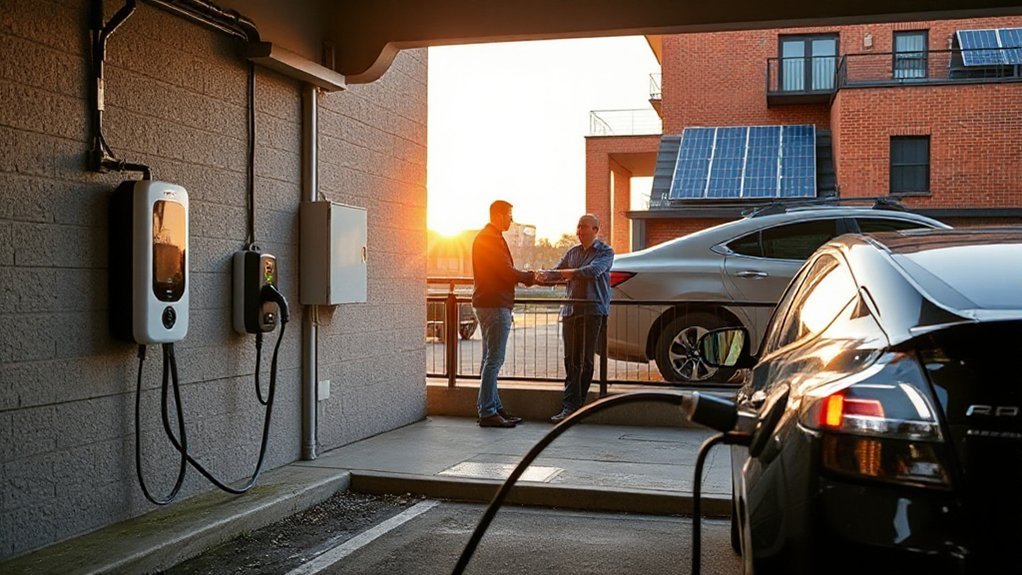
You should identify the landlord’s obligations under any “right-to-charge” statute and your lease, and cite the exact sections (e.g., state civil code, condo/HOA act, utility tariff). Then map permitting and policy constraints—reference the municipal code, NEC/IFC provisions, utility interconnection rules, house rules, insurance limits, and licensed-contractor requirements. Finally, submit a targeted proposal that includes scope, load calcs, metering, costs, maintenance, indemnity, additional insured endorsements, and timelines, so you reduce the owner’s risk and support every assertion with a citation.
Legal Obligations
Although state and local rules vary, landlords and tenants face specific statutory duties and notice procedures when adding EV charging in multifamily housing. Many “right‑to‑charge” laws require you to submit a written request, plans, and proof of insurance, and require the landlord to respond within set timelines (e.g., Cal. Civ. Code §1947.6; Colo. Rev. Stat. §38‑12‑601). You must pay installation and operation costs unless a lease or statute shifts them. Landlords may require indemnity, compliance with municipal ordinances, and utility metering, but can’t unreasonably prohibit compliant installations.
If the landlord ignores deadlines or imposes unlawful conditions, pursue contractual remedies and statutory enforcement, including damages or fee awards where authorized. Preserve evidence, follow notice cure periods, and avoid material lease defaults that could justify denial.
Building Permits and Policies
Beyond statutory rights and notice deadlines, approval often turns on permits and documented compliance with building and fire codes. You’ll need the landlord’s written consent conditioned on municipal approvals, stamped engineering drawings, and proof of licensed electricians. Confirm whether the jurisdiction treats EVSE as an electrical alteration, triggering plan review, inspections, and load calculations. Check HOA rules, parking easements, and any required zoning variances for exterior conduit runs. Expect department coordination among building, electrical, fire, and planning offices.
- Labeled conduit paths, posted panel schedules, and clear shutoff signage
- Sealed load letters, one-line diagrams, and fault-current calculations
- Fire-resistance ratings, bollards, and working clearances in feet
- Accessible routes, EV-only striping, and wheelstop placements
Obtain certificates naming the landlord as additional insured. Keep permits and cards signed.
Persuasive Tenant Proposal
Because landlords underwrite code, safety, and financial risk, frame your EVSE request as a turnkey, no‑cost, no‑lien package with verifiable citations and conditions precedent. Provide stamped drawings, load calculations, and a one‑line diagram by a licensed electrician; cite NEC Articles 625, 210, 220, and local fire‑life‑safety ordinances. Attach insurance certificates naming the owner and HOA as additional insureds, waiver of subrogation, and an indemnity rider.
Specify contractor qualifications, permit numbers, inspection milestones, and as‑built delivery. Offer a removal bond or decommissioning escrow. Limit work hours, spell out parking, housekeeping, and hot‑work controls. Include Visual Mockups and signage samples to preserve aesthetics. Provide utility pre‑approval correspondence evidence. Quantify Community Benefits: reduced emissions, property value lift, and future‑ready marketing. Accept reasonable monitoring, access, and cure rights.
Evaluating Building Electrical Capacity and Panel Space
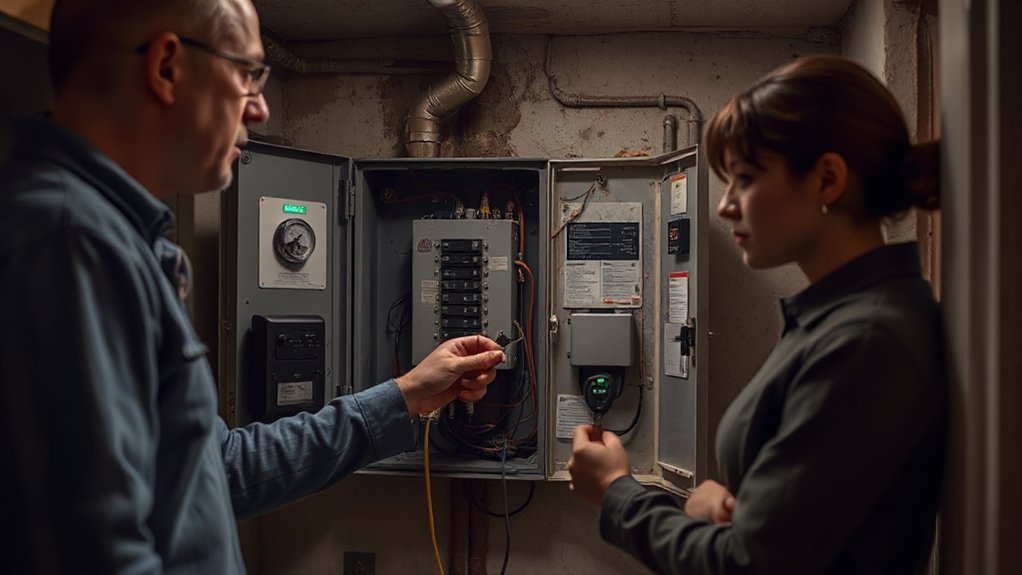




You’ll verify service capacity by documenting the utility transformer and service rating, main disconnect ampacity, and any demand-limiting tariffs, citing NEC 220 and utility interconnection policies. You’ll confirm panel space availability by checking bus ratings, spare pole count, labeling, and breaker listings per NEC 408 and manufacturer instructions; don’t assume tandem breakers are permitted. You’ll perform load calculations with demand factors and diversity per NEC 220, treat EVSE as a continuous load, and obtain a licensed engineer’s stamped study and AHJ approval before procurement.
Service Capacity Assessment
Before committing to EVSE, verify the building’s electrical service and panel capacity with a defensible load calculation and documented panelboard review. Require a licensed professional to apply NEC Article 220 methods, incorporate historical consumption, and account for seasonal variability and demand diversity. Confirm the service rating, main overcurrent device, feeder ampacity, and meter stack limits. Where load management is proposed, document controls compliant with NEC 625 and manufacturer specifications. Obtain confirmation from the utility regarding transformer and service lateral capacity.
- Peak-summer corridors buzzing, HVAC at full draw
- A crisp one-line diagram pinned to the electrical room wall
- A clamp meter capturing true RMS during evening charging hours
- A dated utility letter acknowledging available kVA
Keep records; unverified assumptions create overload, trip, and liability risks.
Panel Space Availability
From the outset, verify that panelboards serving proposed EVSE have both sufficient breaker spaces and bus capacity, documented under NEC Articles 408 and 110. Confirm spare poles, tandem allowance per the panelboard’s labeling, and bus ampacity equal to or exceeding the feeder rating. Review manufacturer listing, series ratings, and available fault current to verify the EVSE breaker is compatible and does not exceed the panel’s short-circuit rating (NEC 110.3(B), 110.9). Require accurate directory labeling and identification of spare spaces (NEC 408.4). Examine historical blueprints, as-builts, and warranty documentation to reconcile nameplate data with actual field conditions. Photograph interiors, verify torque and termination space for EVSE conductors, and check working clearances at the panel (NEC 110.26). Document any deficiencies and obtain owner authorization before alterations.
Load Calculations and Diversity
Although panel space matters, capacity governs EVSE deployment: perform service and feeder load calculations under NEC Article 220, applying demand factors for dwelling loads (220.42) and the optional method for multifamily buildings where permitted (220.84), or measured demand for existing services (220.87). Use conservative diversity factors; don’t assume simultaneous charging without documented demand profiling, interval data, or a certified load management system.
- A load curve showing peaks from HVAC, water heating, and EVs—verify coincidence.
- A main switchboard nameplate, feeder ampacities, and breaker spaces—confirm ratings.
- Submeter or utility interval reports—calculate maximum demand, demand factors applied, and headroom.
- An EVEMS schematic under NEC 625.42—set limits, assign priorities, and test failsafes.
You must document assumptions, stamp calculations when required, and coordinate utility upgrades before committing circuits permanently.
Installation Paths: Level 1 vs. Level 2, Shared vs. Dedicated Parking
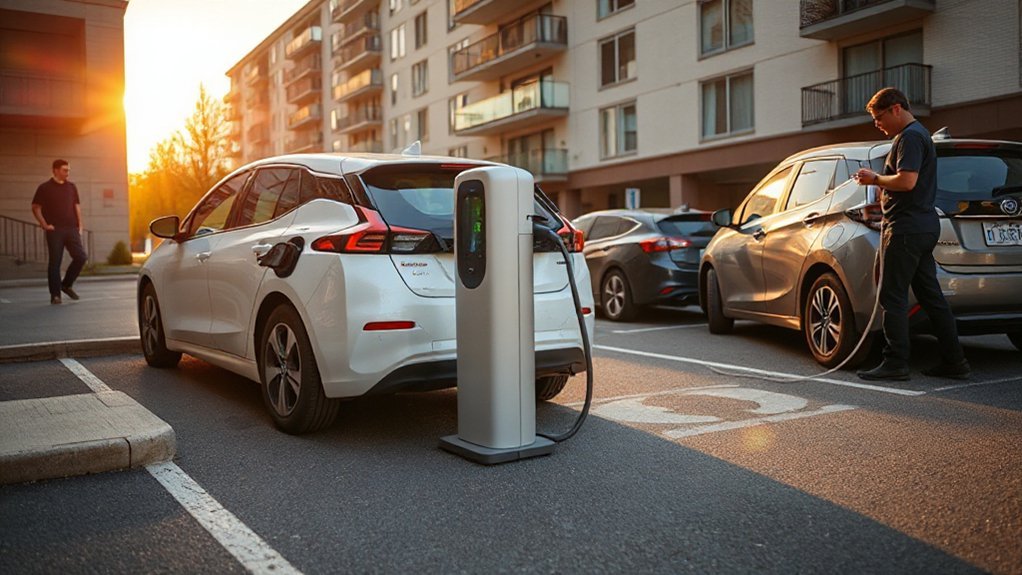
While Level 1 can work in a pinch, your choice between Level 1 and Level 2—and between shared and dedicated parking—sets the code, permitting, metering, and landlord-tenant obligations you’ll face. For Level 1, specify a listed EVSE on a dedicated 120‑V, 20‑A GFCI circuit with in-use cover (NEC 210.8, 210.52, 625). For Level 2, expect a 240‑V, 40‑A branch circuit, disconnecting means, and labeling (NEC 625.40–625.54; UL 2594 listing).
Shared parking requires written policies on access, dwell time, Parking Etiquette, Cable Management, cost allocation, and damage; add indemnity and reservation terms. Dedicated stalls trigger exclusivity language, conduit routing rights, meter or submeter terms, and restoration at move‑out. In both cases, obtain landlord consent, permits, inspection approvals, insurance, ADA clearance, utility notification, and tariff selection documentation.
Load Management, Smart Hardware, and Safety Standards
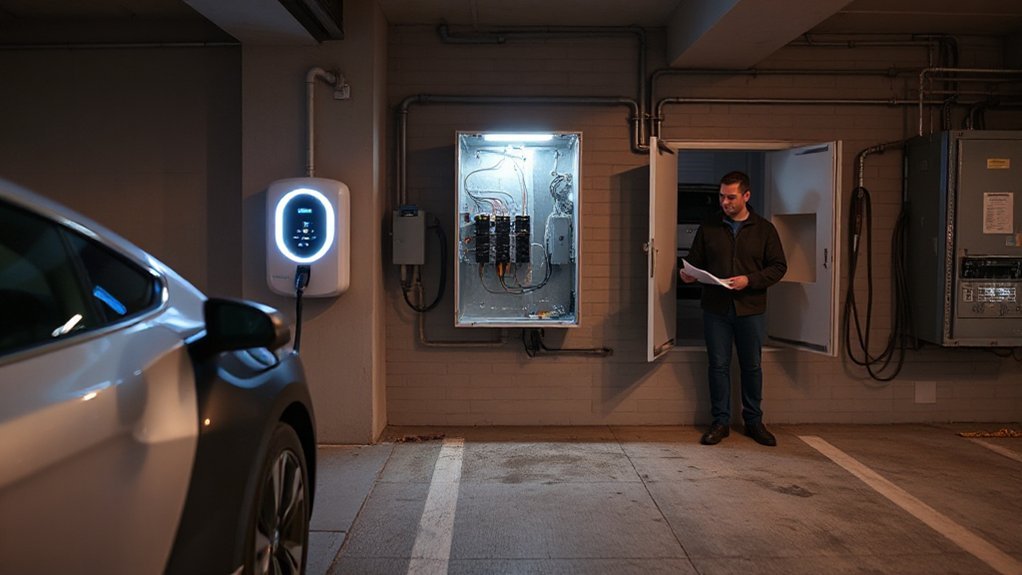
Because apartment electrical capacity is finite, you should plan charging around an EV energy management strategy that’s code‑compliant, interoperable, and safe. Specify EV energy management per NEC 625.42; require certified EVSE (UL 2594; UL 2231), and document fault current and GFCI coordination. Mandate open protocols (OCPP 1.6/2.0.1; ISO 15118) with Interoperability testing and digitally signed Firmware updates. Verify enclosure ratings and network security baselines.
- Dynamic load graphs that cap aggregate amps at the service limit
- Priority queues that shed lower-criticality sessions during peaks
- Alerts showing ground-fault trips and overtemperature cutoffs
- Audit logs proving standards compliance and change control
Conduct commissioning tests: breaker verification, pilot-signal checks per SAE J1772, and disconnect labeling. Record as‑built drawings, serials, and maintenance intervals to satisfy lease and insurance obligations.
Costs, Rebates, Permitting, and Utility Programs
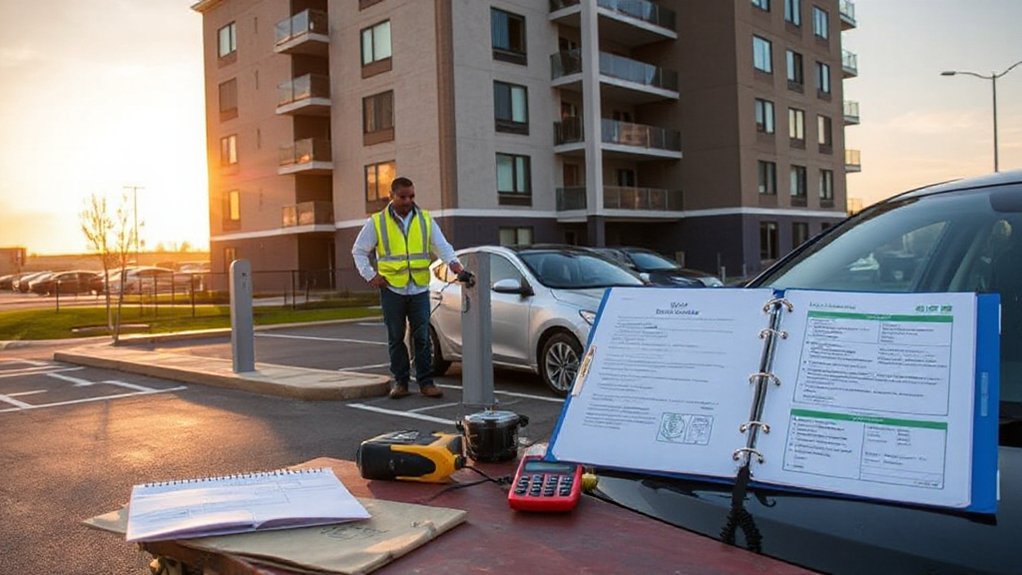
Your load‑management design now drives the budget and eligibility for incentives, permitting, and utility coordination. Itemize hard costs (EVSE, conductors, panels, trenching) and soft costs (engineering, permits, utility studies, commissioning). Verify whether a service upgrade, transformer set, or meter swap triggers utility fees or demand charges. For incentives, map federal tax credits (IRC §30C), state/local rebates, and utility make‑ready programs. Confirm rebate stacking rules, basis‑reduction effects on credits, and any prevailing‑wage/apprenticeship conditions. Require written pre‑approval where programs mandate it, and calendar completion, inspection, and payment milestones. For permitting, align drawings with NEC, local amendments, fire/life‑safety, and accessibility clearances; maintain stamped plans and load calcs. Preserve documentation: itemized invoices, W‑9/W‑9S, permits, inspection sign‑offs, and utility interconnection or service letters. You’ll expedite payments and reduce disputes.
Charging Alternatives When Onsite Installation Isn’t Feasible
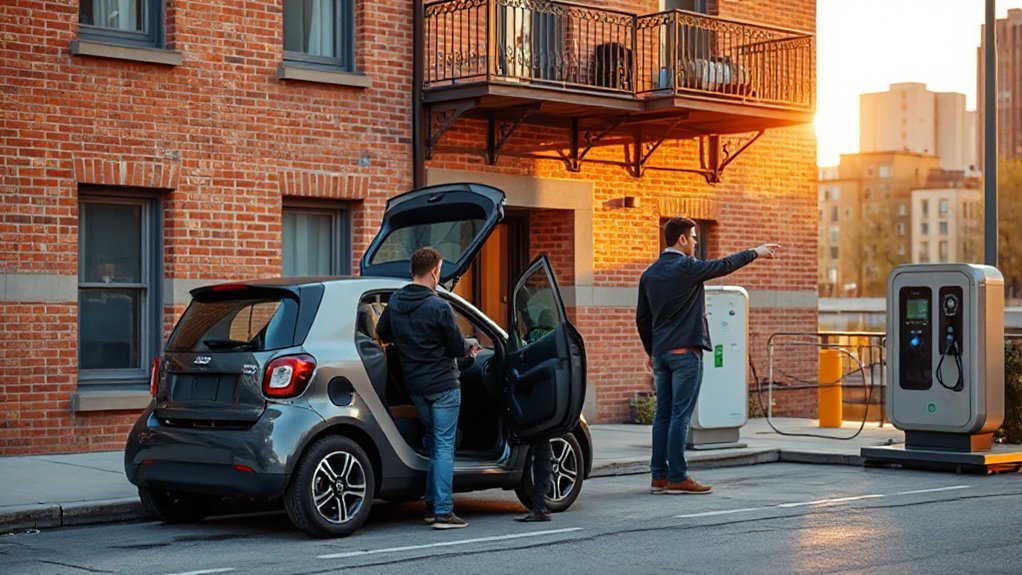
How do you support EV drivers when onsite installation isn’t feasible? You pivot to compliant, interim solutions and document them. Verify local right-to-charge laws, parking covenants, and fire-code limits on extension cords and portable EVSE. Provide equitable access while avoiding utility reselling without authorization. Disclose any costs in writing and set program terms that are revocable with notice.
- Curbside Level 2 pilots via utility or city curb-management permits.
- Mobile Charging vendors for scheduled top-ups; require insurance and indemnity.
- Battery Swaps where supported; designate safe handoff zones, no idling.
- Workplace or public DC fast-charging stipends; cap reimbursements; require receipts.
Audit ADA accessibility, electrical capacity, and queuing impacts; update house rules; align with HOA bylaws and municipal code. Secure tenant consent and track utilization for program review.
Conclusion
You’ve got enforceable pathways to charge, but your success hinges on compliant plans, clear contracts, and notices. Document everything, cite “right‑to‑charge” statutes (e.g., CA Civ. Code §§ 1947.6, 4745), and align with NEC 625 and utility rules. Propose options, budgets, and removal terms. Act now: about 80% of EV charging happens at home, yet over one‑third of U.S. households rent. Confirm local law, permits, and insurance; when uncertain, seek counsel and an electrician’s stamped drawings.