Picture the charge bar creeping from 20% to 80% as you compute t = E_add / (P·η), with E_add = C_bat·(SOC₂−SOC₁). You set C_bat (kWh), choose L1/L2/DC (kW), and enforce limits: min(P_charger, P_connector, C‑rate·C_bat), plus taper above ~60–80% SOC. The calculator outputs time, kWh added, average kW, and cost. Want realistic stops and costs, not brochure numbers?
Key Takeaways
- Enter battery capacity, arrival SOC, target SOC, charger power, vehicle max charge rate, and efficiency.
- Compute energy to add: E_add = C_batt × (SOC_target − SOC_start).
- Estimate time: t = E_add / (η × min(P_charger, P_vehicle)); DC taper lengthens time at high SOC.
- Respect site and connector limits; AC efficiency ~0.92, DC ~0.95; temperature and SOC affect allowable power.
- Report session time, energy added, average rate, and optional cost using price/kWh, session fees, and parking.
How the EV Charging Speed Calculator Works
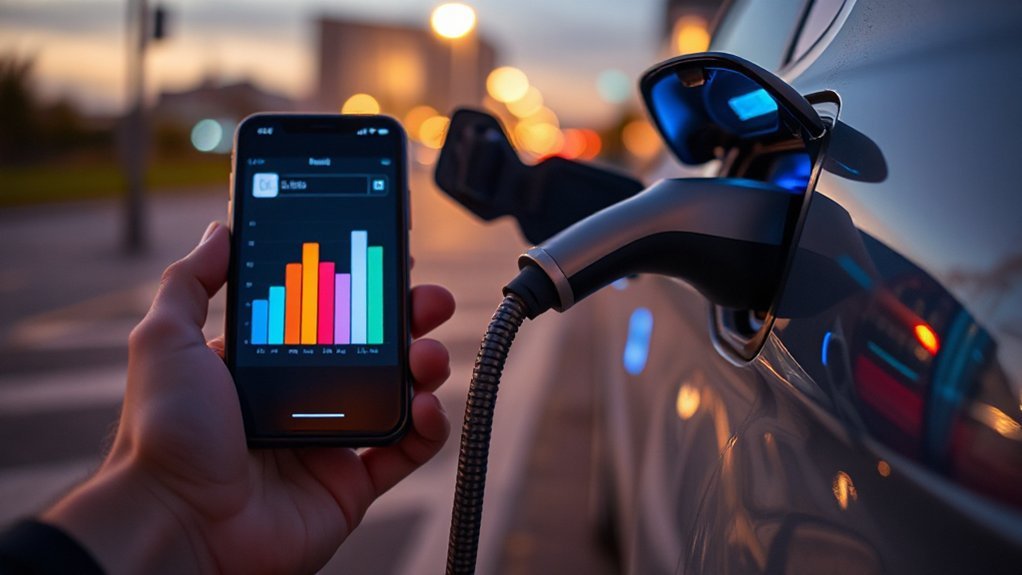
Although EV charging involves many variables, the calculator applies a simple energy-flow model: it computes charge power P (kW) = min(P_charger, P_vehicle, V × I / 1000) and then energy added E (kWh) = P × t × η, constrained by usable battery window E_window = C_usable × (SOC_target − SOC_start).
At timestep Δt (h), you compute ΔE = min(E_window − E_accum, P × Δt × η) and update E_accum. Average rate R (kW) = E_accum / T, with T (h) as session duration. The Backend Architecture enforces unit checks, charger limits, and taper via piecewise P(t). Export time series {t_i, P_i, E_i}. For Data Privacy, inputs remain in-memory, transit is TLS-encrypted, and no identifiers persist. Stop when E_accum ≥ E_window or T elapses.
Key Inputs: Battery Size, State of Charge, and Charge Rate

You’ll treat battery size C_batt (kWh) as the energy reservoir: larger packs need more kWh for the same SOC change. Calculate energy to add as E_add = C_batt × (SOC_target − SOC_start), with SOC in fraction (e.g., 0.20→0.80). Compute charging time t (h) using t = E_add / P_eff, where P_eff = min(P_charger (kW), P_vehicle (kW), P_taper(SOC)).
Battery Size Matters
The time to charge depends on three inputs: battery capacity (kWh), state of charge (SOC, %), and effective charge power (kW). Battery size sets the energy you’ll deliver. For a fixed SOC window, Energy_needed (kWh) = Capacity_kWh × SOC_window_% ÷ 100. Then, Time (h) = Energy_needed ÷ Effective_KW. Doubling capacity doubles Energy_needed and Time at the same power. Example: 60 kWh pack over 40% window needs 24 kWh; at 11 kW, time ≈ 2.18 h. 100 kWh over the same window needs 40 kWh; at 150 kW, time ≈ 0.27 h. Bigger packs store more raw materials, so right-sizing reduces cost and recycling impact. Choose capacity based on real kWh per day and available kW, not headline pack size to minimize charging time overall.
State of Charge
In EV charging, state of charge (SOC, %) defines the energy window you’ll fill and thereby the time. You specify initial SOC_i and target SOC_f. Required energy E_req = C_batt·(SOC_f−SOC_i)/100, in kWh, with C_batt in kWh. Estimated time t ≈ E_req / P_avg, with P_avg in kW. Keep units consistent.
| Input | Symbol | Example |
|---|---|---|
| Battery capacity | C_batt (kWh) | 75 |
| Initial→Target SOC | SOC_i→SOC_f (%) | 20→80 |
Accuracy depends on BMS Calibration Procedures; miscalibration skews SOC and E_req. Validate SOC via periodic full-to-empty learning cycles per OEM guidance. Note Privacy Implications: sharing SOC, location, and timestamps with apps or chargers can reveal habits. Prefer on-device calculation, minimize telemetry, and anonymize session logs. Include margins for meter error always. Document assumptions and round conservatively too.
Charging Rate Limits
Because pack and charger impose ceilings, charging power obeys hard limits from both sides: P(t) = min(P_EVSE, P_pack(SOC, T), P_conn), with dE/dt = η·P(t). You estimate session time by integrating dE = η·P(t) dt over the energy gap ΔE = C_batt·(SOC_target − SOC_start), C_batt in kWh. For AC, P_EVSE ≈ V·I_phase·φ (kW); for DC, it’s nameplate kW minus utility throttling or regulatory caps. P_pack(SOC,T) falls as SOC→1 and at low T; BMS enforces I_max(SOC,T) so P_pack = V_pack(SOC)·I_max. Connector limits set P_conn = V_max·I_conn. Constrain charge rate via C-rate: I = C_rate·Ah; keep C_rate within the vehicle’s allowed map. You’ll minimize time by selecting the station with max feasible min{P_EVSE,P_conn} that the pack can accept. Report time: t = ΔE/mean(P), units hours or minutes.
Charger Types: Level 1, Level 2, and DC Fast Charging


You’ll select a charger by power: Level 1 ≈ 1.4 kW (120 V), Level 2 ≈ 7–11 kW (240 V), DC fast ≈ 50–250+ kW (DC). Use t = E_added/P; for a 60 kWh pack from 10–80% (E_added = 0.70×60 = 42 kWh), you compute time directly from power. Results: 1.4 kW → ≈30 h, 7.2 kW → ≈5.8 h (11 kW → ≈3.8 h), 150 kW → ≈0.3 h (~18 min), with DC fast taper near high SOC.
Power Output Differences
While all EV chargers deliver energy in kilowatts (kW), their power output varies by design: Level 1 ≈1.4–1.9 kW, Level 2 ≈3.3–19.2 kW AC, and DC fast charging ≈50–350 kW DC. Net DC power into the pack equals P_net = P_rated × η_inverter, where η_inverter (inverter efficiency) typically ranges 0.90–0.98; electrical harmonics and poor power factor can force derating. For AC charging, P = V_rms × I_rms × PF × η_onboard.
Level 1 uses 120 V single‑phase at 12–16 A; Level 2 uses 208–240 V at 16–80 A; DCFC supplies regulated DC with current limits 100–600 A. Thermal limits, cable gauge, and connector ratings cap your I_max. AC limits. DC output follows charger and vehicle limits via P = V_dc × I_dc within SOA.
Typical Charging Times
Given a battery capacity E_bat (kWh) and a target SOC window ΔSOC (fraction), estimate charge time with t ≈ (E_bat × ΔSOC) / P_net (kWh/kW = h), noting DC fast charging tapers so t_real ≥ t_ideal. You’ll apply P_net = P_rated × η, with η ≈ 0.90–0.98. Level 1 (~1.4 kW) fits overnight. Level 2 (7.2–11 kW) covers daily needs. DC fast charging (50–250 kW) is trip-focused; taper dominates above ~60–80% SOC, shaping consumer expectations and media narratives.
| Charger | Typical t for 60 kWh, 20–80% |
|---|---|
| Level 1 (1.4 kW) | ≈ 26 h (36/1.4) |
| Level 2 (7.2 kW) | ≈ 5.0 h (36/7.2) |
| Level 2 (11 kW) | ≈ 3.3 h (36/11) |
| DCFC 150 kW | ≈ 20–30 min (ideal 14 min) |
Scale with E_bat, ΔSOC, and η.
Understanding Charging Curves and Efficiency Losses

Although a station may advertise 150 kW, the battery rarely accepts a flat 150 kW because charging power follows a tapering curve with state of charge (SOC) driven by voltage rise, current limits, and thermal constraints. You should think in P=V·I terms: pack voltage increases with SOC, while current is capped by cell limits and thermal management. Effective charge added equals η_coulombic·I·Δt, where coulombic efficiency η_coulombic≈0.995–0.999, but heat, wiring, and converter losses lower energy efficiency η_e. Internal resistance R_int causes I²R_int heating; controllers reduce I as T_cell approaches limits.
- Early CC: I=I_max, P≈V(SOC)·I_max; heat ∝ I²R_int.
- Mid taper: I=I_max·f(SOC,T), 0
- CV region: V=V_max, I→0.
- Net energy in: E_pack=η_e∫P_in dt, with η_e<1 due to conversions and heat dissipation.
- Cold or hot cells shift f(SOC,T) downward.
Estimating Time to Charge and Added Range

Use Mobile Integration to pull SOC, charger limits, and consumption histories, but enforce Data Privacy: store only necessary parameters, anonymize trip logs, and allow opt-in sharing. Always keep units consistent and validate eta_charge.
Home Vs Public Charging Scenarios
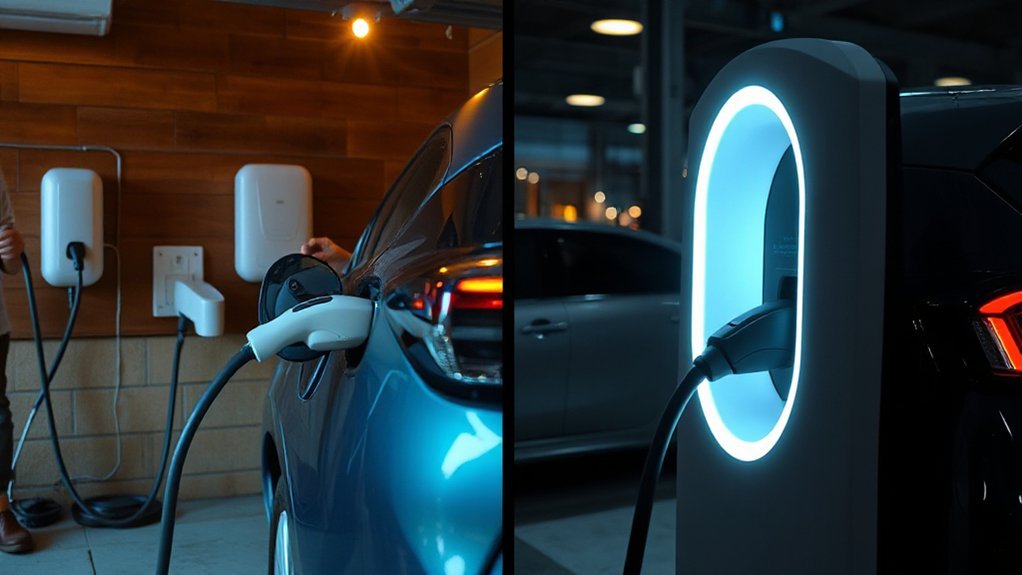
Building on your eta_charge estimates, compare home and public charging by modeling power limits, efficiency, and cost in consistent units. Use P_ac (kW), P_dc (kW), η (unitless), and price c ($/kWh). Normalize energy in kWh; power kW. Home: P≈7.2 kW (240 V×30 A), η≈0.92, c_home variable; public DC: P up to 150 kW, η≈0.95, c_dc higher.
- Time: t = E_needed / (Pη); example 30 kWh: home t≈30/(7.2.92)=4.5 h; DC t≈30/(150*0.95)=0.21 h.
- Added range: R = (Pη)/consumption; use 0.18 kWh/km; home adds ≈37 km/h; DC adds ≈790 km/h.
- Cost: cost = E_delivered*c; home off-peak $0.12/kWh vs DC $0.45/kWh.
- Limits: vehicle max charge rate P_vehicle caps P; cold pack reduces η and raises eta_charge.
- Site factors: Parking infrastructure availability, queueing, Security concerns, idle fees, access hours.
Road Trip Planning With Realistic Charging Stops

Kick off road-trip planning by sizing drive legs and charge stops with a simple energy-and-power model: with consumption e (kWh/km), usable pack C_u (kWh), start SOC s0 (unitless), arrival buffer s_min, site power P_site (kW), vehicle limit P_vehicle (kW), and charger efficiency η (unitless). Compute leg limit L_max = (C_u·(s0−s_min))/e. For a planned distance D, schedule stops N = ceil(D/L_max), then set target SOC per stop to minimize taper. Charging time t = ΔE/(η·min(P_site,P_vehicle)), where ΔE = C_u·(s_target−s_arrival). Include scenic detours by inflating e via terrain, speed, HVAC, or by adding a distance margin δD. For overnight stays, set s_target to a higher SOC at lower P_site, using longer t while maintaining buffers and comfortable arrival SOCs. Adjust departure SOC for headwinds and queues.
Cost Estimation and Energy Pricing Factors

How much will each leg cost? You compute price from energy demand and station billing structures. Estimate energy: E_leg = (distance_km × consumption_Wh_per_km)/1000 kWh. Then apply tariff: Cost = E_leg × price_$/kWh + session_fee_$ + parking_fee_$/min × t_min. If demand charges or tiered rates apply, include them. Note renewable integration may shift price by time-of-use. For subscriptions, amortize monthly_fee_$ over expected_kWh and subtract credits. Use USD and round to $0.01.
- Input: distance km, consumption Wh/km, SOC window %, buffer kWh.
- Power: P_kW defines t_min = (E_leg/η)/P_kW × 60.
- TOU: price_1, price_2 with time fractions f1,f2 → blended $/kWh = Σ(fi×price_i).
- Taxes: Cost_total = Cost × (1 + tax_rate).
- Cross-network: compare $/kWh vs $/min; compute effective $/kWh = ($/min × 60)/P_kW at charger rating.
Tips to Optimize Charging Speed and Battery Health

While you can’t control station hardware, you can optimize speed and battery health by managing state of charge (SoC), temperature, and power limits. Target 10–60% SoC for fast sessions; above 70%, taper reduces power: P≈Pmax×f(SoC). Estimate time: t(h)=ΔE(kWh)/P(kW). Precondition the pack to 20–35 °C using Thermal Management; charging below 10 °C or above 45 °C triggers limits. Keep C‑rate I/Ah ≤1.5 during DC fast charging; if pack is 75 kWh usable, 150 kW implies C≈2.0, so cap to 110–120 kW when hot. Maintain Software Updates to optimize charge curves and cell balancing. Use scheduled charging at 240 V, 32–48 A for overnight, minimizing idle at 100%. Avoid frequent 0–100% cycles; charge windows of 20–80% reduce degradation per cycle. Monitor voltage sag and connector temperature.
Conclusion
You’ve got the controls: plug in capacity (kWh), SOCstart→SOCtarget (%), charger power (kW), and efficiency η, and the calculator charts your course. It models limits—Pavg = min(Pcharger, Pconnector, C‑rate·kWh) and taper near 80%—then integrates to time: t ≈ (ΔE/η)/Pavg (h). You see energy added (kWh), cost ($/kWh), and minutes per stop, so road trips feel like flight plans, not guesses. Tune stops, save cells, and let data be your pit crew. Every session stays quantified.