Tesla Supercharger vs Electrify America: Cost, Speed and Reliability Compared
Compare Tesla Superchargers and Electrify America for your actual route using access, live prices, expected speed and alternatives.
As an Amazon Associate, EV Charging may earn from qualifying purchases. This helps support our independent guides at no extra cost to you. Learn more.
Key takeaways
- Confirm exact vehicle and site compatibility first.
- Compare live session prices and membership break-even costs.
- Network reputation is not a guarantee of an individual site’s availability.
Choose the stop that works for your car and route
Tesla Superchargers and Electrify America can both be useful on a road trip. The better stop is the one your vehicle can use, at a sensible price, without an awkward detour or an avoidable wait. A network-wide winner sounds tidy, but it can hide the details that determine your actual afternoon.
This comparison is a planning guide based on the networks' published information. It is not a head-to-head reliability test, and we have not measured every station's uptime. Prices, access and individual sites change. Check the live details for the stations you intend to use before making them essential to your route.
Shop this guide
Compare current options and prices
Compatibility comes before price
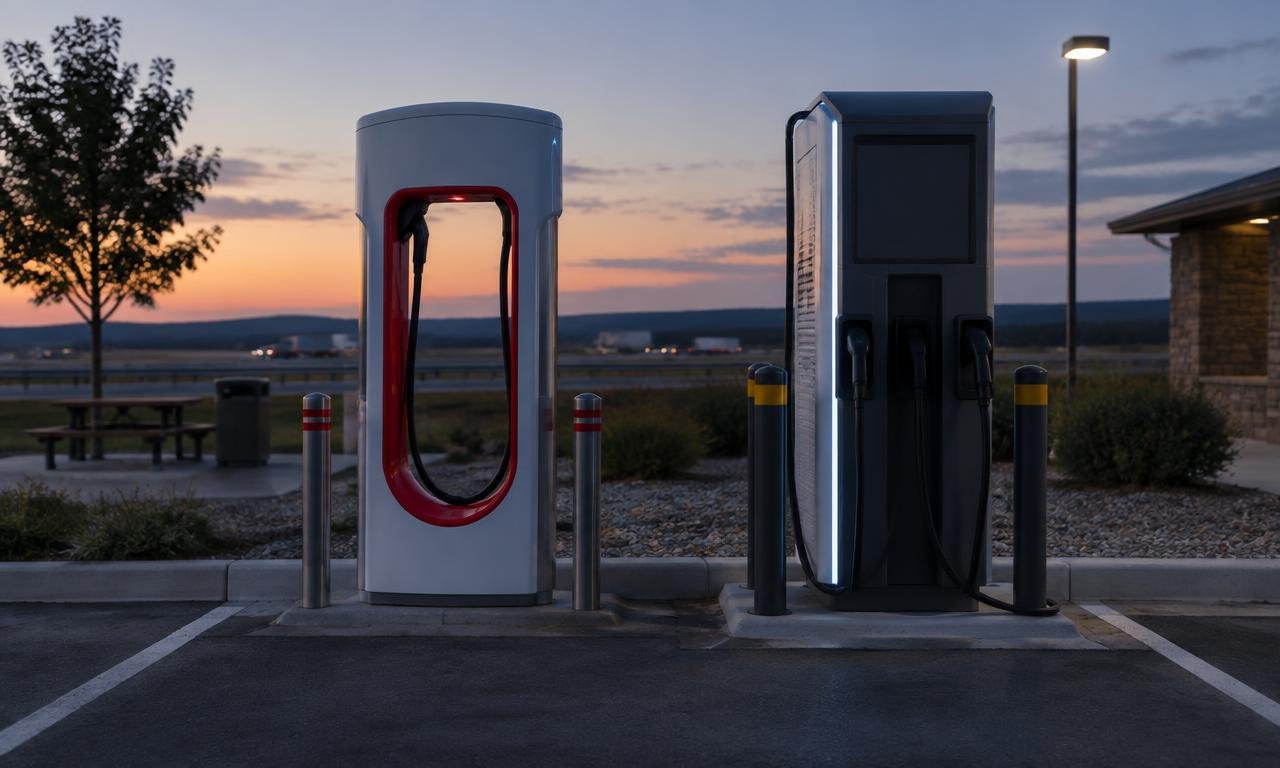
For Tesla charging, identify the site category and confirm your exact vehicle in Tesla's app or official map. Tesla distinguishes sites restricted to Tesla vehicles, sites with an integrated Magic Dock adapter, and eligible NACS sites available to supported vehicles. A familiar red-and-white charging post is not enough information to establish access.
If your car needs a DC adapter, follow the vehicle manufacturer's approved arrangement. A NACS-to-J1772 adapter intended for home AC charging is not a Supercharger adapter. Likewise, having a NACS-shaped inlet does not remove the need to confirm that the particular vehicle and site support the session you are planning.
At Electrify America, verify the connector and charging capability shown for the specific station. Check your vehicle's instructions for any required adapter and its limitations. Network branding alone should never substitute for a connector and vehicle check. Doing this while sitting comfortably at home is much nicer than learning it beside a charger with a nearly empty battery.
Compare the actual session price
Open both station listings for the time and location you expect to charge. Look at the applicable energy rate, plan, time-based conditions and additional fees. Electrify America directs drivers to its app or charger screen for current pricing and notes that location, plan and energy delivered affect the cost.
Tesla pricing also needs a site-specific check. Do not assume a rate quoted by a Tesla owner applies to every other vehicle or membership arrangement. The useful number is the price your account will pay at that site, under the conditions shown when you start.
For an illustrative 45 kWh session, a rate of $0.42 per kWh produces an energy charge of $18.90. At $0.55, it is $24.75. Those are invented comparison rates, not current network prices. The $5.85 difference is useful context, but a long detour, parking charge or membership fee could change the decision.
Memberships need a break-even calculation
A paid plan can make sense when you use a network regularly. Divide the monthly fee by the saving per kilowatt-hour to estimate the energy needed to break even. If an imaginary plan costs $10 and saves $0.10 per kWh, the break-even point is 100 kWh that month, before other differences.
Use the current fee and applicable discount for your actual account. A headline percentage may not describe every site or vehicle arrangement. Also check whether you must start sessions through a particular account or app to receive the benefit. A discounted plan is less exciting when the session accidentally bills through a different route.
For a one-off trip, calculate the charging you realistically expect on that network. Do not count every battery refill if half the route uses a different operator. Note renewal and cancellation terms so a useful vacation subscription does not quietly become a year-round expense.
Peak power is not a charging-time guarantee
A station's maximum kilowatt rating tells you its potential output, not the power your battery will accept throughout the session. Your vehicle's charging curve, battery temperature, state of charge and electrical architecture matter. Site limits and equipment condition can matter too.
Compare the likely charging time for your specific vehicle over the range you need, such as an ordinary road-trip top-up. Do not compare one network's advertised peak with another network's entire session average. Those numbers answer different questions and can make a misleading winner out of almost anything.
Prepare the battery using the car's supported features where available. Some vehicles rely on built-in navigation to trigger preparation for a fast-charging stop. Check the model's instructions. Arriving prepared can be more useful than driving past a convenient compatible site in pursuit of a larger number on a map pin.
Reliability is local enough to check
A broad reputation is a starting point, not proof that a particular site is available today. Review live stall status and recent, specific reports where available. Distinguish a temporary payment issue, a broken connector, reduced power and a fully closed site. They create different risks for your journey.
Recent reports from drivers with the same vehicle can be especially informative, but anecdotes are still anecdotes. A successful session yesterday does not guarantee one today. A frustrated report from months ago may describe equipment that has since been repaired or replaced. Look for patterns and dates rather than a single dramatic comment.
Prefer a route with a reachable alternate site when charging availability is critical. Several working stalls can provide more flexibility than one essential connector, but site size alone does not promise an empty space. Plan around the information you have and keep enough reserve to change course.
The physical layout can decide convenience
Check cable reach, charge-port location and parking orientation. Some combinations require more care to align the car without obstructing another stall. Follow the site's layout and operator guidance; do not stretch a cable across a driving lane or assume occupying adjacent spaces is acceptable.
If you are towing, look for specific information about trailer access and pull-through spaces. A station that is easy for a sedan may be awkward with a trailer attached. Satellite imagery or recent site photos can help you understand the layout, but verify access restrictions and avoid relying on old images alone.
Think about the stop beyond the connector. Restrooms, lighting, food, weather protection and opening hours affect whether a charging break feels easy. A café beside the site may close long before the chargers do. That tiny detail is suddenly a huge deal when the whole car needs a bathroom break.
Set up payment before the trip
Create the necessary accounts and confirm a working payment method while you have time and connectivity. Learn which supported methods apply to your vehicle and station. Plug-and-charge features, network apps and card readers can differ; do not assume your preferred method works everywhere.
Keep the relevant app accessible and know where the station identifier appears. If a session fails, follow the on-screen guidance and contact the operator through its official support channel. Repeatedly starting overlapping sessions from several apps can make the situation harder to understand.
After charging begins, confirm energy is actually flowing and check the estimated completion. Set an alert and return in time to move when required. Charging, idle and congestion conditions can differ, so read the session terms instead of treating the parking space as reserved for the rest of your meal.
Build a route that can use both
The most practical setup is often access to more than one network, with the correct approved equipment for your vehicle. You do not need to choose a permanent team. On one journey, a Supercharger may be the easiest stop; on another, an Electrify America site may have the better location or price.
Before leaving, compare compatibility, expected cost, useful charging time, current status and amenities for the actual stops. Save an alternate that remains reachable with your planned reserve. Recheck when weather, traffic or the route changes substantially.
Judge the result by the whole journey: how much time and money it took to arrive comfortably. A slightly higher energy rate can be reasonable if it avoids a detour, while a cheaper compatible stop can be a smart choice when everything else is equal. The best network comparison ends with a workable route, not a slogan.
Sources & further reading

Written by
LarryLeoLarryLeo started EV Charging while researching his own next car purchase. He digs into the pros, cons and real cost savings of going electric — using government, standards-body and manufacturer sources — and shares what he finds so other buyers can decide with confidence.
Why trust EV Charging Guide
Our guides are researched from government, standards-body and manufacturer sources, reviewed for accuracy, and updated when rules or products change. Brands cannot pay for placement. Read our editorial policy.