
You want a rugged, code-compliant Level 2 charger that’s simple to install and safe to operate. Grizzl‑E delivers a NEMA 4 aluminum enclosure, 20 mA GFCI, 24‑ft J1772, and adjustable 16/24/32/40 A up to 9.6 kW. We’ll cover hardwired vs NEMA 14‑50, NEC 625 breaker/wire sizing, permitting, typical installed cost, and rebates—plus smart add‑ons and competitors—so you can choose confidently…
Key Takeaways
- Level 2 240‑V EVSE up to 40 A (9.6 kW), adjustable 16/24/32/40 A, 24‑ft J1772, NEMA 4 aluminum, UL listed with 20 mA GFCI.
- Smart options include Wi‑Fi with OCPP 1.6J, app control, scheduling, notifications, and load sharing across multiple units with site amp limits.
- Hardwired or NEMA 14‑50/6‑50; dedicated 240‑V circuit; breakers 20/30/40/50 A for 16/24/32/40 A; permit and inspection advised.
- Built for weather and safety: −30°C–50°C, sealed ingress, stainless hardware, overcurrent/overtemp protection, NEC 625 alignment, lockable hanger, robust strain relief.
- Cost overview: charger typically $300–$500; installation $200–$1,500+, higher with long runs, outdoor NEMA 4 work, panel upgrades, or trenching.
Overview of the Grizzl‑E Home EV Charger
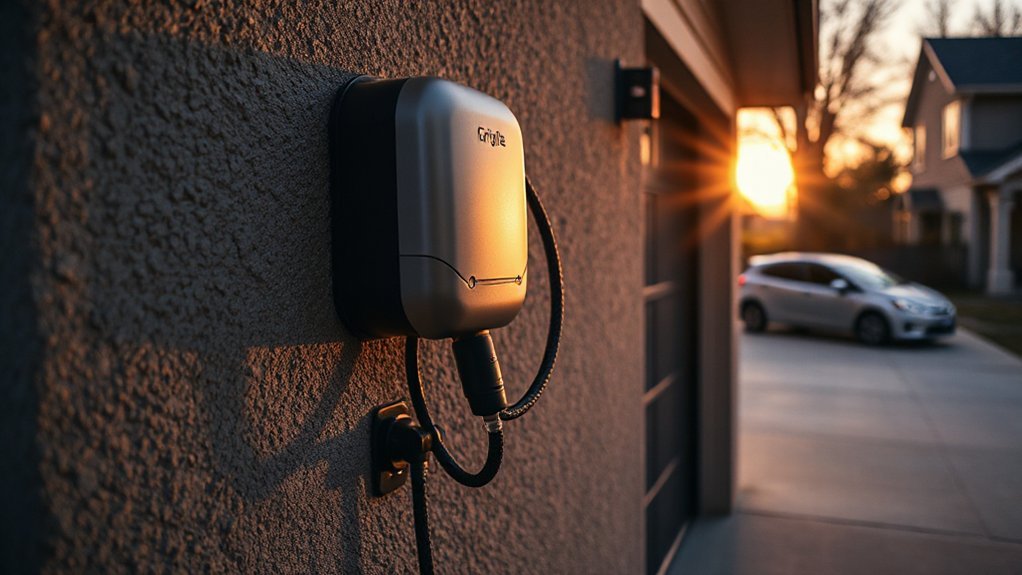
Workhorse hardware for home charging: Grizzl‑E is a Level 2, 240‑V EVSE delivering up to 40 A (9.6 kW) with adjustable current settings (16/24/32/40 A) to match your circuit. You deploy it as a straightforward, code-aware solution for daily charging at home. Choose hardwire or NEMA 14‑50 installation based on panel capacity and local code. The unit supports typical J1772-equipped EVs and adapters where permitted. You’ll coordinate permitting, GFCI, and breaker sizing with your electrician to guarantee safe operation and load calculations. The brand history traces to a Canadian manufacturer focused on rugged, affordable residential EVSEs. Retailer availability is broad: buy direct, from big-box stores, or online marketplaces, enabling price checks, fast delivery, and accessible support. Expect consistent performance and straightforward ownership over time.
Features, Specs, Weatherproofing, and Safety
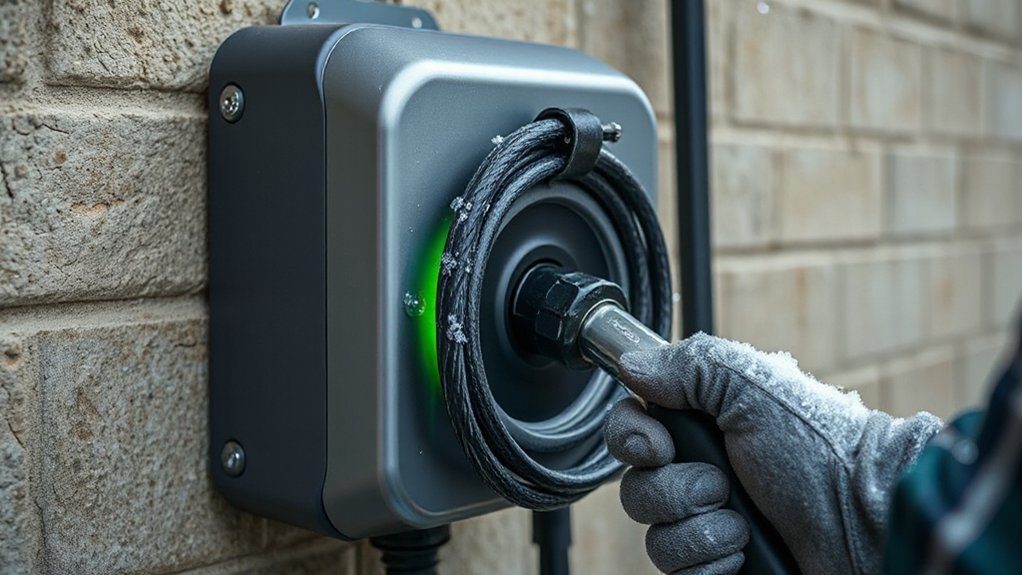
You’ll verify core features and specs—adjustable output current, supply voltage/phase, connector standard, and mounting—against your installation requirements. You’ll examine weatherproofing via enclosure rating (NEMA/IP), operating temperature range, gasketed seals, and UV/impact resistance for outdoor use. You’ll confirm safety controls and certifications, including ground‑fault protection, overcurrent/overtemperature safeguards, pilot signaling compliance, and listings to UL/CSA with NEC Article 625 alignment.
Core Features and Specs
Rugged NEMA 4 aluminum housing protects the Grizzl‑E from rain, snow, and dust for outdoor installs down to −22°F and up to 122°F (−30°C to 50°C). You get a 240‑V Level 2 unit with adjustable output via internal DIP switches for circuit matching. Warranty Coverage is standard and clearly documented, and Packaging Dimensions are compact for straightforward shipping and storage.
- Output: 16/24/32/40 A settings; up to 10 kW on a 240‑V circuit for faster home charging.
- Installation: hardwired or NEMA 14‑50 plug options to meet code and panel capacity.
- Cable: 24‑ft SAE J1772 coupler with rugged strain relief and wall‑mount holster.
- Compliance: integrated 20 mA ground‑fault protection; UL/cUL listed to UL 2594 and UL 2231.
Plan compliant installations with confidence.
Weatherproofing and Safety
Because real‑world installs face weather and electrical hazards, the Grizzl‑E pairs a NEMA 4 aluminum enclosure with sealed cable ingress to resist rain, snow, and wind‑blown dust, maintaining operation from −30°C to 50°C (−22°F to 122°F) without requiring a secondary cover. The sloped body promotes ice shedding, while UV‑stable seals, stainless hardware, and strain‑relieved glands protect conductors and terminations.
For safety, you’ll follow NEC 625 clearances, GFCI protection, and proper bonding. The unit’s integrated ground‑fault, over‑current, and over‑temperature protections interrupt output and automatically recover when conditions normalize. A lockable hanger and robust cable jacket enhance pet resistance and tamper deterrence. Use a dedicated circuit, torque lugs to spec, keep a drip loop, and mount between 18–48 inches to minimize splash, flood, and mechanical impact.
Smart Add‑Ons and Connectivity Options
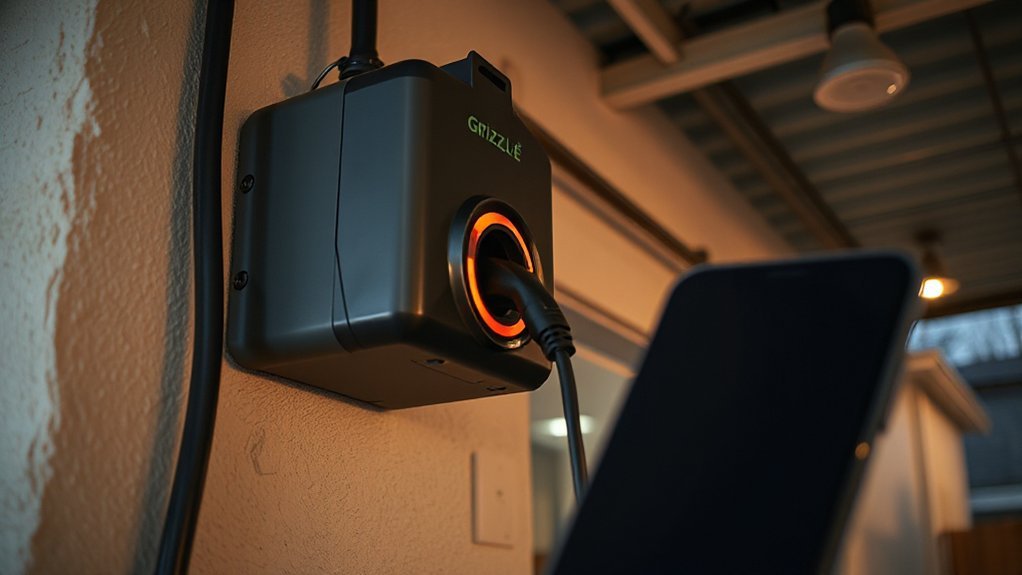
You can enable Wi‑Fi with OCPP 1.6J for real‑time monitoring and utility programs; use WPA2 and TLS 1.2+ to secure communications. You control sessions in the app—start/stop, lock the unit, set TOU‑aligned schedules, and apply firmware updates. Add load‑sharing hardware to coordinate multiple units on one feeder, honoring breaker capacity and the NEC 625 125% continuous‑load rule to prevent trips and overheating.
Wi‑Fi/Ocpp Integrations
How do Wi‑Fi and OCPP add‑ons expand your Grizzl‑E’s capabilities while preserving electrical safety and code compliance? They layer secure communications and utility integration on top of UL-listed hardware, without altering breaker sizing, GFCI, thermal derating, or NEC 625 requirements.
- Secure connectivity: use WPA2/3, TLS 1.2+, unique credentials, VLANs, and firewall rules. Review Privacy Implications, retention policies, and where OCPP data is hosted.
- Open protocols: select OCPP 1.6J/2.0.1 backends to avoid Vendor Lock‑in; require certificate management and signed firmware chains.
- Physical install: maintain enclosure integrity; avoid drilling; use CAT6 with surge protection; verify Wi‑Fi RSSI ≥ −67 dBm; keep low-voltage separate from line conductors.
- Fail-safe behavior: if connectivity fails, charging reverts to limits; safety interlocks and GFCI self-tests remain active.
App Control & Scheduling


Why schedule charging through the app? You align sessions with time‑of‑use rates, set departure targets, and cap current to match the branch‑circuit rating. The app lets you define start/stop windows, one‑time or recurring, and enforces a minimum idle delay so the connector isn’t energized until the EV requests power. You can lock the charger when unattended and require PIN access to prevent unauthorized use.
Configure Notification Preferences for plug‑in detected, charge start/stop, completion, interruptions, ground‑fault trips, over‑temperature throttling, and firmware updates. Create Family Profiles to share access, assign roles, and restrict schedules per vehicle. Thermal and pilot‑signal monitoring remain active during delayed starts. If a fault occurs, scheduling pauses and you’ll receive guidance to inspect the receptacle, breaker rating, and cable condition before resuming.
Load Sharing Add‑Ons
Scheduling governs when energy flows; load sharing governs how multiple Grizzl‑E units or circuits share available amperage safely. With Smart add‑ons and connectivity, you coordinate several ports on a limited feeder without nuisance trips. Use Wi‑Fi or Ethernet to link chargers, then set a site current limit that the group never exceeds; each unit ramps within code.
- Configure master‑follower load sharing; define a global amp cap per NEC 625 and panel rating.
- Add OCPP 1.6J for networked control, tenant billing, and audited session logs.
- Use current transformers to enable dynamic load management that tracks whole‑home demand.
- Enable alerts and lockouts; document settings for inspections and property insurance.
Verify breaker sizes, conductor temperature ratings, and GFCI requirements. Label circuits and firmware.
Power Settings and Charging Performance
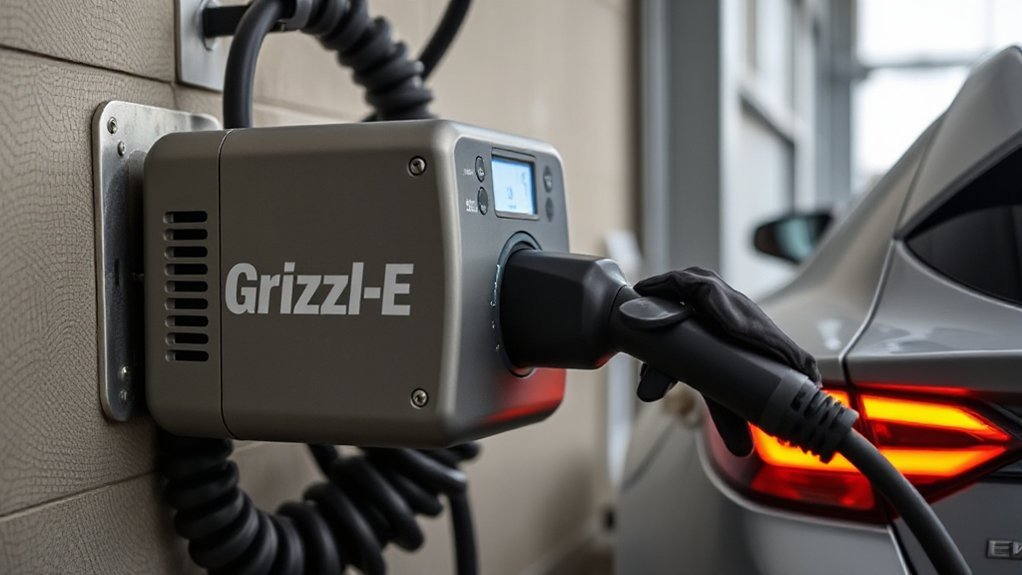
Before you plug in, set the Grizzl‑E’s maximum output to match your branch circuit and local code. Use the DIP switches to cap current at 16, 24, 32, or 40 A on a 240 V circuit, observing the 80% continuous‑load rule.
Charging speed depends on the vehicle’s battery acceptance and the pilot signal you configure. The Grizzl‑E advertises amperage; the car draws what it can. If cable, connector temperatures rise, onboard sensors initiate thermal throttling to protect conductors and terminations. Verify tight lugs, correct wire gauge, and breaker rating to prevent nuisance trips and overheating. Monitor voltage under load; sag indicates undersized supply or long runs. Check GFCI lights and fault codes. When ambient temperatures are high, derate the output for reliable, code‑compliant performance.
Installation Options: Plug‑In Vs Hardwired
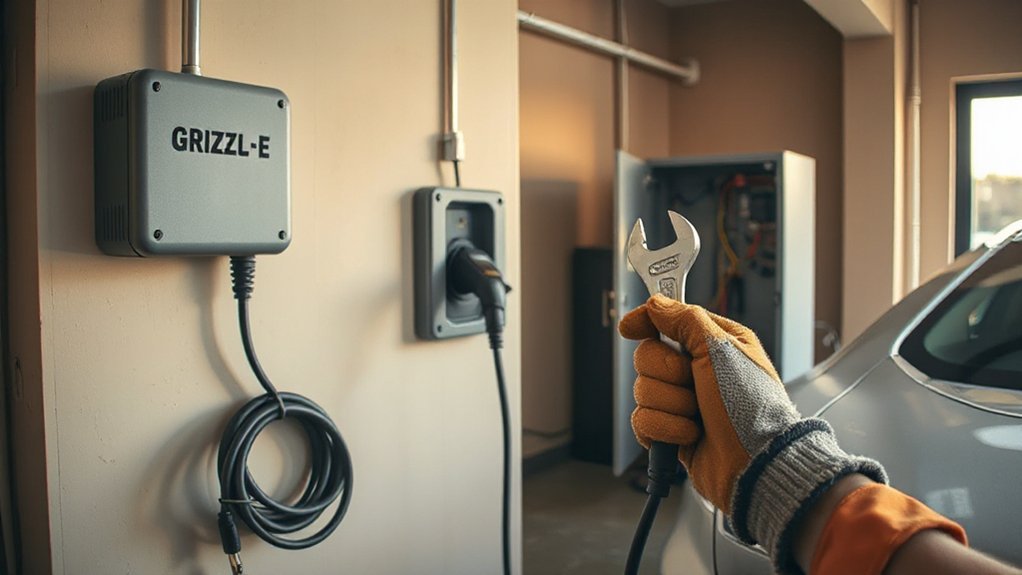
With output current set and the branch circuit verified, choose how to connect the Grizzl‑E: cord‑and‑plug (typically NEMA 14‑50) or hardwired, as permitted by NEC and your AHJ. Plug‑in offers portability and simple replacement; hardwired offers a sealed, permanent connection with fewer mechanical failure points.
- Portability: move the unit or swap for service without opening the enclosure.
- Environmental robustness: prefer hardwired for outdoor exposure or vibration.
- Code and permits: follow manufacturer instructions, use listed fittings, secure strain relief, and obtain inspection.
- Ownership goals: weigh Insurance implications and Resale value—hardwired signals permanence; plug‑in eases removal for tenants.
Confirm labeling, torque, and mounting height per instructions. Coordinate with your inspector on disconnect provisions and site placarding. Document serials, photos, and permits for warranty and future sale.
Electrical Requirements: Outlets, Breakers, and Wiring
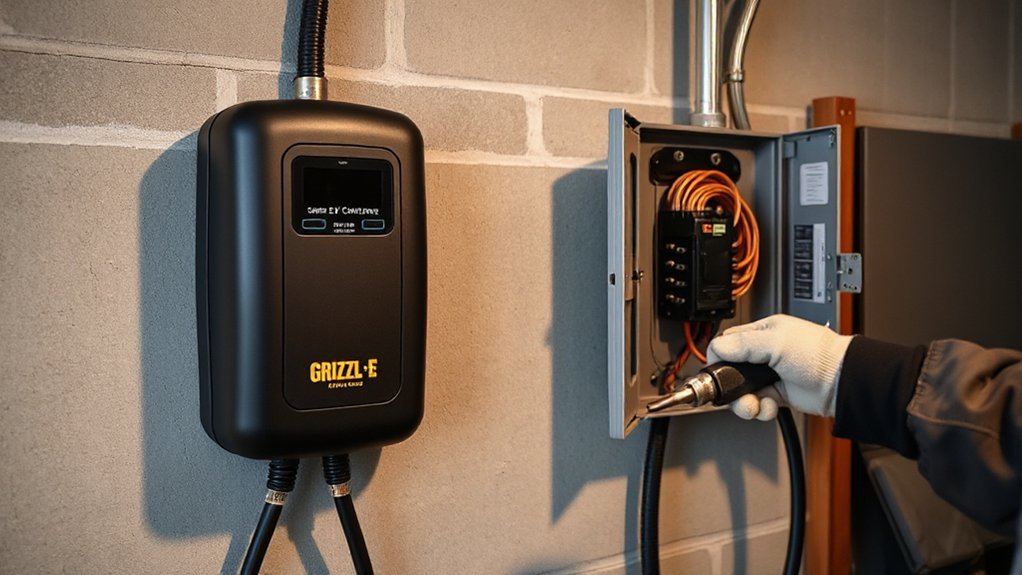
Although the Grizzl‑E lets you set output current, you must size the branch circuit as a continuous load per NEC 625: the breaker must be at least 125% of the selected EVSE amperage, on a dedicated 240 V, 2‑pole circuit with equipment grounding. Typical settings 16/24/32/40 A require 20/30/40/50 A breakers, respectively. For plug‑in units, use a NEMA 14‑50 or 6‑50 receptacle listed for EVSE; avoid stacking GFCI (the EVSE includes ground‑fault protection). For hardwired installs, provide a lockable disconnecting means per 625.43. Use copper THHN/THWN‑2 conductors in appropriately sized raceway; verify conduit sizing and fill. Select conductor gauge to limit voltage drop to 3% or less over the run. Bond grounding, torque lugs to listing, and label the circuit at the service panel.
Pricing, Installed Cost, and Rebates
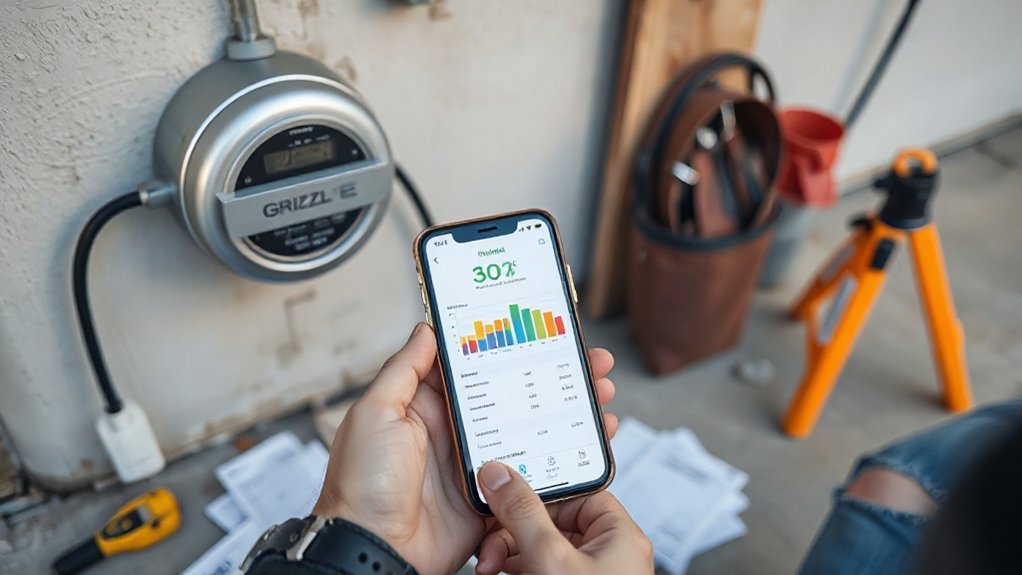
Sizing the circuit per NEC 625 drives material and labor, which in turn sets project cost. You can expect hardware at $349–$539 for Grizzl‑E models, permits, GFCI protection, and conduit. Typical installed cost ranges $600–$2,000, higher for upgrades or long runs.
NEC 625 sizing drives cost: Grizzl‑E hardware $349–$539; installs typically $600–$2,000, more for upgrades.
- Panel capacity: 125% continuous-load rule; add subpanel if bus or feeder limits.
- Distance and routing: EMT/PVC runs, trenching, or coring increase labor.
- Mounting/location: outdoor NEMA 4 enclosures need in-use covers and bonding.
- Incentives: stack utility rebates and Federal/State Tax Incentives; keep receipts and cut sheets.
Document load calcs, breaker size, and conductor gauges on the permit. Rebates can offset costs and improve Resale Value. Hire a licensed electrician; pass inspection before energizing. Keep warranty intact by following manufacturer instructions.
How It Compares to Competitors
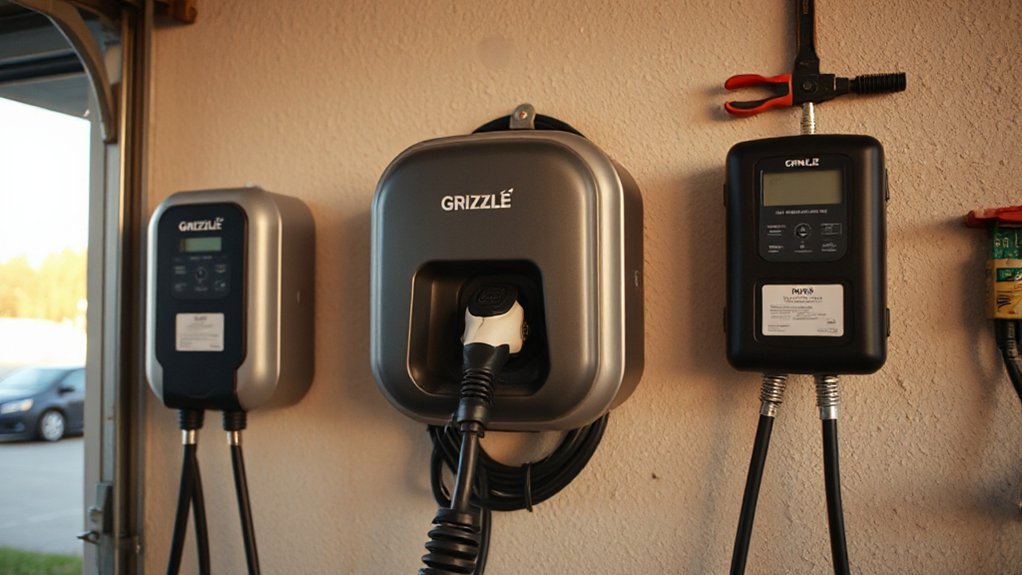
A value benchmark, Grizzl‑E prioritizes a rugged NEMA 4 enclosure, UL/cUL listing, and simple DIP‑switch amperage settings (16/24/32/40 A) over app‑heavy features competitors like ChargePoint, JuiceBox, Wallbox, and Tesla emphasize. You get a hardwearing, field‑serviceable unit with interchangeable cables, a locking holster, and adjustable output that fits 40‑A circuits without derating confusion. It delivers 240 V Level 2 charging up to 9.6 kW, indoor/outdoor, with GFCI and thermal protections built in. Competitors often add Wi‑Fi, load management, and rich apps; if you need robust networking or utility integrations, they may suit better. If you prioritize code compliance, simplicity, and uptime, Grizzl‑E’s brand reputation and market positioning center on reliability and cost control. Expect straightforward installation, fewer failure modes, and durable weather resilience over time.
Conclusion
You’re ready to spec the Grizzl‑E: set 16/24/32/40 A up to 9.6 kW, trust NEMA 4 aluminum housing and 20 mA GFCI, route a 24‑ft J1772 to a lockable holster. Choose hardwire or NEMA 14‑50. Apply NEC 625, size breakers and conductors, pull permits, brief inspectors. Price the install, stack rebates, log maintenance, verify warranty. Competitors tempt—yet reliability matters. Power up… but first, confirm clearances, torque lugs, test GFCI. Ready to hear the relay click?