
Over 80% of EV charging happens at home; a J1772 Level 2 EVSE delivers 208–240 V at 16–48 A (≈3.3–11.5 kW). You’ll size circuits per NEC 625’s 125% continuous-load rule (e.g., 40 A EVSE → 50 A breaker; 48 A → 60 A) and use UL 2594–listed hardware. SAE J1772 pilot/proximity govern safe handshake. GFCI and load management reduce risk. Are you sure your panel, wiring, and adapter plans actually match these limits?
Key Takeaways
- AC Level 2 EVSE using SAE J1772 (Type 1) connector at 208–240 V; typical 3.3–19.2 kW depending on amperage.
- 16–48 A common (up to 80 A); power ≈ V×I; vehicle’s onboard charger and ~8–12% losses limit effective charge rate.
- Signaling/safety: CP/PP handshake sets max current; EVSE energizes after checks; GFCI/isolation monitored; standards SAE J1772, UL 2594, NEC 625.
- Installation: treat as continuous load (125% sizing); e.g., 40 A EVSE → 50 A breaker; target ≤3% voltage drop; use listed, weather‑rated enclosures.
- Compatibility/smart: Works with most non‑Tesla EVs; Teslas require NACS–J1772 adapter; smart units manage load via Wi‑Fi/OCPP and utility demand response.
What Is a J1772 Level 2 Charger

A J1772 Level 2 charger is an AC Electric Vehicle Supply Equipment (EVSE) that uses the SAE J1772 connector to deliver 208–240 V to your EV, typically at 16–48 A (up to 80 A max) for 3.3–19.2 kW of charging power. Defined by SAE J1772 and evaluated under UL 2594, it’s installed per NEC 625. To size service, compute power: kW ≈ V × A ÷ 1000; a 240 V, 40 A unit is ≈9.6 kW. Apply the 125% continuous-load rule: a 40 A EVSE needs a 50 A breaker and conductors rated accordingly. Specify GFCI protection, proper bonding, and weather-rated enclosures (e.g., NEMA 3R/4). Industry history shows J1772’s 2009 standardization shaped North American adoption; market trends favor smart, ENERGY STAR Level 2 units.
How J1772 Charging Works
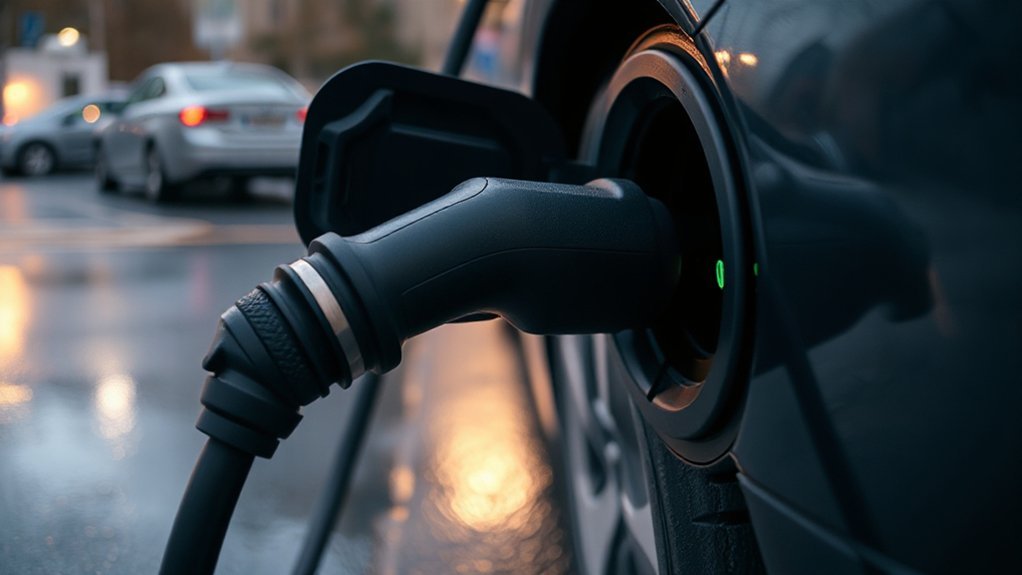
You start with the SAE J1772 pin functions—L1/L2 (or N), PE ground, Control Pilot (CP), and Proximity (PP)—so you verify protective earth, interlock, and the current path. You then interpret the CP’s 1 kHz ±12 V PWM: compute available current from duty cycle per SAE J1772 (Imax = 0.6×D A for 6–85% and Imax = 2.5×(D−64) A for 85–96%), confirm state voltages, and check the ventilation flag. You sequence power delivery—standby, handshake, contactor close, controlled ramp, then shutdown—only after PP and ground checks pass, so you don’t energize until it’s safe at 240 V.
Connector Pin Functions
Five pins govern how a J1772 Level 2 session starts, scales current, and stays safe: two AC power lines (L1 and L2/N), protective earth (PE), Control Pilot (CP), and Proximity Pilot (PP). You route up to 240 V AC on L1–L2/N; at 32 A, that’s 7.7 kW, per SAE J1772 limits and conductor ampacity. PE bonds enclosure to earth, keeping touch voltage at 0 V under fault. CP and PP set readiness and current ceiling without energizing contacts. Verify Pin Materials, plating, and contact force to manage heating at I^2R.
- Keying Alignment guarantees plug can’t mis-insert; geometry enforces phase spacing.
- Measure contact resistance (<10 mΩ typical).
- Confirm insulation coordination for 300 V RMS.
- Use strain relief and gaskets for IP54/IP55.
Pilot Signal Communication
How does the J1772 pilot actually coordinate charging? You read a 1 kHz ±12 V PWM on the Control Pilot per SAE J1772/IEC 61851. The EVSE sources it through 1 kΩ; your car loads CP-to-PE to encode states: ≈2.74 kΩ+diode (≈9 V, State B), ≈882 Ω+diode (≈6 V, State C), ≈270 Ω (≈3 V, ventilation required). The EVSE verifies the diode for safety and opens on 0 V or −12 V faults.
You calculate current permission from the duty cycle: for 10–85% PWM, Imax = 0.6 A/% × duty; for 85–96%, Imax = 2.5 A/% × (duty − 64). You implement signal modulation filtering, hysteresis, and CP surge protection for noise immunity. Always validate frequency tolerance and edge debouncing before closing contactors for safety.
Power Delivery Stages
From the pilot handshake, the charge session progresses through defined power stages per SAE J1772 and IEC 61851-1: Standby (State A, CP ≈ +12 V), Vehicle Detected (State B, ≈9 V via 2.74 kΩ+diode), Ready-to-Charge (State C, ≈6 V via 882 Ω+diode), Energized, and Stop/Fault. You read the PWM duty and compute allowable current: I_max ≈ 0.6 A per duty percent (e.g., 30% → 18 A). After State C, you close contactors, verify PE continuity, then ramp current smoothly; your on-board charger handles voltage ramping and power factor. Continuous monitoring enforces GFCI, isolation, and thermal management limits; breach returns to Stop/Fault.
- Confirm CP levels and duty.
- Calculate I_max and set current.
- Close/open relays only in C/E.
- Monitor temperature, ground, leakage.
Compatibility With EVs and Adapters

You should confirm your EV supports SAE J1772 (IEC 62196-2 Type 1) at 208–240 V and the amperage offered, then estimate charge power with P = V × I while respecting the car’s onboard-charger limit. For Teslas, use a certified J1772–NACS adapter matched to your circuit and EVSE output (e.g., 32–48 A continuous), and size branch circuits per NEC 625 continuous-load rules (125%). Check plug-standard compatibility (J1772, CCS AC pins, NACS) in the vehicle manual, and never exceed the lowest rating among the EVSE, adapter, and vehicle to preserve UL/CSA safety margins.
Supported EV Models


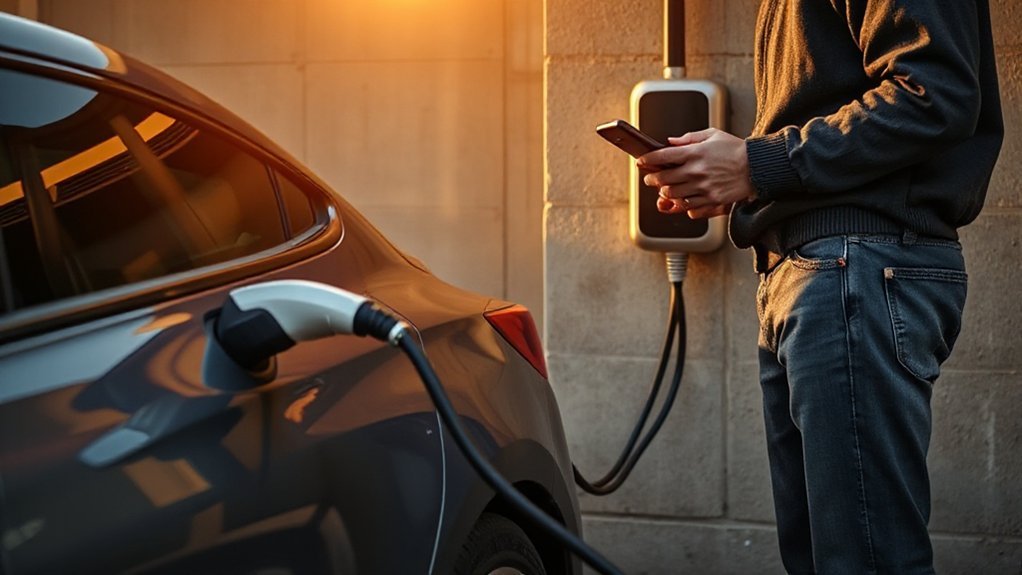
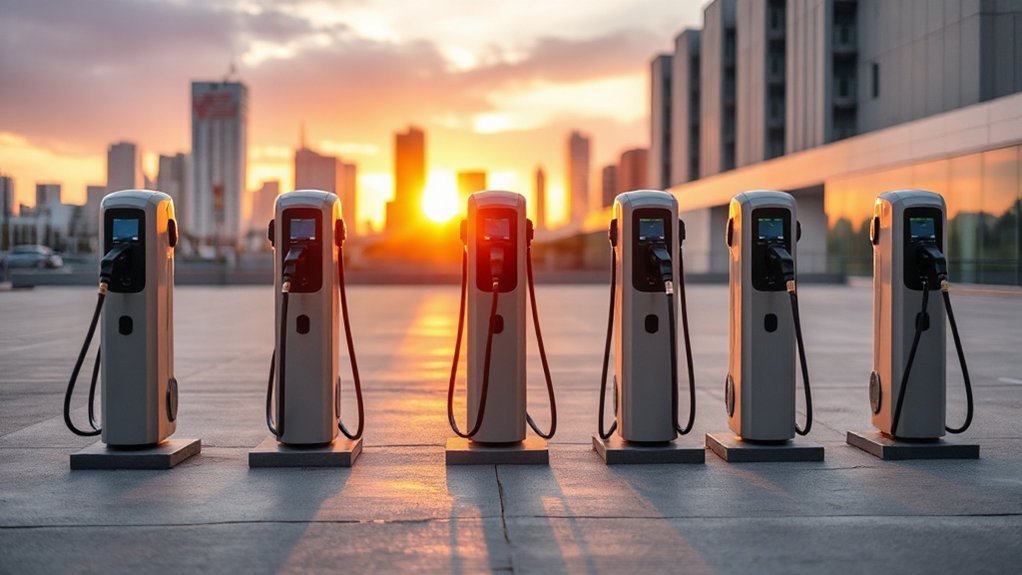
Why does a J1772 Level 2 EVSE fit almost every North American EV? Because SAE J1772 governs the AC inlet used across the non‑Tesla brand lineup for most model years, and EVSEs listed to UL 2594 and installed per NEC 625 deliver 208–240 V at 16–48 A (3.3–11.5 kW). Verify car’s onboard charger rating; the EV dictates the draw, not the station.
- Compact hatch: 32 A max OBC, charges ~7.7 kW on a 40 A circuit (80% rule).
- Family crossover: 40 A OBC, ~9.6 kW; target a 50 A breaker with 6 AWG copper.
- Performance sedan: 48 A OBC, ~11.5 kW; confirm EVSE, wiring, and receptacle ratings align.
- Workplace fleet: 16–30 A units balance; apply calculations per NEC 220 safely.
Tesla Adapter Options
How do Tesla adapters bridge J1772 and NACS safely? You use purpose-built couplers certified to SAE J1772 signaling and UL 2251/UL 2594 safety. A J1772→Tesla or Tesla→J1772 adapter passes the control pilot and proximity lines unchanged, so the EVSE’s duty-cycle advertises available current, and your car limits draw accordingly. At 240 V, a 48 A pilot equates to 11.5 kW (P=VI); verify the adapter’s continuous rating matches. Look for temperature sensing and auto-derating, IP54–IP55 ingress protection, and latch lockouts to prevent arcing. Check cable gauge for <2% voltage drop at max load. Confirm warranty details (typically 12–24 months) and supported VIN ranges. Choose color variants for visibility. Prefer adapters tested with your model year and firmware, and avoid uncertified clones from unknown suppliers altogether.
Plug Standards Compatibility
Where standards intersect, compatibility depends on signaling and ratings: SAE J1772 governs the AC coupler and control pilot (Iavail ≈ duty-cycle% × 0.6 A for 10–85%), so any North American EV with a J1772 or CCS Type 1 inlet will accept Level 2 AC, and Tesla vehicles with SAE J3400 (NACS) inlets use certified adapters to bridge the same pilot/proximity lines without altering them. You read the pilot, cap current, and verify ground before energizing. A 50% duty cycle signals ~30 A; 80% ~48 A at 240 V. Respect mechanical tolerances. Prefer listed adapters and equipment that passes interoperability testing and logs protection states.
- Pilot duty-cycle → current setpoint
- Proximity/latch → insertion and lock
- Ground monitoring → inhibit on fault
- Adapter notes → listings, IP, temperature rise verification
Charging Speed, Amperage, and Circuit Sizing

Anchor your expectations with the math: charging speed equals power, and power equals voltage × current. At nominal 240 V, amperage sets kilowatts. A 32 A EVSE delivers about 7.7 kW; a 48 A unit about 11.5 kW. SAE J1772’s pilot signal advertises the allowable current; your car’s onboard charger then draws at or below that limit, and may reduce draw under thermal throttling. Expect efficiency losses of roughly 8–12%, so wall power exceeds battery gain.
Size circuits for continuous load per NEC: limit continuous current to 80% of breaker rating. Therefore 32 A requires a 40 A circuit; 48 A requires 60 A. Verify equipment listings (UL 2594) and cable ratings, honor ambient derating, and never exceed conductor or connector temperature limits specified.
Home Installation, Wiring, and Outlet Options
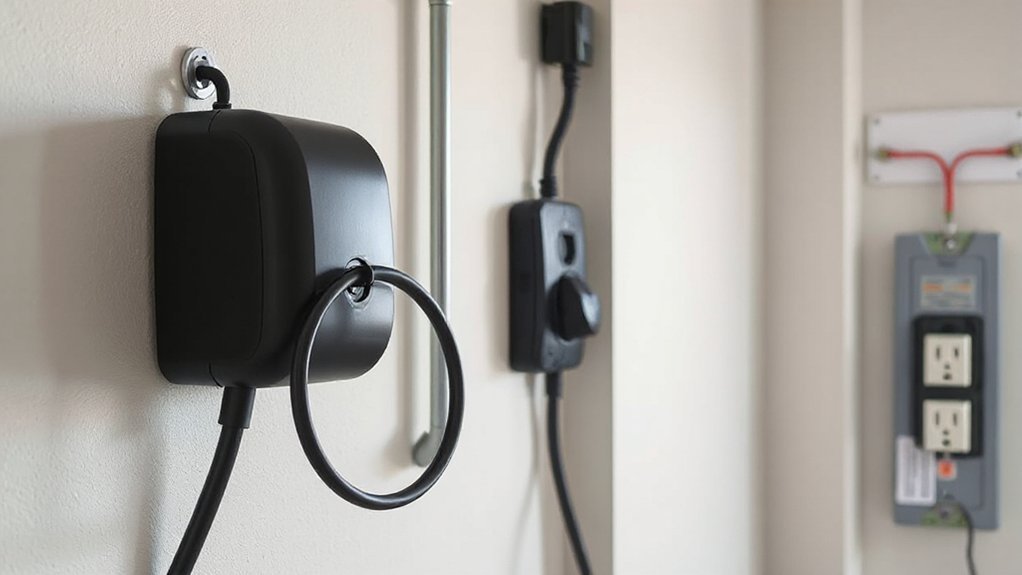
Why begin with code and math? You’ll size everything to NEC 625 and 210. For a 40 A EVSE (continuous), multiply by 125% = 50 A breaker, 6 AWG Cu THHN/THWN-2 typically. Keep branch-circuit voltage drop under 3%; at 240 V and 40 A over 75 ft, target ≤7.2 V drop. Use GFCI protection where required and bond per NEC 250. Choose hardwired or NEMA 14‑50 receptacle; use industrial-grade, 75°C terminations.
Prioritize contractor selection, permits, and inspection. Evaluate mounting options: wall, pedestal, or ceiling, with drip loops and clearance per manufacturer. Route conduit, respect fill and derating, and label the disconnect.
- Load calc confirms panel capacity
- Dedicated 2‑pole breaker location
- Receptacle height and cord reach
- Outdoor enclosure rating (NEMA 3R/4)
Smart Features, Networking, and Load Management
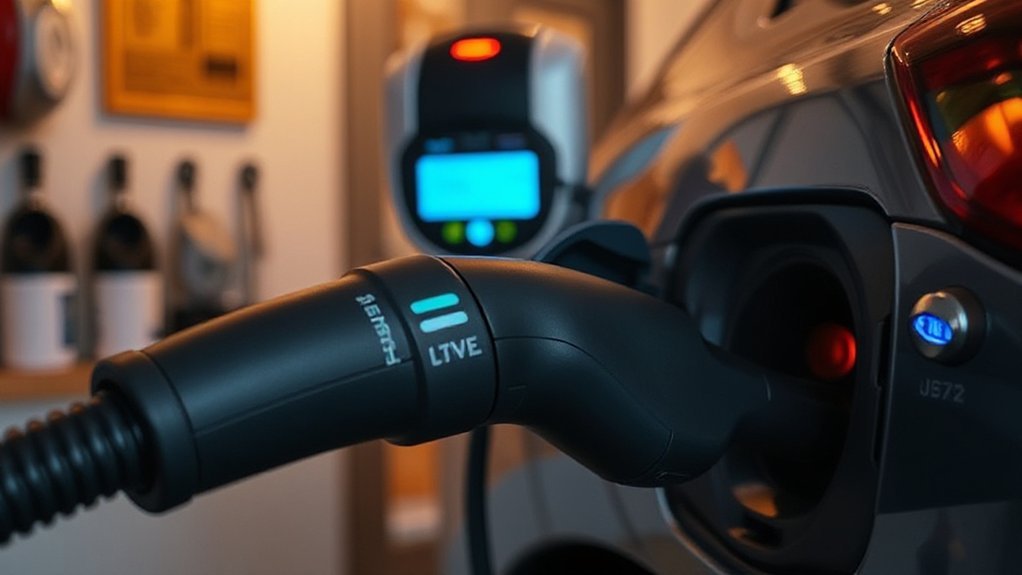
Although the J1772 control pilot ultimately sets charging current, smart EVSE lets you program that value to match code and capacity: set the EVSE’s max to 80% of the branch-circuit rating (NEC 625; continuous load rule) and integrate it with the dwelling load calculation (NEC 220) or an EV energy management system.
For 60A circuits, advertise 48A; for 40A, 32A. Use Wi-Fi or OCPP to coordinate ports: allocate current so the sum never exceeds feeder or service limits. Example: on a 100A subpanel with 60A spare, schedule two EVSE to share 48A, then rebalance as cars connect.
Enable Demand Response to curtail load during utility events and align with TOU schedules. Apply Firmware Updates to fix bugs; verify draw and lock settings periodically, securely.
Safety Standards, Costs, and Incentives
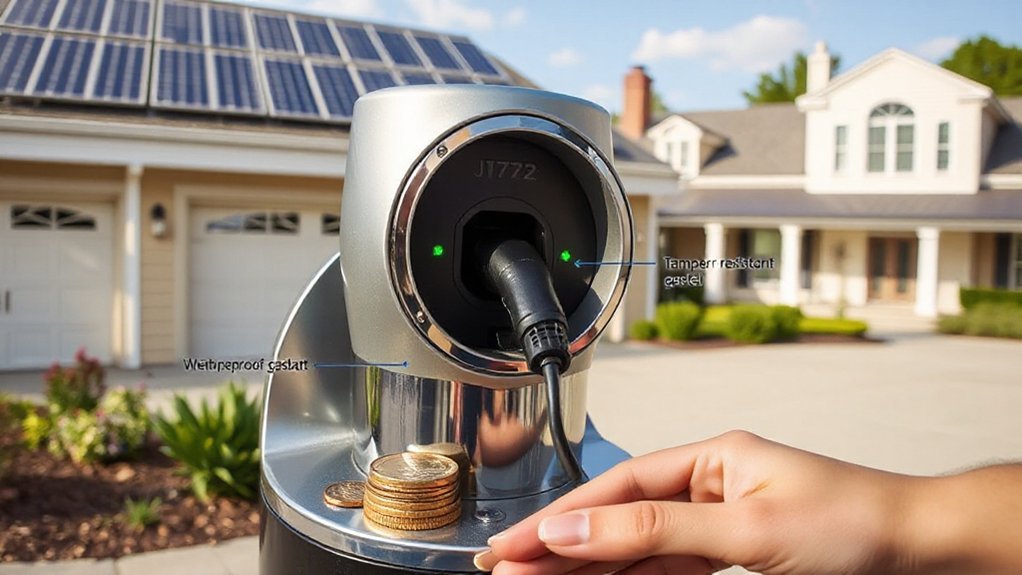
While you’re sizing and networking the EVSE, verify it’s listed and installed to the applicable safety standards, then translate those choices into a clear cost-and-incentive plan.
Confirm UL 2594/2231 listing and NEC 625 installation; add required GFCI. Treat the EVSE as a continuous load: Ibranch ≥ 125% × Ievse per NEC 210.19/215.2. Size conductor for ampacity and keep voltage drop under 3% at full load. Use NEMA 3R outdoors and secure the pedestal. Document regulatory compliance for permits and warranties. Build a cost stack: hardware, panel work, trenching, permits, networking, maintenance. Map incentives: federal credit, utility rebate, DR payments; align incentive eligibility with ENERGY STAR and open protocols.
- 40A EVSE; 50A breaker.
- #8 Cu; 75°C lugs.
- 100 ft run; 2.8% VD.
- Net cost: $2,000.
Conclusion
You’re ready to plug into tomorrow, but pause: will your circuit deliver 40 A continuous on a 50 A breaker per NEC 625, or must you dial the pilot to 32 A? You verify SAE J1772 signaling, GFCI, and UL 2594 listing. At 240 V, 32 A equals 7.7 kW—enough for overnight, unless you chase 11.5 kW on 60 A wiring. You choose smart load sharing, correct conductor gauge, and permits—and reach for the handle… now.