
A calculator sits beside a sunlit parking lot: in 2025, you can stack a 30%+ ITC with NEVI/make‑ready funds, cut retail kWh and demand charges, and see $3–5.5/W DC plus $5k–$15k/port capex pencil to 5–8‑year payback at high utilization, 9–13 at moderate. But tariffs, export limits, interconnection, storage sizing, and prevailing‑wage rules can flip the math. Want to know where your project lands—and what levers you control?
Key Takeaways
- 2025 capex typically $3.0–$5.5/W DC plus $5k–$15k per port; soft costs and interconnection can add 10–20% and long timelines.
- Federal ITC 30% plus 10–20% adders and MACRS improve ROI, but demand charges and TOU spreads dominate operating economics.
- Payback is 5–8 years at 20–30% utilization; 9–13 years at 8–15%; stress‑test outages, incentive cliffs, and demand rebound.
- Residential ROI hinges on net billing and TOU spreads; size arrays 2–3 kW for 3,000–4,500 kWh/year EV loads without service upgrades.
- Fleet sites gain most: managed charging plus 30–50 kW batteries shave 40 kW peaks ($400–$1,200/month) and enable TOU arbitrage and V2G revenues.
Key Cost Drivers, Incentives, and Utility Rate Impacts

While site specifics ultimately set the economics, your ROI will hinge on a few quantifiable levers: capital costs, incentives, and tariff design.
ROI hinges on three levers: capex, incentives, and tariff structures—site specifics set the economics.
Expect $1.2–$2.0/W for PV, $400–$1,000/kW for chargers, plus trenching, switchgear, and interconnection fees that can exceed 10% of capex.
Soft costs—engineering, permits, commissioning—add 10–20%.
Federal ITC (30%), bonus adders (10–20% for domestic content/energy community), MACRS, and state rebates enable incentive stacking; stack carefully to avoid double-counting.

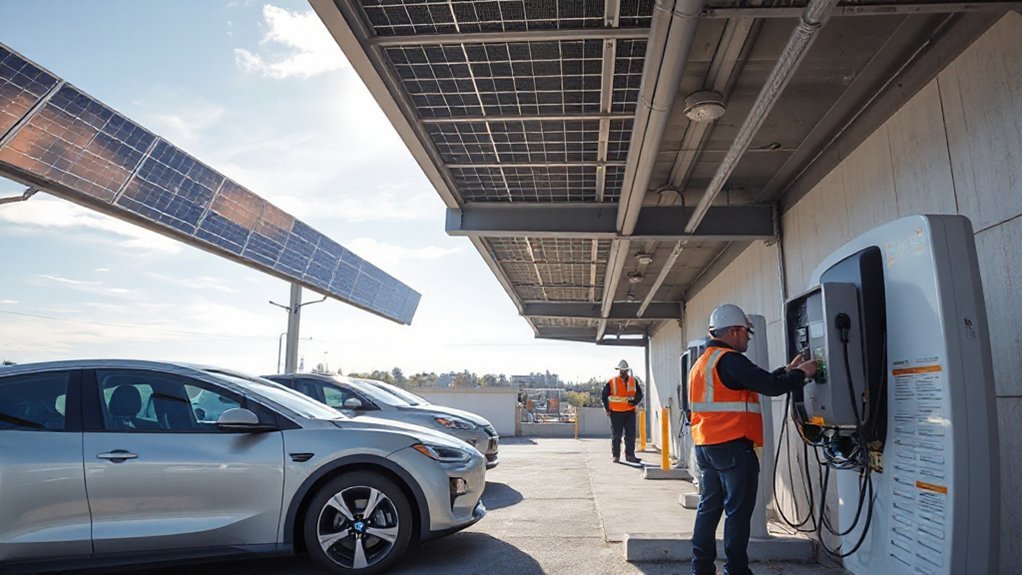
Utility make‑ready grants and NEVI can offset site work but often require prevailing wage and uptime commitments.
Tariffs dominate Opex: demand charges of $10–$30/kW and TOU spreads of $0.10–$0.35/kWh shape payback.
Storage or managed charging can shave peaks and arbitrage TOU, but export rules and NEM 3.0 limit credit value.
Model scenarios with conservative escalation assumptions.
Residential vs. Fleet Economics and System Sizing

Although both homes and depots can pair PV with EV charging, the economics and sizing diverge sharply with load profile, utilization, and tariff design.
For a typical home, you’ll offset 3,000–4,500 kWh/year for one EV, requiring about 2–3 kWdc of PV at 1,500 kWh per kW-year. Net billing and NEM rules shift value to daytime charging; TOU spreads of $0.15–$0.35/kWh set payback. Roof suitability limits array size; you size to annual EV load plus baseload without triggering service upgrades.
Fleet duty cycles and utilization push 50–300 kW systems. You’ll right-size to midday dwell, demand charges, and interconnection caps. At $0.18/kWh solar LCOE replacing $0.25–$0.45 delivered power, margins scale. Plan for canopy space, 480 V service, and scalability planning—modular PV blocks, expanders, and V2G alignment.
Modeling Scenarios: Solar Yield, Charging Behavior, and Storage
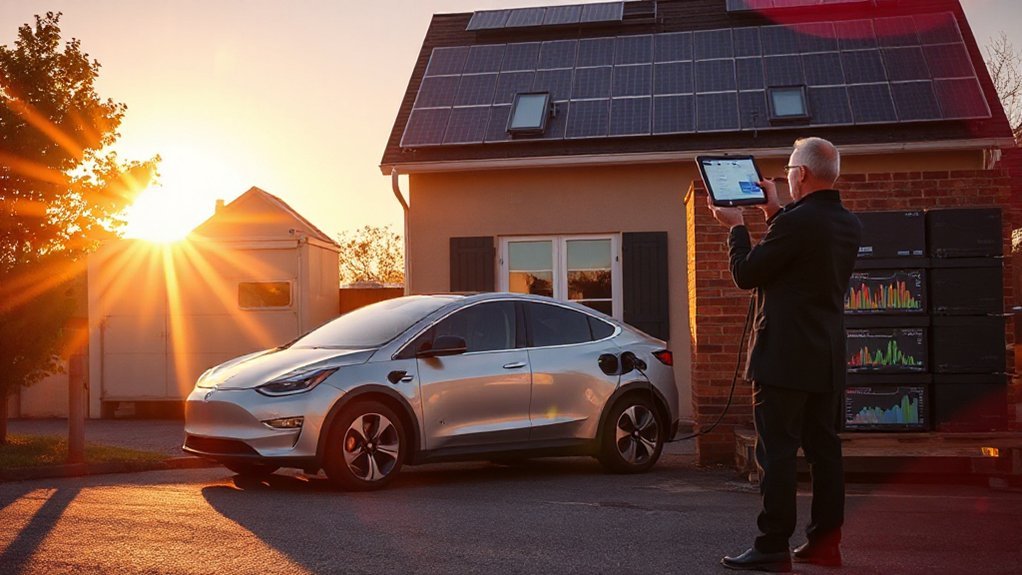
Because tariffs and behavior drive ROI, you need an hourly (or 15‑minute) model that links solar yield, charging, and storage dispatch. Build scenarios with hourly granularity: synthesize PV output from TMY or satellite data, derate for soiling, temperature, inverter limits, and shading. Layer charging demand using behavioral clustering from telematics or smart charger logs—weekday vs weekend, home vs depot, arrival times, dwell, and kW limits. Model the battery with round‑trip efficiency, SOC bounds, C‑rate, cycle life, and reserve rules. Enforce export limits, minimum import, and utility interconnection constraints. Quantify outcomes: onsite solar fraction (%), battery throughput (kWh/cycle), unmet charging (% hours), curtailed energy (kWh), and coincident peak exposure. Reflect policy: NEM phase‑outs, fixed charges, EV tariffs, and local export caps and permitting lead times.
Revenue Opportunities: TOU Arbitrage, Demand Charge Reduction, and V2G
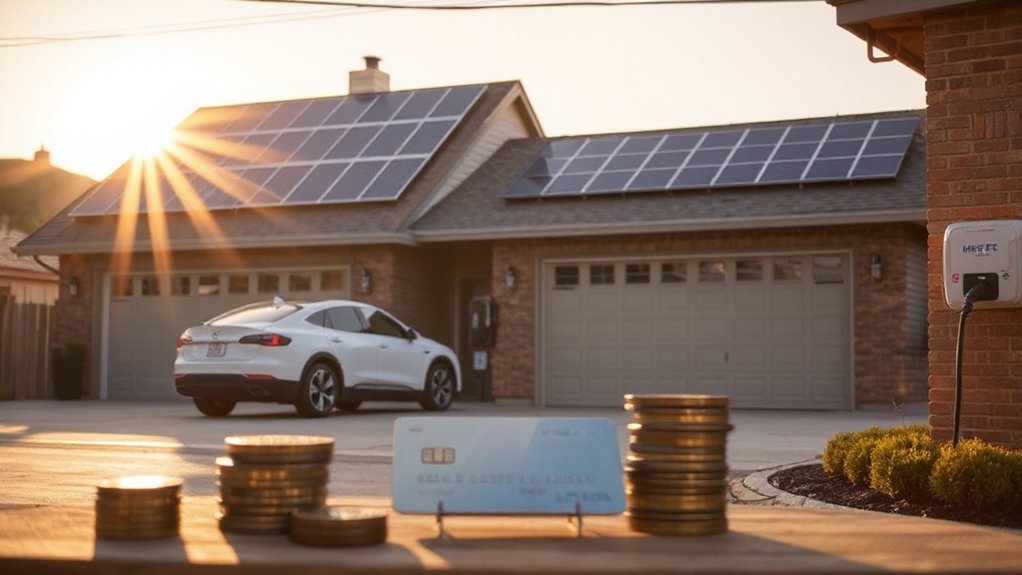
Done right, your solar‑EV system earns on three fronts: TOU arbitrage, demand‑charge reduction, and bidirectional services (V2G). Shift mid-day solar into evening peaks where TOU spreads run $0.15–$0.40/kWh in 2025 tariffs; every 100 kWh shifted daily yields $5–$12 gross. Use managed charging plus a 30–50 kW battery to shave peaks; with commercial demand charges of $10–$30/kW, a 40 kW reduction is worth $400–$1,200 per month. Enable V2G to sell regulation and spinning reserve ancillary services and enroll in capacity markets: typical payments are $5–$20/kW‑month for availability plus $0.02–$0.10/kWh for energy. Policy tailwinds matter: FERC Order 2222 opens aggregator access to ISO/RTO markets; state interconnection and metering rules determine whether your fleet can capture these stacked revenues. Carbon credits and LCFS can enhance net revenue.
Hidden Costs, Permitting Pitfalls, and Real-World Payback Ranges

While the revenue stack looks compelling, your pro forma hinges on soft costs and permitting that can swing IRR by 5–10 points. Expect interconnection studies ($5k–$50k), utility-driven transformer upgrades ($30k–$250k), and ADA/sitework overruns (10–20%). Plan for roof degradation risk on PV carports vs rooftops and insurance increases of 5–15% after adding batteries and public chargers. Permitting time can range from 4–12 months; AHJs may require fire-access lanes, NEVI-compliant hardware, or prevailing wage, adding 8–20% to capex. ITC/IRA adders help, but Buy America and domestic content verification add admin costs. In 2025, all-in capex typically lands at $3.0–$5.5/W DC plus $5k–$15k per port. Real-world payback: 5–8 years at high utilization (20–30%), 9–13 years at moderate (8–15%). Stress-test. Model outages, incentives cliffs, and demand rebound risks.
Conclusion
You weigh 30%+ ITC adders, NEVI/make‑ready grants, and avoided $/kWh and demand charges: do the numbers sing? With capex around $3–$5.5/W DC plus $5k–$15k/port, fleets hitting high utilization see 5–8‑year paybacks; moderate use lands near 9–13. Model TOU arbitrage, demand‑charge shaving, storage/V2G, and export rules. Then audit tariffs, interconnection, and prevailing‑wage permitting. If you size right, you don’t just charge EVs—you charge ROI. For homes, arrays and scheduling matter; for depots, storage sizing rules savings.