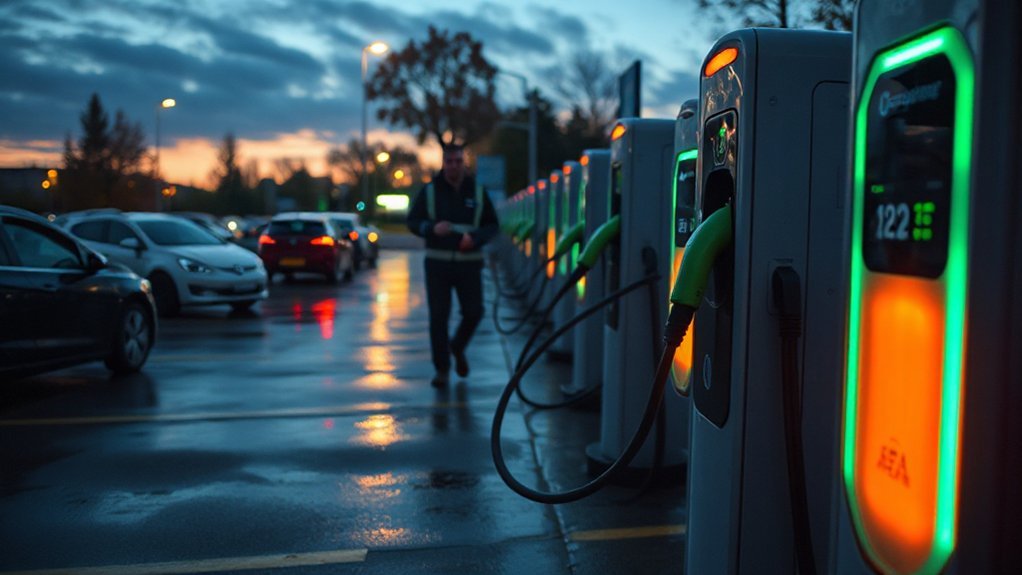
You’re weighing Tesla Superchargers against Electrify America for 2025–2026. Both networks serve fast charging, but they differ in coverage, connector support, pricing, and real-world speed. Depending on your car and routes, one will clearly suit you better. Keep going to see which factors matter most for your next long trip.
Key Takeaways
- Tesla offers a larger, denser global network with high-density corridors and growing V4 coverage, ideal for long interstate and international travel.
- Electrify America advertises up to 350 kW and can deliver higher peak power for some non-Tesla EVs on CCS-enabled models.
- Tesla V4 peaks around 325 kW and benefits from preconditioning, often adding ~200 miles in 15 minutes on optimized Teslas.
- Compatibility favors Tesla owners (NACS); non-Tesla drivers can use Electrify America’s CCS now, while NACS adapters and cross-compatibility roll out through 2025–26.
- Pricing varies: Tesla ~$0.25–0.35/kWh (peaks ~$0.55); Electrify America guest ~$0.43/kWh or ~ $0.31/kWh with subscription, so costs depend on plan and state billing rules.
Network Size and Availability

While Tesla’s Supercharger network spans the globe with over 7,300 DC fast-charging stations and more than 70,000 connectors, Electrify America concentrates thousands of ultra-fast chargers across the U.S. and remains smaller by station and port count. In Q1 2025 Tesla added approximately 2,200 stalls worldwide, further increasing its reach.
You’ll find Tesla’s network across major travel corridors, urban centers, and international markets, with many high‑density stations offering roughly 15 ports on average and some sites exceeding 50–100 ports to reduce wait times.
Electrify America focuses on U.S. interstate and metro coverage, placing typical stations near retail and travel hubs and averaging about ten ports per location.
For safety-conscious drivers, both networks prioritize accessible placement and reliable availability; you’ll want to plan routes using each provider’s app to confirm real-time station status, and often offer basic maintenance support.
Charging Speed and Performance
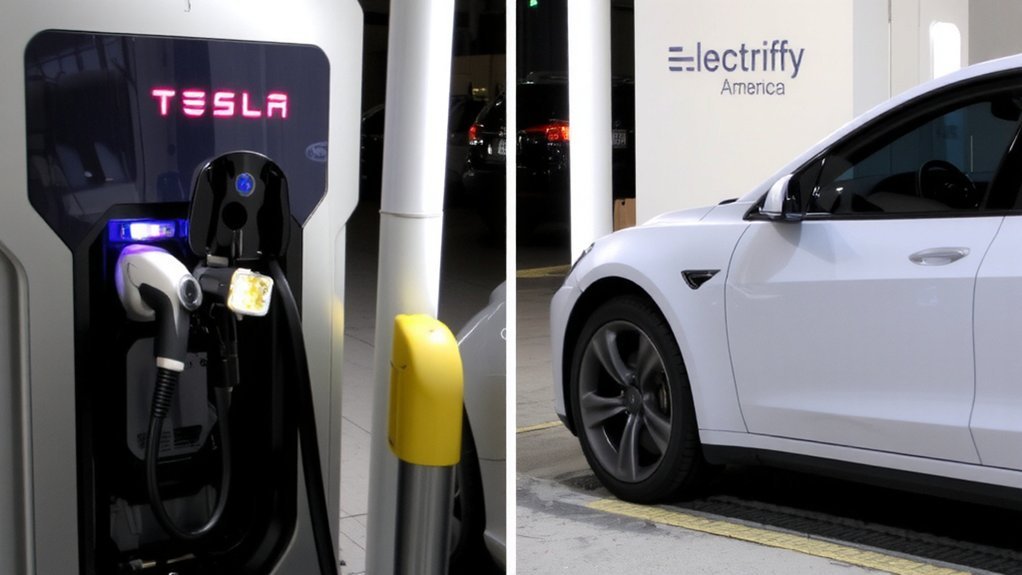
When you’re comparing raw numbers, Electrify America advertises up to 350 kW while Tesla’s newest V4 Superchargers top out at about 325 kW (V3 = 250 kW), but real-world speeds depend on your car, battery temperature, and state of charge. Independent testing showed that Electrify America delivered 152 miles in 15 minutes to a 2025 Hyundai Ioniq 5.
Tesla adds about 200 miles in 15 minutes on optimized models; Electrify America delivered about 152 miles in 15 minutes on a 2025 Ioniq 5.
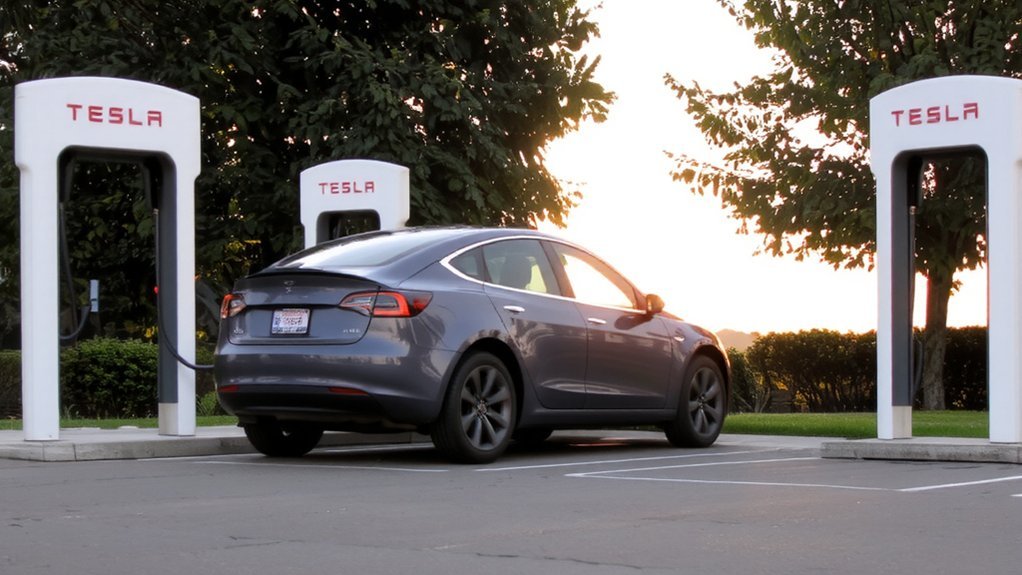
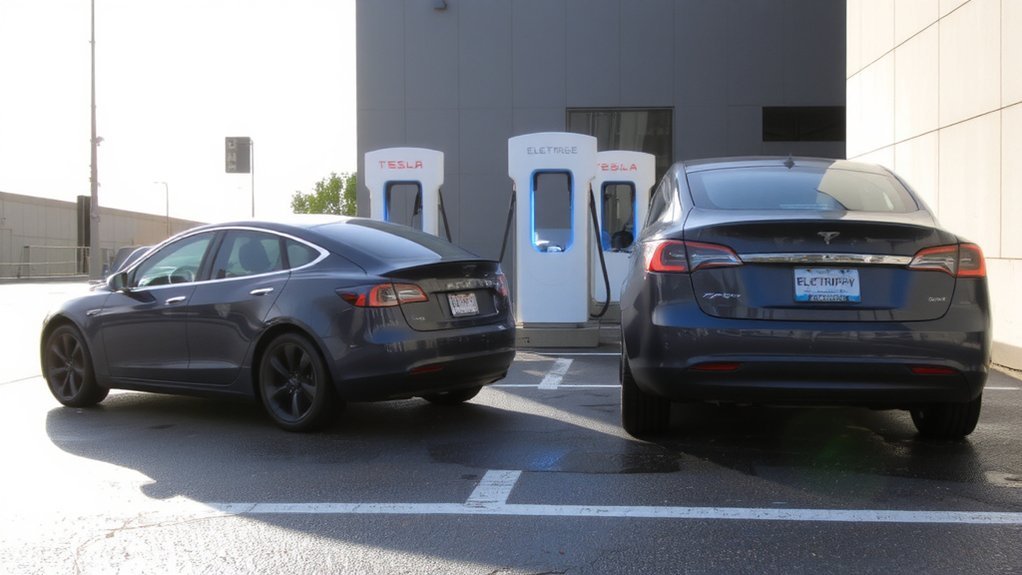
Tesla’s preconditioning can boost charging speed ~25% and helps sustain high power until roughly 50–70% SOC, then tapering protects battery health. Electrify America may hold higher peak power longer for some non‑Tesla EVs.
Expect dynamic power adjustments based on temperature and SOC, and follow gradual charging limits to preserve safety and battery life. Prioritize conservative charging for battery health.
Connector Compatibility and Access
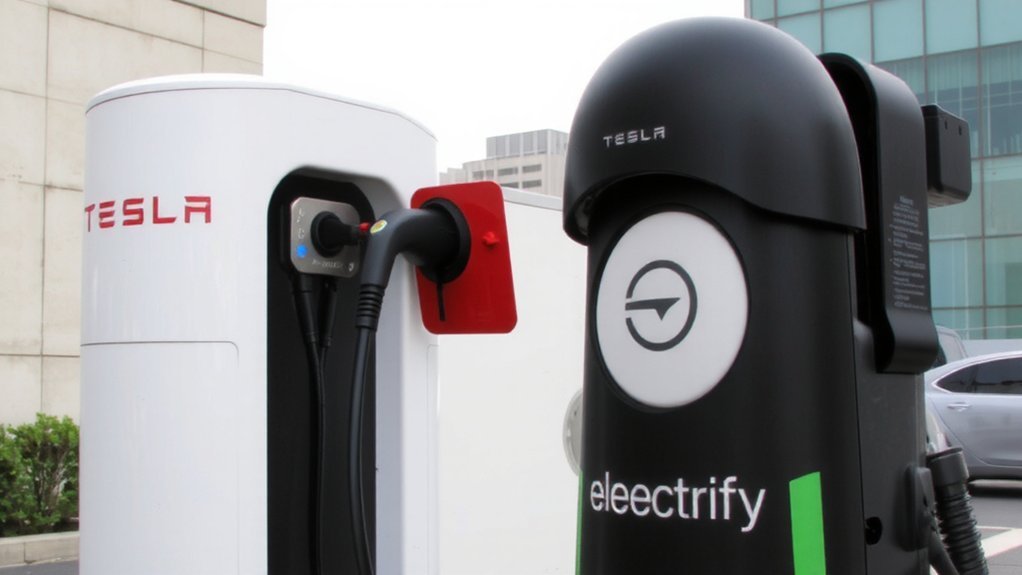
Many drivers face a simple choice: plug in with a native NACS port or use an adapter for Tesla Superchargers, while Electrify America currently accepts CCS and is adding NACS on new sites through 2025–26. Tesla is also opening its Superchargers to other brands to qualify for funding under the bipartisan infrastructure law.
You’ll want the safest, most reliable connection: Tesla’s Superchargers use NACS, so if your EV has that port you’ll connect directly; otherwise you’ll need an adapter and may have to manage app activation or payment unless your manufacturer (like Mercedes‑Benz) handles it for you.
Electrify America’s CCS network already serves most EVs and plans dual CCS/NACS access to remove adapter reliance as automakers add NACS ports. Expect interoperability to improve, but it depends on hardware, software updates, and supply‑chain timelines.
Check compatibility before travel and carry adapters if needed.
Pricing and Cost Efficiency
Pricing matters more than ever if you rely on public fast charging. You’ll find Tesla usually charges per kWh (or per minute where law requires), with averages around $0.25–$0.35/kWh and peaks near $0.55/kWh; time-based tiers can hit $1.25/min for 180–250 kW. Electrify America lists a guest rate of about $0.43/kWh and a $4/month subscription rate near $0.31/kWh (or equivalent per-minute rates). Regional rules can flip per-kWh to per-minute billing; that often makes Electrify America cheaper in states like Tennessee and Georgia. If you charge frequently, the $4 plan yields predictable, lower costs and better safety through reduced idle time. Tesla promotions may cut costs temporarily, but for steady savings Electrify America’s subscription is usually more cost-efficient. Check app prices before you plug in. Electrify America’s free plan, for example, charges $0.16/min on 1–90 kW chargers.
User Experience, Reliability, and Market Outlook
For EV drivers, the choice between Tesla Superchargers and Electrify America comes down to how smoothly charging integrates with your car, how often chargers are up, and where they’re located. Tesla gives seamless plug-and-charge for its vehicles, plus a Trip Planner that eases long trips and reduces range anxiety, and its V4 stalls deliver top speeds for Teslas.
Electrify America supports many models with CCS1 and some CHAdeMO or NACS adapters, often siting stations in convenient commercial areas. Non‑Tesla drivers may see slower plateaus on Tesla chargers and occasional access limits. Tesla’s network shows higher uptime and faster issue resolution; Electrify America is improving but varies by site.
Marketwise, Tesla’s larger footprint offers broader coverage, while Electrify America grows as a key alternative nationwide. Electrify America provides very high power levels for compatible cars, supporting 150–350 kW.
Conclusion
You stand at a fork: one path is a Tesla Supercharger—smooth, map-lit highway reserved for owners; the other is Electrify America—a multi-lane interchange that welcomes all makes. You choose by vehicle and habit: if you own a Tesla you’ll sail with preconditioning and seamless access; if you drive varied brands you’ll value raw power and broader availability. Like choosing a vessel for a voyage, you pick the harbor that fits your ship and course well.