You use the Combined Charging System (CCS1) to charge at up to ~1000 V and ~500 A, combining the SAE J1772 AC interface with two DC pins. The control pilot and PLC (DIN 70121/ISO 15118) handle negotiation, authentication, and Plug‑and‑Charge. Thermal limits and charging curves govern real power, not the headline kW. Connector geometry, cabling, and network interoperability determine your actual experience—so it’s worth parsing how the hardware, protocols, and sites interact.
Key Takeaways
- CCS1 combines SAE J1772 Type 1 AC with two DC pins, enabling AC Level 1/2 and DC fast charging in North America.
- DC contacts support up to 1000 V and ~500 A; typical public chargers deliver 95–350 kW, with ISO 15118‑20 enabling up to 500 kW.
- Communication uses PLC (HomePlug Green PHY) with SLAC; sessions use DIN 70121 or ISO 15118, TLS mutual authentication, and Plug‑and‑Charge via PKI.
- Control Pilot and Proximity Pilot manage safety and limits per IEC 61851‑1; handshakes finish <30 seconds before energizing and controlled ramping.
- Real‑world 10–80% charging is ~25–40 minutes at 150 kW and ~15–25 minutes at 250–350 kW, tapering as SOC rises and temperatures increase.
What Is CCS1 and How It Works
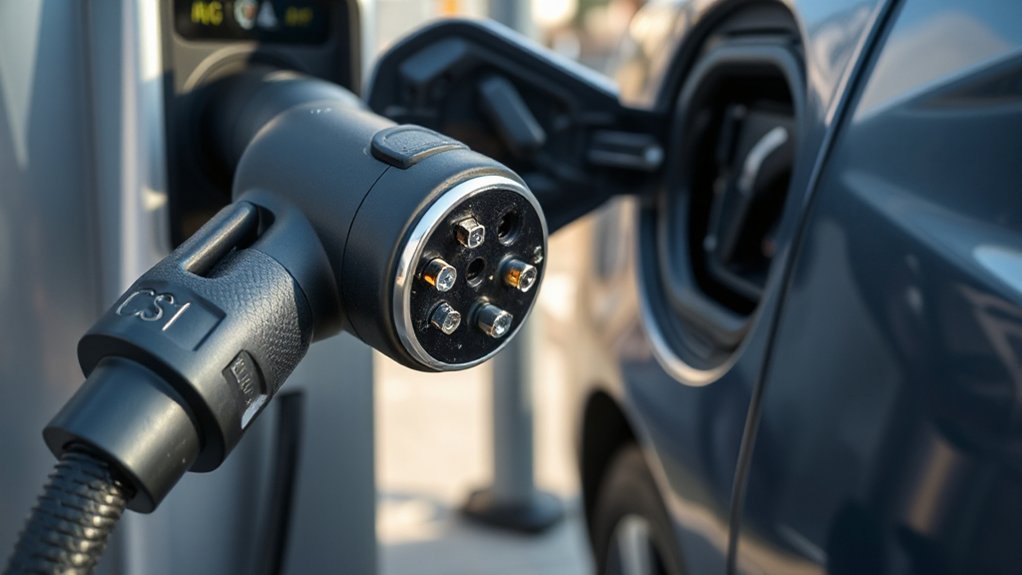
What exactly is CCS1? You use the Combined Charging System Type 1 to negotiate AC or DC charging with an EV through standardized communication stacks. CCS1 implements SAE J1772 signaling for AC and DIN 70121 or ISO 15118 for DC, using HomePlug Green PHY PLC to exchange capabilities, authentication, and charge control. It supports cybersecurity, contract certificates, and charging profiles.
In practice, your EVSE and vehicle perform a handshake, validate limits, then ramp current and voltage to a target curve while monitoring temperature and state of charge. Typical DC service delivers 95–350 kW, with ISO 15118-20 enabling up to 500 kW and bidirectional features. Standards governance spans SAE, ISO/IEC, and CharIN. The regulatory landscape ties compliance to UL safety, FCC/EMC, metering, and NEVI requirements.
Connector Design: Plugs, Pins, and Inlets
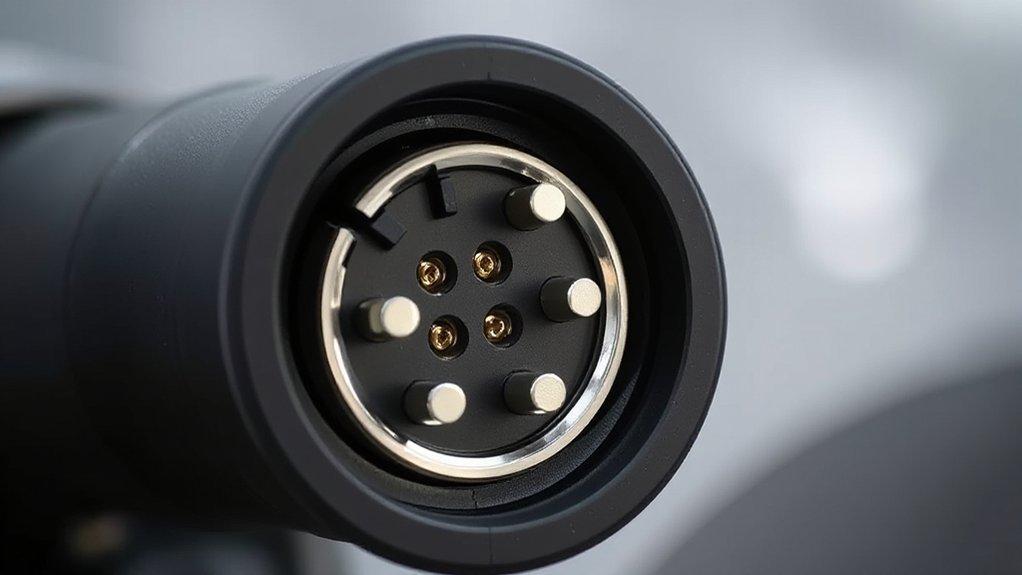
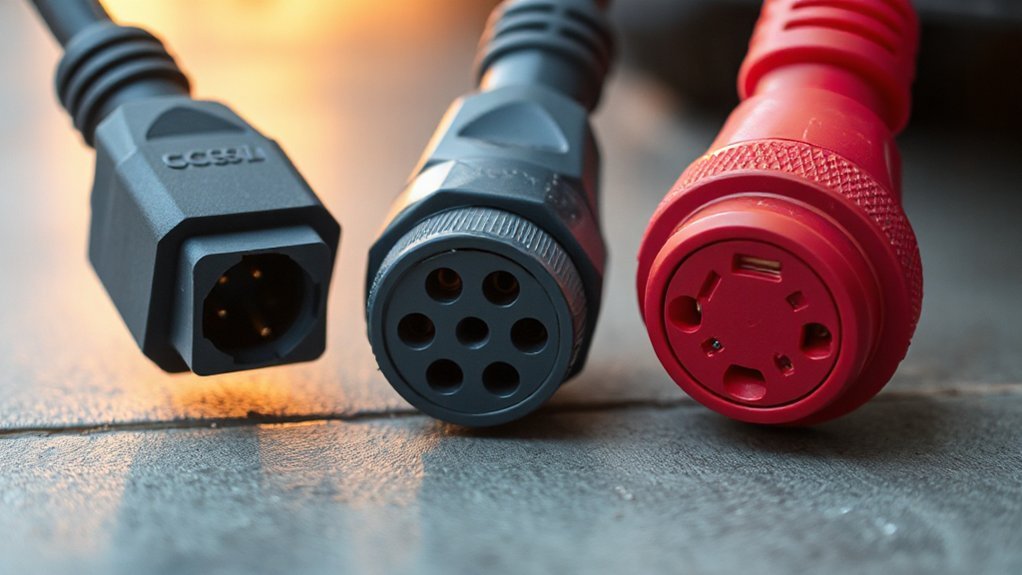
You evaluate CCS1 plug geometry against SAE J1772 and IEC 62196-3: a Type 1 AC coupler with two added DC power pins, keyed features, and latch tolerances for reliable mating. You map the pin layout and ratings—L1, N, CP, PP, DC+, DC−—targeting up to 1000 V DC and 500 A (higher with liquid-cooled leads), while meeting contact resistance and temperature-rise limits. You verify inlet sealing and durability via IP55 mated performance, gasketed interfaces, corrosion protection, and thermal/vibration cycling compliance.
CCS1 Plug Geometry
The CCS1 interface combines the SAE J1772 Type 1 AC coupler with two high-current DC pins in a vertically stacked “Combo 1” layout defined by SAE J1772 and IEC 62196-3. You engage a keyed, ovalized housing that controls angular alignment and insertion depth within specified Mounting tolerances. Grip ergonomics shape handle curvature, trigger reach, and surface texture to support one-handed insertion under cable load. The latch mechanism provides positive retention and audible feedback, with release forces constrained by standard guidance. Sealing ribs and overmold interfaces form an IP54/IP55 interface when mated, while chamfers guide approach to the vehicle inlet. Cable strain relief sets a controlled bend radius, limiting torsion. Materials typically use glass-filled thermoplastics and plated copper alloys for durability, and stable repeated mating.
Pin Layout and Ratings
Building on the Combo 1 housing, pin functions and electrical ratings follow SAE J1772 and IEC 62196-3 allocations: the upper Type 1 section carries AC Line (L1), Neutral (N), Protective Earth (PE), Control Pilot (CP), and Proximity Pilot (PP), while the lower pair provides DC+ and DC− for fast charging. You rate the DC contacts to 1000 Vdc and up to 500 A continuous. The AC set supports 120–240 Vac to 80 A. CP uses a 1 kHz, 12 V PWM; PP encodes cable rating (e.g., 220 Ω ≈ 32 A, 100 Ω ≈ 63 A). Prioritize material selection: copper alloy with silver plating. Perform insulation testing (2.5 kVdc withstand; >100 MΩ at 500 Vdc). Maintain IEC creepage/clearance, keyed engagement, and post-handshake DC energization.
Inlet Sealing Durability
Sealing durability for the CCS1 inlet targets automotive-grade ingress protection and lifecycle robustness validated to IEC 60529 and ISO 20653. You specify IP67 static sealing and IP6K9K jet-wash resistance at the vehicle interface, with gaskets retaining compression set below 25% after 1,000 hours at 85°C. You verify performance through -40°C to 85°C thermal cycling (at least 200 cycles), combined with vibration per ISO 16750-3. To mitigate salt corrosion, you run 240–480 hours neutral salt spray and cyclic SO2 exposure, then remeasure insulation resistance and contact resistance. You screen polymers for UV degradation using ISO 4892, targeting <5% mass loss and no cracking. You validate 10,000 mating cycles with lubricant compatibility. Helium leak and pressure-decay tests confirm seal integrity post-aging and impact and thermal shock.
AC Level 1/2 Vs DC Fast Charging
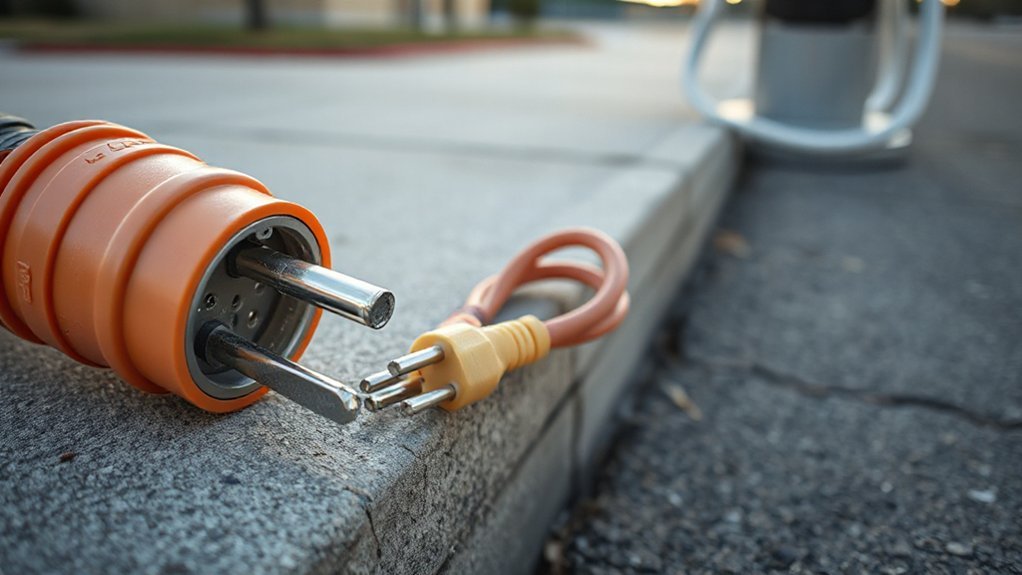
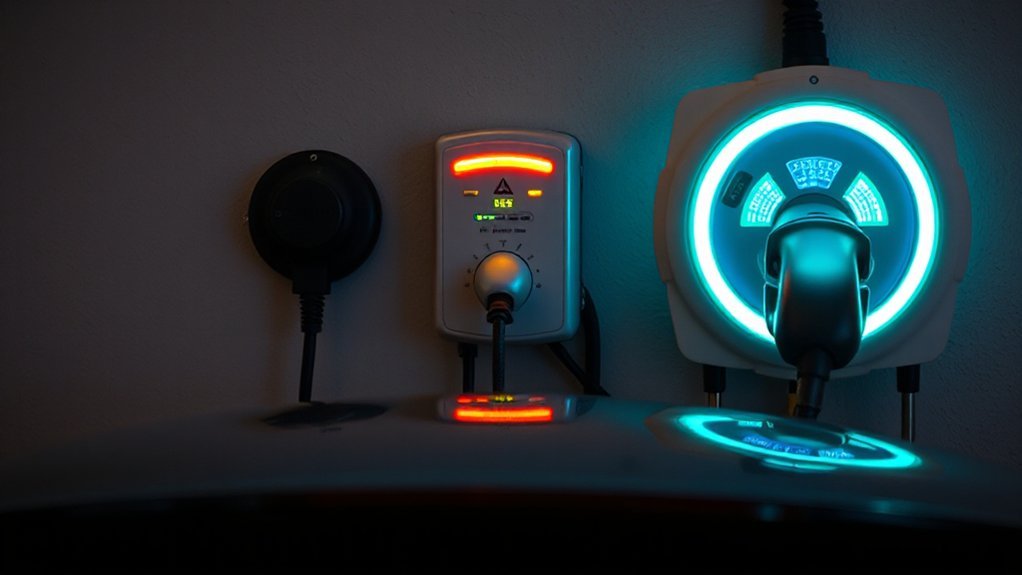
Why distinguish between AC Level 1/2 and DC fast charging? You route AC through onboard charger via SAE J1772 inlets, while DC uses the CCS1 pins to bypass the converter. With AC, the vehicle’s OBC handles rectification, power factor correction, and thermal limits; with DC, the EVSE and your BMS coordinate voltage and current via PLC under ISO 15118 or DIN 70121. AC Level 1/2 supports load management and utility demand response, improving grid resilience. Lower C‑rates and cooler profiles can mitigate battery aging. DC sessions impose higher stress, requiring tighter SOC windows, cooling, and contactor control. Safety differs: AC uses GFCI and pilot signaling; DC adds HVIL, insulation monitoring, and ground‑fault detection per UL 2202/2231. Accurate metering and authentication shift to the EVSE.
Power Ratings, Charging Curves, and Real-World Speeds
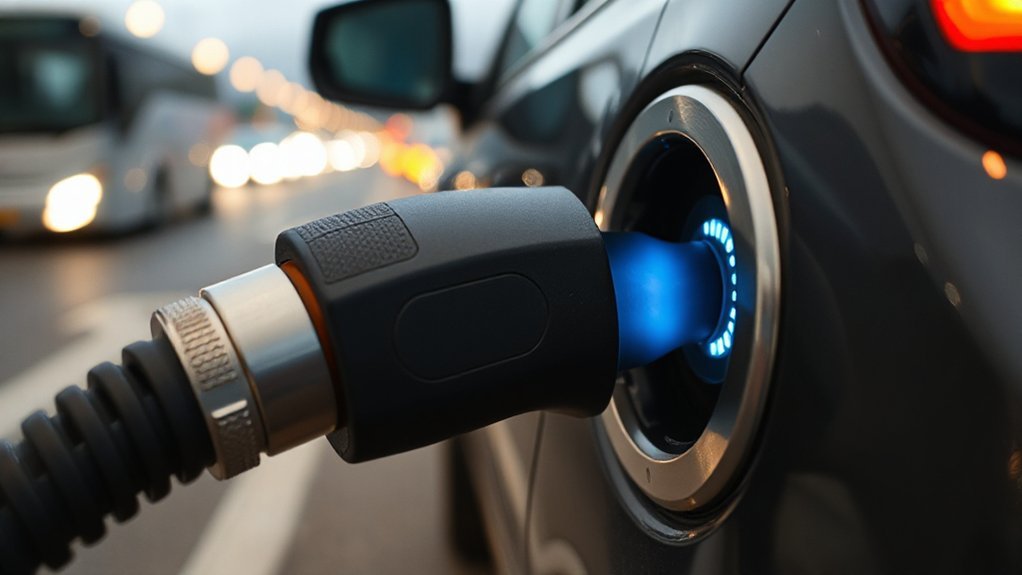
You should verify both charger and vehicle peak kW (e.g., 150/250/350 kW CCS1) and identify the bottleneck per SAE J1772, DIN 70121, and ISO 15118 signaling plus site current limits. Expect a tapered charging curve, with peak hold time constrained by pack voltage window, thermal management, and BMS strategy. Compare 10–80% times under controlled conditions (preconditioned battery, fixed ambient, consistent SoH): 150 kW typically delivers ~25–40 minutes, while 250–350 kW systems often reach ~15–25 minutes, subject to vehicle limits.
Peak Kw and Limits
While CCS1 sites are marketed by headline power (e.g., 150 kW, 350 kW), actual charge rate is the negotiated product of voltage and current limits defined by SAE J1772 Combo (CCS), DIN 70121/ISO 15118, and constrained by the vehicle, the dispenser, and the cable. You’ll see peak kW only when the pack voltage aligns with the charger’s voltage window and the BMS authorizes maximum amps. Cable cross-section, connector temperature sensors, and inlet ratings trigger thermal derating. Shared power cabinets and grid constraints cap simultaneous outputs. Many dispensers deliver 500–1000 V, but current may be 200–500 A; your EV’s allowable V×I sets the ceiling. As SOC rises, BMS reduces current. Environmental heat, cold-soaked packs, and batch-limited rectifiers further limit peak power under many operating conditions.
10–80% Time Comparisons
Two numbers matter for “80% time”: usable pack energy and the vehicle’s DC fast‑charge power curve. You compare cars by dividing energy added to 80% by the area under the charging curve, not peak kW. CCS1 stations advertise 150–350 kW, but taper onset, battery temperature, and state‑of‑charge dominate real‑world speeds. You’ll also model daytime variations, queue dynamics, and shared power cabinets to predict stop length.
| Metric moment | Feeling |
|---|---|
| Arrive at 10% SoC | Relief |
| Mid‑charge taper begins | Impatience |
| Shared cabinet derates | Frustration |
Standardize comparisons by reporting kW‑minutes from 10–80%, ambient 20°C, preconditioned pack, one vehicle per cabinet. Publish median and 95th‑percentile session times. If a car sustains 120 kW to 50% then tapers to 60 kW at 80%, expect 22–28 minutes for 62 kWh usable.
Communication Protocols and Plug-and-Charge
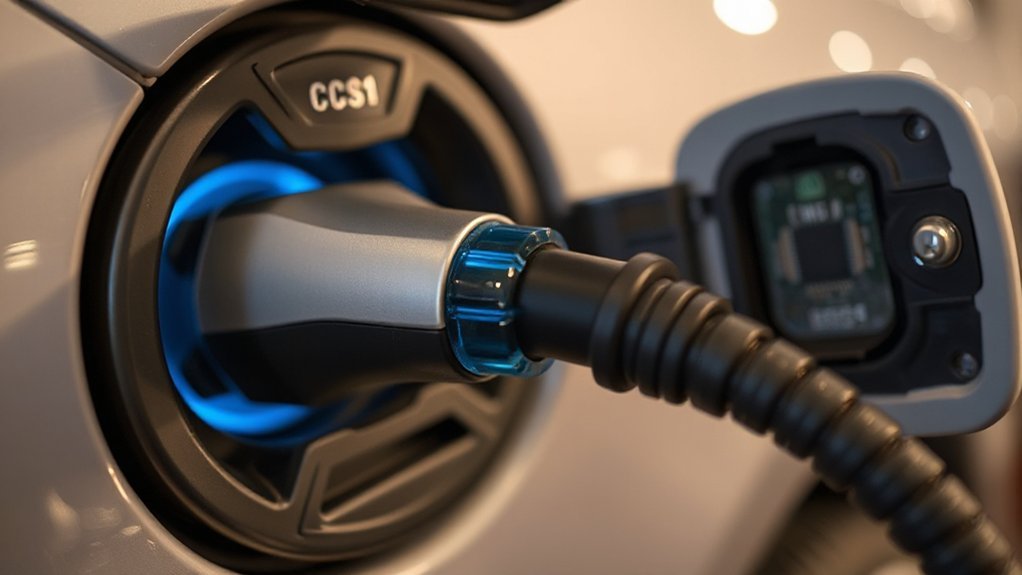
How does a CCS1 charger talk to the vehicle? You establish high-level communication over Power Line Communication on the Control Pilot using HomePlug Green PHY. After SLAC association, DIN 70121 or ISO 15118 exchanges begin between the EVCC and the charger’s SECC. With ISO 15118-2/-20, you negotiate charging mode, limits, and schedules, report SoC, and receive setpoints for voltage and current.
For Plug-and-Charge, ISO 15118 uses a PKI with certificate management to authenticate the EV’s contract certificate against a trusted root. The SECC validates the chain and starts TLS-based session encryption (typically TLS 1.2/1.3 with ECDHE). You then run encrypted Application Protocol Data Units carrying meter info and control commands. CCS1’s physical layer follows SAE J1772 Combo1; message timing and states follow IEC 61851-1.
Network Coverage, Reliability, and Payment Experience
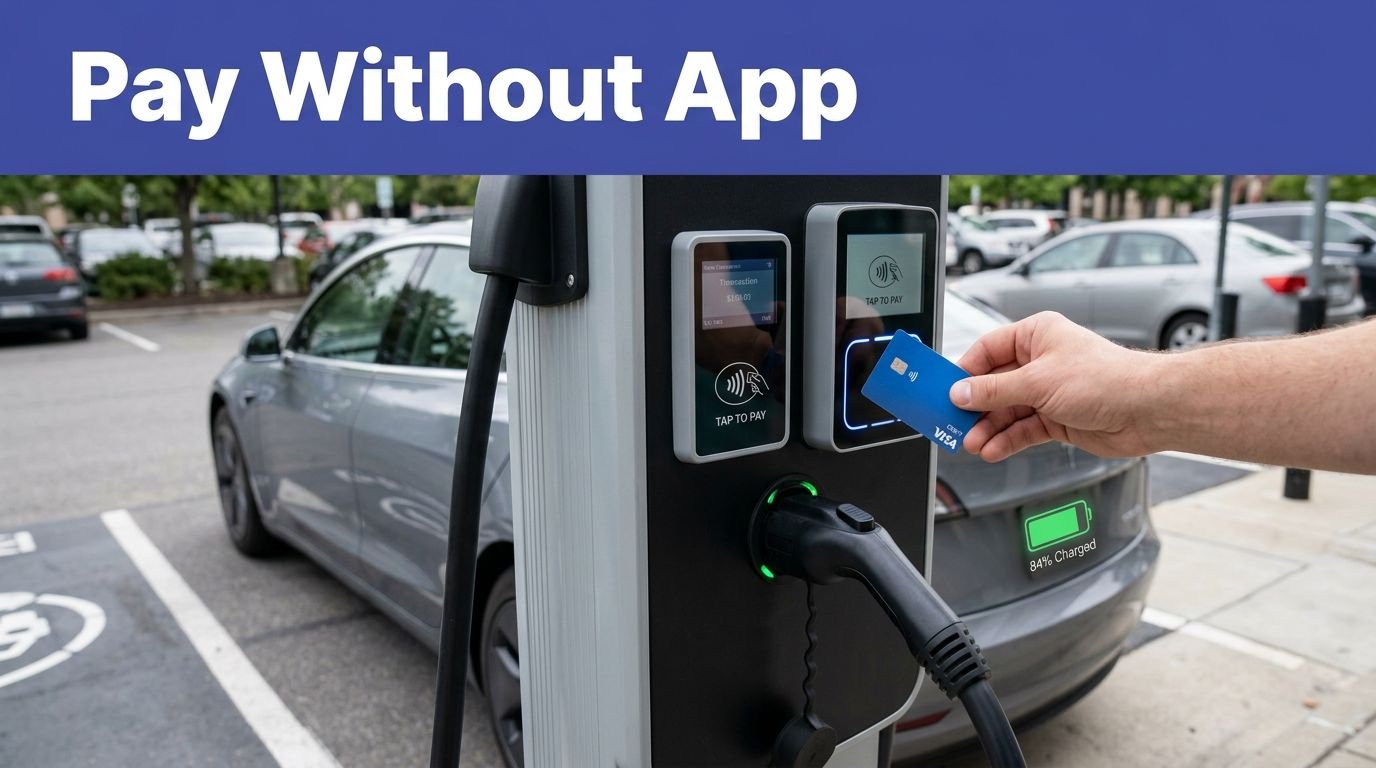
Beyond secure PLC sessions, your experience at a CCS1 site hinges on network breadth, uptime, and how smoothly you can start and pay for a session. Evaluate corridor coverage (stations per 100 highway miles) and urban density (ports per 10k EVs). For reliability, seek networks meeting 97%+ uptime, verified via OCPP availability flags, heartbeat intervals, and downtime reporting. Transaction start success should exceed 95% with ISO 15118-2/-20 or RFID/EMV fallbacks. Payment experience improves with OCPI roaming, tap-to-pay EMV, and session receipts. Demand pricing transparency: pre-tax kWh rates, idle fees, and session fees displayed before authorization. Measure throughput: median delivered power versus nameplate under concurrent load. Prefer sites with remote monitoring, dispatch SLAs, and parts logistics. Track latency: authorization <5 seconds, charger handshakes <30 seconds.
Home and Public Hardware: Cables, Adapters, and Compatibility
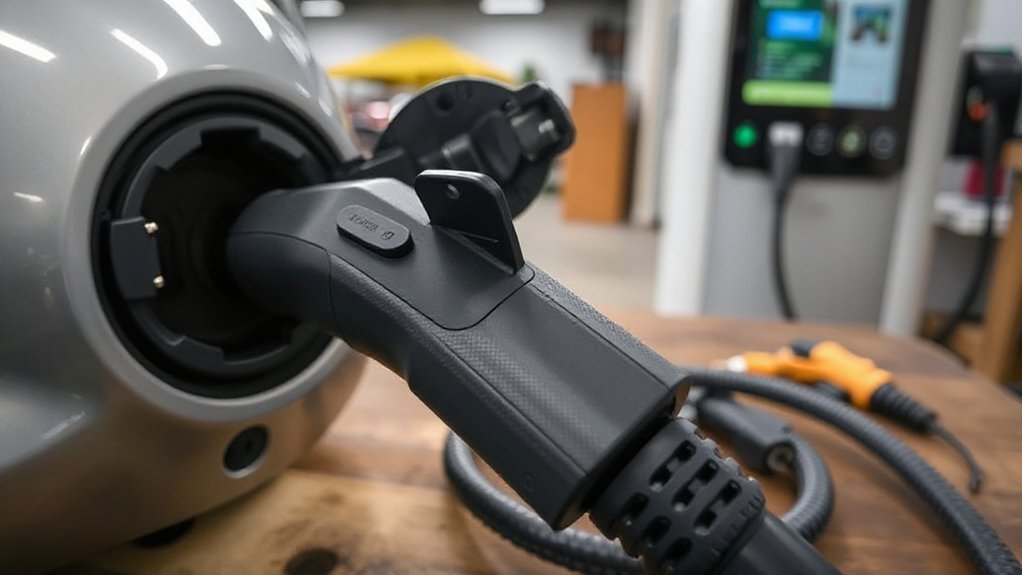
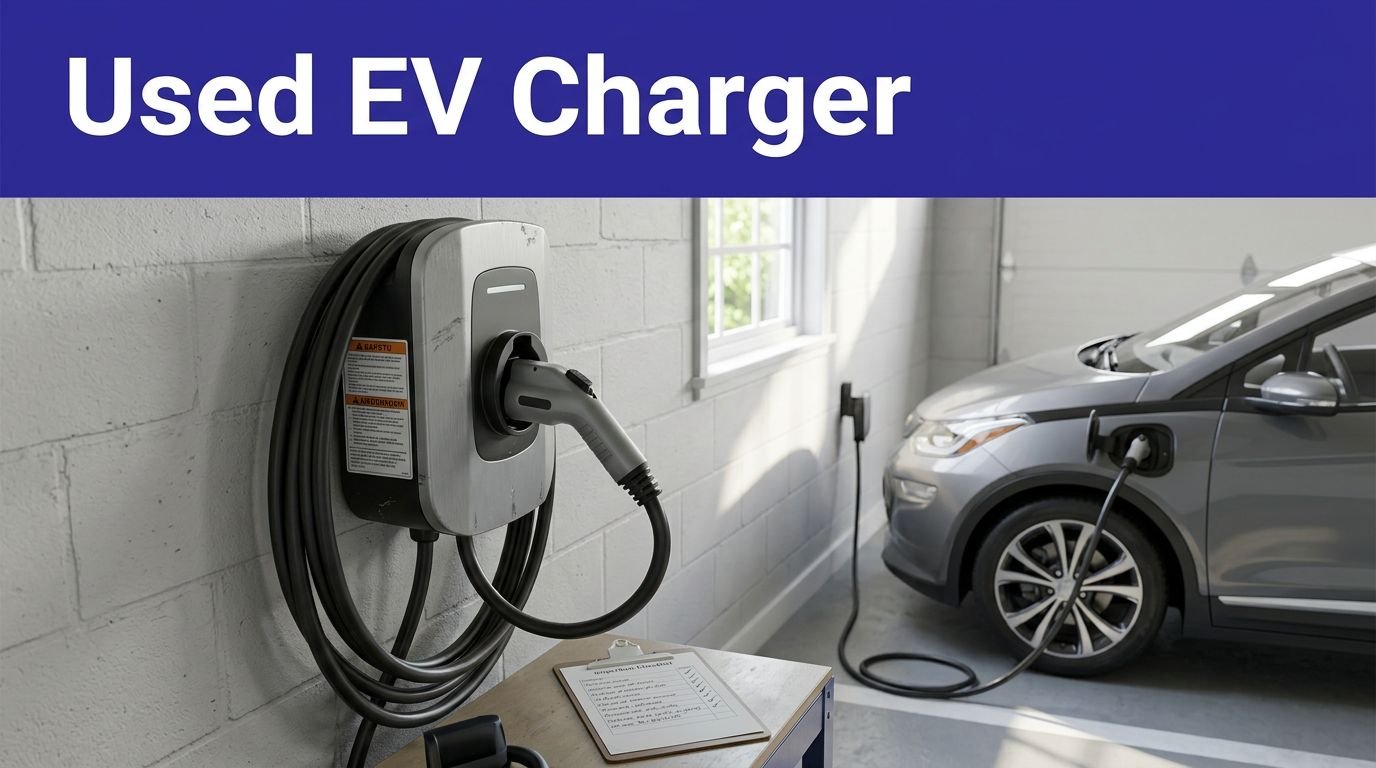
While the plug shape looks simple, CCS1 compatibility depends on exact hardware and signaling across cables, adapters, and inlets. You should verify IEC 62196-3 and ISO 15118/SAE J1772 compliance on home EVSEs, public dispensers, and any adapter. Match current rating, temperature derating, and maximum voltage—many CCS1 cables are 200–500 A and 500–1000 V. Check liquid‑cooled leads for higher continuous current and shorter duty cycles on air‑cooled. Confirm CP/PP resistor values and proximity latch behavior align with your vehicle’s charge handshake. For adapters, confirm pin mapping, HVIL continuity, and insulation coordination. Review warranty terms covering connector wear, liquid‑coolant leaks, and contact pitting. Evaluate accessibility features: cable weight, reach, holster height, glove usability, and ADA-compliant clearances at pedestals. Document firmware versions for EVSE, cable, and adapter.
CCS1 Compared With NACS and CHADEMO
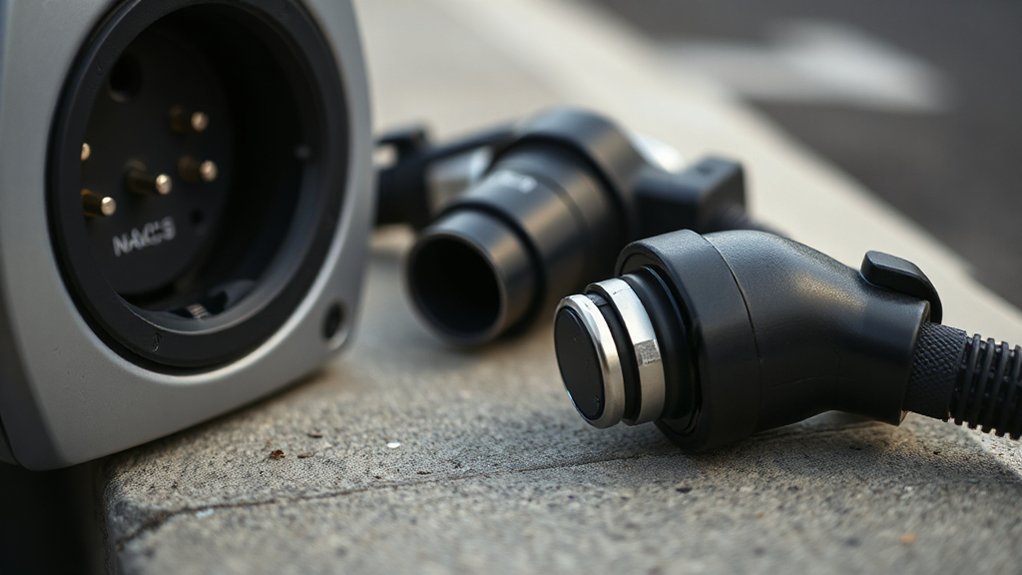
Having validated hardware parameters, compare CCS1 against NACS and CHAdeMO on connector geometry, signaling, and power envelope.
You use CCS1 (SAE J1772 Combo) with a larger two-pin DC add-on; NACS (SAE J3400) is smaller, single-port for AC/DC; CHAdeMO is bulkier and requires a separate J1772 AC inlet. Signaling: CCS1 implements PLC per DIN 70121/ISO 15118/IEC 61851; NACS per SAE J3400 aligns with ISO 15118; CHAdeMO uses CAN. Power: CCS1 supports up to 1000 V, ~500 A (≤350–500 kW deployments). NACS targets 1000 V, up to 1000 A (theoretical ≤1 MW), with widespread 250–500 kW. CHAdeMO commonly 500 V, 125 A (≤62.5 kW), with rare 2.0 high-power sites. For interoperability, you’ll see the market shift favoring NACS adapters and native ports in North America. Smaller connectors and higher currents can reduce dwell time and potential environmental impact per kWh delivered. Soon.
Conclusion
You leave with a clear map: CCS1 integrates SAE J1772 AC with two DC pins, negotiates via PLC (DIN 70121/ISO 15118), and safely delivers up to ~1,000 V and ~500 A. You evaluate curves, not claims, and plan around network uptime, payment flow, and thermal limits. You match home hardware and adapters for interoperability. Compared with NACS and CHAdeMO, you optimize for coverage and features. CCS1 is your standards‑anchored backbone. Isn’t that point, after all?