You want a home charger that fits your car, schedule, and budget without surprises. This roundup compares the top Level 2 chargers for 2025–2026—smart units, rugged workhorses, and portable options—so you can weigh speed, connectivity, and cost. I’ll outline the standout models, trade‑offs, and installation points to help you decide which one might fit your life.
Key Takeaways
- Prioritize charging speed (amps/kW), adjustable amperage, and real-world range-per-hour when comparing Level 2 home chargers.
- Include proven top models: ChargePoint Home Flex, Tesla Wall Connector, Grizzl‑E, Emporia, Wallbox, JuiceBox, and others.
- Compare connector compatibility (J1772 vs NACS), cable length, enclosure rating, and plug‑in versus hardwired options.
- Factor installation complexity, required breaker size (40–60A), potential panel upgrades, and total installed cost.
- Evaluate smart features: scheduling, load balancing, app control, OTA updates, energy monitoring, and utility demand-response support.
ChargePoint Home Flex — Premium Smart Charger

While offering up to 50 amps (12 kW) of Level 2 charging, the ChargePoint Home Flex delivers up to 37 miles of range per hour and lets you dial amperage from 16A to 50A to match your home’s electrical capacity. You’ll get up to nine times faster charging than a 120V outlet, and adjustable settings help you stay within your panel limits. It also supports both J1772 and NACS connectors for compatibility with all EVs, including Tesla, enabling Flexible charging.
Wi‑Fi and the ChargePoint app let you monitor sessions, schedule charging, and receive safe software updates. Installation options include NEMA 6‑50 or 14‑50 plug models and a hardwired version, so you can choose the safest, code‑compliant setup. UL listing, ENERGY STAR certification, a three‑year warranty, and 24/7 support give you confidence and peace of mind. Always follow instructions to guarantee safe operation.
Tesla Universal Wall Connector — Best for Tesla Owners
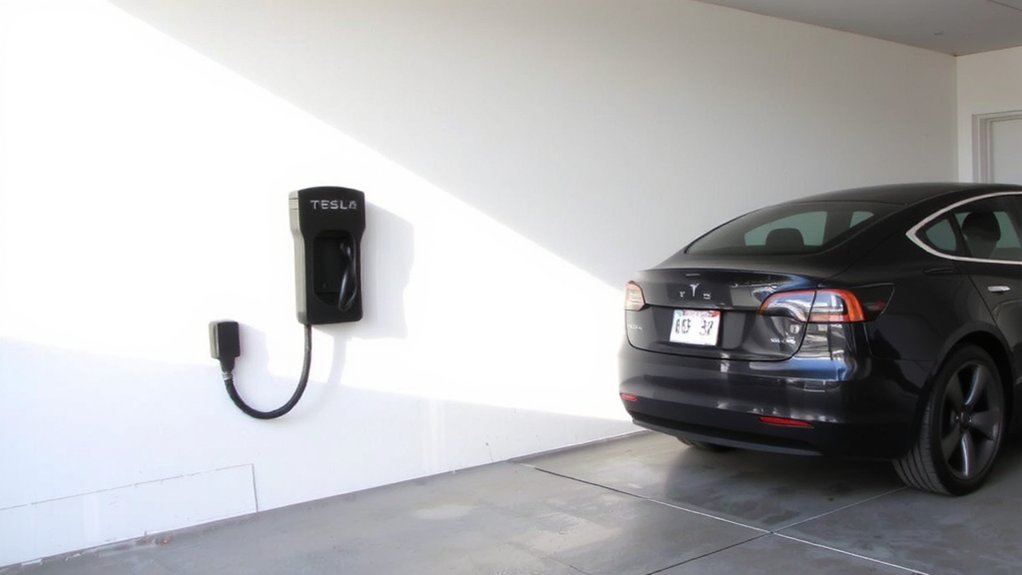
You’ll get up to 48 amps (11.5 kW) — roughly 44 miles of range per hour — with adjustable 12–48 A settings to match your panel capacity. It is available on amazon.com for around $650.00. Because it’s hardwired, you’ll need a professional install and appropriate conduit, but the Type 3R enclosure and wide temperature range make indoor or outdoor mounting straightforward.
The Tesla plug includes a retractable J1772 adapter, so you can charge Teslas and most other EVs without carrying extra adapters.
Charging Speed & Power
The Tesla Universal Wall Connector delivers robust Level 2 charging power, letting you add up to about 44 miles of range per hour when wired for 48 A (11.5 kW) on North American Teslas. You’ll get roughly 44 mi/hr for Model 3 and Y, about 41 mi/hr for Model S and 35 mi/hr for Model X at that output, though actual speed depends on the car’s onboard charger.
The unit’s adjustable 12–48 A setting and 11.5 kW rating give far faster charging than a 120 V outlet, shortening overnight top-ups. It’s UL-approved, weather-resistant, and delivers safe continuous current. A 24-foot cable, auto-sensing handle and Wi‑Fi monitoring help you manage charging efficiently and securely. Monitor sessions and update firmware remotely to maintain favorable, safe performance consistently. It also supports power-sharing with up to six Wall Connectors to intelligently allocate available power among multiple vehicles.
Installation & Compatibility
How you set up the Universal Wall Connector determines whether it’ll be safe, reliable, and fully compatible with your EV. Install it on a dedicated circuit breaker up to 60 amps using 6‑gauge copper and conduit; grounding must be connected first and final voltage tests performed before securing the unit.
Mount top, bottom, or rear to suit panel or garage placement, seal conduit entries to keep moisture out, and keep breaker access clear. Use a torque screwdriver at 50 in‑lbs on terminals and follow the installation manual to meet code and warranty terms.
The unit is optimized for Tesla vehicles (authorized Teslas must be configured in the app), but adapters support J1772 EVs. Commission via QR and Wi‑Fi to enable OTA firmware and monitoring.
EVIQO Level 2 EV Charger — Best App Experience
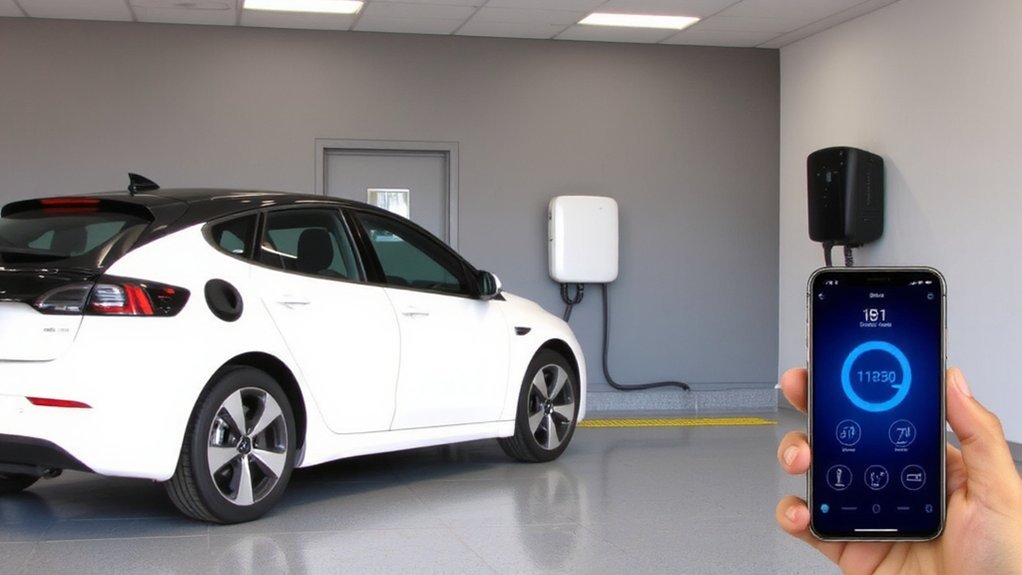
You’ll appreciate EVIQO’s app interface and precise controls that let you adjust charging in 1-amp increments and monitor sessions.
Smart scheduling lets you shift charging to off-peak hours and set recurring charge windows to save on electricity.
The charger uses 2.4 GHz Wi‑Fi for remote control and includes basic security features, though the app could offer richer data and controls.
It supports up to 40 amps with a NEMA 14-50 plug, providing flexible charging for many EVs.
App Interface and Controls
Because it pairs slick design with powerful controls, EVIQO’s app makes managing your Level 2 charger fast and intuitive: you can adjust amperage with a single slider, set up to three scheduled sessions (including delayed starts), add multiple chargers and users, and monitor real-time power, costs, and historical usage via timeline charts and weekly/monthly/quarterly graphs.
The lightweight interface gives clear status and quick access to amperage control, and timeline charts plus usage metrics help you verify safe, efficient operation. Pairing via Bluetooth is straightforward within a 15-minute window, and the app guides troubleshooting to keep connections reliable. You can set accurate electricity rates for cost tracking, receive plug-in reminders, and get OTA firmware updates so your charger stays secure and current and maintain safety. The app also makes it easy to track costs by setting your local electricity rates for precise charging expense monitoring.
Smart Scheduling Features
Alongside its slick controls, the EVIQO app puts smart scheduling front and center: you can create up to three custom charging schedules, tailor them for weekdays or weekends to catch off‑peak rates, enable “Plug & Charge” to let your car’s timer take over, and adjust sessions remotely at any time.
You’ll set schedules to minimize cost and risk by avoiding high‑load periods, and the app shows real‑time consumption, estimated session costs, and a one‑week to three‑month usage history so you can monitor trends safely.
Setup is simple and intuitive, reminders help you stay compliant with safe charging habits, and vehicle timers can override the charger when you prefer. Broad J1772/NACS compatibility keeps things predictable and reliable. Trusted certifications back the charger’s dependable operation daily. It also offers adjustable power from 6 to 48 Amps in 1 Amp increments for tailored charging.
Connectivity and Security
How solid is the EVIQO app’s connectivity and security? You get reliable real-time connectivity for remote start/stop, amperage adjustment and live monitoring, plus push notifications for session status and completion. Plug & Charge reduces touchpoints by automatically starting compatible sessions, so you don’t need the app every time.
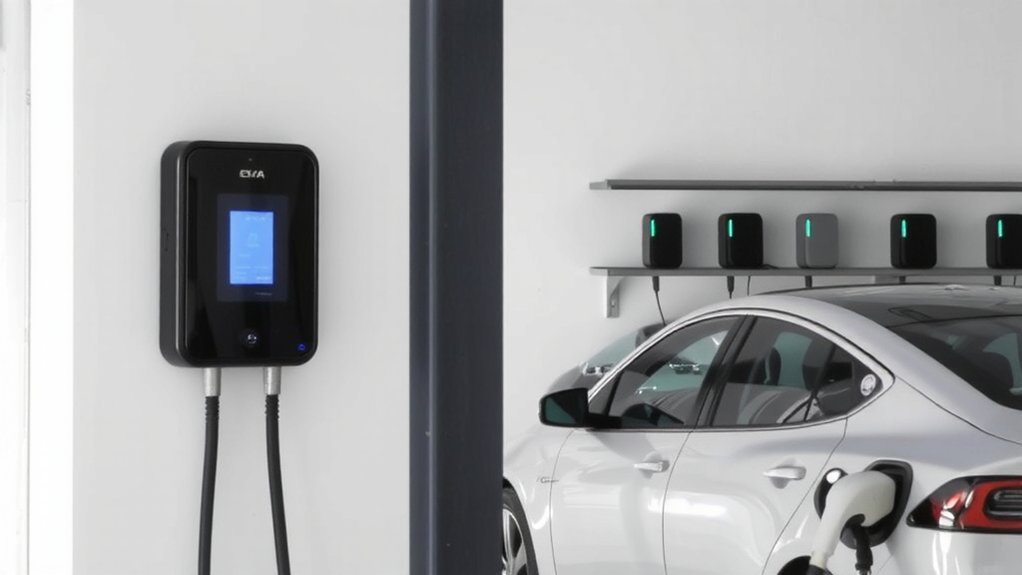
For safety, the app enforces secure login, authentication and access controls: you can invite users and assign levels to prevent unauthorized changes. The dashboard gives clear control over power, costs and history, but note the company hasn’t cited advanced encryption standards or third-party security certifications. That gap means you should weigh convenience against your security expectations and request vendor confirmation on data encryption if strong compliance is required.
Grizzl‑E Classic and Smart 40A — Rugged Dual‑Plug Option
Anyone looking for a rugged, no‑nonsense home charger will find the Grizzl‑E Classic and Smart 40A hard to beat. You get a 40A Level 2 unit delivering up to 10 kW on 208–240 VAC with a 25‑ft cable and universal J1772 plug. The aluminum UL Type 4 enclosure tolerates -30°C to 50°C and resists cracking; it’s designed for indoor or outdoor use and supports hardwired or NEMA 14‑50/6‑50 plug installation.
- Adjustable current (16A/24A/32A/40A) via DIP switches for safe circuit matching.
- Classic skips Wi‑Fi for simplicity; Smart adds Wi‑Fi and OCPP support.
- Three‑year warranty and strong user reports on durability and reliability.
You can set charging limits to protect your home’s wiring and safely schedule sessions for convenience. The charger is made by United Chargers.
Emporia Pro / Classic — Best Overall Value
If you want the most bang for your buck, Emporia’s Pro and Classic deliver—bundling a smart Level 2 charger, the Vue 3 energy monitor, app control, and dynamic load balancing for roughly $599. You’ll get J1772 and NACS compatibility, adjustable amperage (12–48A hardwired, 12–40A plug-in), and up to 11.5 kW hardwired (9.6 kW plug-in). The 25-foot cable and NEMA 4 enclosure suit indoor or outdoor use.
PowerSmart and dynamic load balancing avoid panel upgrades and prevent circuit overloads, keeping charging safe. The Vue 3 tracks real-time usage, supports solar optimization and time-of-use scheduling, and the unit is UL listed, heat tested, restarts automatically after outages, and comes with a three-year warranty. No subscription fees are required, and the plug model converts to hardwire later. You can purchase it on amazon.com.
Wallbox Pulsar Plus — Compact Smart Charger With Voice Control
You’ll like that the Pulsar Plus works with Alexa and Google Home so you can start, stop, or check charging hands-free. Its compact 7.8″ x 7.9″ x 3.9″ body and 4.4 lb weight make wall-mounting in tight garages or shared parking easy. It delivers up to 9.6 kW of charging power.
Together, voice control and a space-saving design make the Pulsar Plus a practical choice for cramped or busy home setups.
Voice Assistant Integration
Smart home integration: the Pulsar Plus works with Amazon Alexa and Google Assistant so you can start, stop, and check charging hands-free once it’s linked through the myWallbox app over Wi‑Fi or Bluetooth. As a Level 2 charger it delivers up to 35 miles of range per hour. You’ll use voice commands to monitor charger status and energy consumption, or trigger schedules and safety locks without touching the unit.
The myWallbox app remains the control hub for setup, firmware updates and complex configurations; voice complements, not replaces, app controls. Onboard intelligence keeps scheduled charging and lock states working even if the internet drops, maintaining secure, reliable operation.
- Use voice to start, stop, and check charging status safely.
- Rely on local control for scheduled charging and locked access.
- Keep firmware updated via the app to maintain responsiveness.
Prioritize safe use.
Space-Saving Design
Voice control makes starting and stopping charging hands-free, but the Pulsar Plus won’t dominate your garage wall. It also supports adjustable charging between 16–48A to match your household circuit and vehicle needs. Its compact dimensions—7.8″ x 7.9″ x 3.9″ (166x163x82 mm) and a 16 cm square footprint—mean it needs minimal wall space and fits tight areas. You’ll appreciate the 4.4 lb (1 kg) weight for easy mounting; hardware is included and no extra ground rod is required.
With NEMA 4 and IP54 ratings plus UL certifications, you can safely install it indoors or outdoors. The 25-foot cable and universal J1772 connector let you position your vehicle flexibly, while adjustable output (16–48A) gives controlled charging up to 11.5 kW, balancing speed with circuit safety. The unit’s operating range down to -22ºF and IK08 impact rating protect it in harsh conditions.
JuiceBox Smart — Multi‑Car Power Management
If you have multiple EVs or heavy household demand, JuiceBox Smart uses the JuiceNet platform to manage charging across several stations. The system is a smart home charging solution with Wi‑Fi connectivity. You’ll get dynamic load balancing that prevents panel overloads by allocating power in real time to up to 16 JuiceBox units, and it adjusts when high‑draw appliances kick on.
JuiceBox Smart uses JuiceNet to balance power across up to 16 chargers, preventing panel overloads in real time
The system integrates with utilities for demand response, shifts charging to off‑peak times, and works with solar or battery backups for safe energy use. You can set per‑vehicle priorities, schedules, and receive alerts through the app. Installation requires a proper electrical panel and certified installer; enclosures are IP66 for outdoor safety and firmware updates arrive over the air.
- Real‑time balancing prevents tripped breakers.
- App lets you set charging priorities.
- Works with solar and batteries.
Webasto Go Portable — Flexible Portable Charging
When you need charging that moves with you instead of staying fixed at the garage, Webasto Go fills that role. It is priced at $549. You get a compact, lightweight dual‑voltage charger that works on 120V and 240V circuits, so you can plug in at home or on the road without hardwiring.
It’s plug‑and‑play with included NEMA 14‑50 and 5‑15 adapters, a 20‑foot cable, and a zip carrying case for neat transport and storage. Safety features include UL/cUL certification, ground‑fault protection, thermal detection with auto‑restart, and a NEMA 6P/IP67 rating suitable for outdoor use.
A mounting cradle, installation guide, screws, and an LED status bar give clear, reliable setup and real‑time charging feedback. It’s compatible with all EVs and plug‑in hybrids and operates from −40°C to +75°C for reliable performance.
Top Features to Compare: Speed, Connectivity, and Durability
Choosing a home EV charger means balancing three priorities: charging speed, smart connectivity, and rugged durability. You’ll want a unit that charges fast—Level 2 models range from 3.8–11.5 kW; Tesla Wall Connector and Wallbox Pulsar Plus reach 11.5 kW, while ChargePoint Home Flex and Grizzl‑E offer multiple amp settings up to 40–48 A. The wall-mounted device is called an EVSE and it manages the connection between your home and car. Connectivity keeps you informed and safe: Wi‑Fi apps, scheduling, load balancing, and access controls let you monitor sessions and restrict users. Durability matters for outdoor exposure—look for aluminum or weatherproof enclosures and secure cable management.
- Speed: amps/kW and adjustable output for safe, efficient fills.
- Connectivity: apps, scheduling, and access control for monitoring.
- Durability: weatherproof build, secure mounting, and hardened casing.
Choose trusted brands and prioritize safety certifications and locking features.
Installation, Costs, and Warranty Considerations
A home EV charger involves more than the unit itself—you’ll need the right tools, a dedicated 240‑volt circuit sized to the charger’s amperage, and permits or inspections to meet NEC and local codes, all of which affect timeline and cost. You’ll also need drills, insulated screwdrivers, wire strippers, voltage testers and a multimeter; pros may use breaker finders, conduit benders and circuit analyzers. Choose a location near the panel to reduce wiring and conduit runs.
Plan for 40–60 amp breakers, proper wire gauge, GFCI protection and correct NEMA outlets.
Costs vary from hundreds to several thousand dollars depending on equipment, labor, panel upgrades, permits and site work. Hire a licensed electrician to guarantee code compliance and preserve warranties and rebates. Safety should be paramount. A straightforward home charger installation typically takes 2–3 hours.
Conclusion
You want fast, reliable charging, and you want smart features, so you’ll choose based on speed, budget, and app control. You’ll favor ruggedness for outdoor use, convenience for Tesla owners, and portability when you travel. You’ll weigh installation costs, warranties, and multi‑car management. You’ll pick the charger that fits your garage, your schedule, and your lifestyle. In the end, you’ll charge smarter, faster, and with confidence. You’ll save time, money, and future headaches today, confidently.