An electric vehicle can arrive at a DC fast charger with plenty of battery percentage and still charge painfully slowly. A cold-soaked battery can restrict incoming current, even when the charger is functioning normally.
EV battery preconditioning uses controlled heating or cooling before fast charging. That helps the EV reach a higher charge rate sooner, especially during winter road trips. The trick is knowing when to start it, how your EV activates it, and what the process can’t fix.
This post may contain affiliate links. If you make a purchase through these links, I may earn a small commission at no extra cost to you.
What battery preconditioning actually does
Your EV battery isn’t a bucket waiting for electricity. It’s a chemical system with temperature limits, current limits, and software watching every move like an overprotective parent.
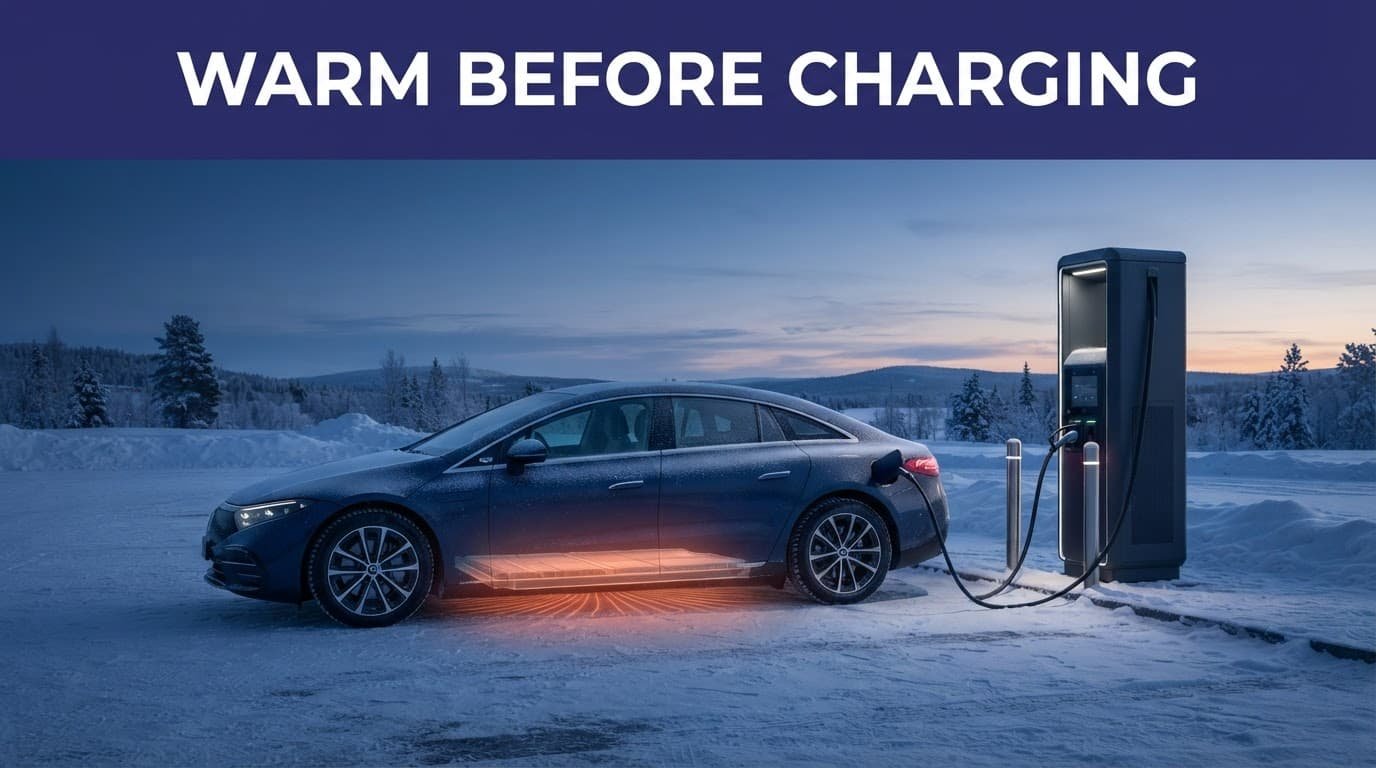
Battery preconditioning uses the vehicle’s thermal management system to heat or cool the high-voltage battery pack before charging. The battery management system, or BMS, then allows more charging power when the cells reach the operating temperature range selected by the manufacturer.
Heating and cooling the battery pack
In cold weather, the system may use a resistance heater, heat pump, motor-generated heat, or a combination of methods. In hot weather, coolant and air-conditioning hardware can pull heat away from the battery.
The goal isn’t to make the battery hot. It is to bring it into a manufacturer-defined operating temperature range where it can accept power efficiently and safely.
A common rule of thumb places comfortable lithium-ion charging somewhere around 15 to 35 degrees Celsius. That is a broad guide, not a universal optimal temperature. Midtronics’ battery guidance gives a similar general range, while each EV uses its own chemistry, sensors, ambient temperature, cooling hardware, and software limits.
Why the charger starts slowly
A cold battery may begin a charging session at a low power level. The BMS gradually increases current as the battery warms.
That means the first several minutes can look disappointing. You may see a lower rate than the station advertises, then watch it rise later. Preconditioning moves much of that warm-up period before you connect, so the charging rate can rise sooner.
Why cold batteries charge so slowly
Cold weather affects more than the number on your dashboard. As ambient temperature falls, internal resistance rises and lithium ions move more slowly. The battery’s ability to deliver or receive energy quickly also declines.
The U.S. Department of Energy’s winter EV guidance also points out that preconditioning can warm the cabin and battery before driving. That matters because cabin heat, battery heating, and slower chemistry all compete for energy on a freezing morning.
The chemistry behind the speed limit
When battery cells are cold, ions move less freely through their electrolyte and electrode materials. The pack can still charge, but it needs more time to absorb the same amount of current.
Your EV responds by limiting charging power when the battery falls below its suitable operating temperature. This protects the cells, but it also creates the classic winter charging experience: you arrive at a fast charger, plug in, and receive the electrical equivalent of a polite shrug.
Cold conditions can temporarily reduce driving range and limit regenerative braking for the same reasons. Higher resistance wastes more energy as heat and can reduce available power output, while cabin heating adds another load. These effects are usually temporary. A cold day doesn’t automatically mean the battery has suffered permanent damage.
Lithium plating is the concern
Lithium plating happens when metallic lithium deposits on the anode instead of entering the electrode structure normally. Cold temperatures and high charging current create unfavorable charging conditions that make this problem more likely.
That is why the BMS restricts fast charging when the cells are below the suitable operating temperature. Preconditioning lowers the risk of lithium plating by warming the pack before high-current charging begins. It isn’t a guarantee against degradation, and it doesn’t give the driver permission to ignore the vehicle’s charging limits.
The practical rule is simple: don’t force high-power charging into a freezing battery. Let the EV manage the temperature first.
How preconditioning improves charging speed
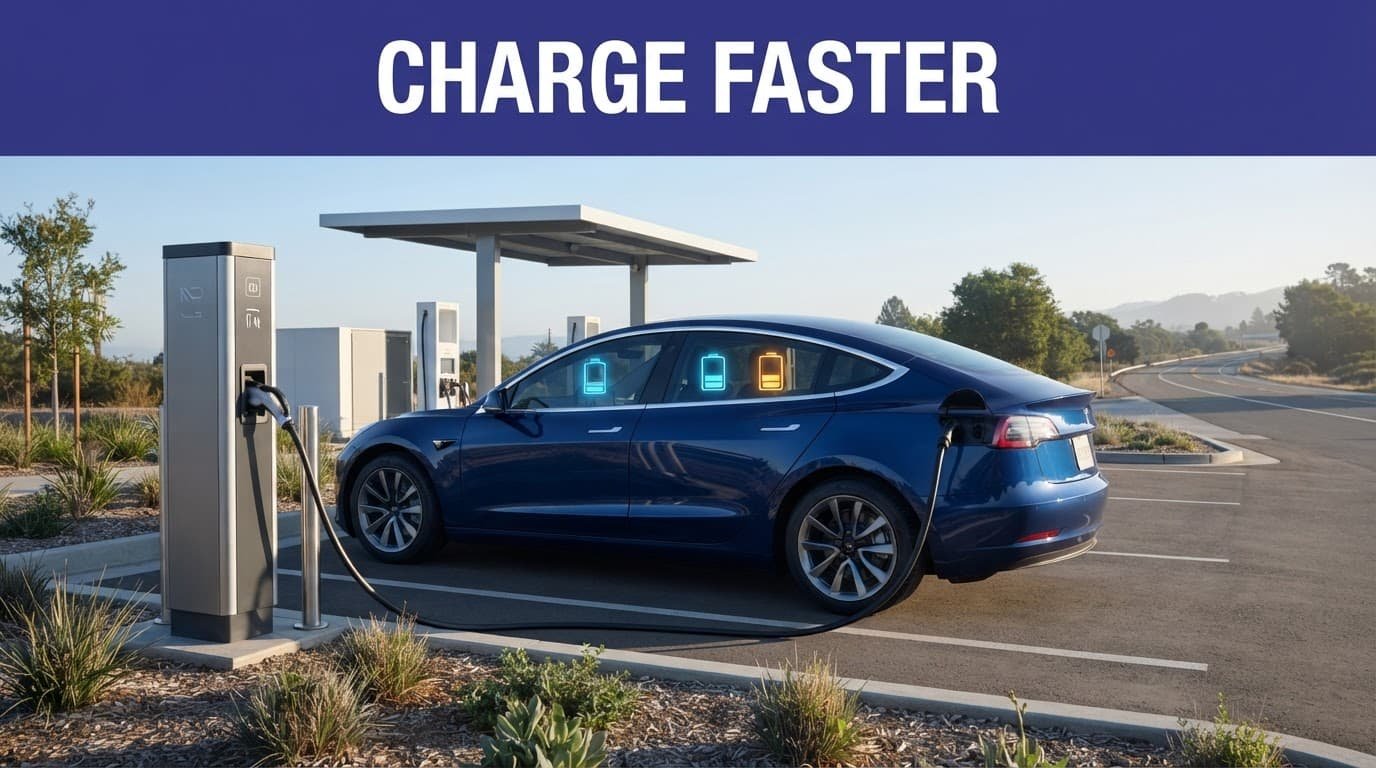
Preconditioning usually doesn’t raise the vehicle’s advertised maximum power, whether shown by the charger or listed in the vehicle brochure. It helps the battery reach its existing charging curve sooner.
Think of the charging curve as a road with a speed limit. A cold pack starts in a slow zone. A warmed pack reaches the faster section sooner.
It moves the slow part before arrival
Without preconditioning, the battery may spend the beginning of the charging session warming itself. You are plugged in, watching the station screen, and waiting through an expensive warm-up routine.
With preconditioning, that work happens during the drive. Once connected, the battery can accept more current sooner. Preconditioning can shorten charging times, even though the charger itself hasn’t changed.
The improvement is largest when the battery starts cold, the station supports DC fast charging, and the route gives the vehicle enough time to prepare.
It doesn’t erase normal charging limits
A warm battery still tapers as it fills. Most EVs accept their highest charging power at a lower state of charge, then reduce power as the battery approaches fuller levels.
Preconditioning can’t prevent that taper. It also can’t make a 50 kW vehicle charge like a 250 kW vehicle. It simply prevents cold temperature from adding another unnecessary limit.
At a warm-weather stop, the feature may do little because the battery is already near its preferred range. Your EV may skip the process entirely when little or no preparation is needed.
How to activate battery preconditioning
The activation method depends on the vehicle. Many drivers find that “navigate to a charger” has a surprisingly narrow meaning.
Some systems recognize only compatible DC fast chargers selected through the built-in navigation system or another approved route-planning workflow. Others offer a manual command in the charging menu. A phone app may show charger locations without sending the route information needed to trigger battery preparation.
Use the vehicle’s navigation system
Ford says supported EVs can activate En-Route Preconditioning when a driver selects a DC fast charger through Connected Navigation, Google Maps EV Routing in Android Auto, or Apple Maps EV Routing in CarPlay. Ford also says manually selecting and navigating to a charger won’t activate the feature on its vehicles. Its DC fast-charging preconditioning instructions explain the difference.

Chevrolet uses a feature called Fast Charge Prep on supported models. Its official quick-start guide says drivers can start the process from the charging settings menu. The guide recommends beginning up to 30 minutes before arrival, or up to 60 minutes in temperatures of 20 degrees Fahrenheit or lower.
Polestar’s manual says battery preconditioning starts automatically when a DC fast-charging station is set as the destination in the built-in navigation app. A nearby address isn’t necessarily enough. Select the actual charger, not the coffee shop next door where you plan to wait for your battery to figure things out.
Manual controls are useful, but not universal
Some EVs show a “Battery Conditioning,” “Fast Charge Prep,” or similar option in the center display or companion app. Other vehicles combine battery preparation with scheduled cabin climate settings.
Read the instructions for your exact model and software version. A feature may be limited to DC charging, unavailable while the vehicle is unplugged, or triggered only when the car predicts a cold arrival at the station.
Cabin preconditioning and battery preconditioning are also different functions. Warming the seats and air inside the car is comfortable. It doesn’t always mean the battery is ready for a high-power charge.
When to precondition during winter
The best time is early enough for the vehicle to finish before you connect. Starting two minutes before arrival is not a strategy. That is a wish with a charging cable attached.
Start before the charging stop
Use the vehicle’s navigation system at the beginning of the trip if the route includes a DC fast charger. This gives the car more time to adjust the battery temperature while you drive.
Around 20 to 30 minutes may be enough in moderate cold, depending on the battery temperature at the start. In severe cold or extreme temperatures, the process can take longer. Chevrolet recommends up to 60 minutes when temperatures reach 20 degrees Fahrenheit or below. Polestar says very cold conditions may require more than 40 minutes.
These are model-specific manufacturer examples, not universal rules. Route length, battery size, starting state, wind, and ambient temperature can all change the timing.
Plugged-in preparation saves driving energy
When an EV is connected to an AC supply, many vehicles can use electricity from the grid to precondition instead of drawing as much stored energy from the battery. That can preserve driving range before departure.
While driving, the thermal system draws energy from the high-voltage battery. That energy use varies with temperature, battery size, starting conditions, software, heat-pump design, and preparation time. There is no honest universal figure for how many kilowatt-hours the process uses.
The tradeoff is usually practical. You may spend some energy warming the pack, then reduce charging times because the vehicle can accept higher power sooner.
Why battery temperature matters in diagnostic testing
Battery preconditioning is not only a road-trip feature. Thermal conditions matter when technicians measure battery performance and estimate long-term condition.
State of health, or SOH, describes long-term battery condition. It isn’t the same as the pack’s current thermal state. A cold pack can temporarily deliver less power and show higher internal resistance without permanent capacity loss.
Cold readings can look worse than they are
Cold cells produce a different voltage response under load. Charging power may be restricted, regenerative braking may be limited, and available output can fall.
A test performed on a cold-soaked battery may suggest weaker performance than one performed on a thermally stable pack. That doesn’t prove the battery has degraded. It shows that the testing conditions were different.
Preconditioning doesn’t restore lost capacity or repair damaged cells. It helps create more consistent conditions for measurement.
Shops should record the conditions
A repeatable diagnostic process should record battery temperature, ambient temperature, state of charge, charging power, test duration, and whether preconditioning ran.
Service technicians should follow the vehicle manufacturer’s service procedure rather than choosing a convenient temperature target. Fleet operators benefit from using the same test conditions across fleet vehicles, especially when comparing battery health over time.
A cold winter test and a warm summer test shouldn’t be treated as equivalent lab results. The battery may be the same, but the conditions aren’t.
When preconditioning doesn’t seem to work
Sometimes the feature appears inactive because the vehicle doesn’t need it. Sometimes the trigger was wrong. Other times, a fault in the thermal management system is involved, and the car is less helpful than it should be.
Check the route and settings first
Start with a quick check of the route, charger selection, and settings. Confirm that you selected the actual DC fast charger through the supported navigation system. Check that battery preparation is enabled and that the vehicle has enough route time to complete it.
A manually entered charger may not trigger automatic preparation. A third-party phone app may locate the station but fail to send the right routing data. The battery may already be warm, so the EV skips the process.
Look for the vehicle’s charging or temperature indicator, but don’t expect every brand to use the same icon or message.
No fault code doesn’t always settle the question
If your EV repeatedly charges slowly in cold weather during a charging session, record the ambient temperature. Check whether the battery temperature changes during the drive and whether power output rises after warm-up.
A faulty temperature sensor, coolant circulation problem, heater issue, or software error can interfere with preparation. Slow charging alone doesn’t prove poor battery health. A missing warning light doesn’t prove everything is working perfectly.
Don’t inspect high-voltage components yourself. Ask a qualified dealer or EV service technician to review thermal data and follow the manufacturer’s diagnostic procedure.
Frequently Asked Questions
Does battery preconditioning improve EV charging speed?
Yes, especially when the battery is cold and you are using a DC fast charger. It warms the pack before arrival so the vehicle can reach its higher charging power sooner.
How do I turn on battery preconditioning?
Many EVs activate it automatically when you select a compatible DC fast charger in the built-in navigation system. Some models also provide a manual option in the charging menu or companion app, so check your vehicle’s instructions.
How long does EV battery preconditioning take?
Around 20 to 30 minutes may be enough in moderate cold, but severe temperatures can require longer. Route length, battery temperature, state of charge, and the vehicle’s thermal system all affect the timing.
Does cabin preconditioning warm the battery too?
Not always. Cabin preconditioning focuses on the interior, while battery preconditioning prepares the high-voltage pack for charging; some vehicles combine the functions, but others keep them separate.
Does preconditioning prevent charging speed from tapering?
No. A warm battery can still charge more slowly as its state of charge rises, and the vehicle’s normal charging curve still applies. Preconditioning only removes cold temperature as an additional limit.
The practical takeaway
EV battery preconditioning prepares the battery pack for the demands of a DC fast charger. In cold weather, it moves the slow warm-up period into the drive, helping the vehicle reach higher charging power sooner.
Use the built-in route planner when possible, and start preparation early in severe cold. Remember that each model handles the process differently. The battery isn’t being difficult. It’s protecting its chemistry, and a few minutes of preparation can make the charging stop much less painful.