Two EVs can turn a perfectly normal garage into a nightly negotiation: “You charge first.” “I leave at six.” “The battery is at 14 percent.” The best dual-port EV chargers stop that conversation by sharing one electrical connection between two cars, but they don’t all deliver the same power or controls.
For most households, the United Chargers Grizzl-E Duo is the strongest dedicated home charging station. A smart splitter costs less when you already own a Level 2 charger, while two separate chargers make more sense when both cars need predictable full-speed charging every night.
The right choice depends on daily mileage, available panel capacity, cable reach, and your household’s overnight charging needs.
This post may contain affiliate links. If you make a purchase through these links, I may earn a small commission at no extra cost to you.
Key Takeaways
- The United Chargers Grizzl-E Duo is the strongest overall choice for most two-EV homes because it provides two long J1772 cables and shares power from one circuit.
- A dual-port charger does not provide two independent full-speed charging sessions. Its total output is divided between vehicles, so charging speed depends on the charger, circuit, and each car’s onboard charger.
- A smart splitter can lower equipment and installation costs when two vehicles can take turns using an existing Level 2 charger. A dedicated dual-port charger is more convenient when both cars need to remain plugged in overnight.
- Electrical capacity matters as much as charger features. Have a licensed electrician complete a load calculation before choosing the circuit, charger setting, or installation design.
- Households with two high-mileage vehicles may be better served by two managed chargers or a higher-capacity setup, while commercial sites need access controls, network management, and a broader site plan.
Best dual-port EV chargers: the short answer
A dual-port charger has two vehicle connectors connected to one charging system. That sounds simple. The electrical side isn’t simple, because one circuit has finite circuit capacity.
Here are the main setups worth considering in 2026:
| Setup | Best for | Main advantage | Main drawback |
|---|---|---|---|
| United Chargers Grizzl-E Duo | Most two-EV homes | Two 24-foot cables and shared power from one circuit | Original version has no Wi-Fi or app |
| Duo Connect | Homes that want connected controls | Adds smart charging features to a dedicated dual charger | Costs more than the non-connected version |
| Smart splitter | Lower-cost upgrades | Lets two cars share one existing charger | Uses sequential charging |
| Two independent chargers | High-mileage households | Each vehicle gets its own charger and schedule | More equipment, circuits, and installation work |
| CyberSwitching CSE3 or Blink Series 7/8 | Commercial and multifamily sites | Built for shared access and site-level charging management | Usually excessive for a standard garage |
The first setup is the clearest overall pick because it combines native dual-vehicle charging with straightforward installation. It isn’t two 40-amp chargers hiding inside one box. Its maximum output is shared.
Load sharing and total circuit capacity determine how much power is available. Actual charging speed depends on the shared output, not the number of connectors.
That distinction matters. Two connectors don’t guarantee the same power for each car. The connector count isn’t the power budget.
Why the Grizzl-E Duo is the best overall home choice
United Chargers designed this dual-port model for households that need two cars charged but don’t want to rebuild the house around them.
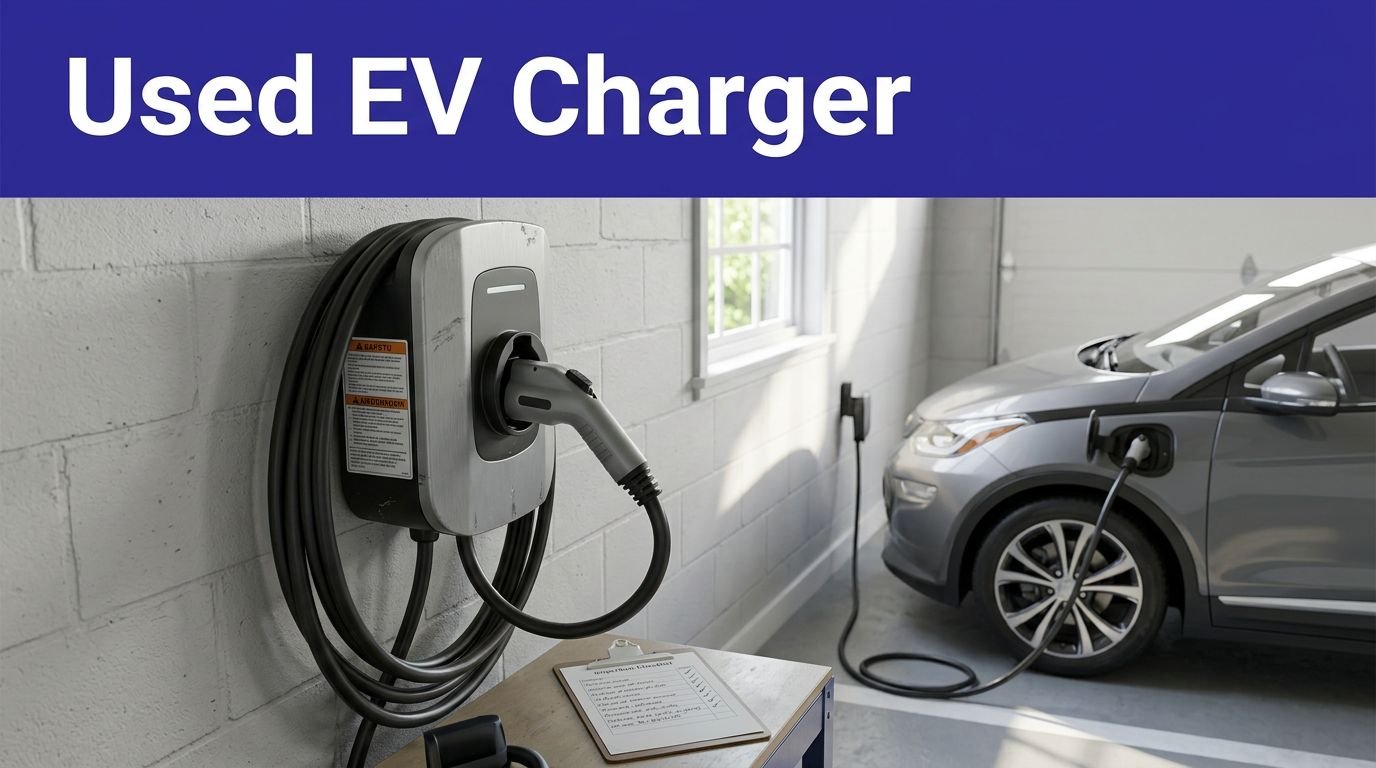
The original unit supports selectable output levels of 16, 24, 32, or 40 amps. At its top setting, it can provide up to 9.6 kW through a 240-volt circuit. It has two 24-foot leads, with each charging cable ending in a J1772 connector. Both vehicles can stay plugged in without one car being parked at an awkward angle.
The unit uses load sharing between the two connected vehicles. Its power distribution gives each car part of the available output when both need energy. When one car needs less power or finishes charging, more capacity moves to the other car.
That is simultaneous charging, but don’t picture two independent rivers of electricity flowing at 40 amps each. Shared output affects charging speed when both vehicles are charging. The total available power remains limited by the unit and circuit.
Car and Driver’s 2026 home charger roundup lists the Duo at about $900 and highlights its two 24-foot cables, dual connectors, and outdoor-rated enclosure. The review also describes the charging station’s ability to charge two vehicles from one outlet and circuit.
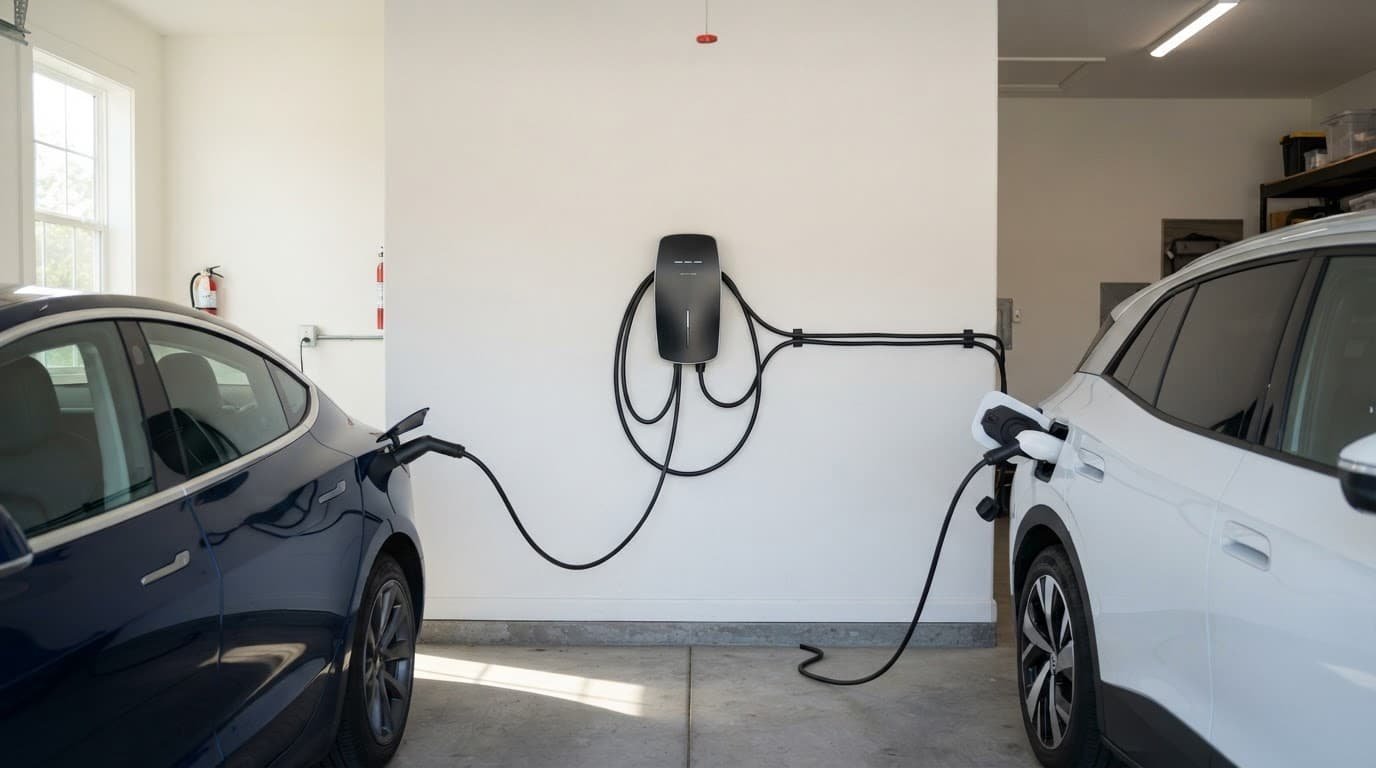
The Duo is available with NEMA 14-50 or NEMA 6-50 plug options, depending on the version. Some versions also support hardwired installation. The enclosure carries NEMA 4 and IP67 ratings in published specifications, making it suitable for many indoor and outdoor installations when mounted correctly.
There are two catches.
First, the original Duo isn’t a Wi-Fi charger. You won’t get a mobile app, charging history, remote start, or electricity-use charts from the unit itself. Second, both connectors use the J1772 standard. A Tesla or another NACS vehicle may need an approved adapter.
The connector itself isn’t a problem. It’s a compatibility question. Check the vehicle’s included equipment and the adapter guidance from the automaker before ordering.
Duo Connect is the smart version, not the same charger
The original Duo and Duo Connect are related products, but they aren’t identical. The original Duo is the practical, offline version. Duo Connect adds Wi-Fi-connected management for households that want more control.
That can mean using smart charging to schedule sessions around time-of-use electricity rates, checking charger status, reviewing session information, or managing charging from a phone. The exact features depend on the current model, app, firmware, and region, so read the current product documentation before assuming a feature is included.
Do you need an app? Maybe.
If overnight charging works for both vehicles and your utility has one simple rate, the original Duo may be enough. Plug in, let the charger share power, and go to bed. The car does not need a motivational speech.
An app becomes more useful when:
- Your utility offers cheaper off-peak electricity.
- One driver needs priority before an early departure.
- You want charging history for household budgeting.
- The charger is outside and you want status information without walking to it.
- You want to coordinate charging with solar production or other household loads.
Published 2026 pricing has varied by retailer and model. The original Duo has appeared around $700 to $1,100, while Duo Connect has been listed near $900. Treat those figures as buying guidance, not a permanent price tag. Promotions, plugs, regional pricing, and stock can move the number.
A connected charger also shouldn’t be confused with whole-home load management. Wi-Fi lets you control the charger. It doesn’t automatically know that your electric dryer, oven, and heat pump are all fighting for the same panel capacity.
Electrical capacity decides whether you need a panel upgrade
Electric vehicle charging depends on more than the charger. Your electrical panel, branch circuit, wiring, breaker, receptacle, and vehicle all have a say.
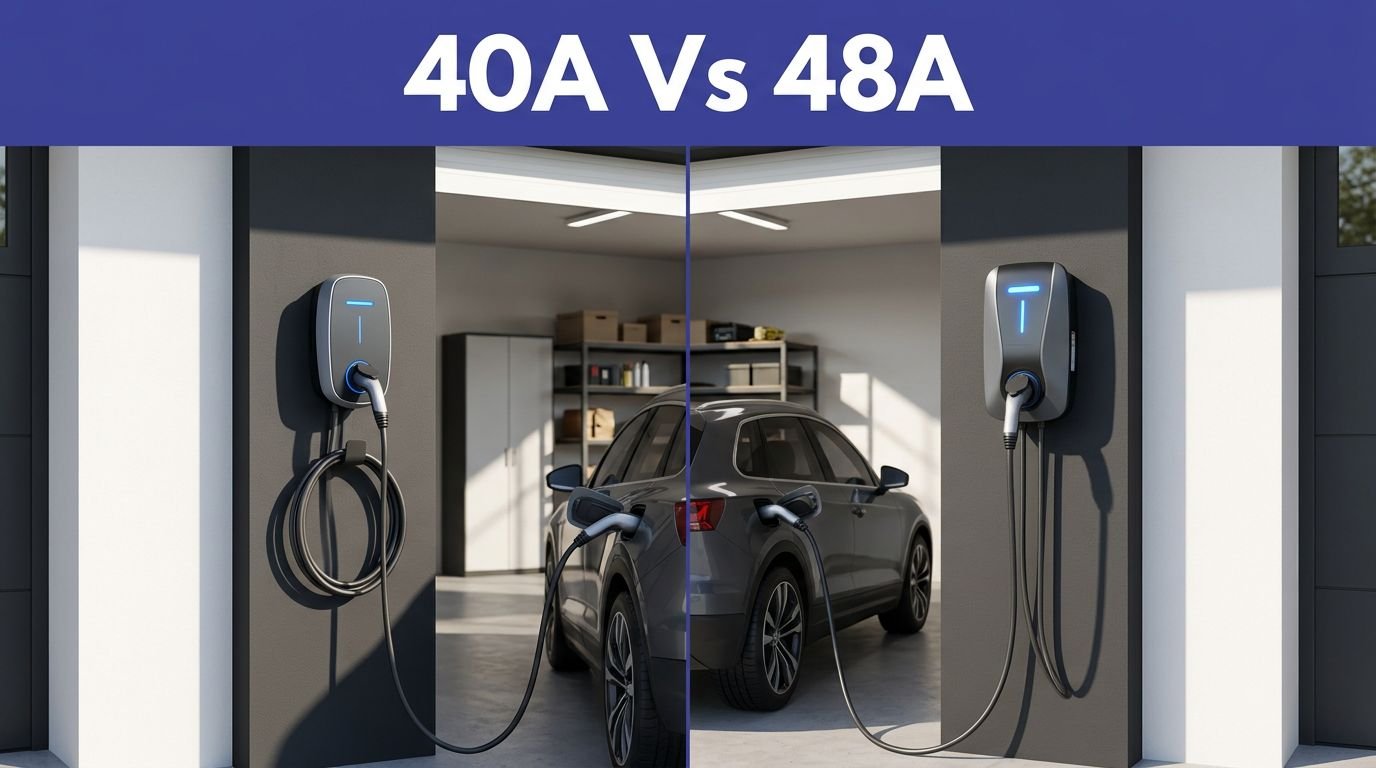
A 40-amp Level 2 charging setting commonly requires a 50-amp circuit because EV charging is treated as a continuous load under electrical codes. A 48-amp setting commonly requires a 60-amp circuit. Local rules and equipment instructions control the final design.
A NEMA 14-50 receptacle tells you the outlet shape. It does not prove that your electrical panel has room for a new 50-amp circuit. The panel does not care that both vehicles are lovely. It sees amperage.
Have a licensed electrician perform a load calculation before choosing the hardware. The calculation should account for the electrical panel’s service rating, existing breakers, air conditioning, electric heat, water heating, cooking equipment, dryers, and other large loads.

How load sharing prevents overloads
A dual charger with power sharing manages the load between its two ports. A whole-home energy management system goes further by watching the home’s total electrical demand.
The basic power distribution sequence looks like this:
- Both cars connect to the charger.
- The charger measures the available charging capacity.
- It divides power between the vehicles.
- If another household load increases demand, the system reduces or pauses EV charging.
- When capacity returns, charging resumes.
Some systems split power evenly. Others give more power to the car with the lower battery state or the earlier scheduled departure. The behavior depends on the hardware and software.
A product described as having dynamic load balancing may monitor the complete electrical service through current sensors. Read the installation documentation carefully. “Load sharing” between two vehicle ports and whole-home load management are related, but they aren’t the same feature. This technical overview of dynamic load balancing explains the distinction in plain terms.
Simultaneous charging versus sequential charging
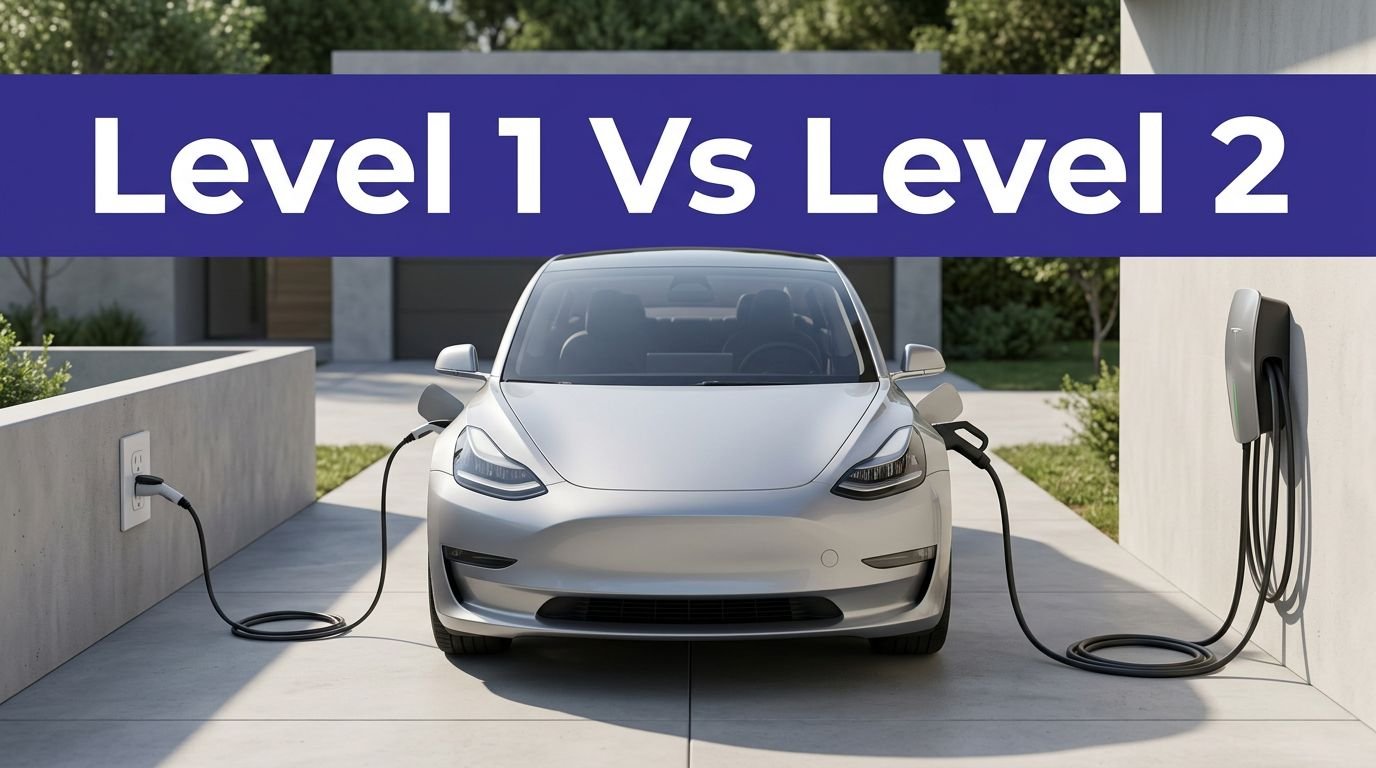
Simultaneous charging keeps both cars connected and supplies both when power is available. It is convenient and works well when the total overnight energy need is moderate.
Sequential charging gives one car the full available rate, then switches to the other. A switching device often uses this approach. It can reduce the second vehicle’s charging speed, but the electrical behavior is easy to understand.
Neither approach is automatically better. A household that drives 25 miles per day per car may never notice the difference. A household with two long commutes, two low batteries, and a 6 a.m. departure will notice every minute.
Can you avoid a service upgrade?
Often, yes. A new circuit may fit within the existing service when the load calculation shows sufficient circuit capacity. A managed charger may also reduce charging power during high-demand periods.
A panel upgrade becomes more likely when the service is already heavily loaded, the home has electric resistance heat, or the installation needs multiple high-amperage circuits. A dual-port charger doesn’t erase those limits. It can manage them, but only within the limits of its listing and installation design.
The Department of Energy’s EVGrid Assist charts project that most future charging ports will be private Level 1 and Level 2 ports at single-family homes. That makes careful residential electrical planning more important, not less.
Smart splitter or dedicated dual-port charger?
This switching device lets two EVs share one Level 2 charger. NeoCharge and Lectron are two names buyers may encounter in this category.
The splitter does not create extra electricity or turn one 40-amp charger into two 40-amp chargers. It controls which vehicle gets access through sequential charging, scheduling, automatic switching, or priority rules. The second vehicle may wait longer, depending on charging speed and the selected priority.
That makes a smart splitter attractive when you already own a good charger and both cars can take turns. The equipment price is usually lower than buying a new dedicated unit, and the installation cost may be lower too. Installation may also be simpler when the existing charger and circuit are already suitable.
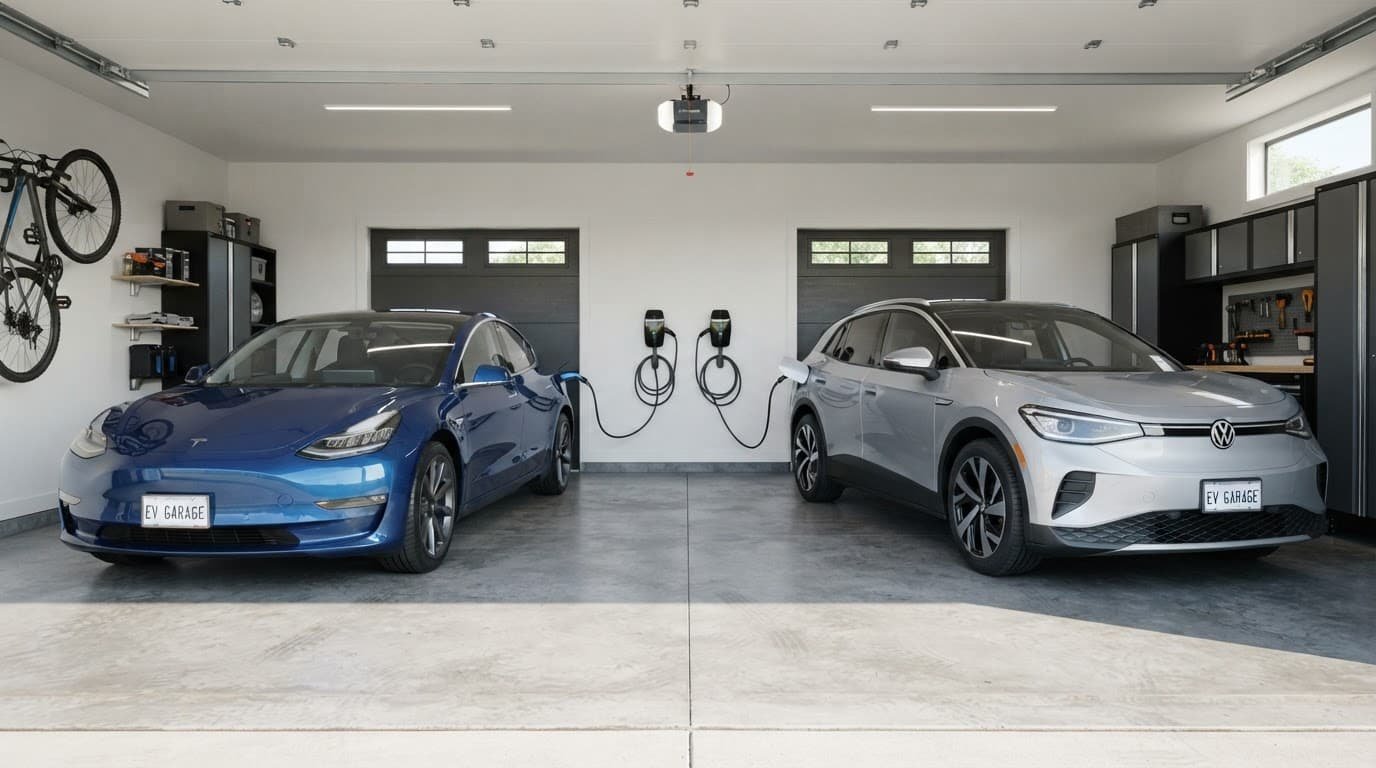
A dedicated dual-port charger has a cleaner physical setup, with two cables from one unit and built-in load sharing between connected vehicles. Both vehicles can remain connected, so there’s less daily plugging and unplugging. That sounds minor until winter arrives and the cable has become a frozen garden hose.
Use a smart splitter when:
- You want a smart splitter for an existing compatible charger.
- Both cars sit near the same parking area.
- The household can follow a schedule.
- The electrical panel cannot support another independent circuit.
- One car usually needs only a small top-up.
Choose a dedicated unit when:
- You want two permanent cables.
- Both cars need charging during the same overnight window.
- You don’t want drivers deciding who plugs in first.
- You want one wall-mounted system instead of several boxes.
- The electrical installation can support the equipment.
Never use a homemade Y-cable, power strip, or ordinary extension cord for this job. EV charging places a sustained load on the circuit. Use listed equipment installed according to its instructions and local code.
Choose the setup by daily mileage, not cable count
The useful question is not “How many ports does this charger have?” It is how much energy both cars need before morning, and how much overnight charging can deliver.
A 40-amp, 240-volt charger provides 9.6 kW at its maximum setting. Eight hours of charging could put roughly 77 kWh through the charger before charging losses. Depending on vehicle efficiency, that may represent around 200 to 250 miles of combined range.
That is a rough planning calculation, not a promise. Cold weather, battery temperature, charging losses, vehicle efficiency, and the car’s onboard AC charger all change the result.
| Household pattern | Sensible starting point |
|---|---|
| Both cars drive short daily trips | One Level 2 charger with a splitter or shared dual-port unit for simultaneous charging when both cars need moderate overnight refills |
| One car drives far more than the other, such as a longer daily commute | Dual-port charger with priority controls or a dedicated charger for the high-mileage car |
| Both cars regularly need large overnight refills | Dedicated dual-port hardware with enough total output, or two managed chargers |
| Home has limited service capacity | One charger with a splitter or sequential charging, depending on circuit capacity |
| Vehicles park far apart | Two chargers may be easier than two long cables |
| Household uses time-of-use rates | A Wi-Fi charger or vehicle-based smart charging can reduce charging costs |
If one car can wait, sequential charging may cover the household’s needs without serving both cars at once.
Remember that charging speed is limited by the lowest ceiling in the system. A 48-amp EVSE cannot force a vehicle with a lower onboard charger to accept 48 amps. The circuit, EVSE, and car all have to agree.
Commercial and multifamily sites need more than two plugs
A home setup can survive a little family confusion. A workplace or apartment property needs records, access rules, maintenance plans, and a clear answer when somebody says, “I was plugged in first.”
The CyberSwitching CSE3 and Blink Series 7 and 8 belong in the commercial conversation. Each is a commercial EV charger built around shared charging infrastructure, not one household’s two vehicles. The right model depends on the site’s electrical infrastructure, parking layout, network requirements, connector mix, and billing plan.
A commercial EV charger can help a property serve more drivers without assigning one charger to every parking space. Load management can reduce peak demand by limiting the combined charging load. That matters when many vehicles arrive at the same time, especially after work.
Before installation, property owners should review:
- Utility service capacity and demand charges.
- Trenching, conduit, bollards, parking layout, and installation cost.
- Accessibility requirements and local permits.
- Network connectivity and payment or access-control needs.
- Maintenance responsibility when a cable or connector is damaged.
- Whether the charger supports J1772, NACS, or approved adapters.
A dual-port charging station isn’t automatically the best commercial design. Sometimes several lower-power ports serve more drivers than two high-power options. The parking pattern and use of each charging port decide that.
Installation and total ownership cost
The equipment price is only the first line on the quote. Installation cost can stay modest when the distance to the electrical panel is short and the wiring route is direct. A long conduit run, detached garage, trench, new subpanel, or service upgrade can push the bill into the thousands.
Think about the purchase in four parts:
- Charger hardware. The original unit has appeared at prices ranging from roughly $700 to $1,100. The smart version has commonly appeared near $900.
- Circuit installation. This includes the breaker, wiring, conduit, receptacle or disconnect, labor, permit, and inspection.
- Electrical capacity work. A load management system may cost less than a service upgrade or panel upgrade, but only when the selected equipment supports that design.
- Electricity and maintenance. Your energy usage determines the electricity cost, based on kilowatt-hours multiplied by your utility rate. Cable wear, hardware damage, firmware support, and app reliability also matter over time.
For a simple comparison, add the charger and installation expenses for each option. Then ask how often the household will need to plug and unplug, schedule sessions, or leave one car waiting.
A splitter usually wins on upfront cost when you already own the charger. The Duo often wins on convenience and charging speed. Two separate chargers win on independence, but their installation expenses can outweigh those benefits.
What to check before ordering
Start with the cars, then inspect the garage, before ordering a charging station or calling the electrician. Buying the charger first is how people end up with a beautiful box and nowhere sensible to put it.
Check these details:
- Connector type: Confirm whether each vehicle uses J1772 or NACS. Verify adapter compatibility before relying on one.
- Single-vehicle option: The Tesla Universal Wall Connector serves one vehicle and isn’t a dual-port solution, so evaluate it separately.
- Total output: Look for total shared power and the output available per charging port, not only the amperage printed beside each port.
- Circuit requirement: Match the charger setting to the breaker, wire, receptacle, and local electrical rules. A NEMA 14-50 outlet alone doesn’t establish the electrical panel’s available power or overall design.
- Cable reach: Two 24-foot cables are useful, but measure the actual parking positions.
- Weather protection: Outdoor installations need equipment rated for the location and a proper mounting method.
- Port behavior: Ask how the charger handles both ports and whether it monitors the whole home.
- Connectivity: Confirm whether Wi-Fi is built in, required, or absent. An app can’t repair weak electrical design.
- Warranty and service: Compare warranty length, replacement procedures, and support access.
- Installation listing: Use equipment approved for EV charging and install it exactly as directed.
Frequently Asked Questions
Can a dual-port EV charger charge two cars at the same time?
Yes, many dual-port chargers can supply both connected vehicles at once through shared output. The available power is divided between the cars, so neither vehicle necessarily receives the charger’s full single-port rating.
Is the Grizzl-E Duo a good choice for a two-EV home?
The Grizzl-E Duo is a strong choice for most households that want two cables, one charging system, and shared power from one circuit. The original version does not include Wi-Fi or an app, while Duo Connect adds connected controls at a higher price.
Do I need a panel upgrade for a dual-port EV charger?
Not always. A licensed electrician should perform a load calculation that considers the home’s service rating, existing circuits, and large electrical loads before deciding whether the current panel can support the installation.
Should I buy a smart splitter or a dedicated dual-port charger?
A smart splitter makes sense when you already own a compatible Level 2 charger and both vehicles can take turns charging. A dedicated dual-port charger is more convenient when both cars need permanent cables or charging during the same overnight window.
What connector type do dual-port EV chargers use?
The original Grizzl-E Duo uses two J1772 connectors, so a Tesla or another NACS vehicle may require an approved adapter. Confirm compatibility with the vehicle manufacturer and the charger’s current documentation before ordering.
Conclusion
For most two-EV households, the original Duo offers the cleanest balance of dual-port convenience, shared power, long cables, and one-circuit installation. The Duo Connect makes more sense when scheduling and app controls matter more than the lowest equipment price.
A splitter remains a sensible choice when both vehicles can take turns. Two independent chargers are better when both drivers depend on overnight charging for high-mileage driving.
The winning setup is not the one with the most cables or the highest charging speed. It is the one that matches your cars’ daily energy needs with your home’s actual electrical capacity, without turning tomorrow morning into a charging summit.