Your electric vehicle can sit in the driveway for 12 hours and still make home charging feel urgent. Then you see two nearly identical charging stations, one rated at 40 amps and another at 48 amps, with faster charging speed and a larger electrical bill behind the bigger number.
The 40 amp vs 48 amp EV charger decision isn’t a macho contest. It’s a practical choice shaped by your daily driving, your overnight charging window, and how quickly you need energy ready by morning. Start with the power difference, then choose the option that fits your routine.
This post may contain affiliate links. If you make a purchase through these links, I may earn a small commission at no extra cost to you.
Key Takeaways
- A 40-amp charger delivers 9.6 kW, while a 48-amp charger delivers approximately 11.5 kW—about 20% more charging power.
- Your EV’s onboard charger sets the real charging limit, so a 48-amp EVSE won’t help if the vehicle accepts only 32 or 40 amps.
- A 40-amp charger typically uses a 50-amp circuit and NEMA 14-50 outlet, while a full-power 48-amp charger generally requires a 60-amp circuit and hardwiring.
- Electricity costs depend on the kilowatt-hours used, not the charger’s amperage, so 48 amps mainly saves time rather than reducing the energy bill.
- For most drivers under 40 miles per day, a 40-amp charger is sufficient; a 48-amp unit makes more sense for high-mileage driving, short charging windows, or a compatible future EV.
40- vs 48-amp home charging: the numbers that matter
A Level 2 EV charger uses 240-volt AC power in most American homes. The basic formula is refreshingly simple:
Volts x amps = watts
The resulting power output is:
At 40 amps:
- 240 volts x 40 amps = 9,600 watts
- That equals 9.6 kW
At 48 amps:
- 240 volts x 48 amps = 11,520 watts
- That equals about 11.5 kW
A 48-amp charger provides 20% more charging power than a 40-amp unit, potentially improving charging speed by about 20%. In real charging time, that usually means about 17% less time for the same amount of energy. This charging speed advantage only applies when the vehicle can accept the full output.
The estimated range added per hour looks like this:
| Home charger | Maximum output | Typical range per hour | Common installation |
|---|---|---|---|
| 40 amp | 9.6 kW | 25 to 35 miles | 50-amp circuit, NEMA 14-50 outlet |
| 48 amp | 11.5 kW | 35 to 44 miles | 60-amp circuit, hardwired |
The 40-amp option is usually a plug-in charger, while the 48-amp option is commonly hardwired. Those range figures vary by vehicle efficiency, battery size, charging efficiency, battery temperature, charging losses, and driving conditions. A small efficient EV may add more miles per hour than a heavy electric pickup using winter heat like it’s trying to warm the entire neighborhood.
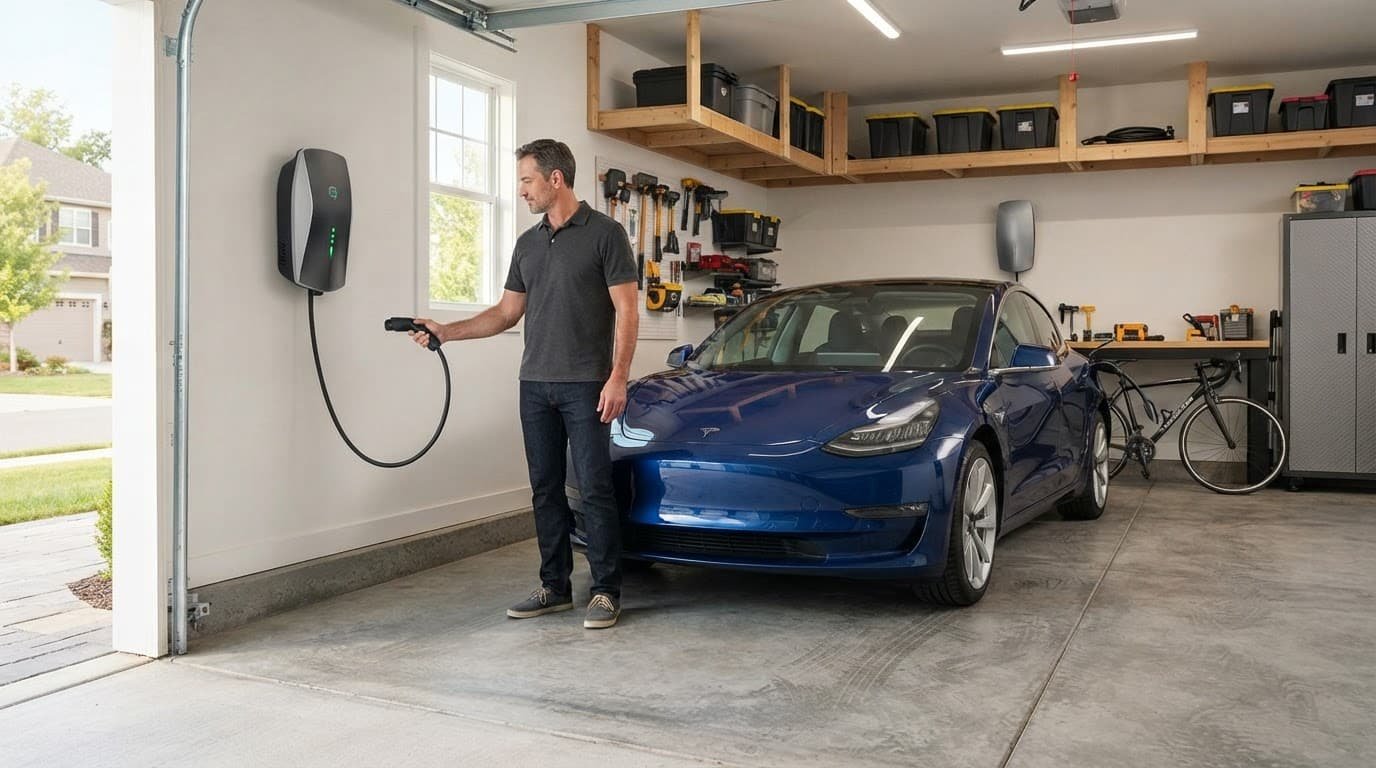
For 30 to 40 miles of daily driving, either option usually handles overnight charging comfortably. A 40-amp charger can often replace that energy in roughly one to two hours of active charging. The car may remain plugged in longer, but the charging session itself doesn’t need the whole night.
You can see the same 9.6-kW and 11.5-kW distinction in Lectron’s amperage comparison. The extra output is useful, but useful doesn’t always mean necessary.
Your vehicle may limit charging speed
The wall unit doesn’t decide how much charging power your EV receives. The vehicle’s onboard charger does.
The equipment mounted on your garage wall is technically EVSE, or electric vehicle supply equipment. It manages the connection and safely delivers AC power. Your vehicle’s onboard charger converts that AC electricity into DC power for the battery.
If the onboard charger accepts only 32 amps, a 48-amp wall unit won’t force it to charge at 48 amps. The vehicle will pull about 7.7 kW at most. The expensive wall box will sit there offering extra power like a waiter holding a second menu nobody ordered from.
An EV limited to 32 or 40 amps also gets no benefit from a 48-amp unit. A higher-rated EVSE won’t shorten its charging time, and a 40-amp EV still tops out at 9.6 kW.
Check your vehicle manual or manufacturer’s specifications for the maximum AC charging input. Don’t use the DC fast-charging number. An EV that accepts 250 kW at a public fast charger may still accept only 11.5 kW for home charging.
This is the first question in any charger comparison: What is your vehicle AC limit? If the answer is 32 or 40 amps, the higher-rated unit won’t shorten your charging session.
Electrical panel and outlet requirements
The National Electrical Code treats EV charging as a continuous load. That means the circuit must be sized for at least 125% of the charger’s maximum continuous current.
The electrical panel, wiring, circuit breaker, outlet, and local code all shape the electrical requirements.
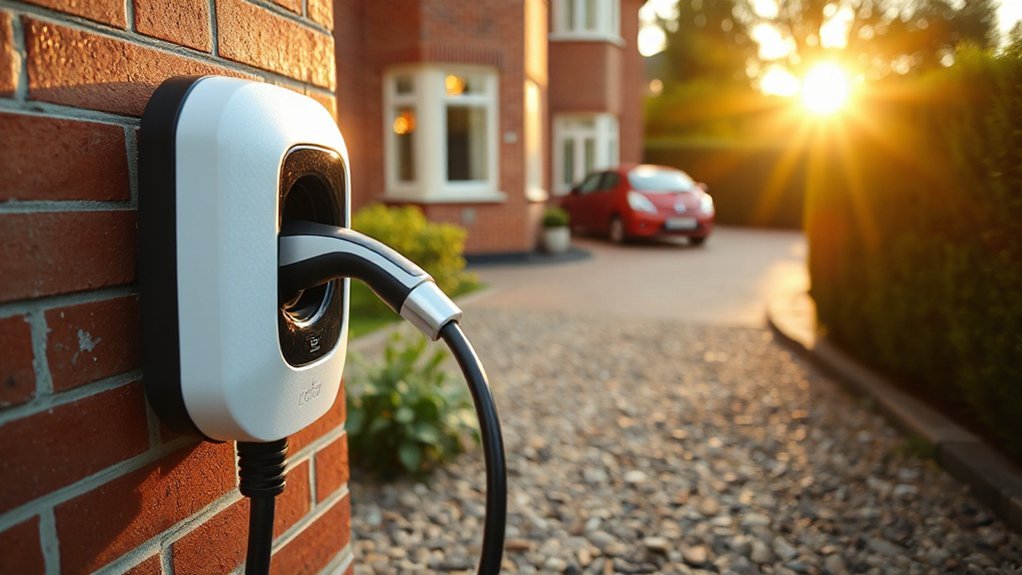

For a 40-amp EVSE:
- The circuit usually needs a 50-amp two-pole breaker.
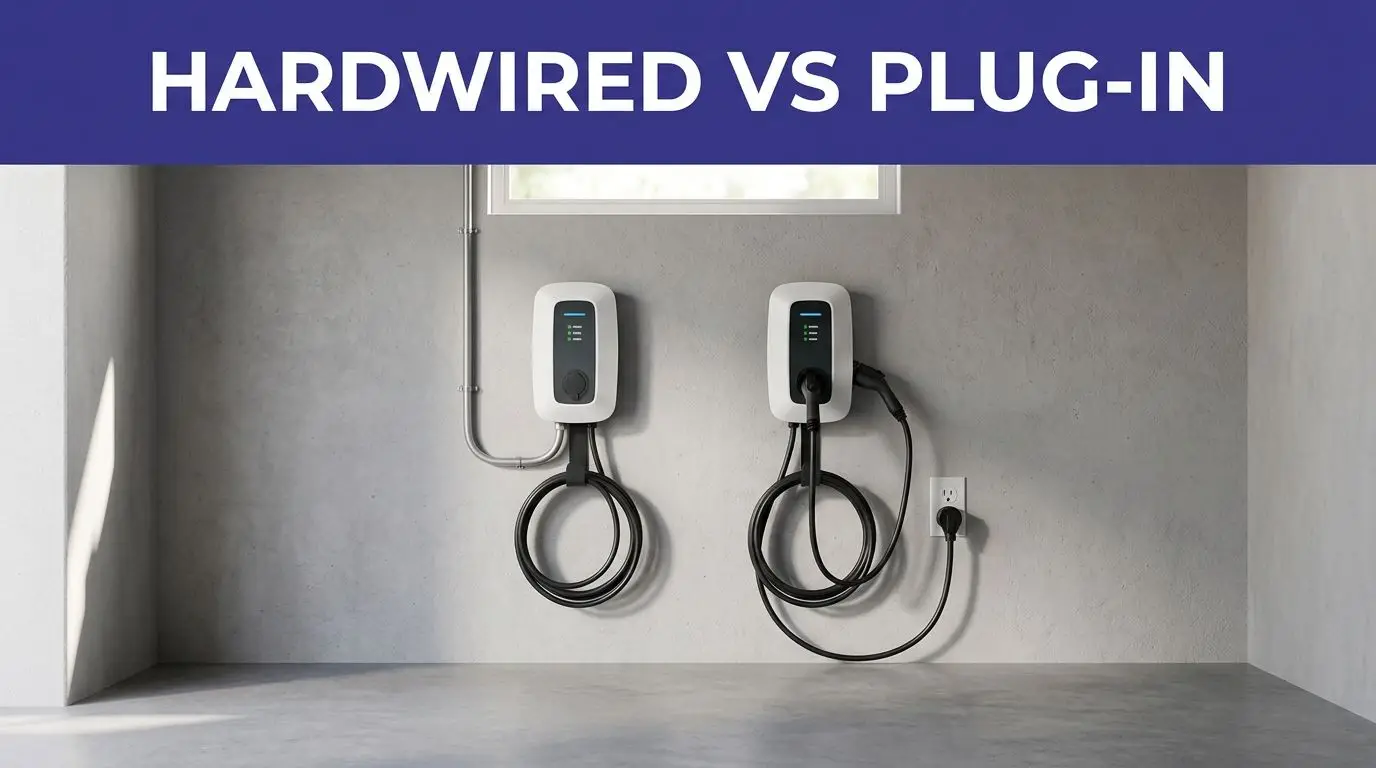
- A dedicated NEMA 14-50 outlet is the common plug-in setup.
- The charger is normally configured to draw no more than 40 amps.
- The outlet, wiring, breaker, and terminations must all be rated and installed for the load.
For a 48-amp EVSE:
- The circuit usually needs a 60-amp two-pole breaker.
- The charger is normally hardwired, not installed as a plug-in unit.
- The wiring size depends on installation method, conductor type, distance, temperature ratings, and local code.
- A licensed electrician should verify the load calculation and installation details.
Why can’t you plug a full-power 48-amp charger into a NEMA 14-50 outlet? Because a 50-amp circuit is generally limited to 40 amps for a continuous load. Some products have a NEMA 14-50 version that can be configured for 40 amps, but that isn’t the same as getting 48 amps through the outlet. Do not defeat the current setting because the charger appears to work. Electricity is not impressed by confidence.
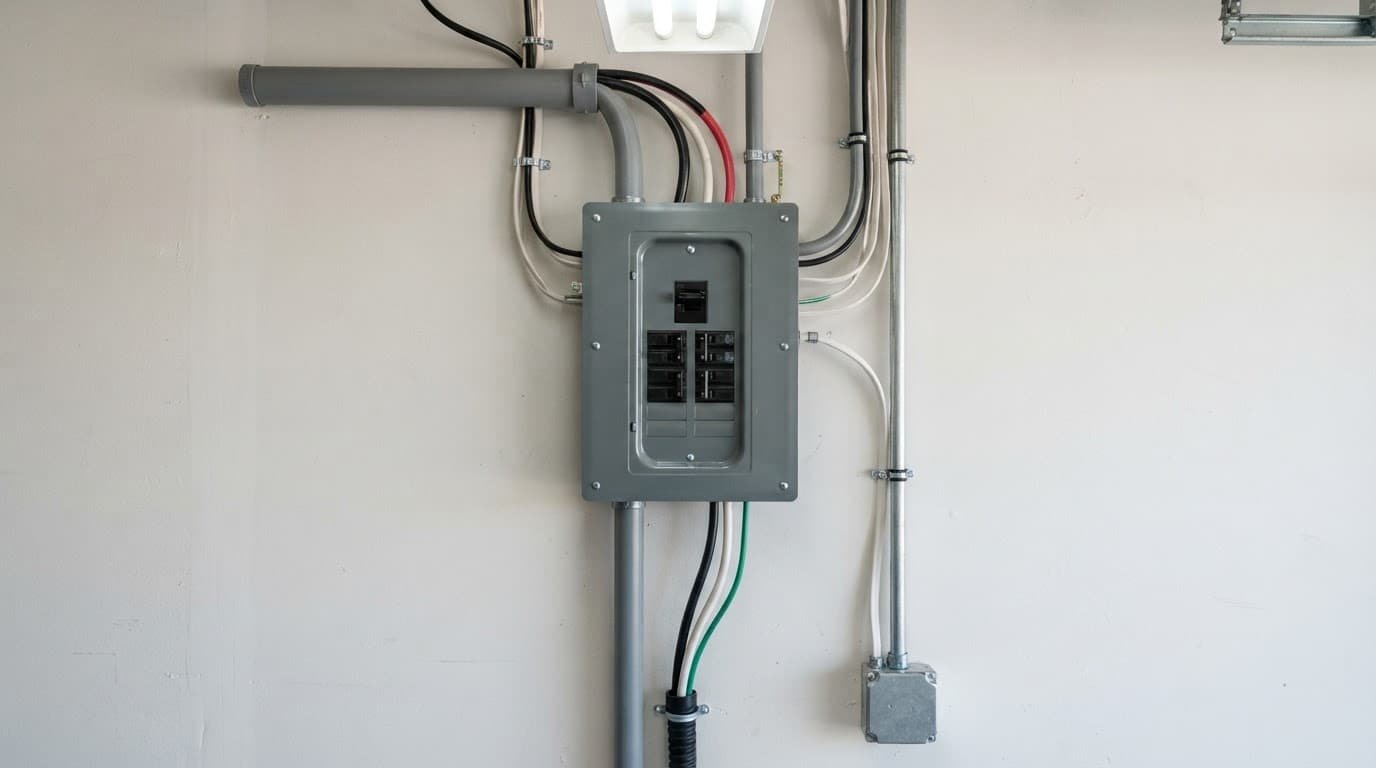
A 48-amp installation also puts more pressure on the home’s electrical system and electrical panel. The load calculation should cover the electrical panel, commonly called a breaker box. It must also account for the HVAC system, electric range, water heater, dryer, and other large loads. A 200-amp main panel may have enough amperage capacity for the needed charging power, while a crowded 100-amp panel may require a different plan.
That plan doesn’t always mean a costly panel upgrade; leaving capacity for future EV needs can be a future-proof choice. A listed load management device, such as simpleSwitch, or a compatible smart panel can monitor demand at the breaker box. It can reduce or pause EV charging when other equipment draws power, then resume when demand drops.
Load management doesn’t make a small service magically larger. It coordinates competing loads within the home’s electrical system so the home doesn’t exceed its safe capacity. The equipment must be approved for the installation and accepted by the local authority having jurisdiction.
A homeowner discussion about Level 2 circuit sizing shows why the breaker rating alone isn’t enough. Wire, outlet type, continuous-load rules, service capacity, and charger settings all belong in the same conversation.
Installation cost, charger price, and electricity use
A 40-amp plug-in charger installation often costs less because the circuit may be simpler. The installation cost varies by region and site conditions. A NEMA 14-50 outlet can make the charger easier to unplug later. Illustrative ranges often fall around $500 to $1,200, though long wire runs, difficult access, trenching, or panel work can push the number higher.
A 48-amp hardwired installation commonly lands around $800 to $2,000 or more, depending on the region and site conditions. The difference comes from the 60-amp circuit, fixed connection, and extra labor. If the electrical panel or breaker box needs work, a circuit breaker upgrade may expand the project. Load management hardware can also increase the scope of the electrical system.
Equipment prices for home charging vary by model. Emporia, Wallbox, and Lectron offer charging station options in this range. Emporia and Wallbox have products that operate at 40 amps with a NEMA 14-50 connection or reach 48 amps when hardwired. Lectron also sells lower-cost 40-amp plug-in and 48-amp hardwired models. Cable length, connector type, warranty, energy monitoring, and smart features can affect the price more than amperage alone.
The electricity bill isn’t automatically higher with 48 amps. It depends on how many kilowatt-hours an electric vehicle uses, not the amperage printed on the wall box.
For example, suppose your car needs 10 kWh to replace a day’s driving. At an electricity rate of $0.18 per kWh, that energy costs about $1.80 whether the charger delivers it at 40 or 48 amps. Charging efficiency can vary slightly, but the difference is usually small.
The 48-amp charger delivers the same energy in less time. That can matter if your utility offers a short off-peak period, but it won’t reduce the total energy needed to drive the same miles.
When is a 48-amp charger worth the extra money?
The higher charging speed helps when your driving schedule regularly eats into the overnight window. A high-mileage driver, rideshare operator, or road-trip-heavy household may need extra energy during short home stops. That’s where charging time matters.
A 48-amp unit is also a reasonable choice when all three conditions are true:
- Your EV’s onboard charger accepts at least 48 amps.
- Your home’s electrical service can support the 60-amp circuit required for a hardwired installation.
- The added installation cost is justified when you often need to add a large amount of range between trips.
A 48-amp unit may also be a future-proof choice for a later EV, but that possibility alone doesn’t justify the added expense.
Multi-EV households need a more careful plan. Two separate 48-amp chargers can put a 96-amp demand on the electrical system before other household loads are counted. Smart EV chargers can use load management to coordinate power sharing, with that load management dividing available load between vehicles. One charger won’t charge two cars at full speed unless it’s designed for that job.
Cold weather adds another wrinkle. Battery heating, cabin heating, and lower winter efficiency can increase the energy needed for each mile. A 48-amp charger can provide more recovery capacity after the battery reaches its normal charging temperature, but it can’t remove the vehicle’s battery-protection limits.
For most drivers under 40 miles per day, a 40-amp charger is the sensible choice and costs less to install. A plug-in charger works well with a NEMA 14-50 outlet, supporting overnight charging and typical daily driving without drama.
Frequently Asked Questions
Is a 48-amp EV charger faster than a 40-amp charger?
Yes. A 48-amp charger can deliver about 11.5 kW compared with 9.6 kW from a 40-amp charger, potentially reducing charging time by roughly 17% for the same amount of energy. The vehicle must support the higher AC charging input to see that benefit.
Can I plug a 48-amp charger into a NEMA 14-50 outlet?
Not at its full 48-amp output. A NEMA 14-50 setup generally uses a 50-amp circuit, which is limited to 40 amps for continuous EV charging, so a full-power 48-amp charger typically requires a dedicated 60-amp circuit and hardwiring.
Does a 48-amp charger increase my electricity bill?
Not automatically. The bill depends mainly on how many kilowatt-hours your EV uses, while the 48-amp charger delivers that energy in less time.
Should I choose a 40-amp or 48-amp EV charger?
Choose 40 amps if your vehicle supports no more than 40 amps or you typically drive under 40 miles per day. A 48-amp charger is worth considering when your EV supports it, your electrical system can handle the installation, and you regularly need faster charging recovery.
Conclusion
The 40 amp vs 48 amp EV charger decision comes down to compatibility and schedule, not the biggest number on the box. A 40-amp unit delivers 9.6 kW, while a 48-amp unit delivers approximately 11.5 kW.
Check the vehicle’s onboard charger first. Then ask an electrician to verify the electrical panel, breaker box, wiring, and load calculation. If your car supports 48 amps and your household needs faster recovery, the extra capacity may be worth paying for as a cautious future-proof choice. Otherwise, 40 amps is already plenty of charger for regular driving.