Best EV Charger for Electric Trucks: Rivian, F-150 Lightning and Silverado EV Owners
Find the right home charger for your Rivian, F-150 Lightning or Silverado EV, with Ford charging guidance, circuit planning and backup-power checks.
As an Amazon Associate, EV Charging may earn from qualifying purchases. This helps support our independent guides at no extra cost to you. Learn more.
Key takeaways
- Size charging for daily energy and your overnight window, then confirm the exact truck’s AC limit and connector.
- Compare adjustable Level 2 equipment by approved circuit capacity, cable reach, outdoor suitability and safety certification.
- Ford and GM home backup require compatible systems beyond an ordinary home charger; quote that work separately.
The best truck charger starts with your parking space, not a leaderboard
An electric pickup makes home charging feel like a bigger purchasing decision. Fair enough: you want tomorrow’s driving covered, and you don’t want a charging cable stretched across the driveway like an ambitious clothesline. But the biggest battery doesn’t automatically call for the biggest charger.
My research-based starting point is an adjustable, safety-certified Level 2 wall charger, with the connector your truck actually uses and enough cable to reach comfortably. Consider 48-amp output if your driving, truck and electrical installation justify it. A lower setting can be the better match when your overnight window is generous or your home has limited capacity.
I’m LarryLeo, a prospective EV buyer comparing official documentation, not reporting hands-on tests. The criteria here are usable charging power, connector fit, installation requirements, driveway practicality and a clear distinction between charging and home backup. This isn’t a tested ranking, and there are no affiliate purchase links in this guide.
Shop this guide
Compare current options and prices
Size the overnight refill, not the entire battery
Level 2 means charging with 240-volt AC power at home. AC is the electricity supplied by the house; the truck’s onboard charger converts it for the battery. That onboard hardware matters: buying a higher-output wall unit won’t force a truck to accept more power than it supports.
Kilowatts, or kW, describe the charging rate. Kilowatt-hours, or kWh, describe the amount of energy, rather like water flow versus the amount collected in a tank. At a nominal 240 volts, 32 amps works out to 7.68 kW, 40 amps to 9.6 kW and 48 amps to 11.52 kW. Those are electrical calculations, not guaranteed battery charging rates.
Try a deliberately hypothetical example: you need to replace 40 kWh after a driving day. Dividing by 7.68 kW gives about 5.2 hours; dividing by 11.52 kW gives about 3.5 hours. Actual completion takes account of charging losses, truck limits and changing conditions. The example doesn’t describe the consumption of any particular Rivian, Ford or Chevrolet.
DOE’s Alternative Fuels Data Center specifically identifies larger batteries, longer commutes and irregular schedules as reasons to consider Level 2. Ask a more useful question than ‘Can it fill the whole battery overnight?’: ‘Can it replace my usual driving before I leave, with room for an unusual day?’
If both outputs cover your routine, our 40-amp versus 48-amp comparison helps frame the installation trade-off.
Match charger output to an electrician-approved circuit
The charger’s operating amperage is not the same thing as the circuit breaker’s rating. Rivian’s May 2023 Wall Charger installation guide provides concrete pairings for that product: 32-amp output on a 40-amp breaker, 40-amp output on a 50-amp breaker and 48-amp output on a 60-amp breaker. These are planning examples from an actual manufacturer, not permission to apply its installation instructions to every charger.
Have a licensed electrician assess your home’s available capacity, the circuit route, the selected equipment and local permit requirements before ordering. The panel’s headline amperage alone doesn’t answer whether there is room for another substantial load. DOE recommends consulting an electrical contractor and checking local requirements.
Ask for quotes based on more than one suitable charging output. Also ask whether an approved load-management arrangement is available for the exact equipment. That means a system designed to manage demand, not an informal promise that nobody will run the dryer while the truck charges.
For the installation decision, see plug-in versus hardwired home charging. Let the electrician and manufacturer instructions determine the safe configuration.
Dedicated F-150 Lightning home-charging guide
Ford’s official home-charger comparison separates two straightforward options. Its Mobile Power Cord is plug-in equipment rated at 12 amps on 120 volts or 30 amps on a suitable 240-volt NEMA 14-50 outlet. The Connected Charge Station is hardwired and rated up to 48 amps. Ford lists a 20-foot cord for both. A portable cord and a wall station are different installations, even when both provide Level 2 charging.
That 30-amp option deserves a fair look if your driving leaves plenty of recovery time. But don’t confuse routine replenishment with a complete refill. Ford’s Lightning charging FAQ estimates 0–100% charging for the 2025 truck on a 240-volt, 30-amp charger at 18 hours for the standard-range battery, 20 hours for the 123-kWh extended-range battery and 23 hours for the 131-kWh extended-range battery. These are Ford estimates for those configurations, not a promise for every Lightning.
For a household that often comes home with substantial energy to replace, a properly supported 48-amp wall station is worth comparing. Before considering anything more powerful, verify the maximum AC input for your exact model year and battery configuration with Ford. Don’t assume a product’s maximum output is what every Lightning will draw. Likewise, public DC fast-charging power is not a specification for your home AC installation.
Ford’s FAQ recommends a 90% charge limit for everyday driving and 100% when you need full trip range. Use the guidance for your truck rather than treating a full recharge as the nightly target. A charger that reliably gets you to your chosen limit before departure is doing its job.
Home backup is a separate decision. Ford’s eligibility documentation requires the Charge Station Pro and Home Integration System for Automatic Home Backup Power, with activation also required for standard-range trucks. Ford’s comparison explicitly says its Mobile Power Cord and Connected Charge Station do not provide home backup. Have the installer confirm current vehicle eligibility, activation and the complete system scope before purchase. A faster ordinary charger does not become bidirectional just because the truck is capable of supplying power.
Rivian R1T: check connector generation before ordering
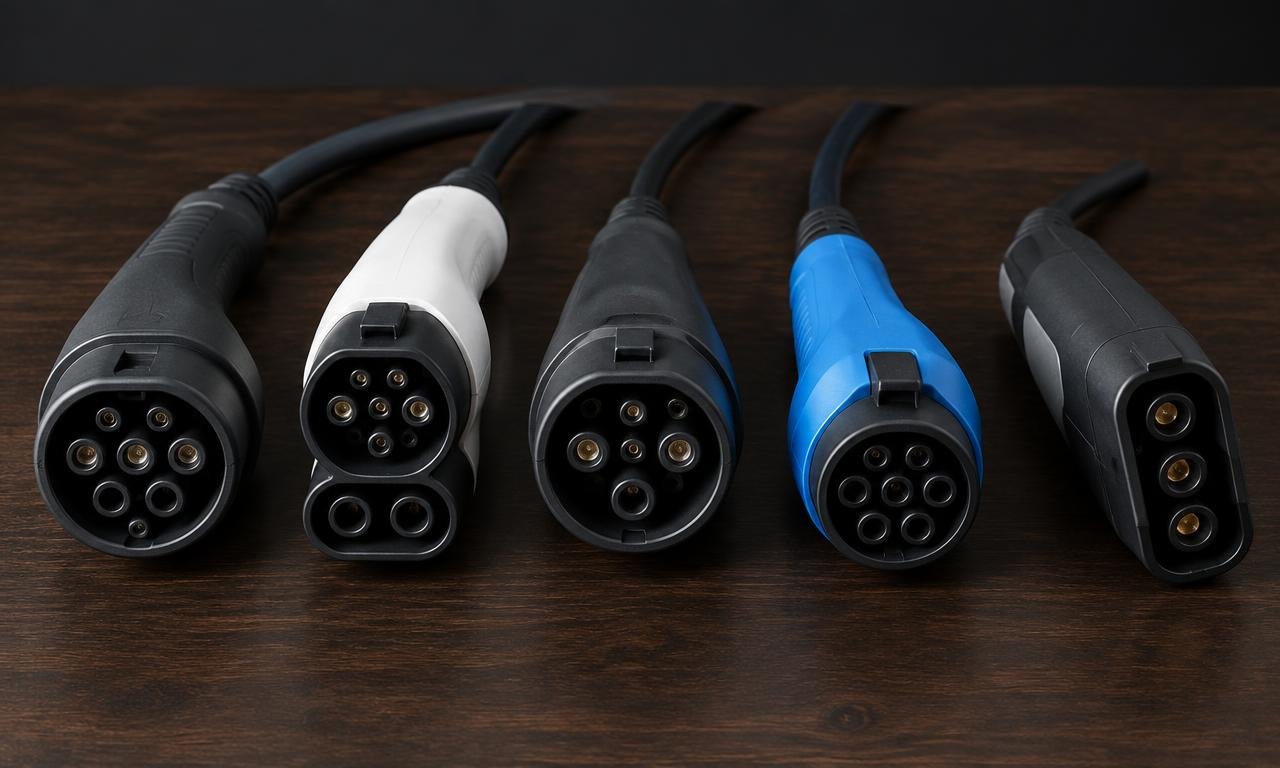
Rivian’s NACS Wall Charger listing specifies 48 amps, 11.5 kW, a 24-foot cable and ENERGY STAR certification. It lists compatibility with 2026-and-newer Rivian vehicles and explicitly warns that its NACS connector is not compatible with a J1772 port without a separate adapter. That warning belongs near the beginning of a buying decision, not after delivery.
NACS and J1772 are connector standards: think different plug shapes, not competing promises of charging speed. Check the port on your actual R1T and the documentation for the charger version you intend to buy. If an adapter is involved, confirm vehicle and charger approval for that exact AC use. Don’t assume an adapter intended for public fast charging solves home-charging compatibility.
The older May 2023 Rivian installation guide is useful for understanding its documented circuit/output combinations, but it is not a replacement for the current NACS unit’s instructions. Match manuals to product numbers. My selection logic for a Rivian is simple: correct connector first, appropriate output second, then cable routing and installation support. The badge on the enclosure comes after those checks.
Silverado EV: separate everyday charging from GM Energy backup
Chevrolet’s home-charging page describes Level 2 equipment across a 3.8–19.2-kW range and presents both ordinary home charging and the GM Energy PowerShift route. That range describes charging options; it does not establish that every Silverado EV configuration accepts the upper figure. Confirm the exact truck’s AC capability before paying for a high-output installation.
Start with the same daily-energy calculation used for the other trucks. If a 32-, 40- or 48-amp arrangement covers your routine, a larger advertised output alone is not a reason to increase the project scope. If it doesn’t, ask Chevrolet and your electrician to compare compatible higher-output equipment against the power your home can actually supply.
For outage backup, Chevrolet’s PowerShift product documentation requires the separately sold GM Energy V2H Enablement Kit, a compatible bidirectional vehicle, a properly equipped home and appropriate grid interconnection. V2H means vehicle-to-home: energy traveling back from the truck to the house. Professional installation is required, and the documentation warns that some appliances or circuits may not be powered during an outage. Ask for a supported-load plan, not simply a charger quote.
Walk the cable route before choosing the mounting spot
A cable’s advertised length isn’t all usable straight-line reach. The route starts at the wall unit, follows a practical path and needs slack at the charge port. Measure with the truck parked as you actually use it, including the less convenient orientation. Include garage-door clearance and space to walk past the fender.
This is where specific products differ in a way you’ll notice nightly: Ford lists 20-foot cords for the Mobile Power Cord and Connected Charge Station, while Rivian lists 24 feet for its NACS Wall Charger. Neither measurement proves a fit for your driveway. Mark a proposed mounting position and measure the real route before the electrician finalizes it.
For outdoor parking, DOE says charging in rain is safe with outdoor-rated equipment. Verify the selected unit’s installation and operating requirements, and arrange cable storage so the connector isn’t left in a puddle or where a tire can cross it. Check the documented temperature range if winter charging is part of your routine; don’t assume every cable will handle identically in cold weather.
Our guide to outdoor charger ratings and weather exposure explains what to check beyond a weatherproof marketing label.
Buy the useful features, then get a complete quote
DOE recommends safety-certified equipment and notes that smart chargers can offer timers, communications and charging data. ENERGY STAR provides a certified-product finder and explains the importance of safety certification. Check the exact model rather than treating an online listing’s reassuring adjectives as evidence.
Ask how the charger behaves without Wi-Fi, whether routine charging needs an account and which settings stay in the truck versus the wall unit. These are purchase questions, not features I’m claiming every product has. A simple, documented charging routine is more useful than an app menu you never wanted to manage.
If another EV may join the household, mention it during the quote. The desired result might be one accessible connector, alternating charging nights or a manufacturer-supported sharing system. Two independent schedules are not proof that equipment may share a circuit.
For that household decision, see charging two EVs with one circuit. Ask the installer to itemize equipment, circuit work, permits and any backup components separately, so you compare equivalent projects.
Frequently asked questions
Does every electric truck need a 48-amp home charger?
No. Size charging around the energy you need to replace and the hours available. A lower-output Level 2 installation may cover your routine. Choose 48 amps when the truck supports it, your driving benefits and a licensed electrician confirms the installation can accommodate it.
Can the Ford Mobile Power Cord charge an F-150 Lightning at home?
Yes. Ford lists 12-amp operation on 120 volts and 30-amp operation on a suitable 240-volt NEMA 14-50 outlet. Full-battery recovery can be lengthy: Ford estimates 18–23 hours for specified 2025 Lightning configurations at 240 volts and 30 amps. Your daily refill may be much smaller.
Will an 80-amp charger automatically charge my truck faster?
No. Usable AC power is limited by the truck, charger and approved installation. Verify your exact model year and configuration before buying higher-output equipment. An advertised public DC fast-charging rate does not tell you the truck’s home AC charging limit.
Can one home charger work with a Rivian, Lightning and Silverado EV?
Potentially, but verify each vehicle’s connector and the charger’s documented compatibility. Rivian’s NACS Wall Charger listing specifically says a J1772 port needs a separate adapter. Confirm approval for any AC adapter rather than assuming all charging adapters are interchangeable.
Will a normal Level 2 charger power my house during an outage?
Not by itself. Ford documents the Charge Station Pro and Home Integration System for its automatic backup setup. GM documents the PowerShift Charger plus V2H Enablement Kit and other vehicle, home and grid requirements. Have a qualified installer design the complete compatible system.
Sources & further reading
- DOE AFDC — Charging Electric Vehicles at Home
- Ford — Home charger comparison
- Ford — F-150 Lightning charging FAQs
- Ford — Home Backup Power eligibility
- Rivian — NACS Wall Charger specifications
- Rivian — Wall Charger installation guide, May 2023
- Chevrolet — Home charging
- Chevrolet — GM Energy PowerShift Charger requirements
- ENERGY STAR — Electric Vehicle Chargers

Written by
LarryLeoLarryLeo started EV Charging while researching his own next car purchase. He digs into the pros, cons and real cost savings of going electric — using government, standards-body and manufacturer sources — and shares what he finds so other buyers can decide with confidence.
Why trust EV Charging Guide
Our guides are researched from government, standards-body and manufacturer sources, reviewed for accuracy, and updated when rules or products change. Brands cannot pay for placement. Read our editorial policy.
Related Posts
Buying a Used EV: How to Check Battery Health and Charging Equipment
EV Charging Speeds Explained: kW, Amps and Volts in Plain English