Best EV Charger for Tesla Model Y at Home: NACS vs J1772 Explained
Choose a Model Y home charging setup by checking your exact car's AC limit, connector options, parking layout, and overnight charging window.
As an Amazon Associate, EV Charging may earn from qualifying purchases. This helps support our independent guides at no extra cost to you. Learn more.
Key takeaways
- Verify your exact Model Y's AC limit; Tesla's public pages differ across configurations.
- A native NACS unit simplifies daily use, while an approved AC adapter may preserve a suitable J1772 installation.
- The current Mobile Connector support table specifies a maximum 32 amps with its NEMA 14-50 adapter.
Choosing a home charger for a Tesla Model Y should be a fairly small project. Then somebody says every Model Y needs 48 amps, somebody else recommends an adapter, and your garage suddenly has homework. Let's clear the clutter: confirm your specific car's AC charging limit, decide which vehicles will use the equipment, and plan around where you park.
This guide compares charging arrangements using manufacturer documentation. It is not a hands-on charger test, and it does not claim that one product suits every Model Y. The practical goal is a reliable overnight routine, with an installation your home can support.
Check your exact Model Y before shopping
Tesla's published charging information is not completely consistent across its pages. Its general onboard-charger table groups Model Y under a 48-amp capability, while a Wall Connector shop-page footnote identifies some Model Y configurations with a 32-amp maximum. Do not resolve that by picking whichever number sounds better. Confirm the maximum for your vehicle through its documentation, touchscreen guidance, or Tesla support.
This matters because a 48-amp wall unit cannot make a 32-amp-limited vehicle accept 48 amps. It can still be compatible when properly configured, but its extra available capacity is not extra charging speed for that car. Model year, configuration, and market all belong in the conversation.
When asking for advice, provide those details instead of just saying “Model Y.” Also distinguish the car's charging limit from the current temporarily allowed by a particular outlet or charging session. A low session reading can reflect the supply rather than the car's maximum capability.
Native NACS keeps the daily connection simple
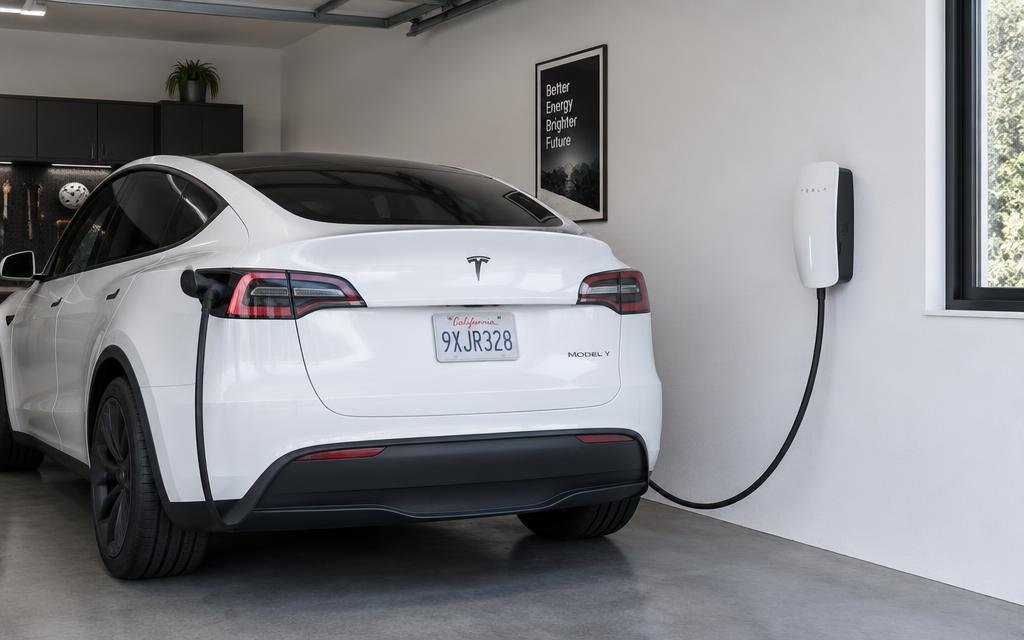
For a North American Model Y with a NACS inlet, a compatible native NACS home unit avoids a separate AC adapter during the ordinary plug-in routine. Fewer items to locate at bedtime can be a real convenience. That convenience is a selection criterion, not proof that every NACS-branded product is a good purchase.
Check the exact model's safety listing, installation manual, cable length, warranty, and supported current settings. A familiar connector does not establish the quality of the entire device. If buying used equipment, confirm the model and condition with the manufacturer rather than relying on a listing that says it fits all Teslas.
When keeping a J1772 charger makes sense
If you already have an appropriate J1772 home installation, first check whether your vehicle and equipment support an approved J1772-to-Tesla AC adapter. Replacing a working installation merely to remove one approved adapter may not be the best use of your budget. Have any uncertainty about equipment condition or circuit suitability assessed before regular use.
For two cars with different inlets, consider who plugs in most often and where an adapter will be stored. Ask whether both drivers can identify the right accessory without guessing. A simple labeled storage spot may be more useful than an elaborate setup that only one person understands.
Keep AC and DC accessories separate in your planning. An adapter sold for Supercharger access solves a different compatibility problem from an adapter used with home AC equipment. Physical fit alone is not an adequate compatibility check. Our connector compatibility guide covers the broader questions.
Compare Wall Connector with Mobile Connector by use
A permanently installed Wall Connector is worth considering when you want a dedicated charging location and the features documented for that model. Tesla describes app-based control, scheduling, and supported power-management options. Have an installer confirm which capabilities your proposed installation actually includes; a feature name does not guarantee the necessary accessories are part of the quote.
Mobile Connector offers an alternative for approved outlet arrangements and travel use. Tesla's current support table lists a maximum 32-amp output with its NEMA 14-50 adapter. It should not be described as a 40-amp charger simply because the receptacle is associated with a 50-amp circuit.
If you want one unit to stay at home and another to travel, include both in the budget. If you plan to move a portable unit regularly, consider whether repeated packing and unpacking will become annoying. Read our portable charging guide before depending on an unfamiliar destination outlet.
Use your overnight window to judge charging speed
Suppose your driving consumes 18 kWh on a particular day. At a steady illustrative 7.68 kW supply, dividing 18 by 7.68 gives about 2.3 hours before charging losses and other energy use. At 11.52 kW, the same arithmetic gives about 1.6 hours. These are simplified calculations, not Model Y charging-time promises.
The useful question is whether either arrangement replaces your normal driving within your available window. If the car sits for eight hours, the difference may have little effect on your routine. If you return late, leave early, and must fit charging into a short utility-rate period, additional usable power may matter more.
Avoid shopping from miles-per-hour claims alone. Driving efficiency, weather, battery conditioning, and the vehicle's limit affect the outcome. Our 40-amp versus 48-amp guide separates power figures from the practical decision.
Give the installer a parking plan
Park the Model Y where it normally lives and identify the charging-port side. Measure the actual route a cable must follow, including slack around the rear corner if needed. Now try your other usual parking position. This tiny rehearsal can prevent years of awkward reaching.
Keep the route away from garage-door movement and walking paths. Decide where the handle and cable will rest between sessions. Outdoor installations need equipment and mounting appropriate for the exposure, plus a location that remains usable after rain or snow. Do not make extension cords or improvised adapters part of the plan.
Ask the electrician to assess household electrical capacity and explain the selected equipment setting. Breaker spaces alone do not establish spare electrical capacity. Any supported load-management arrangement needs the correct design and commissioning; an app slider is not a substitute for that assessment.
Choose one place to manage the schedule
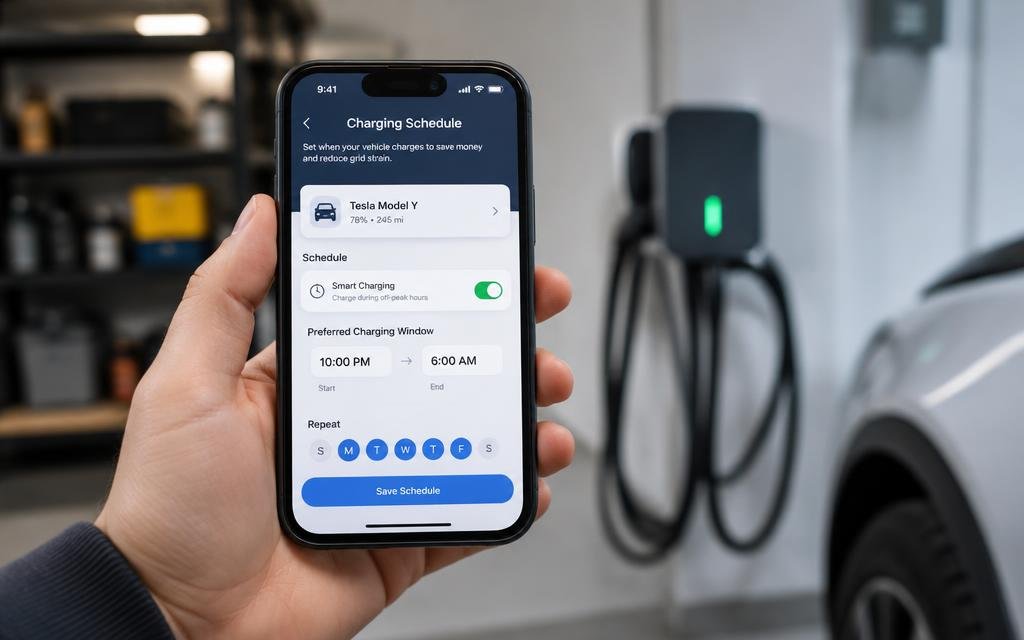
Scheduling in both the car and the wall equipment can make troubleshooting unnecessarily confusing. Pick a clear approach that fits the instructions and your utility arrangement. Write down what you configured so another household member can understand why charging starts at a particular time.
For off-peak billing, verify your actual tariff and any enrollment conditions. Do not assume the time shown in a generic online example is your cheapest period. If you need remote monitoring, check Wi-Fi coverage where the charger will be mounted before installation day.
Questions to answer before ordering
Can the seller identify the exact model and provide its manual? Is the connector arrangement approved for your vehicle? Will the cable reach without tension? Does the quote include required installation work and permits? Who will handle warranty questions? Each clear answer removes a small surprise later.
For a Tesla-only driveway, a suitable native NACS arrangement may be the easiest daily choice. For a mixed household or an existing J1772 installation, an approved adapter or documented multi-connector solution may be more practical. Choose from your actual vehicles and routine, then have the installation verified. The nicest feature is waking up ready to leave without having to think about charging again.
Sources & further reading

Written by
LarryLeoLarryLeo started EV Charging while researching his own next car purchase. He digs into the pros, cons and real cost savings of going electric — using government, standards-body and manufacturer sources — and shares what he finds so other buyers can decide with confidence.
Why trust EV Charging Guide
Our guides are researched from government, standards-body and manufacturer sources, reviewed for accuracy, and updated when rules or products change. Brands cannot pay for placement. Read our editorial policy.
Related Posts
How to Choose a Portable EV Charger for Road Trips and Camping
Best Outdoor EV Charger for Rain and Snow: What NEMA 4 Really Means