Tesla Universal Wall Connector: Specs, Pros and Cons for Mixed-EV Households
Explore Tesla Universal Wall Connector specs, its integrated adapter, installation needs and trade-offs for households charging both NACS and J1772 EVs.
As an Amazon Associate, EV Charging may earn from qualifying purchases. This helps support our independent guides at no extra cost to you. Learn more.
Key takeaways
- The integrated NACS handle and J1772 adapter suit mixed-inlet households, but one unit still connects to only one vehicle at a time.
- Tesla lists up to 48 amps and 11.5 kW at 240 volts; the electrical design and your vehicle determine the charging rate you can use.
- Budget for a hardwired installation, check the applicable warranty category and discuss power-management hardware with a licensed electrician.
Two inlet types, one place to plug in
You have cars with different charging inlets, and you'd rather not make a loose adapter another thing to keep track of. That's the problem Tesla's Universal Wall Connector addresses. Tesla lists a NACS handle, an integrated J1772 adapter, a 24-foot cable, app-based scheduling and power-management features. This is a researched buying assessment based on Tesla's product information and installation documents, not a hands-on test.
Universal is a useful name, but it needs some boundaries. This is AC home-charging equipment, not a Supercharger. It doesn't promise identical behavior from every vehicle or support for every charging feature. Check each car's charging inlet and AC-charging compatibility before ordering; Tesla's manual describes separate NACS and J1772 handle use.
Will you actually use both connector types? If yes, keeping them together at the wall has a clear purpose. If all your cars use the same inlet, compare alternatives before paying for flexibility you may not need. Check current price and availability, too. An old advertised hardware price isn't an installed-project budget.
Shop this guide
Compare current options and prices
Start with the cable route, not the biggest number
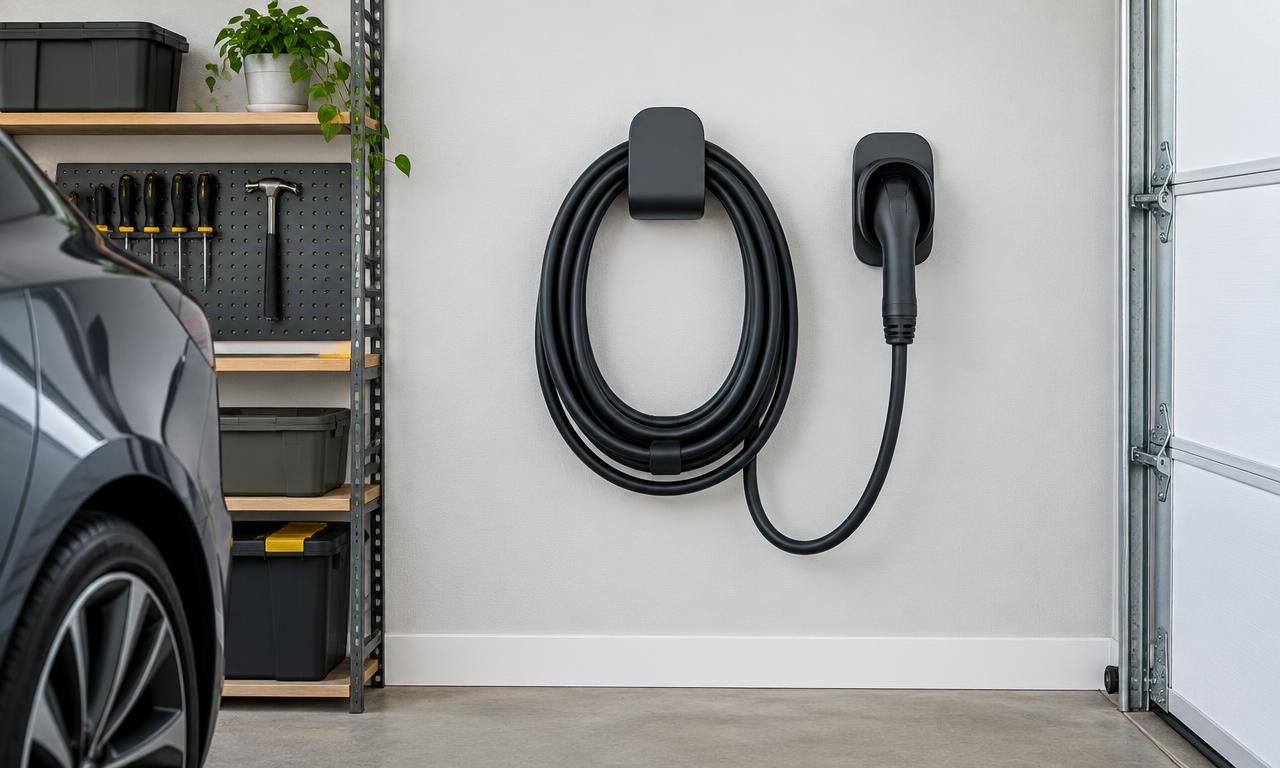
Picture both cars in their usual parking spots. Now trace the cable's route to each charge port, around the cars rather than through them. Tesla specifies a 24-foot cable, so checking that route before choosing the mounting position is worthwhile. Ask the installer about cable storage, walking routes and what happens when the cars swap spaces.
The electrical specifications list nominal 200–240-volt single-phase input and a 12–48-amp output range. Single-phase describes the electrical supply; your electrician can check the match. Think of amps as the width of a hose: they describe current, while kilowatts describe the power delivered. Neither number alone tells you how quickly every car will charge.
Tesla's maximum is 11.5 kilowatts at 240 volts. That's an equipment-output specification, not a promise to your vehicle. Actual charging depends on the Wall Connector's output and the car's onboard charger, which handles incoming AC power. If the car accepts less, installing for the highest output won't remove that limit.
Planning an outdoor location? Tesla markets the unit for indoor or outdoor installation. Its online specifications list Type 3R and IP54 enclosure ratings; the PDF manual lists Type 3R. These are enclosure-protection classifications, not permission to mount it anywhere. Have the installer follow Tesla's location requirements rather than treating a weather rating as a substitute for the instructions.
| Specification | Tesla's published detail | Buying implication |
|---|---|---|
| Maximum output | 48 amps; 11.5 kW at 240 volts | Check both the electrical supply and vehicle AC limit. |
| Cable | 24 feet | Plan around both charge-port locations. |
| Connections | NACS handle with integrated J1772 adapter | One unit can accommodate either inlet type. |
| Installation | Hardwired | Not a plug-in replacement for an existing receptacle. |
| Enclosure | Type 3R; online specifications also list IP54 | Use only an installation location approved under the instructions. |
The breaker rating is not the charging current
A 60-amp circuit and 48-amp charging output can describe the same installation. That isn't a typo. Tesla's table separates circuit-breaker rating from maximum charging current: the 60-amp configuration supports 48 amps, while the 50-amp configuration supports 40 amps. It also lists lower-output configurations, shown below. These are design references for an electrician, not instructions for choosing your own breaker.
The useful part is flexibility. You don't have to pursue maximum output just because it's on the specification sheet. Ask a licensed electrician to assess available capacity, explain the permitted configuration and handle required permits and local-code requirements. The installation and commissioning must follow Tesla's instructions. Compare the resulting output with the time your car normally sits overnight.
Already have an outlet near the parking space? Keep that detail in the conversation, but don't assume it makes this a plug-in purchase. Tesla requires hardwired branch-circuit connections and explicitly prohibits cord-and-plug connections. Hardwired means permanently connected to the circuit rather than plugged into a receptacle. Have the electrician assess the existing installation instead of assuming its outlet or circuit can be reused unchanged.
| Circuit breaker | Maximum output | Published output at 240 volts |
|---|---|---|
| 60 amps | 48 amps | 11.5 kW |
| 50 amps | 40 amps | 9.6 kW |
| 40 amps | 32 amps | 7.6 kW |
| 30 amps | 24 amps | 5.7 kW |
| 20 amps | 16 amps | 3.8 kW |
| 15 amps | 12 amps | 2.8 kW |
For the installation trade-offs, see NEMA 14-50 versus a hardwired EV charger.
The adapter stays with the home charger
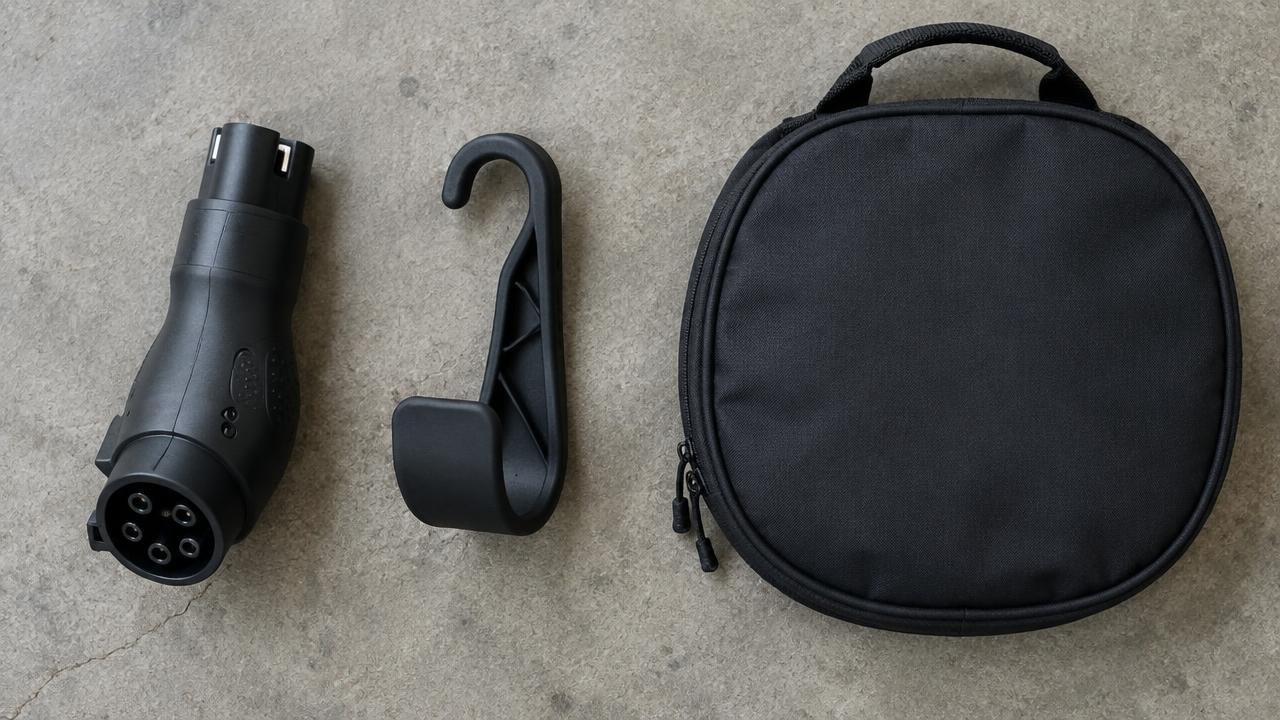
Tesla's manual describes two handle configurations. For NACS use, the NACS connector comes out of its holster. For J1772 use, the adapter's release mechanism lets you remove the J1772 handle assembly. The adapter is integrated into the station, rather than supplied as a separate loose accessory. That's the useful idea behind the Magic Dock-style description.
For a mixed-inlet household, the benefit is organization: both connector choices live at the same parking location, with one installed cable to plan around. The catch is right there in that sentence: one cable. One unit connects to one vehicle at a time. Supporting two inlet types doesn't turn it into a two-port charging station.
Keep public fast charging on a separate research list. The documented output and operating instructions are for AC home charging. This integrated J1772 adapter isn't a portable Supercharger adapter, and buying it doesn't solve public DC fast-charging compatibility. A tidy home setup is useful enough without asking it to do a different job.
Why NACS also appears in fast-charging discussions
If you've seen NACS mentioned for both home charging and public fast charging, the terminology can feel slippery. SAE's J3400 recommended practice is titled North American Charging System (NACS) for Electric Vehicles. Its published scope describes conductive power transfer through a hand-mated coupler: a connector you attach by hand. It covers DC or single-phase AC transfer through two current-carrying contacts.
That shared connector format explains the overlap in the names, not interchangeability between charging systems. For this purchase, stick with the Universal Wall Connector's published AC specifications, your vehicle's requirements and Tesla's instructions. Don't read the J3400 reference as a guarantee of every future vehicle feature or bidirectional capability, meaning power flowing in both directions.
Power sharing divides a limit; it does not create power
Thinking about a second charging station later? Tesla describes static, dynamic and group power management. Static management sets an installation-specific output ceiling. Dynamic management adjusts charging to available panel capacity and needs a separately purchased Tesla-approved power meter. Group management coordinates multiple Wall Connectors within a configured power limit. Different tools, different installation questions.
The Universal Wall Connector manual describes a group of up to six Gen 3 Wall Connectors. That's an expansion option, not six promises of maximum output at once. The group still has to stay within its electrical allocation. Think of sharing an agreed allowance rather than adding a fresh allowance for every station.
For two vehicles, ask your electrician to compare one station used in sequence with two stations under an approved power-management design. Have the quote identify any extra meter, equipment and commissioning costs. The question is whether both cars can get the charging they need during their parking time, not how many units will fit on the wall.
Explore the household planning questions in charging two EVs at home with one circuit.
Read the app details and the warranty category
Before settling on a mounting spot, discuss connectivity there. Tesla lists 2.4 GHz Wi-Fi support, along with charging schedules, usage monitoring, remote diagnostics, access controls and over-the-air updates. Decide whether the car or the Wall Connector will be your main scheduling control; that's a practical choice to make before setting up schedules.
The product page advertises a four-year residential warranty, but the manual supplies the important distinction: 48 months for normal personal use and 12 months for normal commercial use, subject to exclusions and limitations. Its commercial-use definition extends beyond daily personal charging at a residential single-family home and includes multifamily settings. A residential address alone isn't enough to settle the category.
There's another detail worth keeping with your quote: the manual excludes on-site labor costs for removal, reinstallation or repair from warranty coverage. Ask what the installer's separate workmanship coverage includes. The hardware warranty and the installation warranty answer different questions, so save both with the invoice.
A sensible fit when both connections earn their place
Based on the documentation, this makes sense for a household that regularly uses NACS and J1772, wants a permanent installation and values having both connections at the wall. A realistic plan to add another compatible Wall Connector and use Tesla's documented power management is another reason to consider it. Those are the buying criteria here, not a tested ranking.
The trade-offs are straightforward. One unit serves one car at a time. Installation is hardwired. Dynamic management needs additional hardware. Maximum charging rate depends on the electrical design and the vehicle. If you need portability, simultaneous connections from one purchase or only a single connector type, compare other approaches before deciding.
Before ordering, request an itemized installed quote, confirm the warranty category, check current purchase availability and verify incentive eligibility for the exact model. The strongest reason to buy is an identified mixed-inlet need. The word universal shouldn't be doing all the work in the decision.
Build an installation budget with the Tesla Wall Connector installation-cost guide.
Frequently asked questions
Can the Universal Wall Connector charge two EVs at once?
No. One unit has one cable and connects to one vehicle at a time. Tesla documents group power management for multiple compatible Wall Connectors, but simultaneous connections need additional stations and an approved electrical design.
Does it need a 60-amp circuit?
Only its documented maximum 48-amp output calls for the 60-amp configuration. Tesla also lists lower-output options. Have a licensed electrician determine the appropriate design, permits and local-code requirements rather than choosing a circuit from the maximum-output headline.
Is the integrated J1772 adapter a Supercharger adapter?
No. The integrated J1772 adapter serves this Wall Connector's AC home-charging function. It isn't a portable adapter for public DC fast charging; keep those compatibility questions separate.
Is the warranty always four years?
Not automatically. Tesla advertises four years for residential use, while the manual distinguishes normal personal use from commercial use and includes exclusions. Confirm your category, especially for a multifamily property, before relying on the headline.
Sources & further reading

Written by
LarryLeoLarryLeo started EV Charging while researching his own next car purchase. He digs into the pros, cons and real cost savings of going electric — using government, standards-body and manufacturer sources — and shares what he finds so other buyers can decide with confidence.
Why trust EV Charging Guide
Our guides are researched from government, standards-body and manufacturer sources, reviewed for accuracy, and updated when rules or products change. Brands cannot pay for placement. Read our editorial policy.