What EV Charger Cable Length Do You Need? 16 ft vs 25 ft
Choose EV charger cable length by measuring the real parking route. Compare verified specifications, plan safe storage, and avoid relying on extensions.
As an Amazon Associate, EV Charging may earn from qualifying purchases. This helps support our independent guides at no extra cost to you. Learn more.
Key takeaways
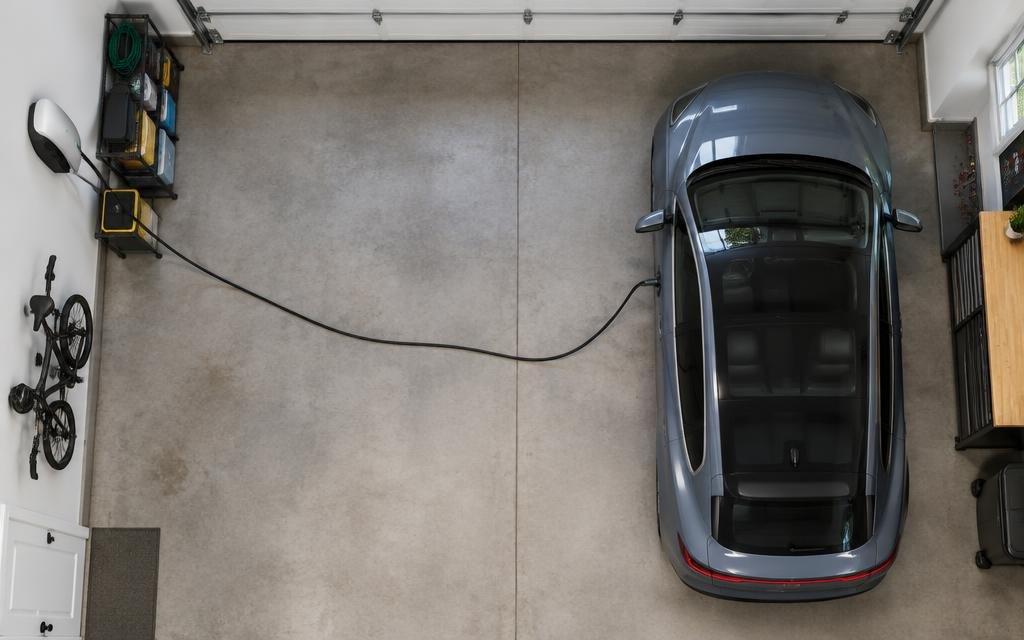
- Measure from the proposed cable exit to the actual charge port, including height changes and enough freedom for a relaxed connection.
- Check the exact model: reviewed documents list Tesla 18- and 24-foot examples, ChargePoint 23 feet, and Emporia Classic and Grizzl-E Duo Connect 25 feet.
- Choose comfortable reach with a storage plan for unused cable; resolve a poor mounting location rather than relying on an extension cord.
Measure the parking route, not just the garage
You're looking at a 16-foot cable and a 25-foot cable. More reach sounds reassuring, but where will the spare length go? The useful choice depends on the route from the charger to your car, not which number looks more generous on the product page.
A 16-foot cable is worth evaluating when the charger can sit close to the charge port and you park consistently. A 25-foot cable deserves a look when the measured route is longer or you want to accommodate more than one parking position. Neither length automatically suits every garage.
Measure the usable path from the cable's exit point to the open charge port, with a relaxed connection at the end. A straight line between wall and car doesn't settle it. Tesla's installation guidance explicitly calls for reaching the port without straining the cable. Just barely reaching isn't the goal.
I'm researching these specifications as a car buyer, not reporting a hands-on comparison. I haven't handled these cables or tested their flexibility. This guide uses manufacturer instructions to build a measuring and purchasing process, rather than ranking cables by how they supposedly feel.
Shop this guide
Compare current options and prices
Try the route before choosing the wall location
Park where you realistically expect to charge. Leave your usual space for doors, walking around the vehicle and reaching storage. Mark a proposed charger location without drilling or changing electrical equipment. A flexible measuring tape or piece of string can represent the intended cable path. This is a planning exercise, not an installation.
Start at the proposed cable exit, not the nearby receptacle or the middle of the charger enclosure. Follow the route to the inlet and include the change in height. Keep the line clear of your normal walking route instead of letting it take an optimistic diagonal across the garage.
At the car, let the line approach the charge port naturally. We're checking for a comfortable connection, not trying to win a stretched-tape contest. Tesla's location guidance also calls for room around the charger so the cable can loop around the unit and the handle can sit in its dock.
Now move the car slightly forward and back within your normal parking area and repeat the check. Include another driver's usual parking position, too. Record the longest realistic route, compare it with the exact product's published length, and discuss the mounting position with your electrician before committing.
Find the port on the actual car
A generic EV photo won't tell you where your cable needs to end. Check the vehicle and its owner's manual. Tesla's Model Y manual, for example, places the charge port on the left side behind a door in the rear tail-light assembly. It tells owners to park so the cable easily reaches that port.
That's useful information for a Model Y, not a template for every EV. Confirm the inlet position on the vehicle you expect to charge. Still shopping for the car? Add a charge-port check to the dealer visit, alongside the other practical questions on your list.
For a two-car household, measure each car in every space you intend to use. Be honest about backing in or swapping spaces. If the cable only works when everyone adopts a new parking ritual, that routine deserves discussion before it becomes part of your charging plan.
The specifications do not fall neatly into two lengths
The 16-foot-versus-25-foot question is a helpful starting point, but the reviewed documents show more variety. ChargePoint's Home Flex resources specify 23 feet. Tesla's current installation-location guidance discusses a 24-foot cable, while the older Gen 3 manual reviewed lists an 18-foot option and an 8.5-foot version.
Emporia is another reason to check the exact model and document revision. The Classic installation guide reviewed specifies 25 feet. An older listing or a remembered number isn't a basis for calling the current Classic cable 24 feet. Confirm the exact product identifier, or SKU, and the documentation for the unit you'll receive.
United Chargers lists two 25-foot output cables for Grizzl-E Duo Connect 40A. That's a separate cable for each vehicle, not one 50-foot cable. Also distinguish the vehicle cable from a plug-in charger's short supply cord to the receptacle. They're different parts of the reach problem.
| Manufacturer and document | Published vehicle-cable length | Buying implication |
|---|---|---|
| Tesla older Gen 3 manual | 18 feet; also lists an 8.5-foot version | Check older-stock and used-unit specifications carefully. |
| Tesla current installation-location guidance | 24 feet | Use the guidance for the exact unit being installed. |
| ChargePoint Home Flex resources | 23 feet | Measure rather than treating it as a 25-foot cable. |
| Emporia Classic installation guide reviewed | 25 feet | Confirm the delivered model and manual revision. |
| Grizzl-E Duo Connect 40A product specifications | Two 25-foot cables | Measure each vehicle's route independently. |
When the shorter cable works—and when it cannot
Picture a hypothetical 11-foot route. A 16-foot cable has five feet between that measured route and its nominal, or stated, length. That makes it worth evaluating, provided the cable exit, connector position and relaxed routing work in practice. Five feet is arithmetic here, not a universal allowance or manufacturer-required minimum.
Now picture a hypothetical 19-foot route. A 16-foot cable cannot cover it. A 23-, 24- or 25-foot product may be a candidate, but repeat the route check for that specific equipment. Don't assume every bit of the stated length will be conveniently available in your proposed installation.
Extra length can be useful when you want different parking positions. It still needs a home when the nearest car is connected, though. A practical selection criterion is the shortest manufacturer-supplied cable that comfortably covers the intended uses, with a storage plan for what remains. Longer isn't a substitute for planning.
Before buying more reach, ask whether a different mounting point solves the problem more cleanly. A licensed electrician should assess feasible locations, the installation method, manufacturer instructions, permits and local code. An existing receptacle needn't decide the entire layout before you've had that conversation.
Mounting flexibility is one reason to discuss plug-in versus hardwired charger installation before choosing equipment solely for its cable length.
Plan where the cable goes in both situations
Imagine the cable connected to the car. Then imagine it put away. Both arrangements need to work. ChargePoint's Home Flex installation guide says to position the cable so it isn't stepped on, tripped over, damaged or stressed. It also explicitly says not to close a garage door on the cable.
Sketch both conditions before choosing the wall location. With a longer cable, identify where the unused length will sit without blocking the path between the house door and the car. With either length, check that the connector returns to its intended holder without being stretched. Storage isn't an afterthought if it affects your walking route.
Tesla's guidance allows a separate cable organizer when space is constrained. Follow the charger's storage and routing instructions rather than improvising tight bends or pulling the handle into its dock. The older Gen 3 safety instructions also warn against forceful folding, twisting, dragging and stepping on the equipment.
Planning to charge outside? Don't make trapping the cable under the garage door part of the plan. Tell the electrician about that parking position and select an appropriate installation location. A cable that reaches only when handled contrary to its manufacturer's instructions hasn't solved the reach problem.
Once the route is established, compare garage charging-cable organizers and holders for storing the unused length and connector.
A temperature rating is not a flexibility test
A freezing morning raises a fair question: how easily will this cable coil? An operating-temperature range doesn't answer it. The Home Flex installation guide reviewed specifies a North American range of minus 40 degrees Fahrenheit to 122 degrees Fahrenheit. That establishes the published operating range, not comparative bending or coiling performance.
Calling a cable best for cold handling on that specification alone would go beyond the evidence. Ask the manufacturer for cable-specific cold-handling guidance and check the exact version's instructions. Keep the measured route relaxed so the connection doesn't depend on forcing the cable into a sharp bend.
For an outdoor installation, look beyond length. Discuss mounting, handle storage and whether the route clears doors and normal foot traffic. Follow the manufacturer's environmental limits and have the electrician assess the proposed location. Reach is one part of the installation, not the whole decision.
If the charger will live outside, pair the reach measurement with outdoor charger enclosure and weather considerations.
Do not make an extension the backup plan
If the supplied cable won't comfortably reach, reconsider the location or buy equipment with the necessary manufacturer-supplied reach. Don't plan around an extension cord. Tesla's NEMA 14-50 Wall Connector manual explicitly prohibits one. That warning applies to the equipment covered by that manual and is a reason to resolve supply-side reach during installation planning.
An aftermarket vehicle-side extension shouldn't be treated as equivalent to the station's supplied charging cable, either. Ask the charger manufacturer to address a proposed accessory explicitly. Matching connectors aren't permission by themselves. Follow the instructions for both the vehicle and charging equipment.
Nor should 25 feet be treated as a universal legal cutoff. The primary-source material reviewed didn't establish the complete wording, measurement method and exceptions needed to assert a blanket UL 2594 or NEC 625.17 maximum-length rule. Have the licensed electrician verify locally applicable requirements and the equipment's listing rather than assuming universal permission or prohibition.
Before purchasing, confirm the exact cable specification, measure the longest intended route, check that the connection stays relaxed and decide how everything will be stored. If one check fails, change the location or product before installation. That's a cleaner decision than discovering afterward that the plan depends on an extension.
Frequently asked questions
Is a 25-foot EV charging cable always better than 16 feet?
No. Choose enough length for the real route and your normal parking variation. A 25-foot cable may accommodate more positions, but its unused length still needs safe storage. More cable isn't automatically a better fit.
Does Tesla Wall Connector have an 18-foot or 24-foot cable?
Both appear in the reviewed Tesla documents. An older Gen 3 manual lists an 18-foot option; current installation-location guidance discusses 24 feet. Check the exact unit and its documentation rather than carrying one number across generations.
Can I close the garage door over the charging cable?
ChargePoint's Home Flex installation guide explicitly says not to close a garage door on the cable. Plan a route that follows the manufacturer's instructions, and ask an electrician about an appropriate location if you need to charge outdoors.
Does an operating-temperature rating show which cable stays flexible?
No. An operating-temperature rating establishes a published range, not how easily a cable bends or coils compared with another. Ask for cable-specific manufacturer guidance rather than assuming an undocumented cold-handling result.
Sources & further reading
- Tesla: Gen 3 Wall Connector Installation Manual
- Tesla: Wall Connector Installation Considerations
- Tesla: Model Y Charging Instructions
- ChargePoint: Home Resources
- ChargePoint: Home Flex Installation Guide
- Emporia: Classic Installation and Usage Guide
- United Chargers: Grizzl-E Duo Connect 40A
- Tesla: NEMA 14-50 Wall Connector Installation Manual

Written by
LarryLeoLarryLeo started EV Charging while researching his own next car purchase. He digs into the pros, cons and real cost savings of going electric — using government, standards-body and manufacturer sources — and shares what he finds so other buyers can decide with confidence.
Why trust EV Charging Guide
Our guides are researched from government, standards-body and manufacturer sources, reviewed for accuracy, and updated when rules or products change. Brands cannot pay for placement. Read our editorial policy.
Related Posts
Best EV Charger for Electric Trucks: Rivian, F-150 Lightning and Silverado EV Owners
Buying a Used EV: How to Check Battery Health and Charging Equipment