EV Charging Costs: A Buyer's Research Checklist
EV charging costs depend on your rates, mileage and home/public mix. Estimate cost per mile, account for fees and compare fairly with gas.
As an Amazon Associate, EV Charging may earn from qualifying purchases. This helps support our independent guides at no extra cost to you. Learn more.
Before choosing an electric vehicle, estimate charging costs using your electricity rate, the car's energy consumption, and your likely home/public charging mix. At 18.3 cents per kilowatt-hour, an EV drawing about 0.31 kWh per mile from the outlet costs roughly $57 per 1,000 miles.
That's a useful starting point, but your charging mix can move the number considerably. A car charged overnight at home has a different budget from the same car relying on highway fast chargers.
Start with the electricity you'll buy, then work through the car, the equipment, and those little fees that like to arrive uninvited.
This post may contain affiliate links. If you make a purchase through these links, I may earn a small commission at no extra cost to you.
Key Takeaways
- Compare cost per mile, because battery size alone doesn't tell you which car costs less to drive.
- Include charging losses when calculating battery replenishment, but don't add them again to EPA electricity-consumption ratings.
- Budget for your actual charging locations, including installation, subscriptions, parking, and idle fees.
Find Your Actual Electricity Rate

Separate Energy Charges From Fixed Charges
Your electric bill may separate electricity supply, delivery, riders, and taxes. For the cost of adding an EV, include charges that increase with each additional kWh.
An existing fixed customer charge usually doesn't increase because you bought a car. A new meter charge or EV-plan enrollment fee does belong in the comparison.
Dividing the entire bill by total electricity use gives a rough historical average. It can overstate the incremental charging rate because it spreads fixed charges across energy use. Tiered pricing can push the added electricity into a different price bracket, too.
Use the utility rate that applies to each additional unit of electricity.
Treat National Averages as Reference Points
EIA's July 2026 residential average was about 18.3 cents per kWh, rounded from 18.31 cents in its monthly electricity price data.
That national average is average revenue per kWh, not a tariff offered to every household. Your location, season, usage tier, and charging hours determine your price.
For shopping comparisons, use the same rate across your shortlisted vehicles. Then repeat the calculation with the public-charging price you expect to pay. The difference deserves attention before the test drive turns into a purchase.
Calculate EV Charging Costs Without Counting Losses Twice
Calculate a Battery Refill
The simple formula is:
Charging cost = battery energy added × electricity rate
For an estimate that includes charging losses:
Charging cost = (battery energy added × electricity rate) ÷ charging efficiency
Use efficiency as a decimal. At an assumed 90% efficiency, adding 45 kWh to the battery requires 50 kWh from the outlet.
For a partial charge, multiply usable battery capacity by the change in charge level. Going from 20% to 80% adds 60% of usable capacity. On an assumed 75-kWh battery, that's 45 kWh.
Use EPA Consumption Differently
For monthly driving, an EPA kWh-per-100-mile rating is usually more useful than battery capacity:
Monthly cost = monthly miles × (kWh per 100 miles ÷ 100) × electricity rate
EPA electricity-consumption figures already include charging losses. Dividing that result by 90% again would inflate the estimate.
Dashboard efficiency can measure energy at a different boundary, so don't mix dashboard and outlet figures casually. Our explanation of EV energy use per mile covers that distinction.
Battery capacity estimates a refill. Electricity consumption estimates the cost of your driving.
Compare Full-Charge Examples Carefully
A full-charge price is useful, provided the assumptions stay visible.
These researched comparisons use arithmetic inputs, not hands-on vehicle measurements.
| Vehicle or Calculation | Battery Energy (kilowatt-hours) | Electricity Rate | Efficiency Assumption | Estimated Cost |
|---|---|---|---|---|
| 2022 Nissan Leaf example | 40 | $0.13/kWh | Losses excluded | $5.20 |
| 2022 Nissan Leaf calculation | 40 | $0.183/kWh | 90% | $8.13 |
| 65-kWh battery calculation | 65 | $0.183/kWh | 90% | $13.22 |
| Tesla Model Y calculation | Assumed 75 | $0.183/kWh | 90% | $15.25 |
| CarMax's 2021 Audi e-tron Premium example | 95 | $0.16/kWh | Simple capacity calculation | $15.20 |
The Leaf's $5.20 example uses an older 13-cent input. It isn't a current national charging price.
The Model Y example assumes 75 kWh; that isn't a universal specification across model years and trims. Likewise, published battery capacity can mean gross capacity rather than the usable energy available between displayed empty and full.
For everyday budgeting, the refill window matters. Charging the assumed 75-kWh battery from 20% to 80% costs $9.15 at 18.3 cents and 90% efficiency. You aren't buying a whole battery's worth of electricity every time you plug in.
Turn Driving Distance Into a Monthly Budget
To estimate monthly charging cost, start with 0.28 kWh per mile at the battery and an assumed 90% charging efficiency. That equals approximately 0.311 kWh per mile purchased.
At 18.3 cents per kilowatt-hour, that's about 5.7 cents per mile, or $57 for 1,000 miles driven per month.
NeoCharge's 2026 home charging analysis illustrates how geography changes that budget.
The following comparison uses its rate inputs and the same driving and efficiency assumptions.
| Reference Location | Rate Used | Estimated Cost for 1,000 Miles |
|---|---|---|
| Louisiana | 12.72 cents/kWh | $40 |
| U.S. average reference | 18.3 cents/kWh | $57 |
| California | 33.61 cents/kWh | $105 |
| Hawaii | 48 cents/kWh | $149 |
These are reference calculations, not household tariffs. The state figures are third-party estimates rather than independently established prices for your address.
Weather, highway speed, cabin heating, and towing can change consumption. Also, a monthly electricity increase isn't automatically the car's entire charging cost: public sessions appear elsewhere.
Our monthly home charging guide focuses on that household-budget calculation. For buying research, keep each vehicle on the same mileage assumption so the comparison stays fair.
Evaluate Off-Peak Savings Across the Whole House
Timing Can Change the Price
A time-of-use rate charges different prices during different periods. Scheduled charging can reduce costs when the car can replenish during off-peak hours.
PG&E's EV2-A rate information lists its lowest-cost period as midnight to 3 p.m. daily. So "off-peak" doesn't automatically mean a short overnight window.
NeoCharge's comparison uses about 22.6 cents per kWh for EV2-A off-peak charging. Under its assumptions, 1,000 miles costs about $70, compared with roughly $105 using California's statewide reference rate. That comparison doesn't establish every PG&E customer's savings.
The Household Bill Still Matters
Some EV tariffs apply to the whole home. Cheaper charging can come with higher prices during peak hours, such as when you're cooking dinner or running air conditioning.
Include seasonal schedules, fixed fees, separate-meter costs, and managed-charging requirements in the decision. A discounted period helps only when your charging schedule lets you use it.
On a flat-rate plan, moving charging to midnight doesn't lower the electricity price. And if the car already handles scheduling, you may not need a more expensive Wi-Fi charger just to control the clock.
Price Public Charging Beyond the Energy Rate
Compare Like-for-Like Energy Purchases
CarMax's calculator estimates $34 to $59 for a full 95-kWh Audi e-tron charge at a DC fast charger. Its calculation uses $0.36 to $0.63 per kWh, based on prices observed by Edmunds.
Those inputs are roughly 2.3 to 3.9 times its $0.16 home-charging input. They aren't universal network prices.
For your budget, weight prices by the share of energy purchased at each location. An 80% home/20% public split produces a different result from public-only charging. Renters, this part deserves its own line in the spreadsheet.
Add Fees and Memberships
Public chargers may bill by kWh, time, or a combination. Time-based billing depends on how quickly your particular car accepts energy.
The session total can also include parking, session minimums, taxes, idle fees, or congestion charges. A low advertised energy rate doesn't cancel those charges.
Subscriptions require another calculation: monthly membership cost divided by the per-kWh discount gives the energy needed to break even. Count promotional charging separately and show the ordinary price after it ends. A temporary benefit shouldn't carry a multiyear ownership budget.
Match Charging Speed and Compatibility to Your Routine
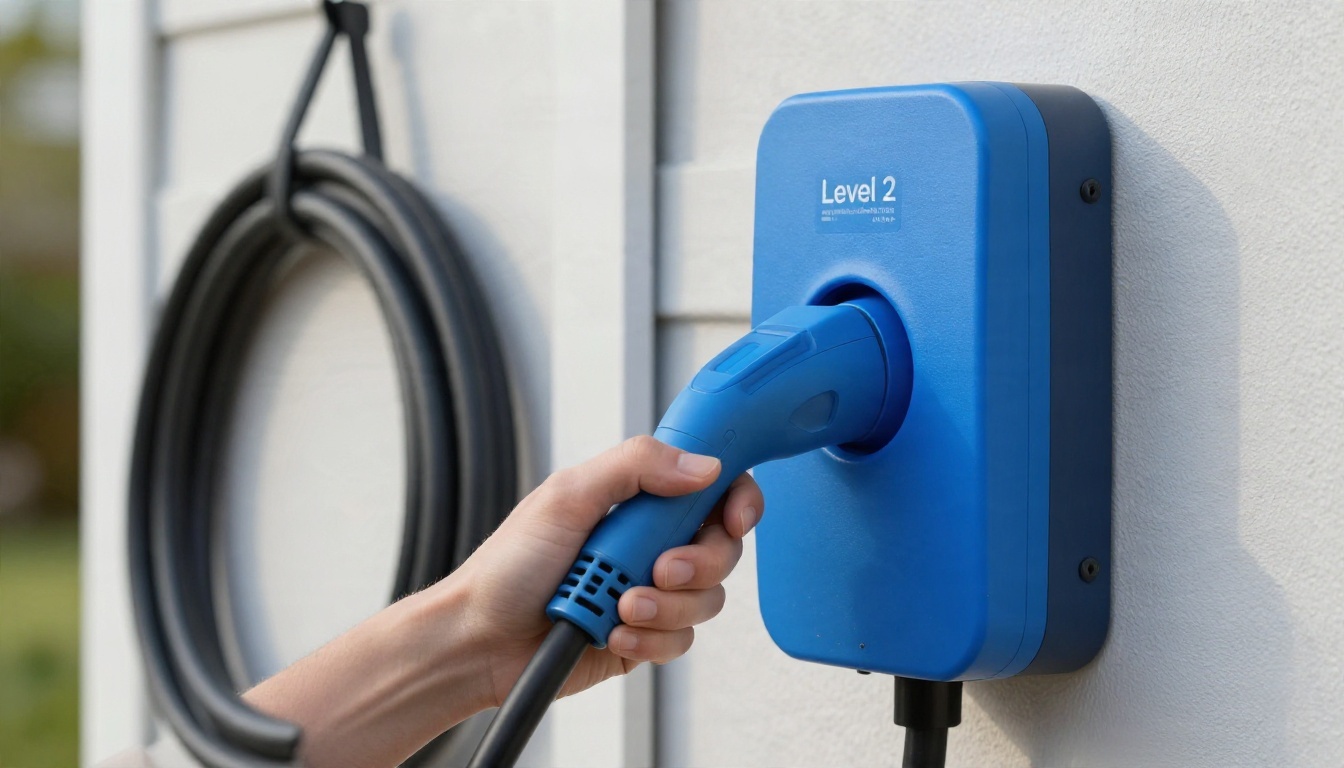
Level 1 charging from a standard 120V outlet typically adds a few miles per hour, about 3 to 5 in favorable conditions. Level 2 charging typically uses a 240V outlet or hardwired 240V equipment, with a conservative estimate of 10 to 20 miles per hour. Use equipment rated for the circuit and follow the manufacturer's installation instructions.
The DOE's home charging guidance distinguishes those two AC options. Available circuit power and the vehicle's onboard AC charger limit the actual speed.
Use our charging time calculator to compare replenishment time with your parking hours. Ten available hours is useful. A four-hour cheap-rate window is a different assignment.
Compatibility affects which public prices you can access, too. AC and DC adapters perform different jobs. An adapter intended for J1772 AC charging cannot replace a CCS1-to-NACS DC fast-charging adapter.
DC access also depends on supported vehicle hardware, software, and network eligibility. Tesla's other-EV Supercharging guidance explains its access arrangements.
The connector fitting physically is only one part of the answer. Price the network access available to the exact vehicle you're considering.
Include Installation and Compare Gasoline Fairly
Keep Setup Costs Separate
Home electricity savings don't erase the cost of getting charging installed. Equipment, circuit work, permits, cable routing, trenching, and possible panel or service changes belong in a separate upfront budget.
A qualified electrician should assess the installation. A scope-based quote is more useful than a national price range that hides the difficult work.
Damaged equipment, overheating, repeated breaker trips, and persistent faults require attention from a qualified electrician or the manufacturer. Don't bypass protective devices or treat repeated resets as a charging routine.
Compare Equal Annual Mileage
Here's a separate illustrative fuel comparison, using assumed prices rather than current local averages.
Driving 12,000 miles in a 30-mpg gas car consumes 400 gallons. At $3.60 per gallon, that's $1,440.
An EV rated at 30 kWh per 100 miles uses 3,600 kWh over that distance. At $0.183 per kilowatt-hour, electricity costs about $659. At an assumed $0.50 public-charging rate, it costs $1,800 before additional fees.
Our EV versus gas savings calculator lets you compare your own charging mix. Fuel savings alone don't establish total ownership savings; purchase price, insurance, maintenance, and installation remain separate.
Build Your Before-You-Buy Charging Checklist
Work through these steps in order. Each gives the next calculation something solid to stand on.
- For each shortlisted electric vehicle, record the exact model year and trim, EPA electricity consumption, usable battery capacity where published, and supported charging connections.
- Establish your charging routine, including monthly mileage, parking hours, home access, workplace charging, and likely public stops.
- Calculate energy costs using the applicable utility periods and public prices, with charging losses handled once.
- Add costs outside electricity, including installation, adapters, memberships, parking, and fees that apply to your routine.
- Compare the shortlisted vehicles over identical mileage, then separate temporary charging promotions from the ongoing budget.
Keep battery size and driving efficiency in separate columns. A larger battery can mean a more expensive empty-to-full charge without a higher cost per mile.
That's the comparison that helps you choose a car, rather than admire a cheap-looking refill number.
Sources and Calculation Basis
Primary references include EIA electricity prices, PG&E's EV2-A schedule, Tesla charging guidance, and DOE home-charging information. The DOE charging equipment handbook explains the AC/DC distinction.
CarMax and NeoCharge supply third-party cost examples. Rates and efficiency assumptions are identified above; calculated totals aren't guaranteed charging bills.
Frequently Asked Questions
How Much Does It Cost to Charge a 65-kWh Battery?
Adding 65 kWh at $0.183 per kilowatt-hour and an assumed 90% efficiency costs approximately $13.22. Without a loss allowance, the simple energy calculation is about $11.90.
A 20% to 80% session adds 39 kWh to an assumed 65-kWh usable battery. With those same rate and efficiency assumptions, it costs about $7.93. Partial sessions explain why actual receipts often look smaller than full-charge estimates.
Does the 80% Rule Apply to Every EV?
No universal 80% limit applies to every battery. Follow the vehicle-specific recommendation shown in the car and its manual.
Tesla's battery range guidance says vehicles with a recommended daily limit of 80% should generally use that limit, reserving 100% for when it's needed. Fast-charging power also commonly tapers at higher charge levels, so the final portion can take disproportionately long.
The charge window changes your session total. Your driving still determines how much energy you ultimately need.
Choose the Car Around Your Charging Reality
The most useful EV charging costs estimate combines your mileage, the vehicle's consumption, and the places you'll actually plug in. A national average gives context; your routine gives the budget.
Keep cost per mile at the center of the comparison. Then account for installation and public-charging fees separately.
A car that fits your charging routine is easier to budget for. That confidence is worth having before you sign.
Sources & further reading

Written by
LarryLeoLarryLeo started EV Charging while researching his own next car purchase. He digs into the pros, cons and real cost savings of going electric — using government, standards-body and manufacturer sources — and shares what he finds so other buyers can decide with confidence.
Why trust EV Charging Guide
Our guides are researched from government, standards-body and manufacturer sources, reviewed for accuracy, and updated when rules or products change. Brands cannot pay for placement. Read our editorial policy.