
Workplace vs. Public Charging Costs Without Home Charging
Compare public charging costs with workplace rates, factoring in fees, parking, memberships, and backup charging when work access is limited.
As an Amazon Associate, EV Charging may earn from qualifying purchases. This helps support our independent guides at no extra cost to you. Learn more.
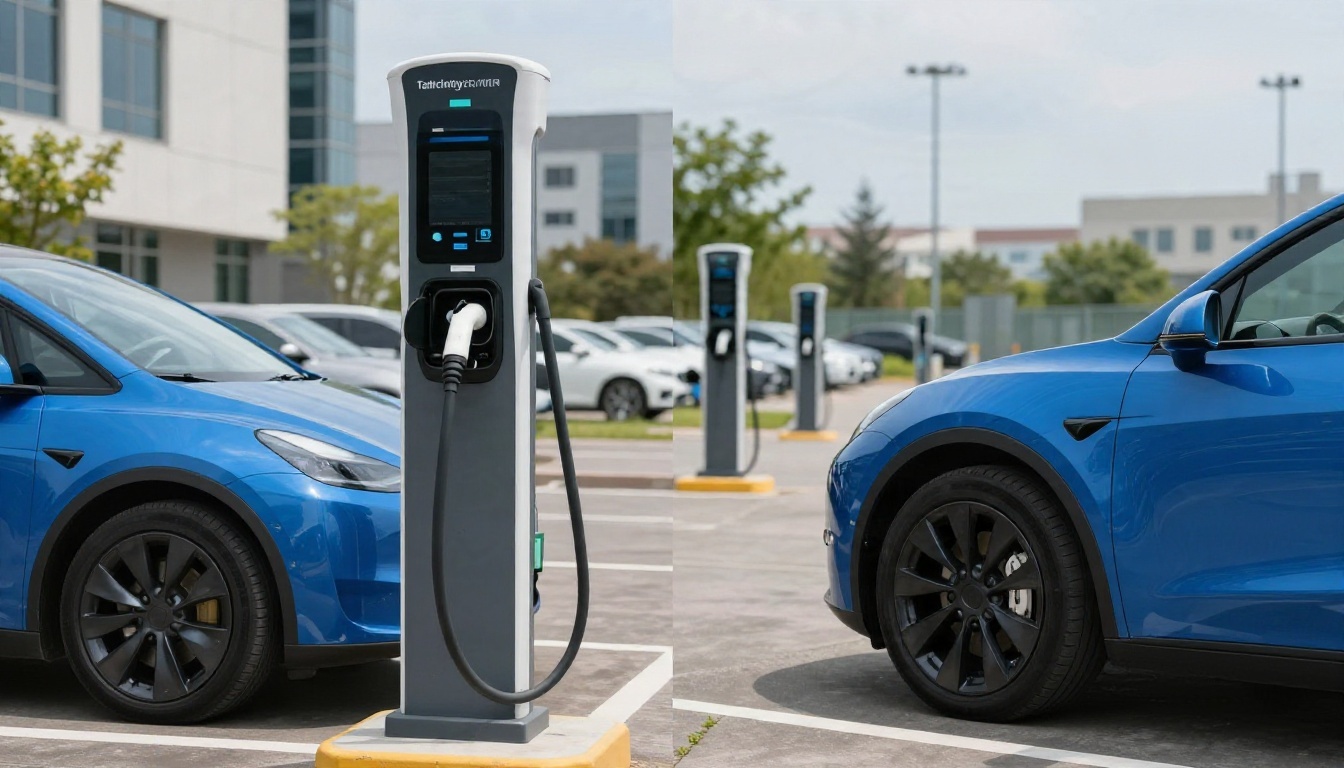
Compare workplace and public charging costs by calculating the total cost to charge per usable kWh, then applying it to the charging you'll actually use. Include parking, memberships, session fees, and the days you can't charge at work.
The free employee charging perk can make owning an electric car much cheaper for drivers without home charging. But a perk that disappears on weekends, holidays, or busy days needs a public-charging backup in your budget.
Start with your weekly energy needs, then put both options on the same footing.
This post may contain affiliate links. If you make a purchase through these links, I may earn a small commission at no extra cost to you.
Key Takeaways
- Compare the complete charging bill, including energy, parking, subscriptions, session charges, and idle fees.
- Budget for a realistic mix of workplace and public charging. A low employee rate only helps when a space is available.
- Use cost per mile to compare electricity with gasoline. Public fast charging doesn't automatically cost less than driving a gasoline car.
Start With the Energy You Need Each Week
Okay, so the first number isn't the charger's price. It's how much electricity you need to replace.
Turn Your Mileage Into Energy Use
Multiply your weekly miles by your vehicle's electricity consumption per 100 miles:
Weekly energy needed = weekly miles × electricity use per 100 miles ÷ 100
For a labeled planning example, assume 250 miles weekly and consumption of 30 units of electricity per 100 miles. That's 75 kWh each week.
Now you have something useful to compare. Can charging at work supply most of that energy during your actual shifts? How much will public stations need to cover?
Keep the vehicle assumption consistent across every option. Otherwise, you're comparing different driving needs along with different charging prices.
Keep Charging Losses Consistent
EPA electricity-consumption ratings include charging losses. Don't automatically add another percentage when using those ratings for your budget.
Dashboard efficiency may measure energy used by the vehicle rather than electricity purchased at the charger. Those numbers don't necessarily describe the same thing.
For an existing EV, charging receipts and mileage over several ordinary weeks provide a useful spending baseline. Include cold-weather driving and highway use when they are part of your routine.
Compare Workplace and Public Charging Costs
Workplace charging has no standard national price. An employer might provide free electricity, subsidize each unit of energy, charge by time, or pass through commercial pricing.
For a researched reference, Qmerit's charging-cost comparison reports public Level 2 prices around $0.25 to $0.40 per unit of energy and a DC fast-charging average of $0.53 per kWh. These are planning references, not guaranteed local prices.
Here's how the options differ.
| Charging Option | Price Basis | Main Cost Concern |
|---|---|---|
| Free employee-site charging | $0 for electricity | Access limits, parking, moving requirements |
| Paid employee-site charging | Employer or site policy | Time fees and shared power |
| Public Level 2 | Often energy or time billing | Parking costs during longer stays |
| Public DC fast charging | Location, plan, and sometimes time of day | Higher energy prices and extra fees |
Compare your employee price with the public stations that fit your route and local electricity rates.
A public price of $0.35 to $0.45 per unit of energy isn't a reliable nationwide ceiling. Likewise, $0.15 per unit of energy shouldn't be treated as a universal home-electricity benchmark.
Calculate the Full Session Bill
The headline energy rate is only the starting point. Here's where a cheap-looking session can become less exciting.
For Per-kWh Billing, Add Every Incremental Fee
Use this formula:
Session cost = delivered energy × energy price + applicable fees
Assume a session delivers 30 kWh at an illustrative rate of $0.50 per unit of energy. Electricity costs $15.
Add a $1 session fee and $3 of parking needed only for charging. Your total becomes $19, or about $0.63 per unit of energy.
Parking you would have paid anyway isn't an additional charging expense. Parking purchased only to reach the charger is. Keep that distinction consistent.
For Per-Minute Billing, Use Delivered Energy
Assume a charger bills an illustrative $0.30 per minute. A 40-minute session costs $12.
If it delivers 20 units of energy, the effective cost is $0.60 per unit. If it delivers 30, it's $0.40.
That's a huge difference for the same time charge.
Calculate:
Effective price per kWh = total session bill ÷ delivered energy
Use actual delivered energy, not the charger's advertised maximum kW. Cold batteries, shared power, vehicle limits, and charging taper can reduce average charging speed.
Idle fees are separate. They apply under the operator's rules when a vehicle remains connected beyond the permitted period.
Put Workplace Access Into the Comparison
A workplace charge point is useful because your car may already sit there for hours. That can make slow charging with Level 2 a good fit during a long work shift.
Record employee eligibility, charging hours, maximum stay, moving requirements, and shared-power limits. Confirm the EV charger's actual power and access rules. A four-hour limit matters if you can't leave your workstation.
For a labeled example, an average delivery rate of 6 kW over four hours supplies approximately 24 kWh. A station advertised at 7.2 kW doesn't promise that average throughout every session.
Level 2 generally uses 240V AC power. Familiar estimates of roughly 20 to 40 miles added per hour depend on the vehicle and charging power. A 120V Level 1 connection adds much less, often around four miles hourly.
Connector compatibility matters too. AC and DC adapters aren't interchangeable. A J1772 AC adapter doesn't provide access to a CCS DC charger. NACS connector shape alone doesn't establish Supercharger access either; vehicle eligibility and any required approved DC adapter matter.
Our guide to apartment and condo charging options covers the broader access questions. Here, give each usable workplace session a realistic energy allowance.
Make a Network Membership Earn Its Fee
A subscription can lower public charging costs, but only for charging you buy through that plan.
As listed in November 2026, EVgo's pricing plans include Pay As You Go, its no-subscription pay as you go option, with a $0.99 session fee. Plus costs $6.99 monthly with a stated 15% charging discount and no session fees. PlusMax costs $12.99 monthly with a stated 30% discount and no session fees.
The energy price still depends on the location and applicable pricing conditions.
For a transparent calculation, assume the eligible base energy rate is $0.60 per unit. A 15% discount saves $0.09 per unit.
Ignoring session-fee savings initially:
$6.99 ÷ $0.09 = about 78 kWh monthly to break even
Now include avoided session fees. Four otherwise applicable $0.99 fees equal $3.96, which lowers that threshold.
The decision depends on both energy and session count. Someone making several small stops can get a different result from someone buying the same amount of electricity in one visit.
Don't subscribe across several networks because each discount sounds good. Count the charging each plan will cover at each charging network.
Build a Monthly Budget With a Workplace Backup
Now put the pieces together. This is where the comparison becomes useful for an ordinary month.
The following calculations use illustrative assumptions, not current network quotes: 1,000 miles monthly, 30 kWh per 100 miles, workplace electricity at $0.20 per unit, and public electricity at $0.50 per unit.
That means 300 kWh monthly before any separate fees.
| Monthly Charging Mix | Workplace Energy (units) | Public Energy (units) | Energy Total |
|---|---|---|---|
| 240 workplace, 60 public | $48 | $30 | $78 |
| 120 workplace, 180 public | $24 | $90 | $114 |
| 0 workplace, 300 public | $0 | $150 | $150 |
In this example, reliable workplace access changes the energy budget by $72 monthly compared with public-only charging.
But the first row requires enough workplace access to obtain 240 units. Across 20 office days, that's an average of 12 units per day.
Use your actual schedule. Remote days, annual leave, occupied stalls, and workplace closures move energy into the public column.
Then add memberships and incremental fees. Keep detour miles in the driving total, and record waiting time separately.
Our guide to EV ownership without home charging addresses the broader buying decision. For this comparison, budget both your normal month and a month with no workplace access.
Treat Free and Off-Peak Charging as Conditional Savings
Free electricity at a charge point is a lovely perk. The complete visit can still cost money.
Supermarkets may offer charging with a qualifying purchase. Government buildings, state rest areas, hotels, and workplaces can also provide free charging. Access restrictions, parking charges, and time limits may apply.
The DOE's charging-station resources help identify public and private charging options. A map pin for a nearby charging station doesn't guarantee unrestricted access.

Off-peak public charging prices can help too. The important rate is the retail price offered to your charging account during that period.
A commercial site's cheaper overnight electricity doesn't automatically mean cheaper charging for drivers. The operator controls its retail pricing.
A free charger that requires a separate paid parking visit can cost more than a paid charger where you're already parked.
The cost of installing a home smart charger doesn't belong in this operating-cost comparison when you have no home charging access. Focus on charging you can use without a new installation.
Understand Why DC Fast Charging Costs More
DC fast charging provides higher power, but the operator pays for more than electricity alone.
Demand Charges Price Peak Power
A traditional commercial demand charge is based on peak demand, the highest measured power draw in kW during the billing period. Utilities commonly measure demand over an averaging interval.
Energy charges cover energy delivered over time. Demand charges cover peak power.
For a lightly used fast-charging site, a short high-power period can create a substantial bill spread across relatively few customer sessions. Equipment, maintenance, payment systems, and site costs add more.
A highway-service-area rapid charge is a high-power DC stop and often carries a convenience premium. Many vehicles can reach around 80% in roughly 20 to 40 minutes under suitable conditions, but starting charge, temperature, and vehicle capability change that timing.
California Utilities Use Different Rate Designs
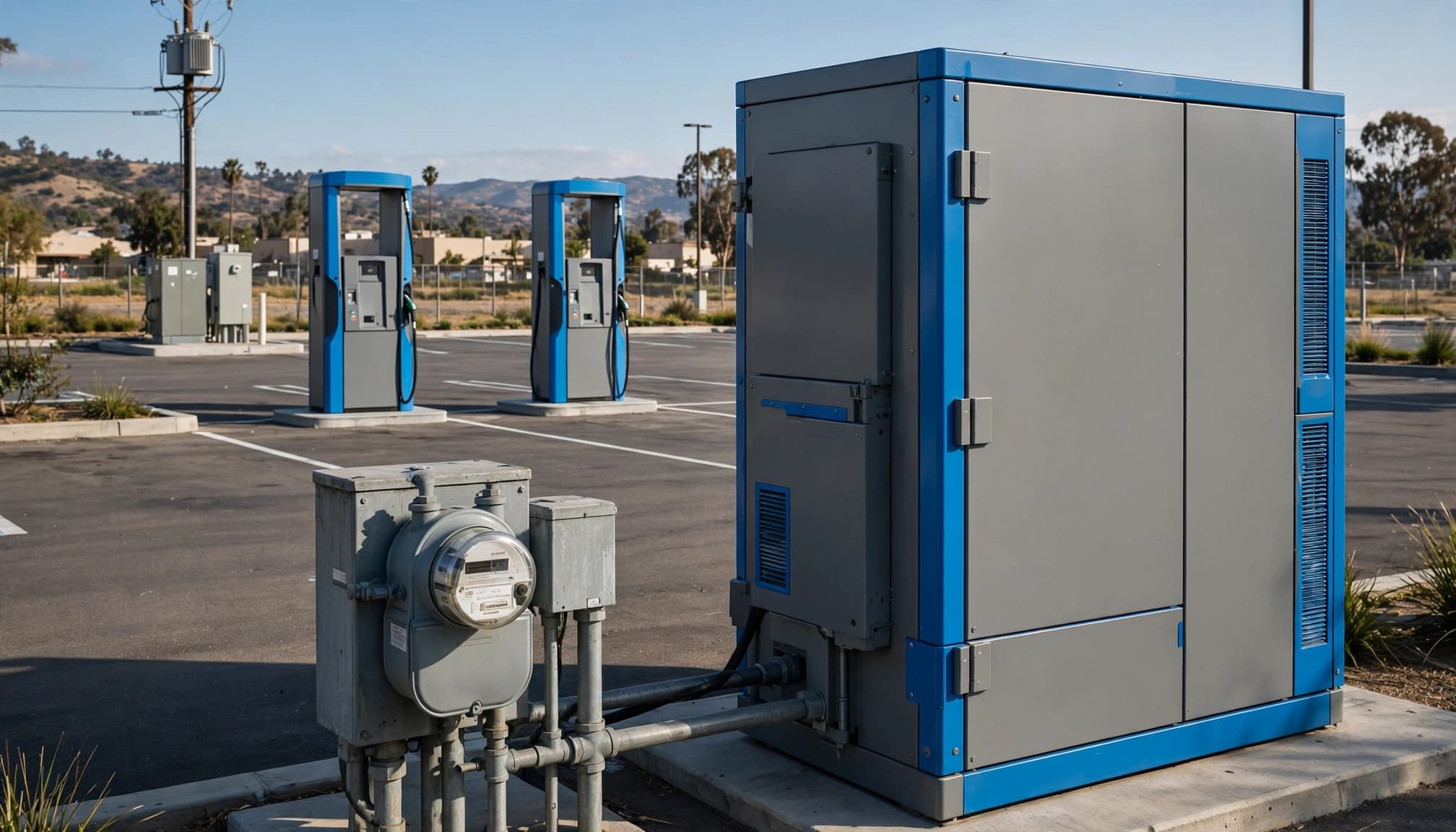
PG&E's business EV plans include BEV2 for installations at or above 100 kW. Its secondary-voltage subscription costs $95.56 monthly per 50 kW block, about $1.91 per kW. Overage is $3.82 per kW, approximately double.
SCE's August 2026 fact sheet says demand charges on TOU-EV-8 and TOU-EV-9 are not applicable until determined and authorized by the commission. Older summaries naming January 1, 2030 shouldn't be treated as a settled return date.
SDG&E uses an EV-HP subscription approach. Its published program description phases down the EV discount through December 31, 2031, with rates beginning to become comparable to AL-TOU on January 1, 2032.
These utility rates fall under an EV tariff, the utility's rate schedule for the charging-site operator. They don't necessarily set the driver's retail price.
Compare Your Charging Mix With Gasoline
Use cost per mile, rather than comparing a charging session with a tank of gas.
Assume gasoline costs $3.60 per gallon and the comparison car achieves 30 mpg. That's $0.12 per mile, or a cost per 100 miles of $12.
An electric car consuming 30 kWh per 100 miles costs $6 per 100 miles at an illustrative $0.20 per unit of energy. At $0.50 per unit, it costs $15.
Under those assumptions, the energy-only break-even electricity price is:
$12 ÷ 30 = $0.40 per kWh
Session fees and charging-related parking lower that break-even price. Free workplace charging moves the overall result in the other direction.
Our EV versus gas savings calculator helps compare fuel spending. Its defaults are examples, not local price quotes.
For a no-home-charging budget, keep home charging at zero. Calculate the at-work/public mix separately rather than treating workplace electricity as residential charging.
Sources and Pricing Scope
These are researched comparisons and labeled calculations, not hands-on charging tests.
Electrify America's pricing policy explains location-, plan-, and energy-dependent billing. Commercial-rate references include SCE's August 2026 fact sheet and SDG&E's EV-HP program fact sheet.
Utility subscriptions and illustrative calculations aren't public-network retail quotes.
Charging prices, fees and eligibility can change. Check the station operator’s current terms or the utility’s published rate schedule before using these examples to estimate your own costs.
Frequently Asked Questions
Is Workplace Charging Always Cheaper?
No. Free or subsidized workplace electricity can be excellent value, but hourly billing, parking charges, and moving requirements can change the result.
Divide the complete incremental bill by the energy delivered. Then compare that figure with the public option you can realistically use.
Should I Charge to 100% at a Fast Charger?
Use the charge needed for your next driving period, consistent with the vehicle manufacturer's guidance. DC charging commonly slows at higher battery percentages.
With time-based billing, slower charging can raise the effective price. With energy billing, extra time still matters for queues and possible idle fees.
Can Workplace Charging Be My Only Charging Plan?
It can cover most energy needs when access matches your driving and work schedule. Still, include a public backup in the budget.
Days off, equipment outages, occupied stalls, or a job change can interrupt workplace access. Price that alternative before treating the employee rate as your year-round cost.
Choose the Routine You Can Repeat
The useful number is your blended monthly charging cost, with realistic workplace access and public backup included.
Start with the energy you need. Apply each station's complete billing terms, then compare the result per mile.
A workplace perk can make a huge difference. Your budget is stronger when it also works on the days that perk isn't available.
Sources & further reading

Written by
LarryLeoLarryLeo started EV Charging while researching his own next car purchase. He digs into the pros, cons and real cost savings of going electric — using government, standards-body and manufacturer sources — and shares what he finds so other buyers can decide with confidence.
Why trust EV Charging Guide
Our guides are researched from government, standards-body and manufacturer sources, reviewed for accuracy, and updated when rules or products change. Brands cannot pay for placement. Read our editorial policy.
Related Posts
How to Charge an EV if You Live in an Apartment or Condo
EV Road Trip Planning: How to Find Fast Chargers and Avoid Range Anxiety