Vehicle-to-Home vs Vehicle-to-Grid: What Each Can Do
Learn how vehicle-to-grid differs from home backup, what equipment and utility approval you need, and when exporting EV power may earn compensation.
As an Amazon Associate, EV Charging may earn from qualifying purchases. This helps support our independent guides at no extra cost to you. Learn more.
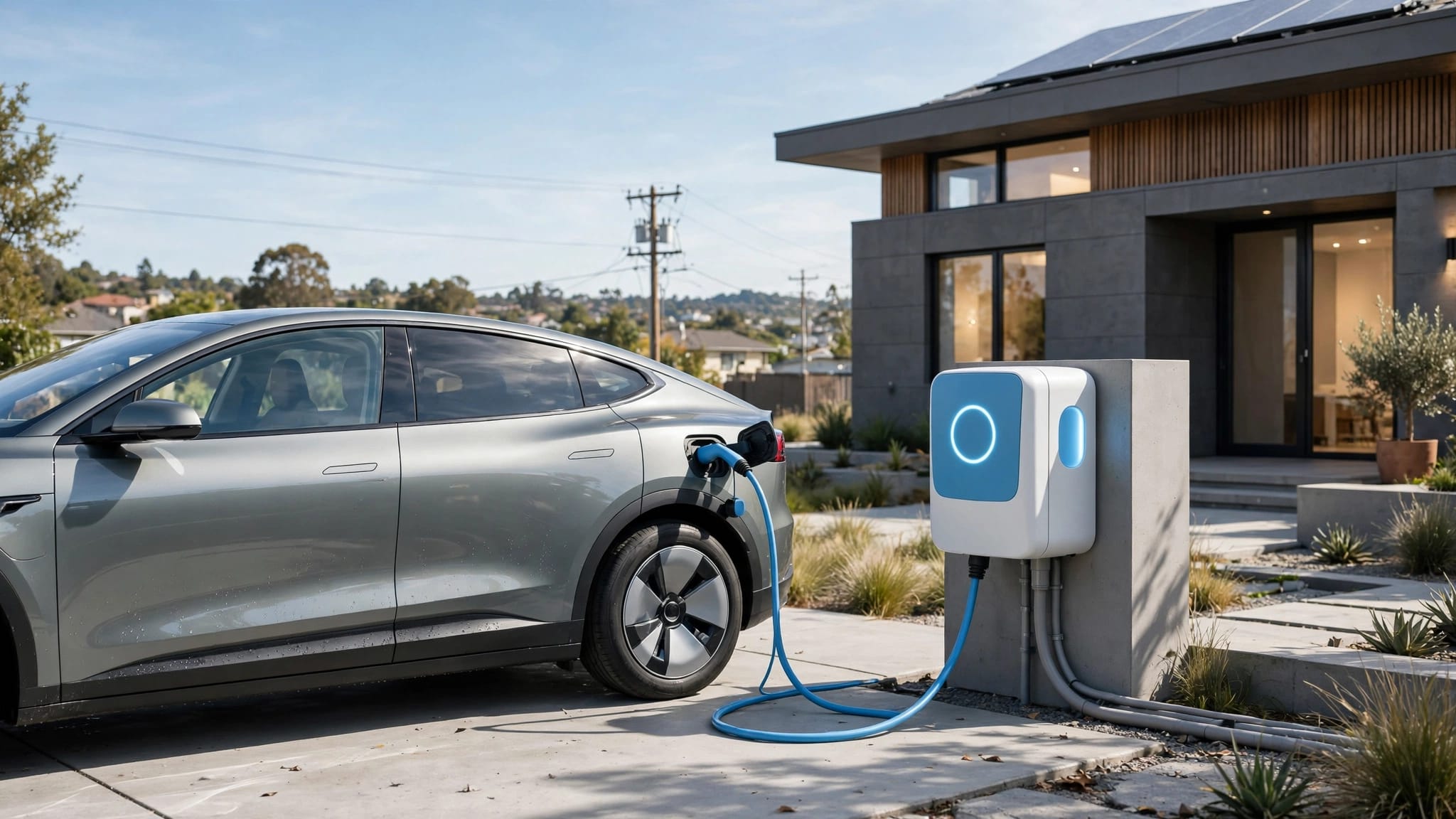
Vehicle-to-home powers your house with energy stored in your EV, while vehicle-to-grid sends that energy into the electricity network. A properly designed system can do both, but home backup and grid export are separate capabilities, with different equipment, controls, and approvals.
That distinction matters when you're buying a charger or counting on your car during a blackout. A big battery is promising, sure, but it doesn't tell you where the electricity can go.
Start with the job you need the system to do, then follow the equipment chain.
This post may contain affiliate links. If you make a purchase through these links, I may earn a small commission at no extra cost to you.
Key Takeaways
- Vehicle-to-home, or V2H, can support household circuits during an outage when compatible equipment safely separates the house from the utility. Runtime depends on available battery energy, household demand, and the driving reserve you keep.
- Vehicle-to-grid, or V2G, can supply electricity to the utility network during peak demand or provide other grid services. Earning money requires an eligible program and an approved installation; owning a power-export-capable EV doesn't create a payment agreement.
- Both arrangements need a supported combination of vehicle, power-conversion equipment, controls, and electrical installation. A standard home charger, a matching connector, or an adapter doesn't provide two-way power capability.
For a homeowner, the useful buying question is simple: which documented functions come with the complete installed system? Backup, everyday bill management, and paid grid export deserve separate answers.
Vehicle-to-Home vs Vehicle-to-Grid at a Glance
V2H and V2G share a basic idea: your parked EV can supply stored electricity as well as receive it. The destination and operating conditions separate them.
Here's how the two arrangements compare.
| Capability | Vehicle-to-Home | Vehicle-to-Grid |
|---|---|---|
| Main destination | Household circuits | Utility electricity network |
| Typical purpose | Outage backup or reducing household imports | Supporting the grid or earning program compensation |
| Blackout operation | Possible with supported islanding equipment | Requires separate backup capability |
| Utility export agreement | Depends on the operating design | Required for authorized grid export |
| Payment for electricity | Usually savings rather than export revenue | Possible under an eligible tariff or program |
| Main constraint | Supported loads and available battery energy | Interconnection, program rules, and vehicle availability |
The important detail is in that blackout row. Grid-export capability alone doesn't guarantee backup power. Equipment operating in parallel with the utility normally stops energizing the connection when the grid fails.
A backup-capable installation needs a controlled way to disconnect the home and establish its own electrical supply. Without that, sending electricity toward damaged utility wiring would endanger workers and neighbors.
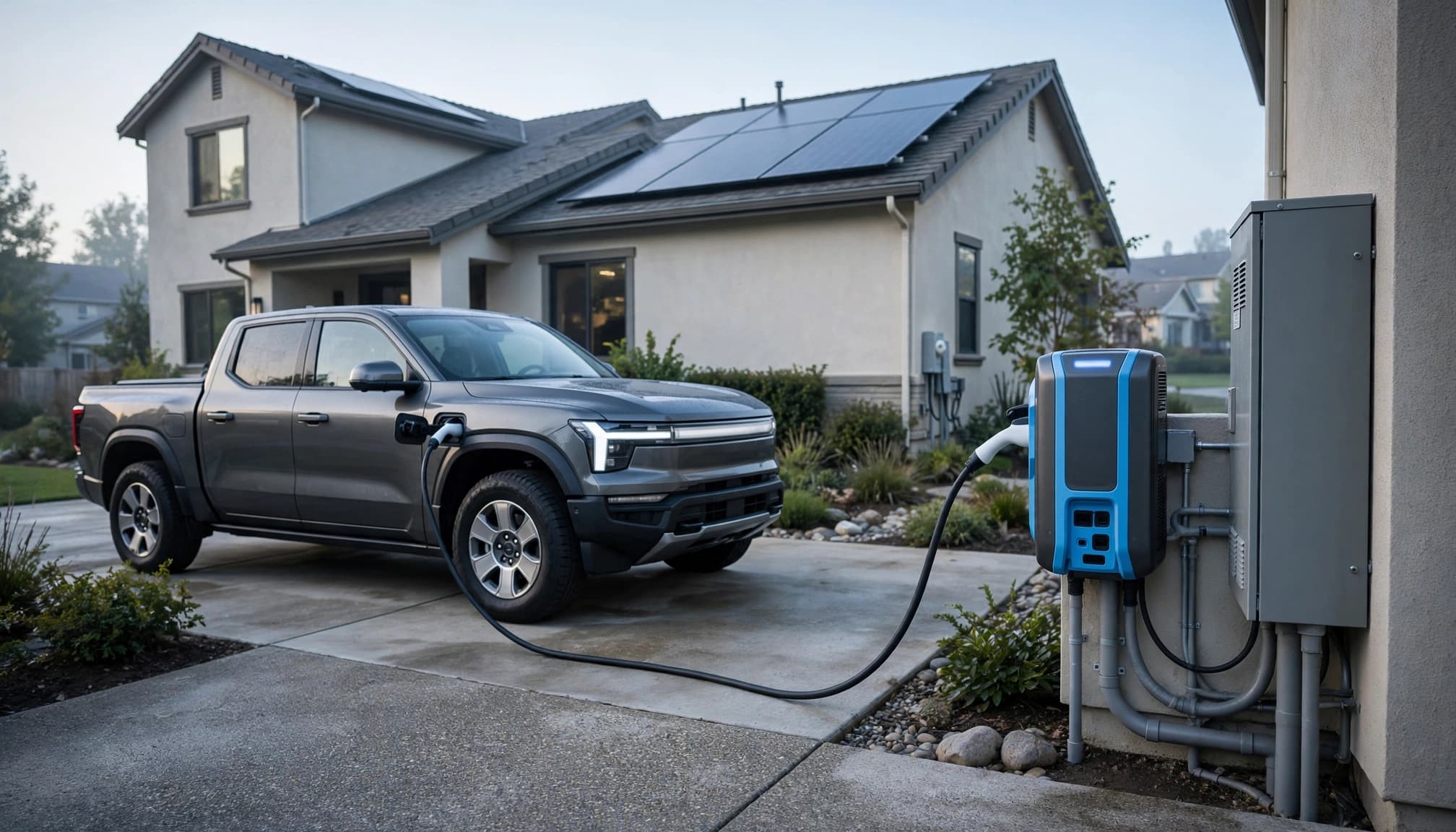
The energy grid is the interconnected system of generators, substations, transmission lines, distribution equipment, and customers. Your home connects to its local distribution network through the service connection and meter.
V2H can keep energy behind that meter. V2G intentionally sends energy across the connection, subject to approved controls.
The Department of Energy's vehicle-grid integration assessment distinguishes vehicles supplying homes, buildings, and the grid. That separation matters because manufacturers sometimes use the broader phrase "two-way power" without promising every operating mode.
A product might support emergency home backup but lack permission for routine export. Another might support a grid-service pilot while offering no islanded household supply. Buy the function the documentation describes, rather than filling in the gaps yourself.
How Bidirectional Charging Moves Electricity
Ordinary power flow moves electricity one way: the supply replenishes the car. Two-way power adds a controlled power-out path and communication that coordinates when electricity moves and how much.
The Inverter Handles the Electrical Conversion
EV traction batteries store direct current, or DC. Homes and the utility distribution network generally use alternating current, or AC.
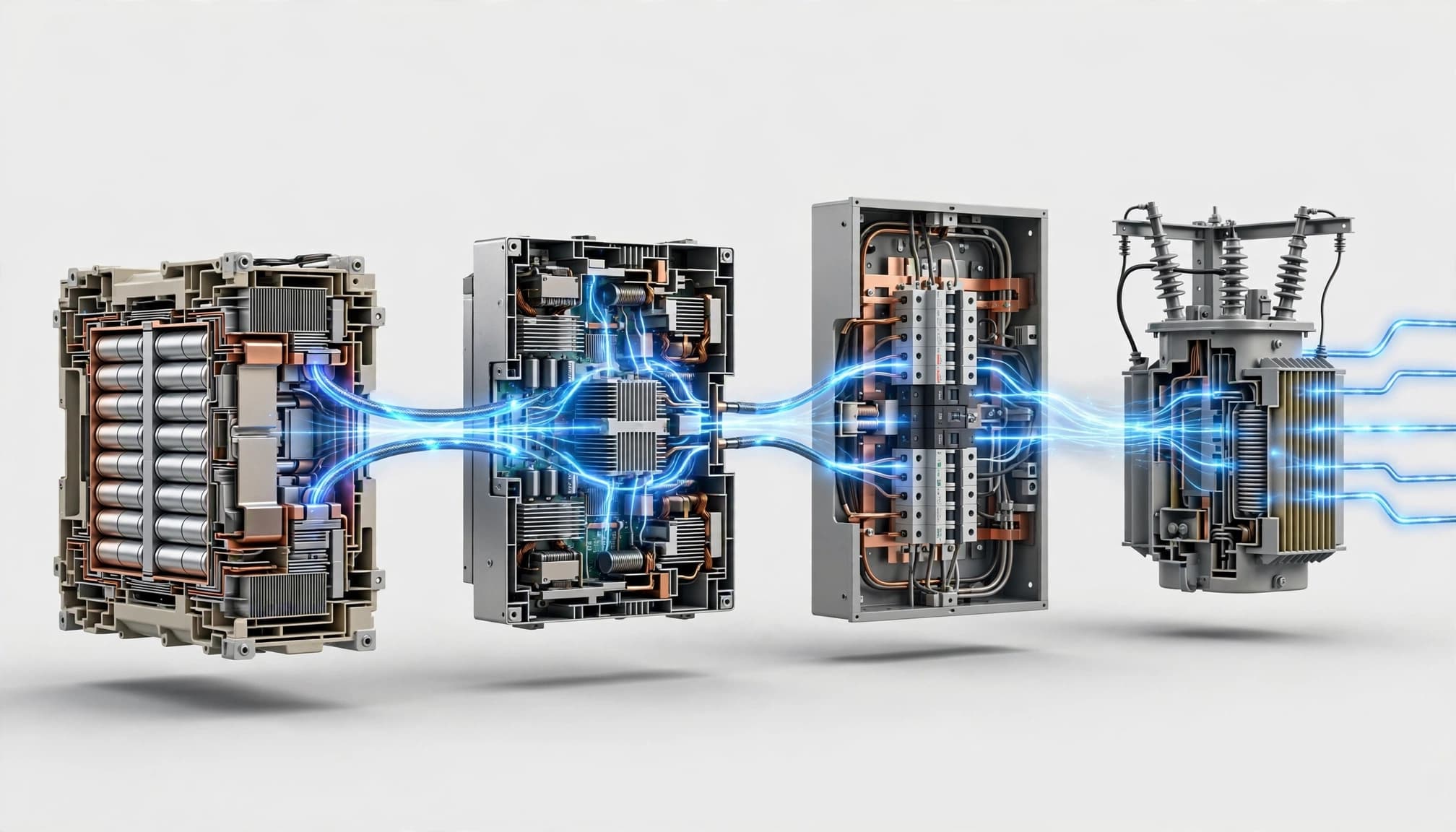
An inverter converts battery DC into AC. During grid-connected operation, its output must match the grid's voltage and frequency within required limits. Protective functions monitor conditions and stop export when operation would be unsafe.
The inverter's location varies. Some designs perform two-way conversion inside the vehicle. Others use external DC equipment, with the inverter outside the car.
This difference affects equipment selection, certification, installation, and compatibility. An ordinary AC wall unit can't gain outward-power capability through an app; a bidirectional charger must support it.
Communication Coordinates the Whole Arrangement
The vehicle and power equipment must agree on operating limits. These include battery state of charge, permitted power-out levels, connection status, and when energy transfer must stop.
ISO 15118-20:2022 defines communication requirements that include two-way power transfer. It provides part of the conversation between the vehicle and power equipment.
A standard's publication doesn't mean every vehicle or unit supports it. Both ends need compatible implementations, and the complete installation still needs appropriate electrical protection.
Other communication happens beyond the cable. A home energy controller may monitor household demand, while an aggregator coordinates enrolled vehicles for a utility.
An aggregator is the service operator that combines smaller resources into a larger controllable group. Its software might request stored energy export during a peak-demand event, while vehicle controls preserve a minimum battery level.
V2G technology combines separate functions: conversion moves electricity, communication coordinates the equipment, and protection determines when operation is allowed.
Where V2L, V2B, and Smart Charging Fit
The alphabet soup gets crowded. Each term becomes more useful when you connect it to a practical destination.
V2X Includes Appliances, Homes, Buildings, and the Grid
Vehicle-to-everything, or V2X, is the umbrella term.
Vehicle-to-load, or V2L, supplies individual electrical loads through manufacturer-supported outlets or accessories. That might mean a refrigerator, suitable tools, or camping equipment, within the vehicle's ratings.
Vehicle-to-building, or V2B, applies the same general idea to a building, often a workplace or commercial property. V2H is the household version.
V2G supplies the electricity network. The same vehicle battery can potentially support several destinations, but each function needs the corresponding hardware and controls.
An appliance outlet never grants permission to energize household wiring. Connecting portable output to fixed circuits requires an approved transfer arrangement and professional installation.
Smart Charging Can Help Without Exporting Anything
Managed power intake, sometimes called V1G, changes when or how quickly an EV takes in electricity. Power still flows into the battery.
A controller can use smart energy management to coordinate when the vehicle takes in power. This can reduce peak demand, avoid expensive hours, or follow solar production. It usually requires less equipment than power-export operation.
The Department of Energy's smart charge management guidance covers coordinated vehicle replenishment alongside more advanced vehicle-grid functions.
For some households, scheduled energy use already captures much of the available financial benefit. If the goal is avoiding an expensive evening period, moving vehicle replenishment overnight may solve it without exporting energy from the battery.
Which Vehicles and Chargers Support These Functions?
Compatibility for electric cars depends on the complete system. The vehicle's model year, battery configuration, software, charging equipment, and intended operating mode all matter.
These examples show why a simple list of cars labeled "V2G compatible" can mislead. The label alone doesn't prove a supported installation or local grid-export eligibility.
| Vehicle or Configuration | Required Equipment or Interface | Documented Use and Limitation |
|---|---|---|
| 2022-2025 Ford F-150 Lightning | Ford Charge Station Pro and Home Integration System | Automatic home backup; this doesn't establish paid utility export |
| Compatible Chevrolet EV, including supported Silverado EV configurations | GM Energy PowerShift Charger and separately sold V2H Enablement Kit | Home backup with a properly equipped installation; some circuits may remain unsupported |
| CHAdeMO-equipped Nissan LEAF | Compatible two-way-power CHAdeMO equipment and supported controls | Established two-way power applications, but a connector alone doesn't establish local grid-export eligibility |
Ford's Home Backup Power documentation identifies 2022-2025 Lightning models and describes output up to 9.6 kW. Ford also warns that the arrangement may not completely supply a higher-demand home.
That's a V2H specification. Calling it unrestricted V2G would promise something the backup documentation doesn't establish.
Chevrolet's PowerShift documentation similarly treats home backup as a complete installation. The separately sold V2H Enablement Kit, compatible vehicle, home equipment, and professional installation belong in the same purchase decision.
The LEAF needs another distinction. Earlier CHAdeMO-equipped versions are well-known two-way-power examples, but the model name alone doesn't establish capability across every generation. Protocol support also doesn't establish an available retail service in your utility territory.
Our EV charging compatibility guide explains the broader connector issue. Two-way power adds another layer beyond standard power-transfer compatibility.
A compatible plug is the beginning of the discussion. The useful finish is a documented vehicle-and-equipment combination with a defined operating mode.
Also separate demonstrated capability from equipment availability. Ford's November 2026 support information says the Charge Station Pro is no longer available for sale. Existing installations and a straightforward new installation are different buying situations.
What Your Home Electrical System Must Support
A home installation has to work in both directions, under the conditions permitted by its design. That involves more than finding an empty breaker position.
Service Capacity and Export Capacity Are Different
Your electrical service must accommodate household demand and the vehicle's power draw within its approved limits. An electrician evaluates the service, panel, feeders, equipment condition, and proposed vehicle load.
Discharging introduces additional considerations. Panel bus ratings, conductor ratings, connection locations, protective devices, and controlled export limits affect how the source can connect.
A "200-amp panel" label doesn't answer all those questions. Nor does a 100-amp service automatically rule out every arrangement.
Our guide to EV charger panel upgrades separates service capacity, panel condition, breaker space, and feeder constraints.
Load management can reduce the vehicle's power draw as other household loads rise. That helps when supplying energy to the vehicle, but an ordinary load-management feature doesn't automatically control power export. The selected equipment needs documentation for the proposed task.
Backup Requires an Isolation and Supported-Load Plan
During an outage, the system must separate the backed-up circuits from the utility connection. Depending on the product, that can involve a transfer device, gateway, controller, dedicated integration equipment, or a combination.
The installation also needs a supported-load plan. Which circuits remain active? Can the equipment start the well pump? Does it shed the water heater when the heating system runs?
Those answers determine whether backup feels useful or frustrating.
NREL's V2G and V2H status review treats grid-connected and home-isolated operating states separately. The distinction is physical and electrical, not simply a setting labeled "backup."
Cable reach deserves attention too. The vehicle must park close enough for the approved connection without blocking a walkway or straining the inlet.
Measure the actual route, including slack and your less convenient parking orientation. A charger mounted in the wrong place can turn an expensive backup system into an awkward daily negotiation.
Can an EV Power Your Home for Hours or Days?
Both answers can be correct. A vehicle supporting a few essential circuits may run for days, while the same battery supplying heavy household demand lasts far less time.
Calculate Available Energy Before Discussing Runtime
Battery capacity is measured in kilowatt-hours, or kWh. Power demand is measured in kilowatts, or kW.
The basic relationship is:
Runtime in hours = usable energy delivered to the home ÷ average household load.
Available energy depends on starting charge, the minimum reserve, operating limits, and conversion losses. You don't necessarily have the battery's entire usable capacity available for the house.
For a calculation using a 131-kWh extended-range Lightning battery, an 80% starting charge and 30% stopping point release 65.5 kWh before losses. Allowing 10% for conversion and associated losses leaves about 59 kWh.
Those charge limits and losses are sizing assumptions, not Ford guarantees.
At an average 1 kW load, 59 kWh corresponds to about 59 hours. At 3 kW, it corresponds to about 20 hours. At 6 kW, it's roughly 10 hours.
That is how "hours" and "days" can describe the same battery without contradiction.

Output Power Limits What Can Run Together
Energy capacity determines duration. Output power determines the loads the system can supply at once.
A battery can have plenty of energy left while the inverter reaches its power limit. Motor starting requirements can also exceed an appliance's normal running demand.
Refrigeration, lights, internet equipment, and selected outlets create a different backup assignment than electric resistance heating, cooking, and replenishing an EV at once.
"Whole-home connection" doesn't mean every household appliance can run simultaneously.
Greener Ideal's older suggestion that an EV battery could power about 10 homes isn't a usable sizing claim without household demand and duration. Ten homes for a short period and one home for several days describe different requirements.
A plug-in hybrid generally has a smaller traction battery, so it usually offers less stored energy for external loads. Outward-power support still depends on the exact vehicle.
Our guide to EV charging during an outage also separates powering the house from replenishing the vehicle.
What a Bidirectional Installation Actually Costs
There isn't a defensible universal installed price. Vehicle-specific hardware, backup equipment, electrical work, and utility requirements make these projects different enough that a single charger price hides too much.
Price the Complete Electrical Arrangement
A complete proposal should identify the power-transfer unit, inverter where separate, home-integration equipment, metering, controls, installation labor, permits, and commissioning.
Panel replacement, service work, trenching, or a long cable route can add substantial scope. A project using suitable existing infrastructure differs from one rebuilding the service connection.
Chevrolet's PowerShift arrangement illustrates the problem with comparing wall-unit prices alone. The V2H Enablement Kit is a separate required component for the documented backup function.
Ford provides one concrete additional charge: its support information lists a one-time $500 backup activation for standard-range Lightning owners. That charge is not the installed system price.
Equipment availability affects the budget as well. Ford's Home Power Management FAQ says the required Charge Station Pro is no longer sold and describes Home Power Management as an Early Access Program feature.
A previously advertised equipment price doesn't establish the cost or availability of a new installation in November 2026.
Separate Backup Value From Financial Payback
Backup has value even when it doesn't earn a dollar from the utility. Keeping refrigeration, communications, or selected household equipment running may be the main reason for the purchase.
Bill savings deserve their own calculation. So do export payments.
Include any subscription, aggregator fee, maintenance requirement, conversion losses, and electrical upgrades attributable to the project. A rebate can reduce the upfront amount, but only within its actual eligibility rules.
Our charger installation rebate guide explains how utility and state assistance fit into installation planning.
For a fair comparison, put V2H beside a stationary home battery or other supported backup option serving the same loads. Comparing a complete backup installation with an ordinary charger produces an impressive price gap and very little useful information.
Will Your Utility Pay You for V2G?
It may, through an eligible program. There is no universal residential grid-export payment rate, and an ordinary electricity account doesn't automatically give you permission to sell vehicle energy. Check utility programs for enrollment rules and eligibility.
Understand What the Payment Buys
Some arrangements compensate exported kilowatt-hours. Others pay for availability, event participation, or a defined amount of controllable power.
An aggregator may combine enrolled vehicles into a virtual power plant. That group can respond to utility requests or participate in markets where the rules allow it, helping meet smart grid needs.
Payment terms matter. A headline annual incentive may require the car to be plugged in during certain hours, compatible equipment, or repeated events when you send stored energy to the home.
A vehicle-replenishment reward can look similar while involving no export at all. In that arrangement, the utility benefits because power intake pauses or moves to another period.
NREL's analysis of V2G economic considerations treats value as dependent on the service, equipment costs, and operating assumptions. Owning stored energy is only one part of the business case.
Calculate Net Value, Including the Energy You Replace
Gross revenue is the amount received before associated costs. Net value also accounts for replacement electricity, losses, fees, and any relevant battery-throughput cost.
Time-of-use prices can make household discharge attractive when electricity is expensive. But the spread between low-cost vehicle replenishment and expensive avoided imports must cover losses and affect your electricity bills.
Export compensation may differ from the price you pay to import electricity. A solar export credit also doesn't automatically apply to energy sent from a vehicle.
Participation can affect convenience. A program may need the car plugged in during the same evening hours you want to use it.
The useful comparison is the actual compensation structure against your driving and parking routine. Guaranteed availability payments, uncertain event revenue, and avoided household purchases belong on separate lines.
And keep a minimum mobility reserve. A payment that leaves you buying expensive public rapid-replenishment afterward can lose its appeal rather quickly.
How Bidirectional Use Affects Battery Wear
Additional discharge adds battery throughput. That deserves an honest place in the decision, without treating every exported kilowatt-hour as a crisis.
Battery Aging Depends on Operating Conditions
Lithium-ion batteries age through time and use. Temperature, time spent at high charge, depth of energy use, charge rates, and cumulative throughput all affect the result.
A shallow export of energy within a controlled operating window creates a different duty cycle than repeated deep battery cycling followed by a high-power recharge.
Battery chemistry and thermal management matter too. That makes a universal statement such as "V2G won't affect battery life" too broad.
The opposite claim, that any bidirectional use will quickly ruin the pack, is equally unhelpful.
Occasional outage backup and daily grid-service operation are different patterns. A household that sends energy from the pack only during rare blackouts adds less throughput than a vehicle responding throughout the year.
A credible program describes its operating window, export limits, and owner controls. Those details reveal much more than the word "battery-friendly."
Warranty Coverage and Owner Controls Belong Together
Warranty terms are vehicle- and application-specific. A normal battery warranty should never be treated as automatic approval for every external power arrangement.
Manufacturer-supported equipment and permitted operating modes matter because they define the intended use.
Useful controls include minimum state of charge, departure targets, participation schedules, and the ability to opt out of events. A driver needs enough authority to keep the car useful as transportation.
There is also a practical aging effect: as usable battery capacity declines, the same charge-percentage window contains less energy. Backup estimates should reflect the battery's available condition rather than assuming its original capacity forever.
For ownership budgeting, keep projected payments separate from guaranteed warranty coverage. Revenue estimates can change with participation and tariffs; warranty obligations come from the written terms for the vehicle and supported application.
That keeps the decision grounded. You can value the grid service without pretending the battery has unlimited cycles.
Pairing V2H or V2G With Rooftop Solar
Solar and two-way power can work well together. The key is deciding when to use generation directly, when to store it, and whether the car is home.
Daytime Charging Can Supply Evening Household Loads
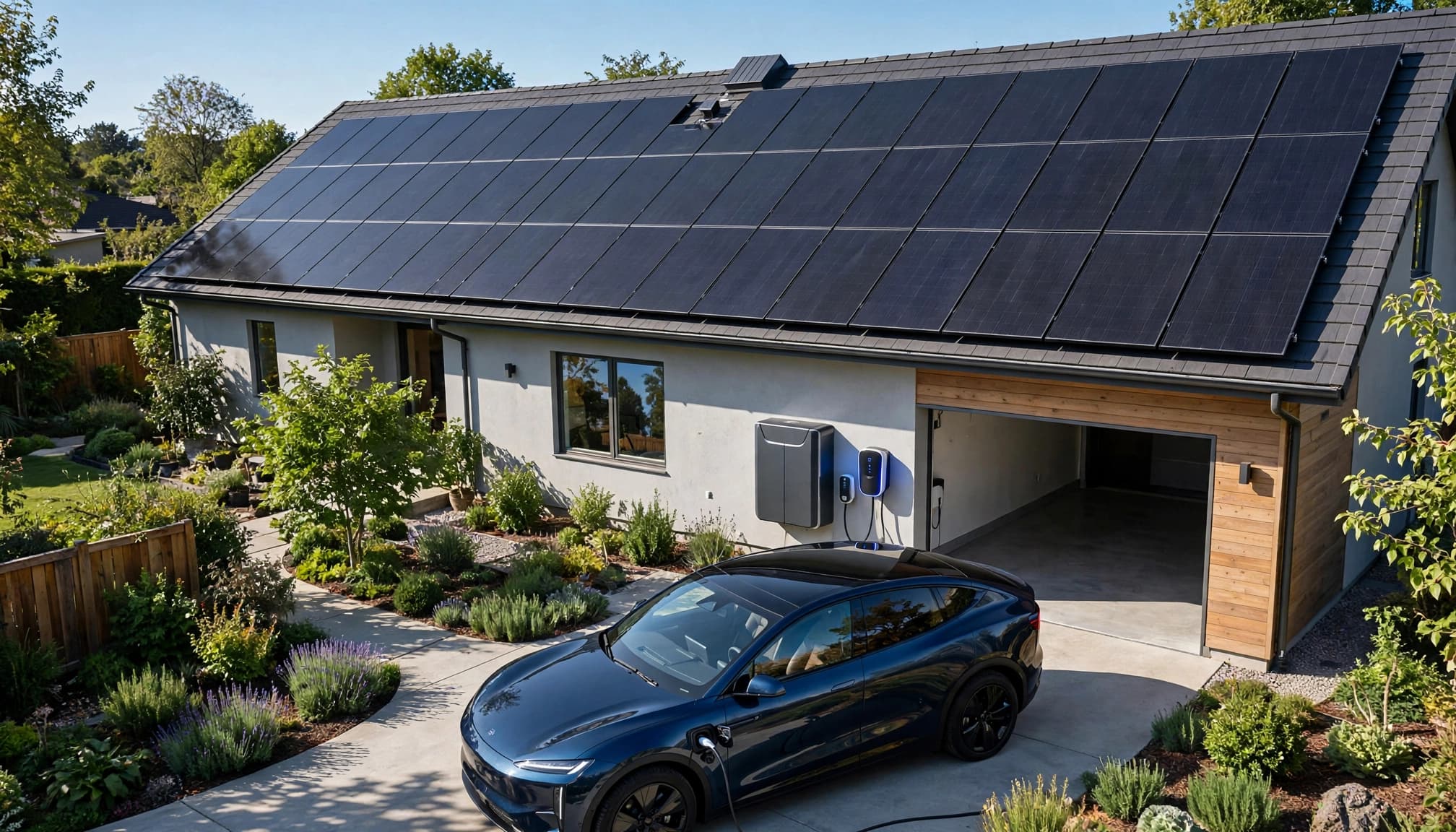
During sunny hours, rooftop generation can supply household demand and support vehicle replenishment with renewable energy. Later, a supported bidirectional system can send stored energy to the home or grid.
That can reduce evening imports and increase use of your own generation. Stored energy can also help during cloudy periods, within the battery's available capacity.
Direct solar use avoids a storage round trip, so it deserves priority where practical. Every conversion and storage stage introduces losses.
Parking patterns can limit energy capture. If the car spends working hours away from the roof generating electricity, the system has less opportunity to capture that production.
Our guide to solar panels for EV charging explains how driving energy and solar production fit together.
Outage Solar Needs Supported Islanded Operation
Ordinary grid-connected solar usually stops supplying power when the utility fails. Panels alone don't establish a safe backup supply.
Continuing operation needs equipment that can manage an isolated electrical system. The solar inverter, vehicle inverter, controller, and protective devices must support the intended combination.
A system that can send EV power to a home during an outage might not recharge the vehicle from solar in islanded mode. The design needs to document that capability.
The environmental benefit depends on timing. Using renewable energy during cleaner generation periods can help, while unnecessary battery cycling adds losses.
The Department of Energy's grid-impact assessment discusses coordinated vehicles and distributed resources as part of grid planning.
The broader emissions case is substantial: the 2023 federal transportation blueprint identified transportation as the largest U.S. source of greenhouse gas emissions, responsible for about one-third of total emissions. Vehicle-to-home and vehicle-to-grid power can support cleaner energy use, but the benefit depends on how the system operates.
Utility Approval, Standards, and Control Rights
An export-capable installation connects a generating resource to the distribution system. Utilities need defined behavior during normal operation, faults, and outages.
Interconnection Covers More Than the Charger
An interconnection agreement defines how equipment may connect and operate in parallel with the utility.
Requirements can address equipment certification, protection settings, metering, export limits, disconnects, and commissioning. State rules and utility procedures influence the process.
IEEE 1547 addresses interconnection and interoperability requirements for distributed energy resources. UL 1741 covers relevant inverter and power-conversion equipment requirements. SAE J3072 addresses onboard grid-support inverter interconnection.
NREL's AC V2G standards overview identifies these standards alongside communication requirements such as ISO 15118-20.
They cover different layers of the system. Compliance with a communication standard doesn't replace inverter certification or utility permission.
An export-limited or non-export design may follow a different approval path from unrestricted export. It still needs controls suitable for its permitted operation.
For safety, a licensed electrician and the applicable permitting process belong in the project. Sending power into fixed wiring is serious electrical work.
Software Permissions Affect Everyday Ownership
The control agreement determines who can request discharge, within what limits, and with what owner override.
It also determines how the system handles missed communications, equipment faults, or an unexpected departure.
Backup behavior deserves separate attention. Some grid-service functions depend on remote coordination, while emergency household operation may need to work through a local controller.
Internet loss, cellular loss, utility outage, and manufacturer-server failure are different events. A system's response to one doesn't establish its response to the others.
Our EV load-management guide makes the same practical distinction for ordinary managed power intake: supported communications and failure behavior belong in the equipment design.
For bidirectional operation, those details influence both electrical operation and how much control you retain over the car.
What V2G Pilots and Market Forecasts Tell Us
The fleet-scale potential is real, but older forecasts and demonstration projects need dates attached. Otherwise, a 2022 snapshot starts masquerading as a 2026 buying guide.
Parked Vehicles Offer Storage, With Conditions
Vehicles spend much of their time parked. NREL's vehicle-grid integration presentation reports electric vehicles are parked 94.1% of weekdays and 95.4% of weekends, supporting the familiar "about 95%" shorthand.
Parked doesn't mean connected, available, or authorized to export. Workplace access, vehicle connection, departure needs, and owner participation reduce the usable share.
ENGIE's August 2022 explainer, citing Columbia University, described the potential for aggregated EVs to provide distributed energy storage, with aggregate power exceeding conventional power plants. That was a fleet-scale energy storage potential claim, not a measurement of dispatchable V2G capacity.
The same older discussion included a projected 48% market growth rate through 2027 and only four commercially available compatible cars. Neither figure should be treated as a November 2026 inventory.
The often-repeated forecast of 145 million EVs worldwide by 2030 also came from an earlier outlook. Forecasts depend on policy, vehicle sales, infrastructure, and their underlying scenario.
For buyers, an available supported system matters more than an impressive global total.
School Buses Make the Scheduling Opportunity Clear
Electric school buses are useful candidates because fleet operators can coordinate vehicles, depot power schedules, and service needs.
An older industry count described 15 utilities in 14 states planning electric-school-bus V2G pilot programs. That figure captures a development stage, rather than establishing how many programs are operating or open for enrollment in November 2026.
A concrete federal example is the Department of Energy's conditional commitment for Zum, which describes planned V2G-capable school-bus deployment across at least 13 school districts in eight states. A conditional commitment is distinct from a fully completed deployment.
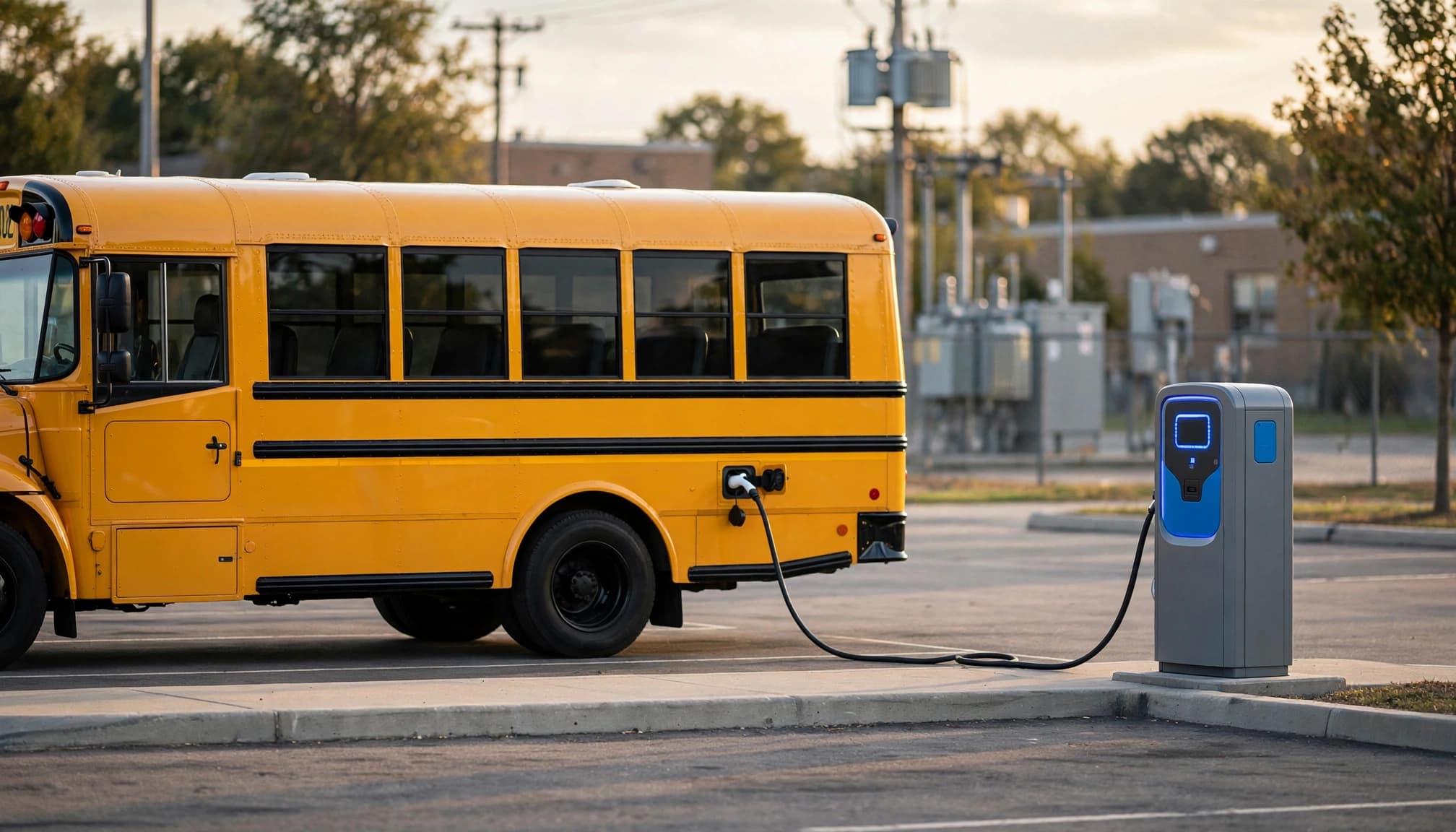
Pilots in the United States and Europe demonstrate that bidirectional power can work. They don't establish universal household access to V2G technology.
Fleet projects still need transportation reserves, interconnection, reliable controls, and clear economics. The buses have an assignment in the morning. Grid support has to fit around it.
Frequently Asked Questions
Do I Need a Special Charger for Vehicle-to-Grid?
You need a supported two-way power system. Many ordinary Level 2 home chargers only deliver electricity to the vehicle and can't send battery energy outward.
Depending on the design, the inverter may sit inside the vehicle or in external equipment. Either way, the vehicle, power equipment, controls, protection, and utility connection must support the intended mode.
An adapter changes a physical connection within its approved use. It doesn't create two-way power electronics or utility authorization. The complete equipment combination determines what can operate safely.
Can V2H Lower Bills Without Selling Electricity?
Yes, when the system supports grid-connected household discharge. Stored energy can reduce purchases during expensive periods or increase household use of rooftop solar.
That differs from selling electricity across the meter. A home-backup product may support outage operation without supporting everyday rate-based use of stored energy.
Savings depend on electricity prices, losses, equipment costs, and the permitted operating mode. A time-of-use tariff with little price difference offers less room for savings than a larger spread, all else equal. The available function must also match your parking schedule.
Does Every Bidirectional EV Work During a Blackout?
No. Supported islanding equipment is necessary to operate during blackouts. It must isolate the supported home circuits and supply them independently.
A grid-connected export system may shut down when utility power fails. That protective response is normal unless the installation includes supported islanded operation.
The vehicle also needs sufficient stored energy and enough output power for the selected loads. A large battery doesn't overcome an inverter limit, and the system stops supplying the house when it reaches its operating floor. Backup availability also disappears when the vehicle leaves.
Can One EV Replace a Stationary Home Battery?
For some households, an EV can perform much of the backup or energy-shifting role. It still leaves with you.
A stationary battery remains connected while the vehicle is away. It can also provide a different set of documented solar-integration and backup functions.
The fair comparison covers supported loads, usable energy, output power, availability, installation cost, and permitted daily operation. An EV's larger battery doesn't settle the decision by itself.
A combined system can offer more flexibility, but that adds equipment and requires a supported control design. The simplest arrangement meeting your needs deserves serious consideration.
Choose the Function Before the Hardware
V2H makes sense when your priority is keeping selected household loads running. V2G adds the possibility of utility services and compensation, with additional operating requirements.
The strongest purchase decision starts with a documented complete system: the right vehicle, compatible equipment, supported loads, and clear control rights. Keep backup value separate from projected earnings.
Your EV can take on another job while it's parked. The useful setup is the one that does that job without compromising the reason you bought the car.
Sources & further reading

Written by
LarryLeoLarryLeo started EV Charging while researching his own next car purchase. He digs into the pros, cons and real cost savings of going electric — using government, standards-body and manufacturer sources — and shares what he finds so other buyers can decide with confidence.
Why trust EV Charging Guide
Our guides are researched from government, standards-body and manufacturer sources, reviewed for accuracy, and updated when rules or products change. Brands cannot pay for placement. Read our editorial policy.