Vehicle-to-Load: Powering Appliances and Tools From an EV
Vehicle-to-load lets compatible EVs power appliances and tools, but output limits, startup demand, battery reserves, and safe connections matter.
As an Amazon Associate, EV Charging may earn from qualifying purchases. This helps support our independent guides at no extra cost to you. Learn more.
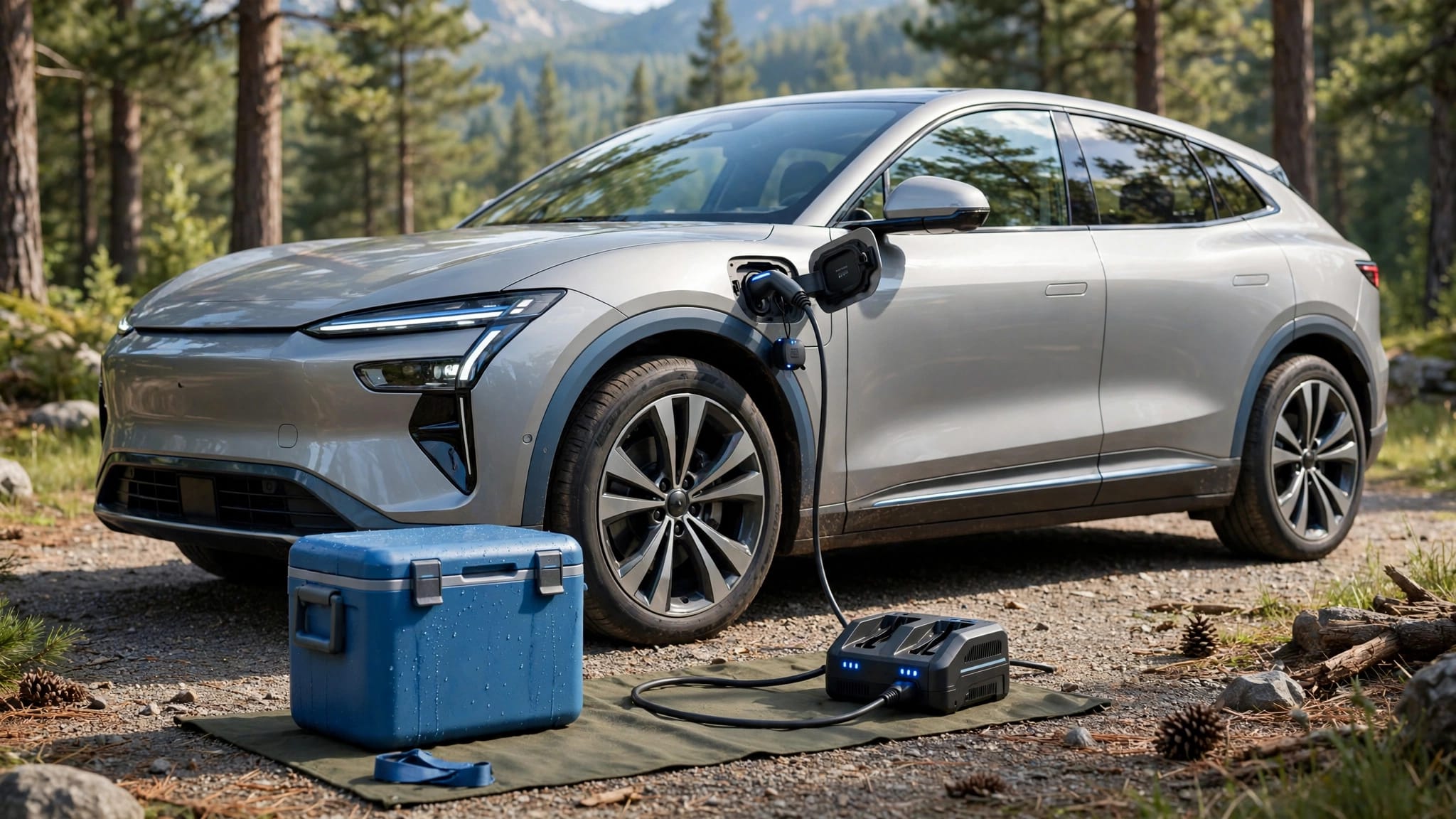
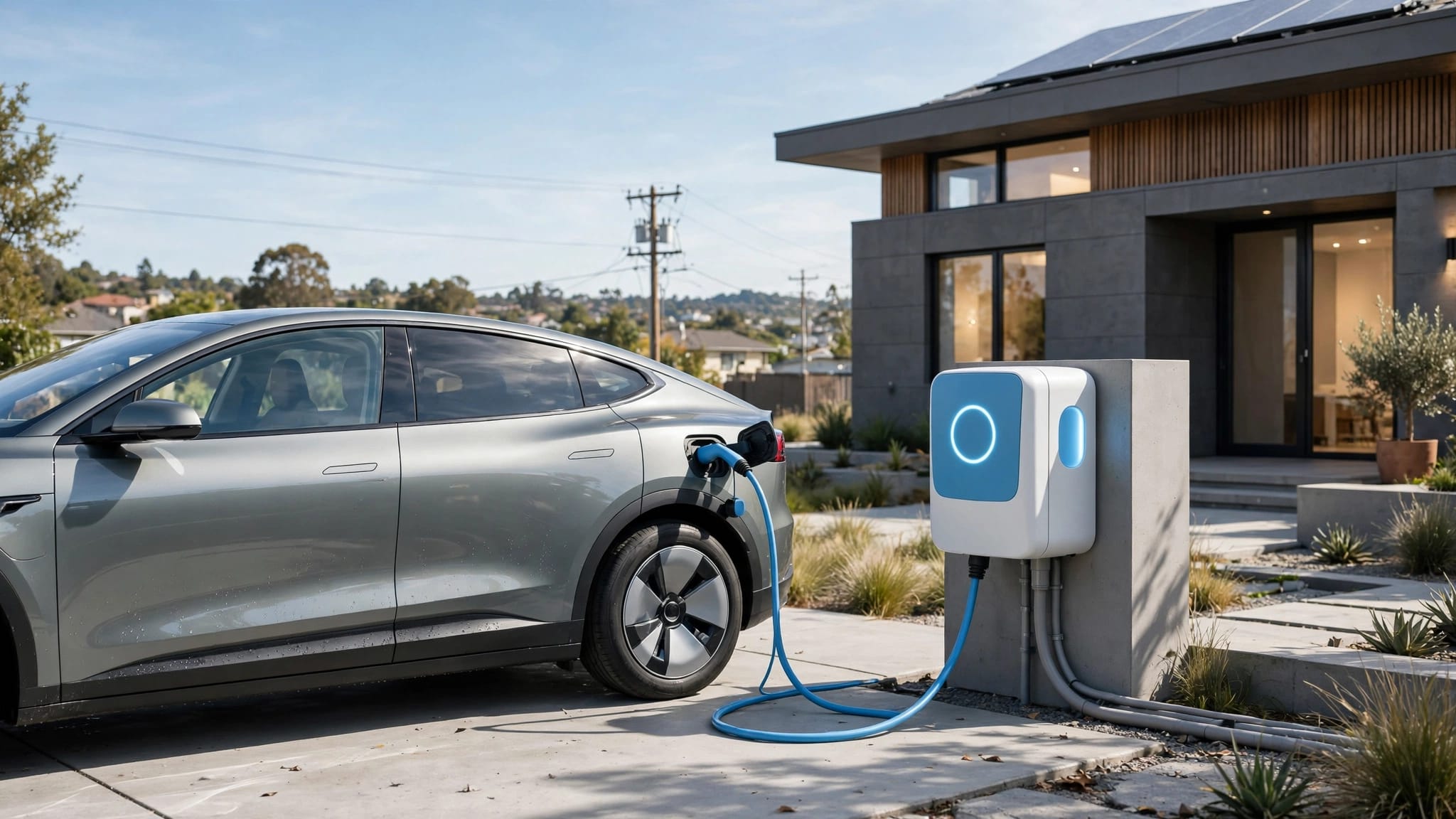
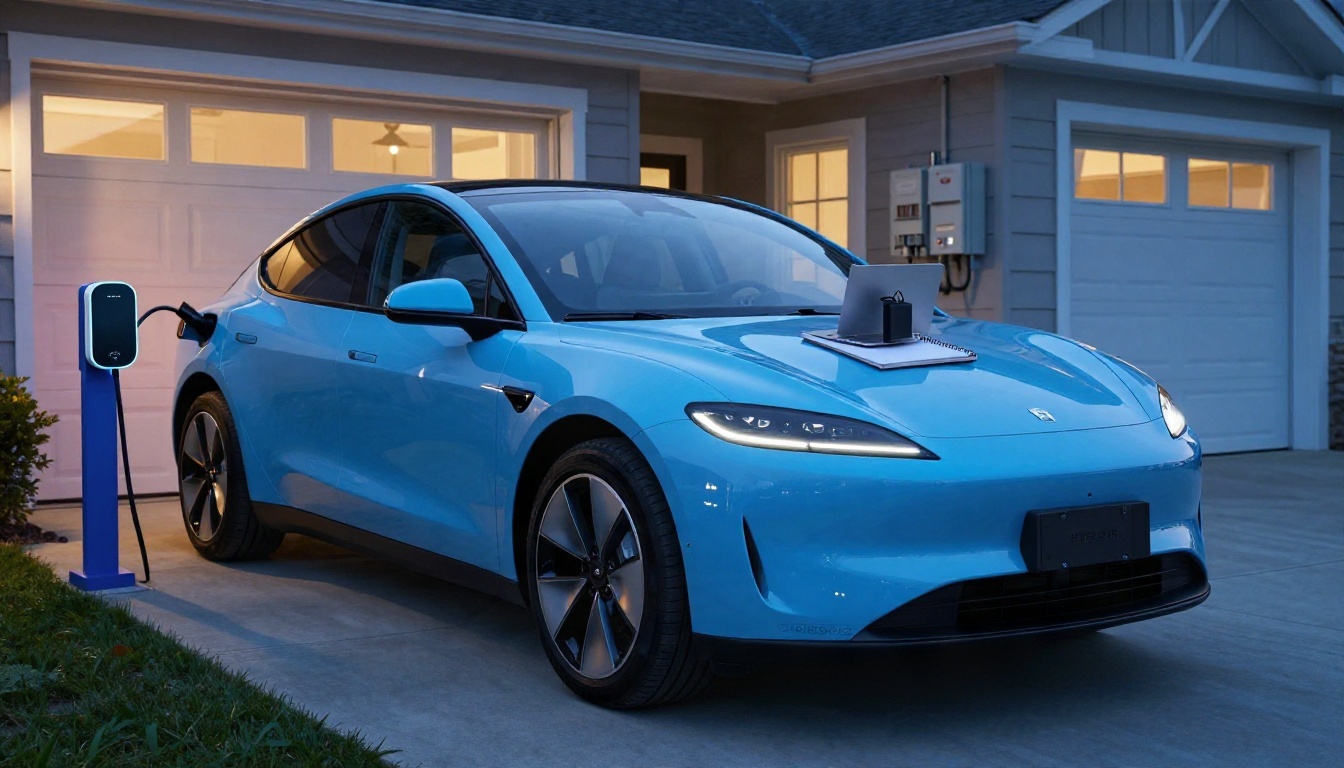
Vehicle-to-load lets a compatible EV supply AC electricity to appliances and tools using energy stored in its driving battery. Plug into a supported vehicle outlet or V2L adapter, and the car can power equipment while parked, within its electrical limits.
That's useful for camping, work and keeping essentials running during an outage. The important distinction is what you're connecting: powering a refrigerator through an approved outlet is a different job from supplying your home's electrical panel.
Start there, and the rest becomes much easier to understand.
This post may contain affiliate links. If you make a purchase through these links, I may earn a small commission at no extra cost to you.
Key Takeaways
- V2L supplies individual electrical loads through manufacturer-supported outlets or accessories. Home backup and grid export require additional capabilities and equipment.
- Battery capacity determines how much energy is available. The V2L output rating determines how much equipment can run together.
- Appliance startup demand, shared outlet limits and cable ratings matter alongside ordinary running watts.
- A battery discharge cutoff protects a selected reserve, but that reserve still needs to cover your travel.
- A large EV battery doesn't automatically make a vehicle compatible with V2L, vehicle-to-home or vehicle-to-grid operation.
The practical approach is straightforward: match the supported connection, appliance demand and available energy before switching anything on.
What Vehicle-to-Load Means
Vehicle-to-load, usually shortened to V2L, turns a compatible EV into a portable source of household-style AC electricity. Hyundai's V2L operating explanation describes power supplied by the high-voltage battery to electrical equipment.
The battery already does a demanding job moving the car. V2L gives some of that stored energy another supported use.
The Battery Supplies the Energy
An EV's traction battery stores direct-current electricity, or DC. Most plug-in household appliances use alternating current, or AC. V2L equipment converts the battery's DC into AC at the voltage and frequency supported by that vehicle.
Your appliance connects to the resulting AC supply. You don't access the high-voltage battery or attach anything to its terminals.
That distinction matters. A supported appliance outlet is designed around the vehicle's protection systems. Opening high-voltage equipment or improvising a battery connection introduces a completely different level of danger.
The Vehicle Still Has Boundaries
A refrigerator, laptop charger or power tool only runs if its electrical needs fit the system. That includes voltage, frequency, operating current and startup behavior.
A familiar-looking socket doesn't settle all of those questions. Neither does the size of the battery.
Think of V2L as a useful appliance supply with defined limits. Once you understand those limits, you can put it to work without expecting it to carry every electrical demand you own.
How V2L Delivers Power
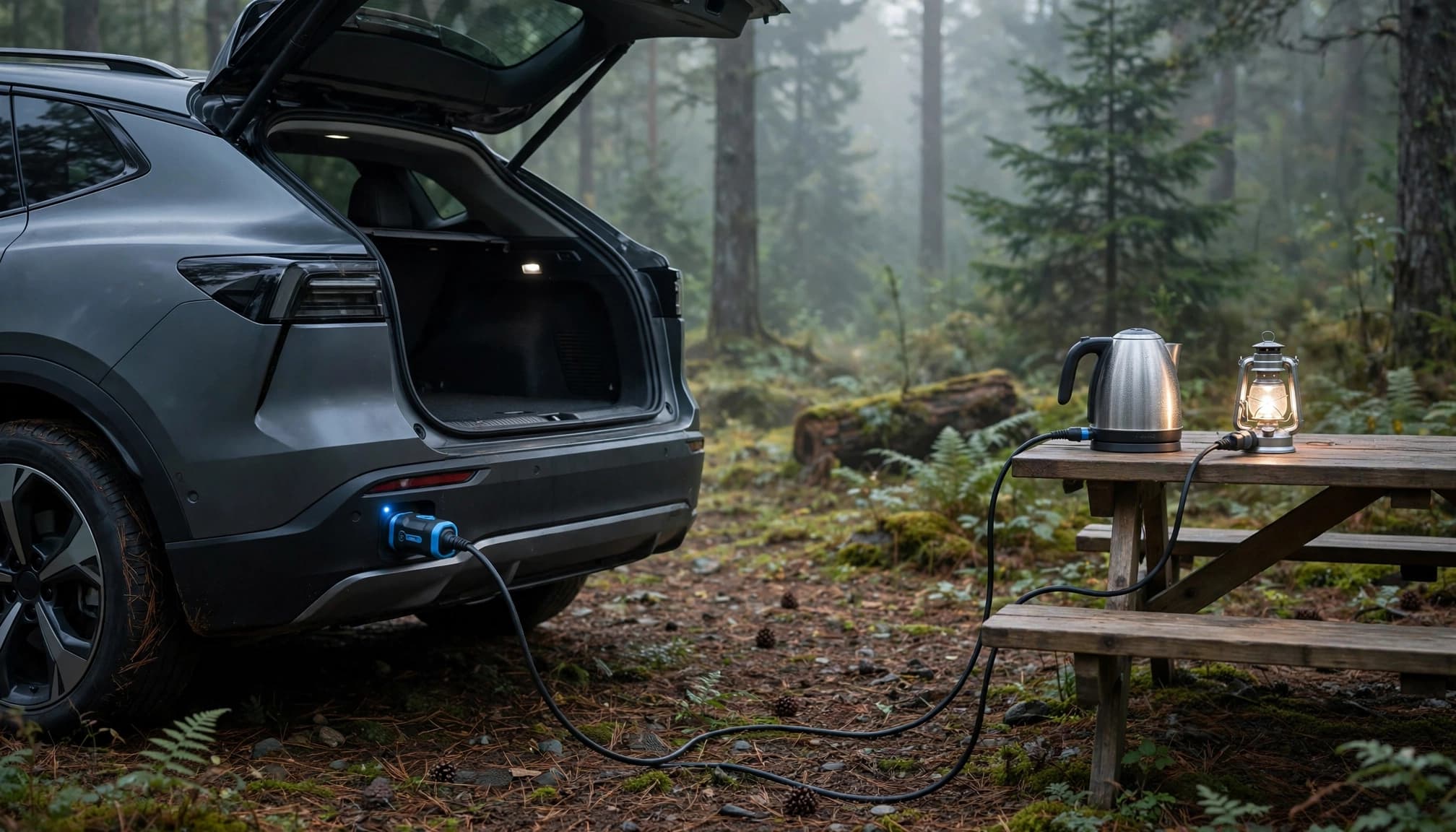
The connection depends on the vehicle. Some EVs have an interior AC outlet, some support an external adapter at the charging inlet, and some offer several outlets around the vehicle.
Those arrangements can have different operating conditions even when they draw energy from the same battery.
Built-In Outlets and External Adapters
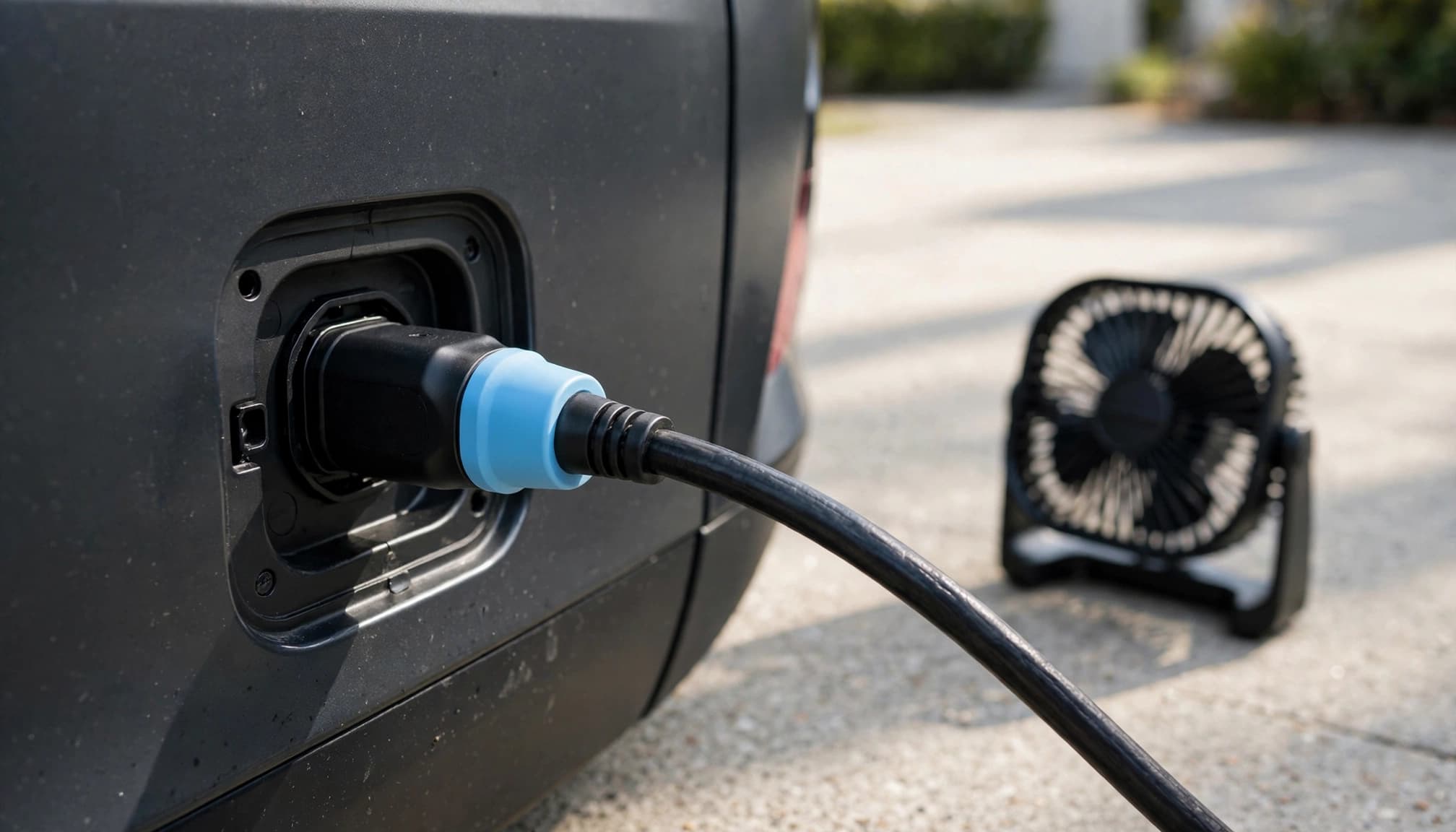
An interior outlet can be convenient for electronics inside the cabin. An external adapter places the appliance connection outside, which better suits camping equipment or work around the vehicle.
Kia's 2026 V2L operating instructions describe connecting appliances to a V2L connector, attaching that connector to the vehicle and operating its switch.
That sequence belongs to the supported system. A connector that physically fits the charging port doesn't automatically have the required electronics or approval.
Adapter shape, electrical rating and vehicle compatibility all belong in the same decision.
Controls Supervise the Supply
The vehicle manages more than an on/off switch. Depending on the implementation, it supervises battery charge, electrical demand, operating temperature and protective shutdowns.
You may also need a particular vehicle mode or an enabled outlet setting. An exterior outlet and an interior outlet can have different availability rules.
This is why a normal charging specification doesn't tell you the V2L specification. A car that accepts high-power DC charging may offer a much smaller AC appliance supply, or no supported export capability at all.
Incoming charging power and outgoing appliance power are separate specifications.
V2L, V2H and V2G Have Different Jobs
The abbreviations sound like close relatives because they are. Each describes a different destination for electricity leaving the vehicle.
The Department of Energy's vehicle-grid integration assessment discusses EVs as controllable electrical loads and mobile energy resources. Turning that potential into a working system requires the right equipment for the intended destination.
V2L Powers Appliances; V2H Supplies a Home
V2L usually means individual appliances connected through supported outlets or accessories. Vehicle-to-home, or V2H, supplies a home's electrical system through compatible integration equipment.
That equipment must manage the connection between the vehicle, household circuits and utility supply. During an outage, the installation must prevent unintended export onto utility lines.
Ford provides a concrete example. Its Home Backup Power arrangement uses a compatible F-150 Lightning, Ford Charge Station Pro and Home Integration System.
An appliance socket alone doesn't provide that home-integration function. A large battery doesn't provide it either.
V2G Adds the Utility Connection
Vehicle-to-grid, or V2G, sends energy into the electricity network under an approved arrangement. That introduces utility interconnection requirements, compatible controls and rules governing when export happens.
A vehicle can support V2L without supporting V2G. A bidirectional charger also needs a compatible vehicle and an approved installation before useful power can move in either direction.
There are other supported ways to connect vehicle-generated AC to selected home loads. Ford's home backup support information covers its broader backup arrangements.
The connection method and protective equipment define the system. Treating every exported kilowatt as interchangeable is where the confusion starts.
Real EV Examples Show Why Specifications Matter
Hyundai, Kia and Ford offer useful examples, but their features shouldn't be blended into one universal V2L rating. Market, model year and equipment package matter.
These examples illustrate the differences.
| Vehicle or Configuration | Documented Capability | Practical Meaning |
|---|---|---|
| Hyundai IONIQ 5 with supported V2L equipment | AC power for external electrical devices | Appliance support depends on the equipped vehicle and connection. |
| Hyundai IONIQ 5, documented 230V configuration | Up to 3.6 kW | This regional specification doesn't establish U.S. output. |
| Kia EV9, 2026 U.S. manual | V2L connector operation for electrical appliances | The manual describes a supported connection and control sequence. |
| Ford F-150 Lightning with available 9.6-kW Pro Power Onboard | Multiple outlets, including a 240V outlet | Total system output and individual outlet limits are separate. |
The useful comparison is the capability of the actual configuration, rather than the vehicle name alone.
Hyundai and Kia: Useful Appliance Power
Hyundai's 230V IONIQ 5 documentation describes output up to 3.6 kW. That figure belongs to the documented configuration.
Hyundai's U.S. 2026 IONIQ 5 specifications also show that second-row V2L availability differs across trims.
An interior outlet's availability shouldn't be used as a shortcut for every other V2L feature. External adapter support, included accessories and outlet locations are separate pieces of equipment information.
Kia's EV9 manual demonstrates the same broader point: supported vehicle hardware and a supported operating procedure work together.
Ford: Higher Output Still Has Circuit Limits
Ford's 2024 F-150 Lightning product information describes available Pro Power Onboard configurations with substantially different power capabilities.
The available 9.6-kW system provides more flexibility than a small appliance outlet. But its headline output doesn't mean any single socket can supply that entire amount.
Power can be divided among outlet groups with their own protection and limits. Planning a worksite therefore requires attention to where equipment connects, as well as the total demand.
More sockets are convenient. They don't remove the electrical budget.
Understand Watts, Amps and Battery Capacity
The units can make this feel more complicated than it needs to be. Three questions keep things grounded: How much power does the equipment need? Can the outlet supply it? How much energy can you spend?
Answer those separately.
Kilowatts Describe Power; Kilowatt-Hours Describe Energy
Watts and kilowatts describe the rate at which electricity is used or supplied. Kilowatt-hours describe an amount of energy.
A constant 1-kW load uses 1 kWh over one hour. That's a unit relationship, not a runtime promise for a particular appliance.
Battery capacity is normally expressed in kWh. V2L output is normally expressed in watts or kW. A bigger battery can support a modest load for longer, but it doesn't automatically raise the outlet's maximum power.
Your EV can have plenty of stored energy and still shut down when an appliance asks for too much at once.
Amps and Shared Limits Matter Too
Amps describe current. Equipment ratings may specify current, power or both, and the supported voltage matters.
For simple resistive loads, multiplying volts by amps gives power in watts. Motor-driven and electronic equipment can also involve power factor and more complicated current behavior.
Avoid treating every nameplate calculation as a complete description of compatibility. The manufacturer's appliance rating and the vehicle's permitted load types matter.
Hyundai's IONIQ 5 owner's manual describes shutdown and a warning when equipment exceeds the vehicle's maximum output.
Multiple outlets may share that maximum. Two appliances plugged into different sockets can still overload one common supply.
Which Appliances Can Vehicle-to-Load Run?
Phones, laptops, lighting, refrigeration and cooking equipment can all be useful V2L loads when their requirements fit the vehicle.
The interesting question is how they behave. A charger, heater and refrigerator each ask for electricity in a different way.
Electronics and Small Everyday Loads
LED lighting, phone chargers, laptop power supplies and some networking equipment are often manageable because their demand is modest compared with high-power heating equipment.
They still need compatible input voltage and frequency. A power supply's printed input specification describes what it accepts.
A router also needs a working network connection beyond the house. Electricity can keep your local equipment running while an upstream internet outage continues. The same applies to equipment that relies on cellular service or cloud access.
For sensitive electronics, use the protection and connection arrangements permitted by both the appliance and vehicle manufacturers. A power strip doesn't improve the underlying supply's capacity.
Heating and Refrigeration Need More Attention
Kettles, portable heaters, hair dryers and electric cooking equipment convert substantial electrical power into heat. Running several together can consume the available output surprisingly quickly.
Refrigerators and freezers behave differently. Their compressors cycle, so average energy consumption can be much lower than continuous running demand. Starting the compressor may briefly require more power than keeping it running.
These differences affect both compatibility and energy planning.
A refrigerator's annual energy label can help describe typical consumption, but it doesn't establish the starting current of its compressor. Likewise, a cooktop's maximum rating doesn't mean it draws that amount on every setting.
Use each appliance's actual operating behavior. A short cooking task and an all-night heater create very different demands on the battery.
Power Tools Bring Startup Demand Into the Picture
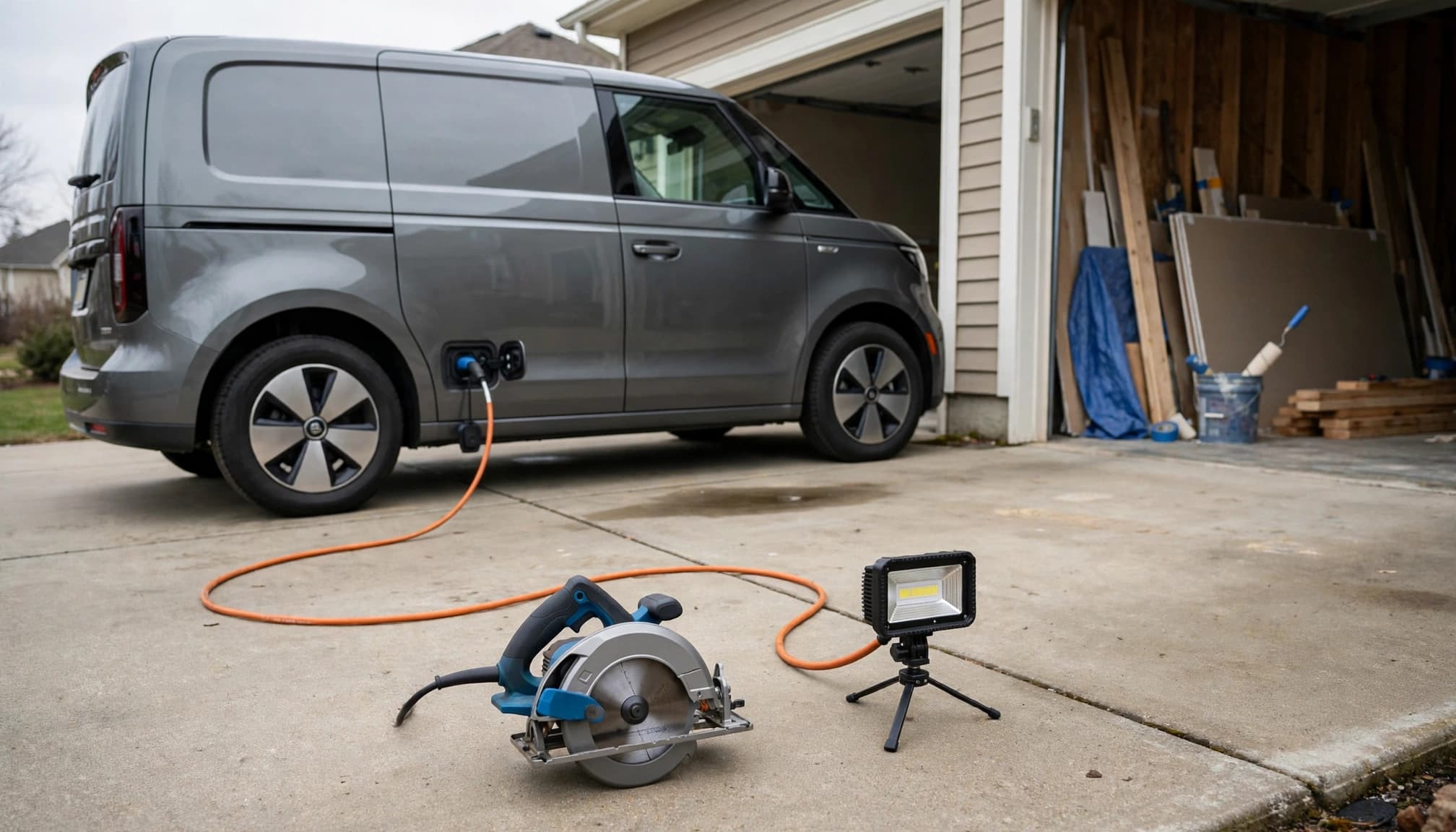
V2L can be appealing for renovation work, repairs and places without convenient mains electricity. No fuel can, no engine idling nearby, and one less piece of equipment to transport.
But tools deserve their own load plan. Their electrical behavior can be less forgiving than a phone charger.
Running Power Doesn't Capture Every Demand
Saws, compressors, pumps and other motor-driven equipment can draw a brief starting surge. Some tools also draw more current when heavily loaded.
A vehicle outlet may support the tool's normal running demand yet shut down during startup. A compressor restarting against pressure can be particularly demanding.
A published continuous output rating doesn't establish an additional surge allowance. Use only the surge capability documented for the supported system.
Avoid repeatedly restarting a tool after the vehicle trips. Repeated shutdowns are a reason to stop using that combination, not an invitation to keep trying until it catches.
Plan the Whole Work Area
Tool battery chargers and LED work lights can be practical loads because they let cordless equipment do the demanding work away from the car.
A corded saw, dust extractor and compressor operating together create a different setup. Their combined demand and overlapping starts can exceed a system that comfortably runs any one device.
Cable placement matters too. Keep leads clear of blades, sharp edges, vehicle movement and standing water.
For regular worksite use, assign equipment to supported outlet groups and account for simultaneous operation. That gives you a repeatable plan instead of discovering the limits halfway through a cut.
The car's available energy may be generous. The electrical connection still needs discipline.
Plan Loads and Runtime Without False Precision
Runtime depends on usable energy, average demand, conversion losses and the vehicle's own consumption. Battery capacity alone leaves too much out.
A sensible estimate starts with the energy you can allocate after protecting your driving reserve.
Set Aside Mobility Energy First
The charge displayed on the dashboard belongs to both the appliance plan and your next journey. It can't do both jobs twice.
Reserve enough energy for essential travel, reaching a working charger and the conditions you may encounter. Cold weather, highway driving and towing can change the energy that journey requires.
Some vehicles let you set a discharge cutoff. Kia's V2L discharge-limit instructions describe stopping the supply when the selected battery limit is reached.
That control can preserve a selected percentage. It doesn't decide whether that percentage is enough for your route.
Match the Energy Boundary to the Power Boundary
The basic relationship is:
Estimated runtime equals allocated battery energy divided by average battery-side power demand.
Battery-side demand includes the appliances, conversion losses and vehicle systems operating while V2L is active.
An appliance meter usually measures energy delivered on the AC side. Dividing battery energy by that reading alone can overstate runtime because the boundaries differ.
Cycling equipment adds another complication. A refrigerator's average demand changes with temperature, door openings and how much cooling is needed.
Treat the result as a planning estimate with breathing room. An exact-looking number doesn't become dependable because a calculator displays two decimal places.
Choose Adapters and Extension Cords Carefully
The adapter and cable are part of the electrical system. Their job is more serious than making two shapes fit together.
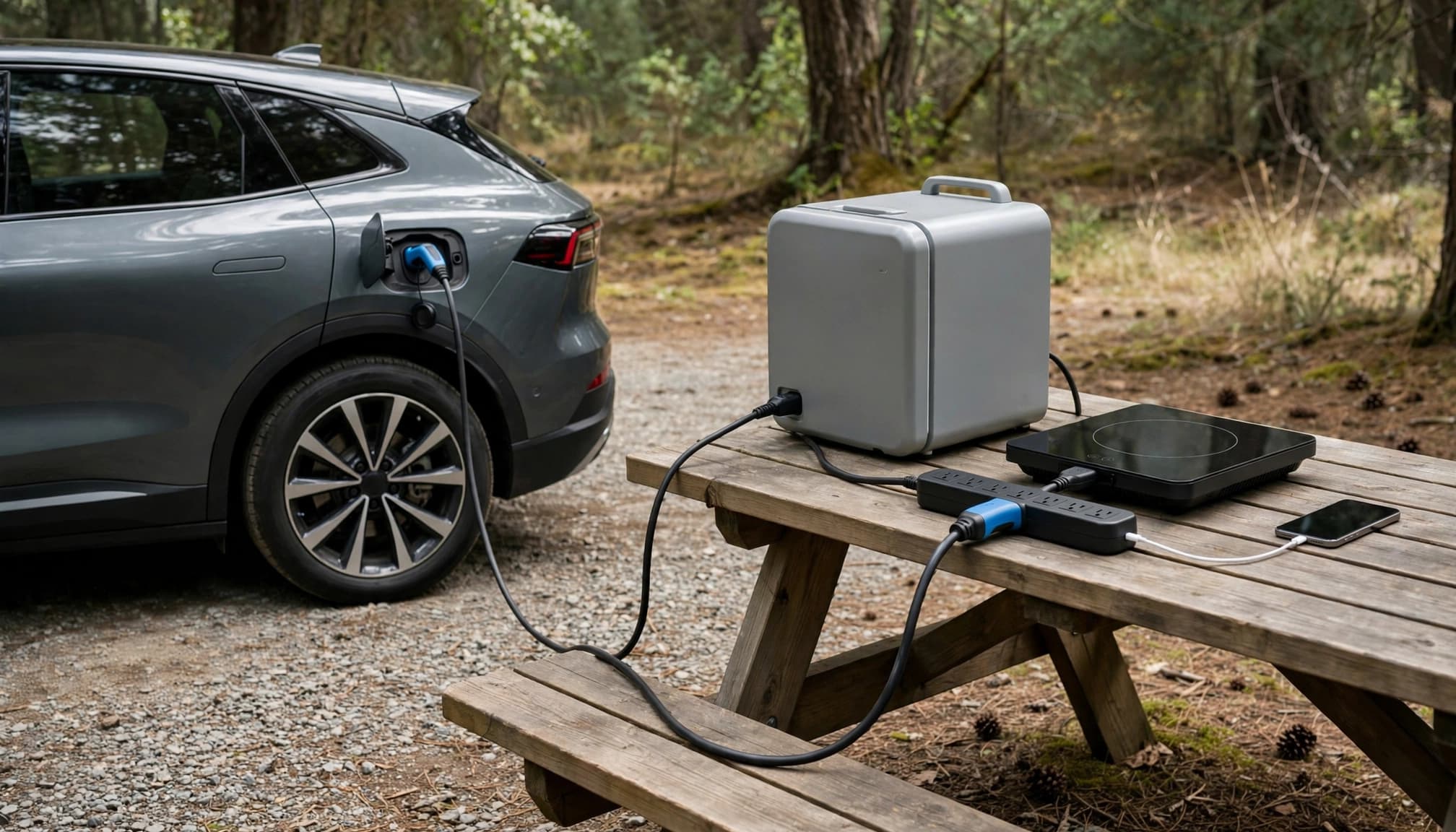
Use manufacturer-supported V2L accessories and cables rated for the connected equipment and conditions.
Charging Adapters and V2L Adapters Do Different Jobs
A charging adapter allows a supported charging connection. A V2L adapter enables supported power export. Similar connectors don't make those functions interchangeable.
A change in charging inlet between model years can also affect accessory compatibility. Vehicle-family names are too broad to settle that issue.
Our guide to EV charging connector compatibility explains why plug shape, electrical capability and charging access are separate questions.
The same care applies here. A device sold as fitting a connector still needs to support the vehicle's export function, electrical rating and protection requirements.
Cable Rating Includes the Whole Connected Load
The CPSC's portable power cord guidance calls for heavy-duty, outdoor-rated cords with a rating adequate for the connected appliances. Those electrical considerations also matter when an approved EV outlet supplies the power.
Long or undersized cables can create voltage drop and heat. A cable reel may have different permitted loads when coiled and fully unwound.
Use the applicable rating, keep connections dry and protect cables against crushing or abrasion. Damaged insulation, loose plugs and scorched contacts are reasons to stop using the equipment.
A multi-outlet strip only distributes the available supply. It doesn't add capacity.
Set Up a Supported V2L Connection
The precise connection sequence belongs to the vehicle and accessory instructions. The overall preparation is consistent: establish the permitted equipment, protect the battery reserve and introduce loads under control.
A sensible sequence looks like this:
- Park securely in a suitable location, with the vehicle clear of floodwater and the cable route away from traffic and moving equipment.
- Set the supported V2L operating mode and battery discharge limit, leaving enough energy for essential driving.
- Inspect the approved adapter, appliance plugs and cables for damage, moisture, debris or overheating marks.
- Connect the equipment using the vehicle's specified sequence, with appliances switched off where their instructions require it.
- Enable the supply and start loads individually. Observe the vehicle's load indication and allow for equipment that cycles or restarts.
- Switch appliances off and shut down the V2L supply before disconnecting, following the supported removal procedure.
For the first use of an unfamiliar appliance combination, stay with the setup. Watch for warning messages, repeated trips or unstable operation.
If protection operates, remove the load and follow the vehicle's shutdown guidance. Don't bypass a protective device or add improvised wiring to keep the outlet alive.
The aim is a setup another adult in the household can understand and shut down safely. Labeling your stored cables and keeping the operating instructions with the adapter can help.
Routine matters here. During an outage, darkness and stress make a complicated arrangement much harder to manage.
Use V2L During an Outage With Clear Priorities
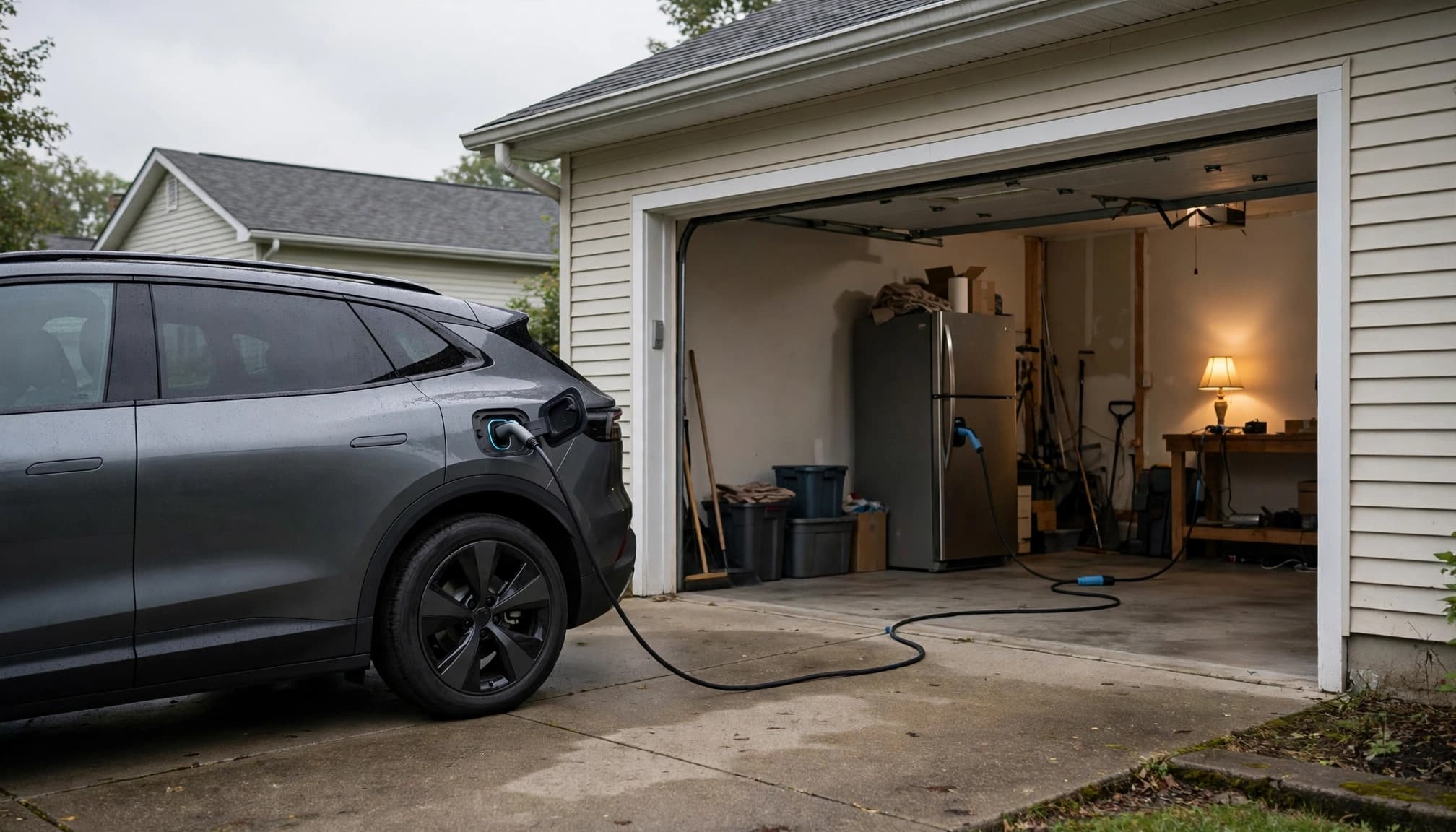
An EV can keep selected essentials running when utility power fails. The most useful plan starts with the equipment that protects health, communication and food.
That plan also needs a way to preserve mobility if the outage lasts longer than expected.
Prioritize Equipment You Can Actually Connect
A refrigerator with an accessible plug may be a practical V2L load. A hardwired furnace, well pump or central air-conditioning system introduces a different connection problem.
V2L alone doesn't provide permission to energize those circuits through household wiring.
Medical equipment needs additional care. Ready.gov's power-outage preparedness guidance recommends making a plan with your doctor for electrically powered medical devices and medication storage.
An EV outlet shouldn't be the sole safety plan for equipment that cannot tolerate interruption. Discharge cutoffs, protection trips and vehicle availability can all interrupt the supply.
Plan How the Vehicle Gets Recharged
An outage can disable your home charger and nearby public stations at the same time. A charger appearing in an app doesn't establish that its site has electricity or working communications.
Our guide to charging during a power outage covers the limits of available charging options.
Charge ahead of an expected disruption when safe and consistent with the vehicle's guidance. Keep the travel reserve tied to real destinations and likely road conditions.
One more practical detail: the household loses that V2L supply when you drive away. Anyone depending on the appliances needs to know the departure plan.
Keep Electrical Safety Separate From Convenience
Battery-electric V2L doesn't produce combustion exhaust at the point of use. That removes a major hazard associated with gasoline generators.
It doesn't remove shock, fire, overheating or backfeed hazards. Electricity remains electricity, even when the source has comfortable seats.
Never Backfeed Through a Household Outlet
Never connect a V2L outlet to a household receptacle using a cable with exposed male pins. This can expose live conductors and energize wiring in dangerous, uncontrolled ways.
It can also send electricity toward utility equipment or circuits someone believes are de-energized.
A household appliance plug is a load connection. Supplying a building requires a supported installation that controls and isolates the power source.
Any connection to fixed household wiring needs a licensed electrician and equipment approved for that application. That includes the transfer arrangement, grounding and neutral configuration, circuit protection and applicable permits.
An ordinary charging wall unit doesn't automatically provide those functions.
Respect Moisture, Grounding and Protective Trips
An outdoor-capable accessory still has operating restrictions. Keep plug connections out of puddles and follow the accessory's environmental limits.
Don't improvise a sealed container around equipment that needs airflow. Weather protection and cooling both matter.
Ground-fault protection detects electrical leakage under its design conditions. It doesn't make wet equipment safe, and a trip shouldn't be defeated with a modified plug or homemade bonding device.
Grounding and neutral arrangements differ among power sources. Compatibility problems involving protective devices belong with the manufacturer-supported setup or a qualified electrician.
If flooding has reached the vehicle or electrical equipment, stop using it. A damaged system needs professional assessment before further operation.
Account for Recharge Costs and Battery Use
V2L electricity has a cost even when there's no payment screen attached to the outlet. Energy used by appliances must eventually be replaced.
The full picture includes charging losses, vehicle overhead and any change in where you recharge.
Price the Replacement Energy
Your electricity tariff applies to the energy supplied when recharging. The AC energy delivered to appliances and the later wall energy needed to restore the battery won't be identical.
Off-peak home charging can produce a different replacement cost from a public fast-charging stop. If V2L forces an otherwise unnecessary paid charging visit, that visit belongs in the calculation.
Time matters too. Our EV charging time calculator helps frame the refill around available charging power and parking hours.
A modest refill overnight may fit easily. Replacing appliance use before an early departure can be less convenient when charging time is short.
Recognize Wear Without Inventing a Penalty
Discharging and recharging add energy throughput to the battery. Battery aging also depends on temperature, time, state of charge, chemistry and operating conditions.
There isn't one defensible battery-life penalty that applies to every V2L session or every EV. Occasional appliance use and frequent substantial discharge create different patterns.
Use the supported controls and avoid repeatedly consuming a reserve needed for travel.
Charging with solar can change where the replacement energy comes from. It doesn't increase the V2L outlet's power rating or automatically keep rooftop solar operating during a blackout.
Our guide to solar charging requirements separates generation, storage and outage operation. Those are related decisions, but each has its own limits.
Decide Whether V2L Belongs on Your Shopping List
Start with the job you want the vehicle to do. Camping lights and electronics need a different setup from worksite equipment or household backup.
For occasional low-demand use, a supported appliance outlet may provide all the capability you need. Regular tool use puts more weight on outlet placement, startup performance and the way power is divided among circuits.
Value the Equipment You'll Use
An adapter has little practical value if the cable route is awkward or the vehicle can't stay where the appliances need power.
Consider access with the car parked normally. Include open doors, walking space, charge-port location and protection against weather.
A portable power station can complement an EV when smaller loads need to remain powered after the car leaves. That adds another device to charge and another conversion path, so it deserves its own cost and energy calculation.
Convenience counts, but count the whole routine.
Buy Home Backup as a Complete System
If the actual goal is powering household circuits, compare complete supported backup arrangements rather than shopping by battery size.
The vehicle, power conversion equipment, integration hardware, software requirements and installation all need to work together. The supported load plan must also address startup demands and equipment that cannot run simultaneously.
Our guide to electric-truck home charging discusses the distinction between everyday charging equipment and backup arrangements.
A higher-output charger alone doesn't establish home-backup capability. The complete supported system does.
Frequently Asked Questions About Vehicle-to-Load
Can Every Electric Car Provide V2L?
No. V2L requires compatible vehicle hardware, controls and supported outlets or accessories.
A large traction battery doesn't establish export capability. Neither does a familiar charging connector or an adapter that physically fits it.
Vehicles within the same model family can also have different equipment by market, model year or trim. Treat V2L as a defined feature of the configured vehicle, rather than a general property of electric cars.
Can V2L Charge Another Electric Vehicle?
Some systems support charging another EV through compatible portable charging equipment. Ford's Lightning charging guidance describes supported Level 1 operation and Level 2 operation with the appropriate Pro Power Onboard configuration.
The source vehicle, outlet, portable EVSE and receiving vehicle must all support the arrangement.
Both vehicles also consume energy during the transfer. Energy removed from the source battery won't all reach the receiving battery.
Can You Charge the EV While Using V2L?
Don't assume simultaneous charging and export is supported.
An external adapter occupying the charging inlet prevents another connector from using that inlet at the same time. Interior outlets can have their own operating restrictions and permitted vehicle modes.
V2L also doesn't establish pass-through charging or solar-input capability. Those functions require their own supported design.
Use the operating combinations the vehicle provides, without improvised splitters or attempts to override its controls.
Will V2L Keep Working When the Battery Gets Low?
Many systems stop supplying power when the battery reaches a configured or prescribed discharge limit. They can also stop because of overload, temperature or another protective condition.
That means V2L can interrupt appliances even when some battery energy remains.
Plan around the selected reserve and the consequences of a shutdown. Equipment that needs uninterrupted power requires an appropriate continuity plan beyond simply leaving it plugged into the vehicle.
Put the Appliance Plan Before the Battery Number
Vehicle-to-load is useful when the connection, power demand and energy budget fit together. A compatible EV can run meaningful everyday equipment without a separate fuel-burning generator.
Keep appliance power and home backup separate. Protect your travel reserve, respect startup loads and use supported accessories.
The strongest setup is one you can operate safely, explain clearly and shut down without improvisation.
Sources & further reading

Written by
LarryLeoLarryLeo started EV Charging while researching his own next car purchase. He digs into the pros, cons and real cost savings of going electric — using government, standards-body and manufacturer sources — and shares what he finds so other buyers can decide with confidence.
Why trust EV Charging Guide
Our guides are researched from government, standards-body and manufacturer sources, reviewed for accuracy, and updated when rules or products change. Brands cannot pay for placement. Read our editorial policy.