Hotel EV Charging: 12 Questions to Ask Before Booking
Hotel EV charging can vary by property. Ask about connectors, power, reservations, fees, overnight access, and backup options before you book.
As an Amazon Associate, EV Charging may earn from qualifying purchases. This helps support our independent guides at no extra cost to you. Learn more.
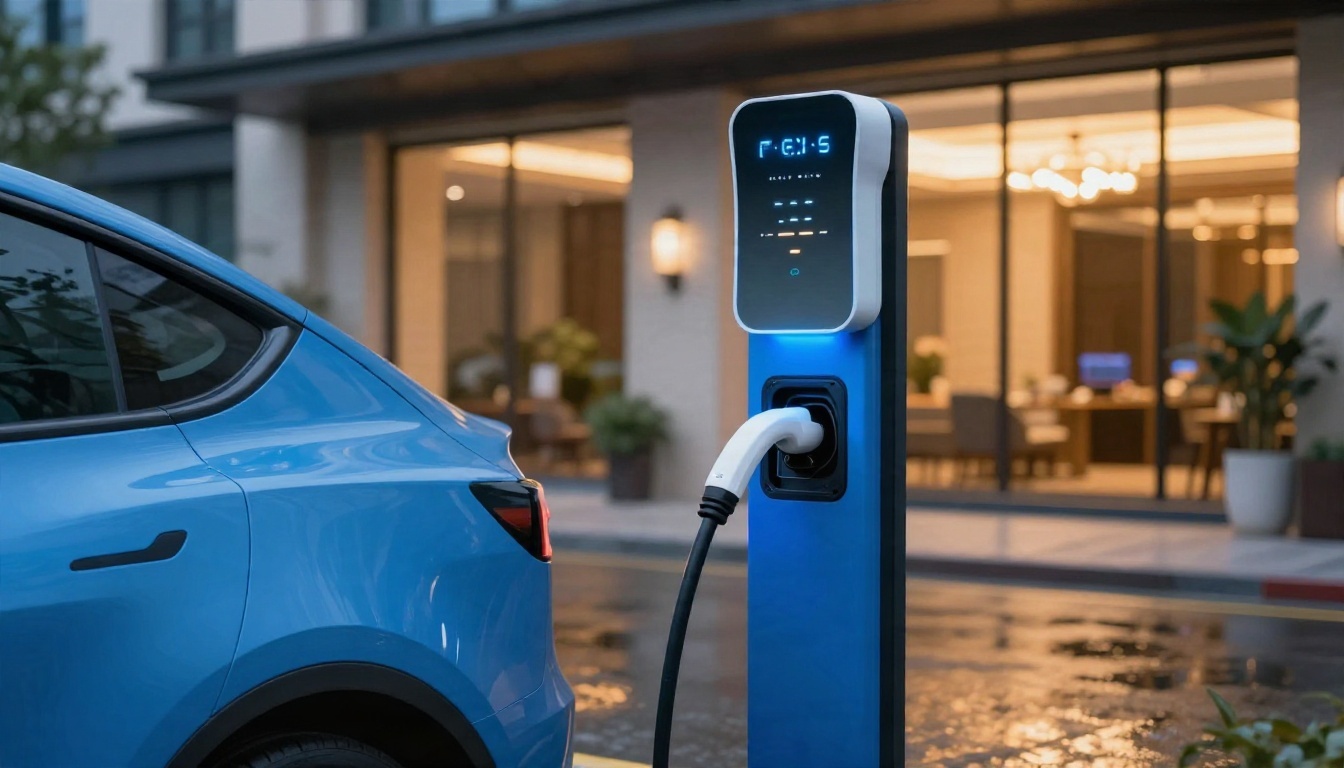
Before booking, get clear answers about the charger's connector, available power, reservations, fees, and overnight access. For EV drivers, charger availability matters as much as speed.
You want to wake up ready for the next leg, without a surprise charging errand before breakfast. Start with these 12 questions, because that little amenity icon leaves plenty unsaid.
This post may contain affiliate links. If you make a purchase through these links, I may earn a small commission at no extra cost to you.
Key Takeaways
- Prioritize a compatible connector, dependable access, and enough energy for your next drive.
- Treat charging fees, parking charges, and idle penalties as separate costs.
- Keep a reachable backup unless your charging space is genuinely reserved.
1. Is the Charger Actually on the Property?
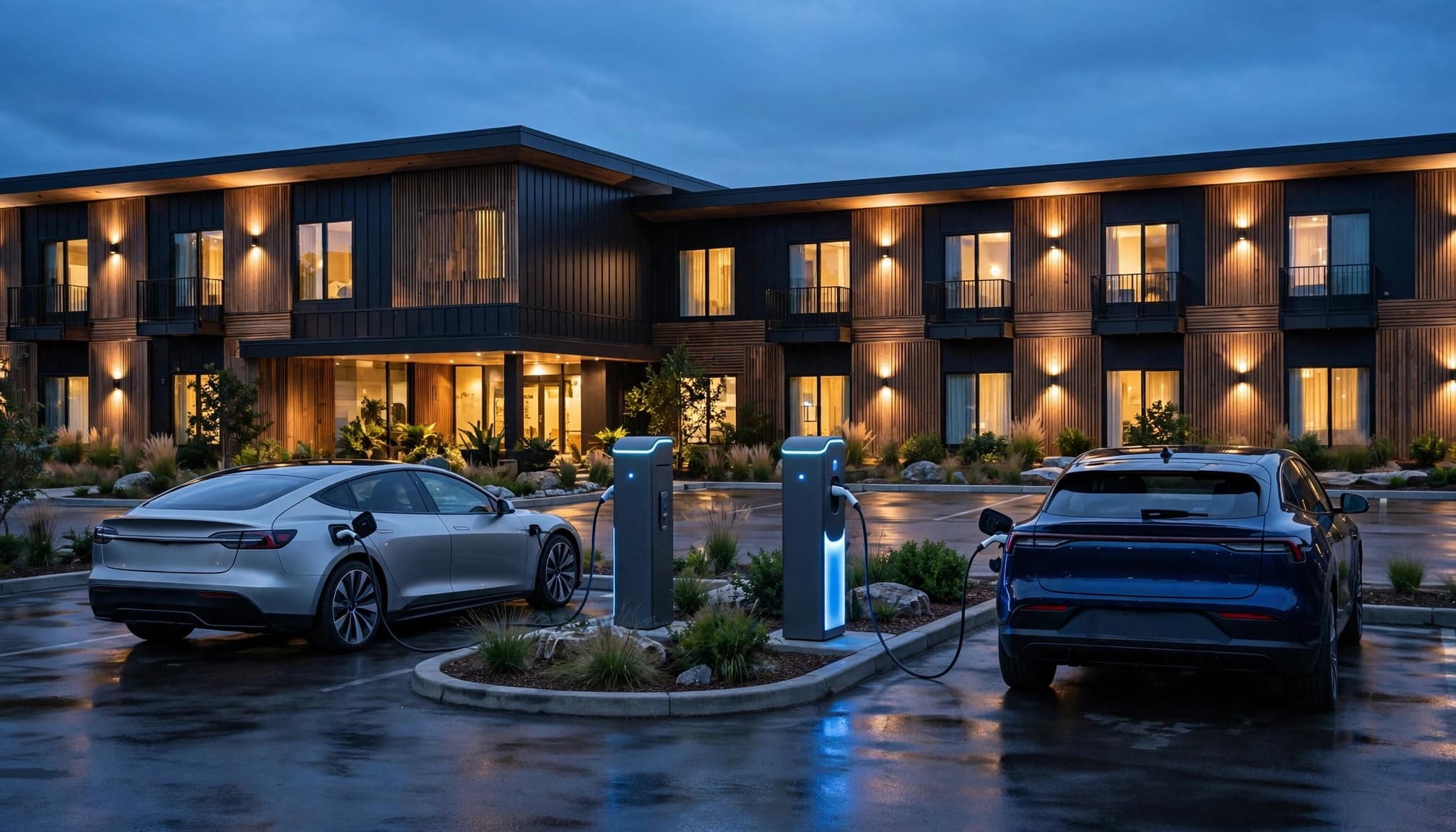
"EV charging available" at hotels or resorts may refer to an on-site charger, a paid garage, or a nearby location. Ask whether EV chargers are on the property and how many charging stations guests can access.
Confirm whether hotel guests have direct access. A shared public garage may have its own entrance, operating hours, and parking bill.
Blink's hospitality guide reported that nine of the top 14 travel booking sites included EV-charging filters. Useful for finding candidates, but a filter doesn't describe the actual setup.
A directory description for Hampton Inn & Suites Durham, for example, lists eight charging stations at the rear of the hotel. That's more helpful than an amenity icon, but it still leaves connector type, power, and payment unanswered.
2. Is It Level 2 or DC Fast Charging?
The right charger depends on how long your car will sit. Overnight parking gives slower equipment time to do its job.
Here's the practical comparison, based on published charging characteristics.
| Charging Type | Best Hotel Use | Time to Plan Around |
|---|---|---|
| Level 2 chargers (AC) | Overnight guest parking | Often four to eight hours for a substantial recharge |
| DC Fast Charging | Short visits or travel stops | Often under an hour for a partial recharge |
Neither time estimate guarantees an empty-to-full charge.
Level 2 Fits an Overnight Stay
Level 2 chargers supply alternating current, which the vehicle's onboard charger converts to battery-ready DC power. They're usually a sensible match for overnight charging because the car has hours to spare.
A four-to-eight-hour window can cover a substantial recharge, but a large battery, low starting charge, or lower-power station can require longer. DOE describes Level 2 as suitable for charging a typical EV overnight. Your required energy and the car's AC limit determine whether that fits your stay.
DC Fast Charging Fits Short Stops
DC fast chargers deliver direct current to the battery, bypassing the onboard AC charger. They can provide a useful recharge in under an hour when the vehicle and conditions cooperate.
That suits conference visitors, restaurant customers, and drivers stopping briefly. The familiar fast-charging window is generally a partial refill, often described as 10% to 80%, rather than 0% to 100%. Charging slows at higher battery percentages. For an overnight guest, access and parking rules may matter more than peak power.
3. Does the Connector Work With My Exact Vehicle?
Ask for the connector name, not simply whether the station "works with EVs."
US hotel AC charging commonly uses J1772 or Tesla-style connectors, now associated with the NACS/J3400 standard. DC equipment may use CCS1, NACS, or older CHAdeMO connections. Vehicle model year and manufacturer support matter, particularly during the transition between connector standards.
AC and DC adapters aren't interchangeable. An adapter for a J1772 hotel charger doesn't establish compatibility with a DC fast charger. Physical fit alone doesn't establish vehicle or network authorization, either.
Use only an adapter supported for your exact vehicle and charging application under the manufacturer's instructions. A hotel employee saying "people use adapters all the time" isn't a compatibility specification. The connector, adapter, vehicle, and charging mode have to match.
4. How Many Vehicles Can Charge Simultaneously?
Count usable charging ports, rather than pedestals or parking signs.
One pedestal may serve two cars. Two cables may share a power limit. Several marked spaces may depend on equipment that's partly out of service. Ask how many vehicles can actively charge at once and how many ports are working.
For a concrete equipment example, Blink Charging's hospitality charging guide describes the dual-port Series 8 as charging two EVs simultaneously, with up to 19.2 kW to the vehicle. That's a published equipment specification, not a promise about a hotel's electrical configuration.
A small inn with two working ports may suit you better than a large resort with two ports serving hundreds of rooms.
5. Can I Reserve a Charging Space?
A room reservation and a charging reservation are separate things.
Ask whether the hotel assigns a specific charging space, offers only first-come access, or maintains a waiting list. If reservations exist, ask what happens when someone occupies the assigned space.
Also establish whether public users, restaurant customers, or employees share the equipment. Public access can help the hotel's revenue, but it increases competition for plugs.
Get any promised charging arrangement included in your booking communication. A general note saying "guest has an EV" doesn't reserve a port.
A station marked available now isn't reserved for your arrival tonight. Live status and a reservation answer different questions.
6. What Power Will My Car Actually Receive?
Ask for kilowatts per vehicle when neighboring ports are occupied. That's more useful than the largest number printed on the equipment.
Delivered power can be limited by the station, shared electrical capacity, or your car's onboard AC charger. A 19.2 kW station won't make a vehicle with a lower AC limit accept 19.2 kW.
Here's a transparent calculation. A 60 kWh battery going from 20% to 80% needs approximately 36 kWh stored in the battery. At 7.2 kW, that takes five hours before losses.
Assuming 90% wall-to-battery efficiency, the estimate becomes about 5.6 hours: 36 ÷ (7.2 × 0.90). At 3.6 kW, the same assumptions produce about 11.1 hours.
Power sharing can turn an easy overnight refill into a tight schedule. That's why the actual output matters.
7. What's the Total Charging Cost?
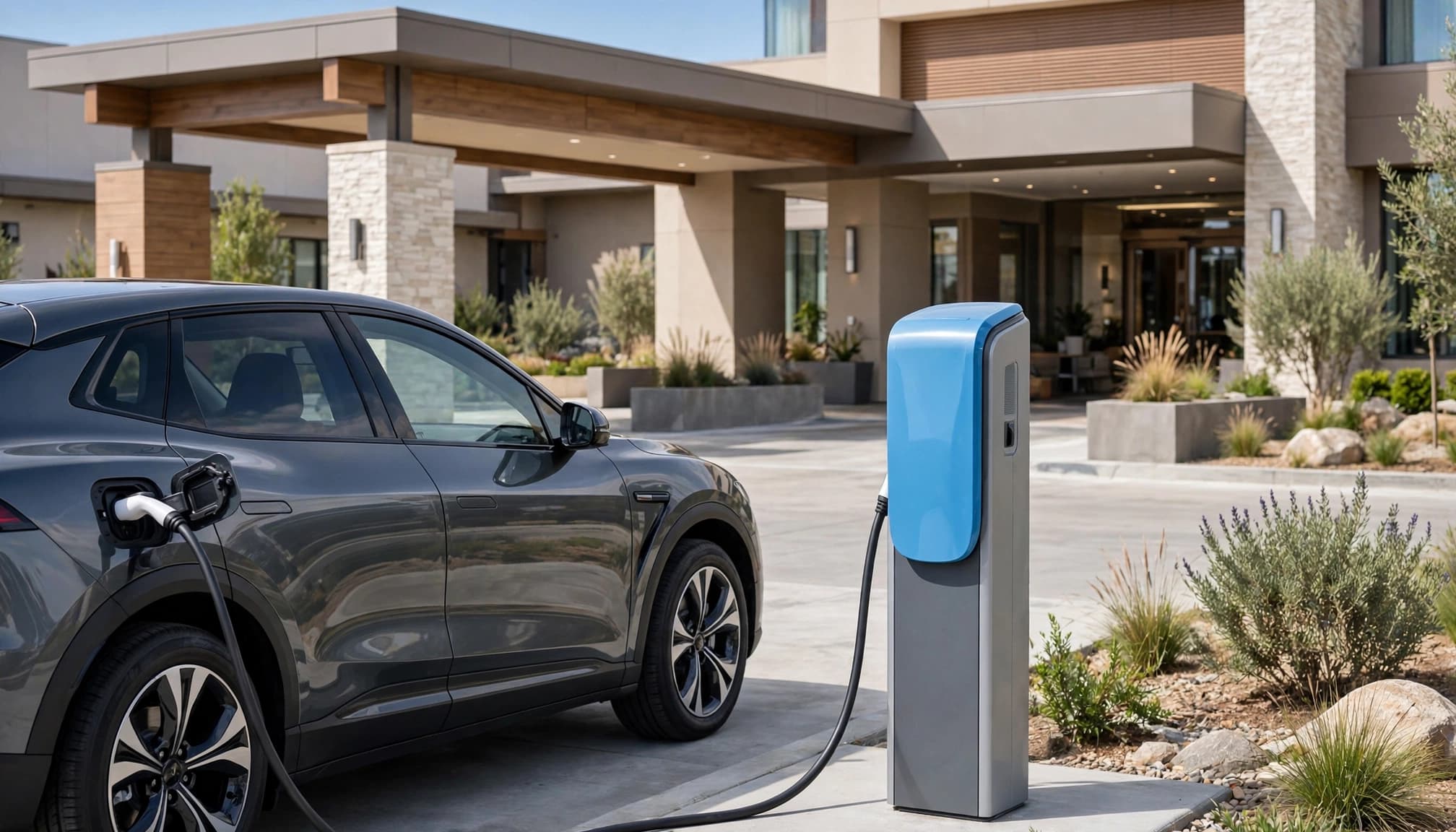
Ask for the billing unit and every separate fee. "Charging included" deserves a little more detail before you build your budget around it.
Separate Energy Charges From Parking
Hotels can include charging as an amenity, charge a flat amount to the room, or bill for actual energy used. Where permitted, per-kWh pricing makes the energy calculation straightforward.
For an illustrative calculation, assume the station bills 35 kWh at $0.35/kWh. The charging cost is $12.25. Add a $15 parking charge and the total becomes $27.25, before any taxes or session fees.
Those are labeled assumptions, not a quoted hotel rate. Our explanation of free public charging costs covers why free electricity can still come with a parking bill.
Ask About Guest and Public Rates
Operators can offer one price to hotel guests or rewards members and a higher price to public users. Ask how the station recognizes your rate before the session begins.
A room key, access code, network account, or front-desk adjustment may be involved. If billing is by time, slower charging can raise the cost per kWh received.
Also ask about minimum charges, connection fees, and idle penalties. A discounted room rate loses some shine when the charger adds fees you weren't expecting.
8. How Do I Start and Pay for a Session?
Room billing, app payment, and credit-card payment are different systems. Don't assume the front desk can transfer a network charging bill to your room.
Ask which payment methods that specific unit supports and whether you need an account. Check whether guest pricing requires a code before plugging in.
Some stations support an app or RFID card; others have a card reader. Options can vary by unit, even within the same network, so check the equipment rather than relying on the network's logo.
For more on that distinction, see Blink payment guide from Blink Charging. Set up the required payment method before arriving tired, hungry, and ready to be finished driving.
9. Can I Access the Charger Overnight?
A charger can be physically present and still be unavailable when you need it.
Ask about garage closing times, gates, valet-only access, and any charging-hour restrictions. If charging depends on valet staff, establish when they can connect and retrieve the vehicle, including early departures.
The parking layout matters, too. Accessible routes, vehicle clearance, and a cable that reaches your charge port without crossing a walkway affect whether the space works for you.
Bring your vehicle's parking orientation into the conversation. A charger behind a space may suit one charge-port location and be awkward for another. Nobody wants to discover that while blocking the garage entrance.
10. Will I Have to Move My Car During the Night?
This question deserves its own answer. You're booking somewhere to sleep.
Ask whether the hotel allows overnight occupancy after charging finishes, requires vehicles to move, or applies idle fees. Establish when any grace period starts and whether the policy changes overnight.
A flat charging fee doesn't automatically include unrestricted use of the parking space. Likewise, free electricity doesn't remove a move-your-car rule.
Choose a charging target that supports the next leg and fits the hotel's policy. Enable session notifications if movement is required, and don't unplug another driver's vehicle unless the operator's rules expressly authorize it. A shared amenity works better when the handoff is predictable.
11. Who Helps If Charging Fails?
Find out whether help comes through the front desk, a valet team, or the charging network. The hotel may control parking while the network controls payment and equipment.
A useful answer identifies who can address an occupied space, a failed payment, and a station fault. Those are three different problems.
Stop using equipment with damaged cables, burning smells, overheating, or repeated faults. Report it to hotel staff and the operator. Repairs belong with the manufacturer or a qualified electrician.
Don't reset electrical panels, bypass protections, or improvise an extension-cord solution. Your road trip doesn't need an electrical side project.
12. What's My Backup if the Charger Is Unavailable?
Choose a nearby charging station with EV chargers compatible with your car. Check its access hours, payment method, and realistic charging time, and make sure you can reach it with your planned arrival reserve.
Recent driver reports and network status can help identify trouble, but neither guarantees a free port later. Our EV charging app comparison separates station discovery, payment, and location-specific reports.
If the hotel's charging is uncertain, a useful fast-charging stop before arrival can remove pressure from the overnight session. Our road-trip planning guide covers compatible stops and reachable alternatives.
The backup should fit your car and schedule. A nearby Level 2 station behind a locked gate won't solve an early-morning departure problem.

Why Hotel EV Charging Matters to Operators
Hotels and resorts vary in whether they offer charging, so availability still differs by property type. Dependable charging can attract overnight guests and support paid charging revenue.
The 2022 Green Lodging Trends US Market Report put adoption at just over 26%, leaving nearly 74% without charging. Adoption approached 60% among full-service hotels, compared with about 20% among limited-service properties.
City figures varied: San Jose reached 66%, Albany, New York, 56.8%, and Portland, Oregon, 56.3%. These are historical figures, not a November 2026 inventory. Confirm charger availability with the specific hotel before booking.
The same reporting period found nearly 99% of properties had implemented energy efficiency measures in the preceding three years. Energy efficiency is a broader operating topic than charger availability, and electricity use and sustainability outcomes depend on actual operations.
The IEA reported over 2.3 million EV sales globally in Q1 2023, about 25% above Q1 2022. Those historical EV sales figures explain interest, but don't forecast usage at an individual hotel.
What Hotel Owners Should Budget
Hardware is only part of a hotel charging project. Electrical capacity, trenching, accessible parking design, networking, maintenance, and electricity can affect charging prices and availability.
DOE's charging procurement guidance cites average public and workplace Level 2 installation costs around $2,500 per connector. This is a planning reference for installation, not a November 2026 turnkey hotel quote.
Operating costs also affect what hotels charge. Using assumed rates, selling 35 kWh at $0.35/kWh produces $12.25 in revenue. Buying that energy at $0.15/kWh costs $5.25, leaving $7 before other expenses. That's not net profit.
Network subscriptions, payment processing, maintenance, and capital recovery reduce that amount. DOE also notes that DC fast charging can trigger demand charges. A qualified electrician and the utility should handle site capacity and installation planning.
Which Funding Rules Apply in November 2026?
Older hospitality articles can describe incentives that no longer apply to a new installation. Dates matter here.
Section 30C Had a June 2026 Cutoff
The Alternative Fuel Vehicle Refueling Property Credit ended for property placed in service after June 30, 2026. A November 2026 installation shouldn't include this tax credit in its budget.
The phrase "Alternative Fuel Infrastructure Tax Credit" isn't the official title on the cited IRS page.
For eligible business property within the qualifying period, the base credit was 6%, rising to 30% when prevailing-wage and apprenticeship requirements were met, subject to applicable exceptions. The maximum was $100,000 per qualifying item.
Eligibility for the tax credit also depended on location: property had to be in an eligible low-income or non-urban census tract. "Up to 30% per station" leaves out important conditions.
NEVI Funding Runs Through States
The NEVI Formula Program allocates funding through states. Businesses generally participate through state solicitations and project partnerships, rather than receiving four chargers automatically.
Original corridor-buildout standards called for at least four DC fast-charging ports capable of supplying 150 kW each simultaneously, generally within one travel mile of a designated Alternative Fuel Corridor.
Those are station and corridor requirements, not an entitlement for every nearby hotel. Awards depend on the applicable state program. Overnight guest charging and publicly accessible highway fast-charging projects also have different operating needs.
Frequently Asked Questions
What should I confirm before booking a hotel EV charger?
Ask whether the charger is on the property, which connector it uses, and how much power your car can receive. Confirm how many vehicles can charge at once and whether hotel guests have access.
Can I reserve a hotel charging space?
Ask whether the hotel reserves a specific space or uses first-come access. Get any promised arrangement in your booking communication, and ask what happens if another vehicle occupies the space.
How much does hotel EV charging cost?
Ask whether the hotel charges by energy, time, or a flat fee, and whether parking, connection, or idle fees are separate. Confirm how guest pricing works and which payment method the charger accepts.
How long does overnight hotel charging take?
Level 2 charging often takes four to eight hours for a substantial recharge, but the time depends on your battery, starting charge, vehicle limit, and station output. Ask how much power your car will receive when other ports are in use.
What should I do if the hotel charger is unavailable?
Find a nearby compatible station and check its access hours, payment method, and expected charging time. Make sure you can reach it with your planned arrival reserve.
Sources
The AHLA Green Lodging report provides historical context on Green Lodging Trends in hospitality. DOE's public-charging handbook covers site-host planning. Equipment specifications, vehicle limits, hotel access policies, and tax eligibility answer separate questions; none substitutes for the others.
Book Around the Charging You Can Use
The strongest hotel charging arrangement gives you a compatible connection, enough charging time, clear pricing, and predictable access. A powerful charger means little if you can't use it overnight.
Before committing to the room, settle the reservation and movement rules. Then keep a reachable backup so one occupied space doesn't decide your morning.
Sources & further reading

Written by
LarryLeoLarryLeo started EV Charging while researching his own next car purchase. He digs into the pros, cons and real cost savings of going electric — using government, standards-body and manufacturer sources — and shares what he finds so other buyers can decide with confidence.
Why trust EV Charging Guide
Our guides are researched from government, standards-body and manufacturer sources, reviewed for accuracy, and updated when rules or products change. Brands cannot pay for placement. Read our editorial policy.